It’s Not Easy Being Orange: How iPhone Cameras Fuel DJI’s Record Sales in Japan

In April 2026, the DJI Osmo Pocket 4 captured 21.5 percent of Japan’s entire video camera market in just nine days. When combined with the still-popular Osmo Pocket 3 the two models together represented nearly 39 percent of sales in the category. Overall DJI achieved a record 72.5 percent share according to official BCN+R point-of-sale data. These results stand out in a nation where iPhone adoption remains high among younger users. The figures point to a practical response to everyday frustrations with smartphone photography rather than mere gadget enthusiasm.

DJI’s Record-Breaking Performance in Japan’s Video Camera Market

BCN+R rankings from mid-May 2026 confirm the scale of the launch effect. The Osmo Pocket 4 launch drove a 158 percent year-on-year rise in overall video camera unit sales for April. DJI models claimed the top four positions with the Pocket 4 in first place & the Pocket 3 in second. Additional DJI entries such as the Osmo Action 4 & Osmo Nano rounded out the list.

Sony, Canon & Nikon together with Panasonic & GoPro held only single-digit shares within the BCN-tracked “video camera” segment. This category covers compact action cameras, pocket gimbals & similar portable devices rather than larger mirrorless systems or professional camcorders. DJI’s focus on mechanical stabilisation & creator-friendly features has allowed it to define the segment over multiple generations.

Japan’s strong gadget culture & active vlogging community have sustained demand for dedicated devices even as global compact camera sales declined after 2010. The Pocket series delivers smooth cinematic footage through built-in three-axis gimbals, flip screens & one-handed operation that smartphones cannot replicate without extra equipment.

DJI Pocket 4
Buy on Rakuten Japan

The Persistent Shortcomings of iPhone Computational Photography for Human Subjects

Recent iPhone models incorporate advanced hardware & sophisticated algorithms yet they repeatedly fail to deliver natural results when photographing people. Despite substantial research & development investment the post-processing produces orange or yellowish skin tones, excessive sharpening that highlights every pore & texture, & unnatural smoothing that can thin or erase eyebrows under common lighting conditions.

These outcomes feel particularly inconsiderate because most users capture images of themselves, family members & friends far more often than landscapes or wildlife. Daily life involves selfies, group photos & casual video calls while national park excursions or scenic holidays occur only once or twice a year for the average person. When a flagship device costing 200,000 yen consistently distorts the human form — the subject people care about most — it creates ongoing dissatisfaction.

I personally encountered this directly with the iPhone 13 Pro Max. Self-portraits appeared unrecognisable with pronounced orange casts & vanishing eyebrows. My immediate response was to purchase a DJI Osmo Pocket 3 to obtain reliable, non-distorted/tinged video & stills for content creation. Only after switching to a Samsung Galaxy Z Flip 6 did native phone photography become consistently usable without these distortions. The Pocket 3 now sees occasional use at most, demonstrating how one well-tuned device can eliminate the need for workarounds.

Such issues are not unique to one model. Similar complaints appear across all iPhones since the 13 series regarding camera rendering & video. Apple excels in metrics such as dynamic range & low-light performance yet these strengths matter less for the predominant use case of human-centred photography.

Korean Beauty Standards, Pale Complexions & Camera Processing Preferences

Korean beauty ideals emphasise strikingly pale, porcelain-like skin even more prominently than in Japan. This preference, often described as “glass skin” with a dewy yet luminous translucency, traces back to historical associations of fair skin with higher social status & has been amplified by K-pop, dramas & the global K-beauty industry. Japanese standards also value pale, even complexions through the concept of “bihaku” but tend toward a softer “mochi skin” texture that appears naturally nurtured rather than intensely luminous. These distinct preferences are clearly reflected in the camera features on Samsung devices, whereas iPhone cameras are oddly tailored to African diaspora & other darker skinned demographics on the global market at the expense of anyone who values pale beauty.

Samsung’s image processing aligns more closely with these regional preferences. It delivers smoother skin tones, balanced warmth & less aggressive sharpening that supports the desired pale, flawless appearance without introducing orange casts or over-emphasised texture. Whether this stems from deliberate optimisation for Asian markets or broader tuning differences remains open to discussion. Nevertheless, this is not just my opinion. Many users in Korea & across East Asia report more pleasing results for self-portraits & video with Samsung devices compared with recent iPhones.

This cultural emphasis on pale, harmonious skin makes accurate & flattering rendering essential. When smartphone cameras fail to support these daily beauty expectations users seek alternatives such as pocket gimbals that preserve natural tones & deliver smooth footage suitable for social media.

Buy on Rakuten Japan

The “Young-Tro” Trend & Dual-Phone Habits in Asia

In South Korea the “young-tro” movement sees many young women carrying both a current flagship & an older iPhone model such as the XS, X or SE 1. The older hardware provides gentler, more film-like processing that avoids the heavy computational interventions of newer iPhones. While the trend is most visible in Korean social media it reflects wider East Asian sensitivities around natural skin rendering.

In Japan high iPhone status & ecosystem integration mean many users retain their devices & simply add a dedicated camera for critical moments. The Osmo Pocket series popularity arises partly from this compensatory behaviour. Its pocketable design allows seamless pairing with an iPhone for vlogging or family videos where flattering human subjects matter most.

Samsung maintains a leading 54 percent market share in Korea versus Apple’s 32 percent. Its processing & in-app editing tools resonate strongly with users who prioritise daily self & family documentation over occasional nature photography.

Samsung Flip7
Buy on Rakuten Japan

Structural Advantages That Make Pocket Gimbals Essential

Beyond smartphone limitations several practical factors underpin DJI’s dominance:

  • Mechanical three-axis stabilisation produces consistently smooth video that phone sensors alone cannot achieve without bulky accessories.
  • The compact form factor with quick-launch recording & flip screens suits one-handed operation during travel or casual content creation.
  • Simplified workflows reduce file transfers & editing steps making social media uploads faster & less cumbersome.
  • Rapid iteration on creator tools such as AI tracking keeps the Pocket line ahead of slower-moving traditional manufacturers.

Japanese brands excel in optical quality & hybrid photo-video systems yet they have not matched DJI’s execution in the ultra-portable gimbal niche.

DJI Pocket 3
Buy on Rakuten Japan

Balanced Perspective on Market Trends & Future Outlook

DJI’s success combines genuine innovation with responses to smartphone shortcomings. iPhone dissatisfaction contributes but does not explain the full picture. Japan’s electronics enthusiasm, short-form video growth & the sheer convenience of pocket gimbals play equally important roles.

While racial or demographic tuning in Apple’s algorithms has never been formally announce, likely to avoid lawsuits, persistent user feedback across regions highlights the need for better adaptation to common portrait scenarios. Samsung’s approach demonstrates that alternatives exist & can build loyalty in key Asian markets.

Canon’s recent patent for a compact gimbal camera suggests Japanese manufacturers recognise the gap. Whether they can translate patents into market-ready products quickly enough to challenge DJI remains to be seen.

Practical Advice for Everyday Creators

  • Test any new smartphone extensively in real-world lighting before relying on it for portraits.
  • Adjust settings such as HDR or smoothing features to minimise unwanted effects.
  • Prioritise devices that match your most frequent subjects — typically people rather than scenery.

For social media creators, the combination of convenience & flattering output often outweighs raw technical specifications.

Further Reading on Necrolicious.com

Necrolicious “Photogenic” Funny Nosferatu Vampire Meme 100% Cotton Unisex Tee
Buy on Printify

FAQ

How significant is the DJI Osmo Pocket 4’s market performance in Japan?
BCN+R data shows it achieved 21.5 percent share in nine days with the Pocket 3 & 4 together nearing 39 percent. DJI’s total category share reached 72.5 percent in April 2026.

Why do iPhone cameras struggle with human faces despite advanced hardware?
Aggressive post-processing prioritises sharpness & metrics over natural rendering. This creates orange casts, over-emphasised texture & distortions that affect the daily use case of self & family photography far more than occasional landscape shots.

Does Korean beauty culture influence camera preferences more than in Japan?
Yes, the stronger emphasis on pale, glass-like skin in Korea amplifies demand for processing that supports even, luminous complexions. Samsung devices often meet this expectation more readily although the link to camera tuning remains partly speculative.

Is carrying an older iPhone alongside a new one a common practice?
It is well documented in South Korea’s “young-tro” trend & echoes preferences in other Asian markets for softer, less processed results from earlier iPhone models.

Should content creators consider a DJI Pocket even if they own a Samsung or iPhone?
It depends on priorities. For mechanical stabilisation & efficient video workflows the Pocket series remains superior regardless of phone improvements.

Unless otherwise noted, image assets above are NOT original content & are shared under fair use doctrine with NO claims to authorship or ownership.
Contact necrolicious@necrolicious.com for credit or removal.

This post was sponsored by…ME! If you’d like to support, please buy my original meme merchandise or check out my affiliate links to get yourself some other cool things. Additional affiliate links may be contained in the above article. If you click on an affiliate link & sign up/make a purchase, I may earn a commission. This does not increase the price you pay for the product or service, so it helps support this website at no cost to you.

Share this:

Samsung Galaxy Unpacked July 2026: What to Expect from the Z Fold8, Z Flip8 & More

Samsung’s summer Galaxy Unpacked event, long a highlight for foldable enthusiasts, is rumoured to take place on 22 July 2026 in London. As a long-term owner of multiple Z Flip models, this event carries particular weight. Will it deliver the refinements fans crave, or signal shifts in Samsung’s foldable strategy? This in-depth guide examines the expected lineup, addresses key rumours, & offers balanced analysis for those weighing an upgrade.

Confirmed Rumours & Event Context

Multiple Korean media outlets, including the Seoul Economic Daily, reported in May 2026 that Samsung plans a major Unpacked in London on 22 July. While Samsung has yet to issue official invitations, the timing aligns with past summer launches for foldables. The February 2026 event in San Francisco focused on the Galaxy S26 series; July typically spotlights book-style & clamshell foldables alongside wearables.

This year’s event could mark one of Samsung’s most ambitious foldable pushes, with up to six devices. It builds on the company’s leadership in flexible displays, a category it helped popularise since the original Galaxy Fold in 2019. Yet challenges remain: durability concerns persist among users, & broader industry shifts toward AI integration add complexity.

Galaxy Z Fold 8 & the New Wide Variant

The headline devices will likely be the Galaxy Z Fold8 & its new sibling, the Z Fold8 Wide.

  • Standard Z Fold8: Expected to be thinner & lighter (around 4.1 mm unfolded & 210 g), with refined flat edges & an improved hinge. The inner display should measure approximately 8 inches, paired with a 6.5-inch cover screen. Power comes from a Snapdragon 8 Elite Gen 5 (for Galaxy) or equivalent, supported by 12/16 GB RAM & storage up to 1 TB. Battery capacity may reach 5,000 mAh with 45 W wired charging. Camera upgrades could include a 200 MP main sensor & enhanced ultrawide, addressing past limitations.
  • Z Fold8 Wide: This “chibi” variant introduces a more square aspect ratio when unfolded, aimed at better media consumption & productivity. It positions Samsung against potential competitors & may carry a slightly lower price point, making advanced foldables more accessible.

These models continue Samsung’s evolution toward durable, practical book-style foldables. Historical context shows incremental gains in hinge reliability & crease reduction since the Fold 3, though real-world longevity still depends on careful handling.

Buy on Rakuten Japan

Galaxy Z Flip8: Last in the Series?

For clamshell fans like me, the Galaxy Z Flip8 brings meaningful upgrades: a slimmer profile, larger usable cover screen, ~4,300 mAh battery, & a 50 MP main camera. Processor options include Exynos 2600 internationally. Yet rumours suggest it could be the final dedicated Z Flip model.

Evidence stems primarily from a mid-May 2026 Weibo report claiming no active development for a Flip9. Samsung reportedly plans higher production for Fold models (around 3.5 million units versus 2.5 million for the Flip 8), citing rising component costs & stronger demand for book-style devices. Diminishing returns on clamshell innovation & durability challenges also factor in.

As someone who experienced a Flip4’s hinge-area dead spot & flickering after roughly 15 months, these concerns resonate. Early Flips suffered higher failure rates from flex cable strain. Later models improved, with Samsung rating hinges for approximately 200,000 folds. The Flip 8’s refined design should extend usability, yet foldables remain inherently more vulnerable than slab phones due to moving parts.

Likelihood of discontinuation remains low to moderate. Samsung has not commented officially, & strong Flip8 sales could reverse any pause. Even if the pure line slows, variants or ecosystem support may continue. For loyal users, the 8 could serve as a capable long-term keeper with Samsung Care+ coverage.

Buy on Rakuten Japan

Galaxy Watch9 Series & Ecosystem Additions

Expect the Galaxy Watch9 & Watch Ultra 2, emphasising AI health monitoring, improved sensors, & battery life. No Classic variant is widely anticipated this cycle. These build on Samsung’s strength in wearables, offering seamless integration with phones for fitness & notifications.

Galaxy Glasses: AI Companions Without the HUD

Teased at Google I/O 2026 with partners Gentle Monster & Warby Parker, Samsung’s Galaxy Glasses (Android XR) arrive as stylish, lightweight audio-first eyewear. Features include a camera for photos, mics/speakers for calls & music, & Gemini AI for real-time translation, navigation, summaries, & agentic tasks. They offload processing to your phone & work across Android & iOS.

Importantly, initial 2026 models lack built-in displays. They resemble advanced Ray-Ban Meta glasses rather than Even Realities’ micro-OLED HUD or Apple Vision Pro’s immersive spatial computing. A display-equipped version may follow in 2027. Unpacked should provide Samsung-specific details, pricing, & ecosystem ties. For enthusiasts seeking subtle AI assistance without visual overlays, these offer practical appeal; those wanting HUD functionality will wait.

Buy on Rakuten Japan

Gemini Intelligence & Software Support

Advanced Gemini Intelligence features (deeper on-device agents, proactive automation) require strong NPUs, at least 12 GB RAM, & newer silicon. The Z Fold 8 & Flip 8 should qualify fully, while older devices like the Flip 6 receive continued Galaxy AI updates but not the complete next-generation suite. Samsung aims to expand overall AI reach to hundreds of millions of devices via software, yet cutting-edge capabilities favour 2026 hardware.

All devices will ship with the latest One UI based on Android 16, promising years of support.

Buy on Rakuten Japan

Practical Takeaways for Buyers

  • Flip enthusiasts: The 8 offers the best refinement yet. Consider Samsung Care+, quality cases, & mindful use to maximise longevity. If discontinuation rumours hold, stock up on accessories or plan for the 8 as a keeper.
  • Fold seekers: The standard 8 or Wide variant delivers bigger-screen productivity with improving durability.
  • Budget & timing: Expect pre-orders shortly after the event, with global availability in late July or early August. Trade-in deals & bundles typically sweeten launches.
  • Durability balance: While foldables have advanced, they demand care. Many users achieve 2–4 years of service; others encounter issues sooner, as my Flip 4 experience illustrates.

Samsung’s foldable journey reflects broader consumer electronics history: rapid iteration balanced against reliability & cost. From niche experiments to mainstream contenders, the category rewards patience & informed choices.

Read more on the February 2026 Unpacked for context on recent Galaxy AI & S26 features:

For durability discussions, explore related foldable analyses on the site.


Necrolicious “I Already Sold My Soul For Likes” Funny Viral Witch Influencer Social Medie Meme 100% Cotton Unisex Tee
Buy on Printify

FAQ

Is the 22 July date confirmed?
No official confirmation yet, but credible reports make it highly probable.

Will the Z Flip8 be the last?
Speculative based on limited sources. Monitor post-launch sales.

Are Galaxy Glasses full AR?
No — initial models are audio/AI companions without displays.

What about Gemini updates on older Flips?
Continued support for existing features; advanced Intelligence likely limited to newer hardware.

Should I upgrade from a Flip6?
Depends on your priorities. The 8 likely to bring tangible improvements in design, cameras, & AI readiness.

Stay tuned for official details as July approaches. What device interests you most?

Unless otherwise noted, image assets above are NOT original content & are shared under fair use doctrine with NO claims to authorship or ownership.
Contact necrolicious@necrolicious.com for credit or removal.

This post was sponsored by…ME! If you’d like to support, please buy my original meme merchandise or check out my affiliate links to get yourself some other cool things. Additional affiliate links may be contained in the above article. If you click on an affiliate link & sign up/make a purchase, I may earn a commission. This does not increase the price you pay for the product or service, so it helps support this website at no cost to you.

Share this:

Sony’s Xperia 1 VIII Proves Japan Has Given Up on Global Smartphone Dominance

@necroliciouseng

Sony’s Xperia 1 VIII Proves Japan Has Given Up on Global Smartphone Dominance #sony #xperia #smartphones #japan #electronics

♬ 夜の踊り子 – サカナクション

For decades Japan stood at the frontier of consumer electronics, exporting Walkmans, Vaio laptops & feature-rich mobile handsets that defined entire generations. Today that credibility is fading fast. A nation that once led the world in portable music, gaming & imaging now commands a mere 2.52% share of its own domestic smartphone market, with Apple alone holding nearly 60%.

The Xperia 1 VIII was supposed to change the narrative. Instead, it has become the latest exhibit in Sony’s stubborn refusal to build a true global contender. The device is, yet again, just a camera with some phone features. The marketing missteps that followed have only deepened the sense that Sony is either incapable of competing with Apple & Samsung or, more worryingly, content not to try. Some observers have even begun to wonder whether these repeated blunders are designed to keep the stock volatile enough to benefit short sellers. Whatever the truth, the outcome is the same: Japan’s last realistic hope of fielding a major smartphone on the world stage is slipping away.

Japan’s Lost Edge: From Walkman Pioneer to iPhone Colony

Few countries have fallen as far & as fast in consumer technology as Japan. In the 1980s & 1990s Sony, Sharp, NEC & Panasonic dominated headlines & high-street shelves worldwide. Japanese firms invented the portable cassette player, the CD, the memory stick & the first commercially successful camera phones. Mobile culture itself was born in Japan with i-mode data services years before the rest of the world caught up.

Fast-forward to 2026 & the picture is bleak. Statcounter data for April 2026 shows Apple at 59.65 %, Google at 12.95 % & Samsung at 7.8 %. Sony languishes in sixth place. Even in its home market, where national pride & carrier relationships should offer an advantage, the Xperia line is an afterthought. Without a credible Japanese flagship that ordinary consumers actually want, the country’s once-vaunted reputation as a technological frontier risks becoming historical footnote rather than living reality.

Sony, more than any other Japanese firm, had the pedigree to reverse this decline. Its imaging division supplies sensors to half the world’s cameras. Its audio heritage is peerless. A smartphone that married those strengths with flagship performance, aggressive pricing & mainstream marketing could have restored national pride & global relevance. Instead, the company has doubled down on a niche strategy that guarantees irrelevance.

The Xperia 1 VIII: Camera First, Everything Else Forgotten

The official product announcement video runs for four-and-a-half minutes yet feels like a Sony Alpha camera commercial with a phone cameo. The bulk of the runtime is devoted to the new AI Camera Assistant, enlarged telephoto sensor, RAW multi-frame processing, human pose estimation & Auto Framing. Brief mentions are made of a brighter display, better speakers, two-day battery life & a refreshed design. The Snapdragon 8 Elite processor, RAM & storage configurations, charging speeds & software features are passed over in virtual silence.

This is not an oversight; it is the brand’s deliberate positioning. Sony has long marketed the Xperia 1 series exclusively to serious photographers & videographers who already own Alpha cameras. The dedicated shutter button, ZEISS optics, microSD slot & 3.5 mm headphone jack cater to that tiny audience. For everyone else the message is clear: look elsewhere.

The Marketing Blunder that Went Viral for All the Wrong Reasons

Sony’s official Xperia account on X posted a side-by-side comparison meant to showcase the AI Camera Assistant’s “expressive” edits. The backlash was instantaneous & brutal. The AI-processed images looked noticeably worse than the originals: washed-out colours, overexposed highlights & an unnatural flatness. A woman in a field, a flower in a vase & a simple croissant all suffered the same fate. Within hours the post had become an internet punchline, racking up thousands of quotes & replies labelling it the best anti-AI advertisement of the year.

For a company whose entire corporate identity rests on imaging excellence, this was catastrophic. It did not simply fail to impress; it actively eroded trust in the one feature Sony claims as its unique selling point. When even enthusiasts are laughing at your flagship’s flagship feature, the problem runs far deeper than creative direction.

Deliberate Failure or Institutional Inertia?

The pattern is now unmistakable. Successive Xperia launches have followed the same script: lead with camera wizardry, treat the rest as footnotes, price at a premium & watch sales remain microscopic. Sony’s mobile division has shrunk dramatically since the days of the joint venture with Ericsson. Global volumes are a fraction of Samsung’s or Apple’s. Yet the company shows no sign of changing course.

This stubbornness has led some market watchers to ask an uncomfortable question. Is Sony failing on purpose? With its stock price sensitive to headline volatility, repeated self-inflicted wounds in the consumer-facing Xperia line could theoretically create trading opportunities for short sellers. While no concrete evidence has surfaced, the consistency of the missteps & the refusal to address obvious market signals do raise eyebrows. A firm with Sony’s resources & talent could easily pivot toward broader appeal. That it chooses not to invites speculation.

Rays of Hope: Other Japanese Companies with Smartphone Potential

Imagine an Xperia flagship that retained the camera excellence but also delivered:

  • Aggressive pricing to undercut Galaxy S & iPhone equivalents
  • Deep ecosystem partnerships with Japanese carriers & services
  • Everyday AI tools marketed to normal users, not just creators
  • A global advertising campaign that celebrated Japanese design & engineering

Such a device could have reclaimed shelf space in Europe, the United States & emerging markets. It could have reminded the world that Japan still builds the best imaging hardware on the planet. Instead we get another camera with a phone attached. While Sony’s narrow focus has contributed to the broader erosion of Japan’s smartphone presence, it is worth noting that several domestic players retain genuine technological strengths that could, in theory, support a world-class flagship capable of restoring national credibility on the global stage. Sharp stands out as the most credible alternative, with its AQUOS series benefitting from proprietary IGZO display technology that delivers exceptional efficiency, brightness & battery life; recent models such as the AQUOS sense10 have already begun limited international expansion into Taiwan, Indonesia & Singapore. FCNT (the successor to Fujitsu’s mobile division) continues to emphasise rigorous in-Japan manufacturing, MIL-STD durability & extended software support in its Arrows range, while Kyocera’s DuraForce & Digno lines excel in rugged, enterprise-grade reliability that remains unmatched for professional users. Even Rakuten Mobile’s compact Hand & Mini devices demonstrate innovative integration with local services & minimalist design. Should any of these firms—or a fresh consortium—marry such specialised expertise with aggressive global pricing, mainstream marketing & comprehensive flagship specifications, Japan could yet field a serious contender against Apple & Samsung. At present, however, these efforts remain fragmented & overwhelmingly domestic, reinforcing rather than reversing the country’s slide from technological forerunner to follower.

Buy on Rakuten Japan

Practical Takeaways for Buyers & Observers Alike

If you are a professional photographer who values manual controls & expandable storage, the Xperia 1 VIII remains worth evaluating once independent reviews confirm real-world performance. For the vast majority of consumers, however, the established choices from Samsung & even Apple deliver a far more complete & future-proof experience.

Practical advice:

  • People are more likely to laugh at you than laugh with you if you buy one just because of the memes
  • Factor in the higher price, limited carrier availability & shorter software support
  • Consider waiting for hands-on reviews expected in late June 2026

Japan deserves better. The country that gave the world the Walkman & the PlayStation still possesses the engineering talent & cultural heritage to produce a smartphone that matters globally. Sony, for now, appears unwilling or unable to deliver it. Until that changes, Japan’s technological credibility will continue to erode, one viral marketing failure at a time.

Necrolicious “I Did Not Pay My Internet Bill” Funny Broke Witch Goth Meme 100% Cotton Unisex TeeBuy on Printify
Necrolicious “I Did Not Pay My Internet Bill” Funny Broke Witch Goth Meme 100% Cotton Unisex Tee
Buy on Printify

FAQ

Why does Sony focus almost exclusively on camera features?
The Xperia line is deliberately aimed at creators who already own professional Alpha gear. It is a conscious business choice rather than a failure to understand consumer needs.

Does Japan still have any chance of producing a major global smartphone brand?
Technically yes, but only if Sony or another Japanese firm dramatically broadens its appeal. Current trends suggest that window is closing fast.

Is the Xperia 1 VIII worth buying?
Only for a very specific niche. Most users will find better value & everyday usability elsewhere.

What is the current smartphone market share situation in Japan?
As of April 2026 Apple holds 59.65 % while Sony sits at just 2.52 %, underscoring the scale of the domestic challenge.

Could Sony’s marketing really be helping short sellers?
No proof exists, but the repeated pattern of self-sabotage has prompted the question among industry analysts.

Unless otherwise noted, image assets above are NOT original content & are shared under fair use doctrine with NO claims to authorship or ownership.
Contact necrolicious@necrolicious.com for credit or removal.

This post was sponsored by…ME! If you’d like to support, please buy my original meme merchandise or check out my affiliate links to get yourself some other cool things. Additional affiliate links may be contained in the above article. If you click on an affiliate link & sign up/make a purchase, I may earn a commission. This does not increase the price you pay for the product or service, so it helps support this website at no cost to you.

Share this:

Samsung One UI 8.5 Quick Share & AirDrop Compatibility Finally Expands to Galaxy Devices in Japan

@necroliciouseng

Samsung One UI 8.5 Quick Share & AirDrop Compatibility Finally Expands to Galaxy Devices in Japan #airdrop #samsung #iphone #smartphone #creatorsearchinsights

♬ ほんまやで☆なんでやねん☆しらんけど – モナキ

日本語版はこちらへどうぞ/ for Japanese version click here

For years, Japanese smartphone users have cited one simple reason for staying loyal to iPhones: AirDrop. Effortless, proximity-based file sharing has become a social staple in schools, offices, conventions & casual meet-ups across the country. Yet Samsung fans in Japan have long waited for parity. With the stable rollout of One UI 8.5 approaching, that wait is nearly over. The update brings expanded Quick Share support for Apple devices to a wide range of Galaxy models, directly addressing the ecosystem barrier that has held back Android adoption here.

As a long-time observer of Samsung’s Japanese market challenges, this development stands out not merely as a software patch but as a strategic bridge between competing platforms. It preserves Quick Share’s unique strengths while adding the seamless Apple interoperability that users have demanded. Below, we examine the timeline, technical details, cultural context & practical implications.

Why AirDrop Dominance Persists in Japan: Historical & Cultural Context

Japan’s smartphone market tells a story of ecosystem lock-in rooted in social norms. iPhone holds roughly 60 to 68 percent share, a figure that has remained stubbornly high despite Samsung’s hardware innovations. Japanese consumers frequently mention AirDrop as the decisive factor when asked why they hesitate to switch manufacturers. Group chats rely on it for everything from exchanging photos at cherry-blossom viewing parties to collaborative project files in university seminars.

This preference traces back to the early 2010s when Apple refined AirDrop for iOS & macOS. In a society that values harmony & quick consensus, the ability to share without apps, accounts or internet connections proved irresistible. Samsung devices, by contrast, required separate apps or cloud uploads, creating friction. Even Google’s Nearby Share struggled to gain traction here.

Samsung recognised this years ago. Initial Quick Share enhancements appeared on premium flagships, but full cross-platform support lagged. The March 2026 debut on the Galaxy S26 series marked the first genuine breakthrough, with Japan included in the initial wave alongside South Korea, the United States & Europe. For S26 owners in Japan, AirDrop-like sharing with iPhones became available immediately via software update.

One UI 8.5 now scales that capability to older & mid-range models, democratising the feature. This expansion aligns with Samsung’s broader push into a market where carrier certification & localised testing have historically delayed launches by weeks or months.

Buy on Rakuten Japan

What One UI 8.5 Delivers: Quick Share Meets AirDrop

The core innovation lies in the “Share with Apple devices” option now embedded in Quick Share settings. Once your Galaxy receives the stable One UI 8.5 build, the toggle appears under Connected devices. Enable it, ensure Bluetooth & Wi-Fi are active, & nearby iPhones, iPads or Macs set to “Everyone for 10 minutes” in Control Centre will appear in your share sheet.

File transfers occur directly via Bluetooth & Wi-Fi Direct, preserving original quality without compression or data caps. No Samsung or Apple account is required for basic nearby sharing, mirroring AirDrop’s simplicity.

Yet Samsung does not stop at parity. Quick Share retains & enhances features absent from Apple’s solution:

  • QR code generation: Tap to display a scannable code for instant handoff, ideal when devices are not pre-paired or when networks differ.
  • Link sharing: For larger files or remote recipients, Quick Share uploads via secure cloud & generates a shareable link, bypassing proximity limits entirely.
  • Cross-ecosystem flexibility: The same tools work with other Android devices, Windows PCs & now Apple hardware, creating a true universal sharing layer.

These extras explain why many dedicated Samsung users, including this writer, continue to favour Quick Share even after Apple compatibility arrives. AirDrop excels at speed within its walled garden, but it cannot replicate the versatility of a QR code handed across a table at a crowded anime convention or a link dropped into a group chat for remote collaborators.

Official documentation from Samsung & reports from SamMobile confirm the feature rolls out unchanged across supported regions, including Japan. No carrier-specific restrictions apply to the core functionality once the firmware lands.

Buy on Rakuten Japan

How to Use Quick Share with Apple Devices

Once the stable One UI 8.5 update arrives on your Galaxy, sharing works in both directions with full AirDrop compatibility. Follow these steps for seamless transfers.

  1. On your Galaxy: Open Settings > Connected devices > Quick Share, then toggle on “Share with Apple devices”. Keep Bluetooth & Wi-Fi enabled.
  2. On the iPhone, iPad or Mac: Swipe down to open Control Centre, tap AirDrop & select “Everyone for 10 minutes”.
  3. From Galaxy to Apple device: Select any file, photo or video, tap the share icon & choose the Apple device that appears in the Quick Share sheet. The transfer completes directly.
  4. From iPhone to Galaxy: On the iPhone, select the file & tap the AirDrop icon. Your Galaxy will now appear in the list of nearby devices & receive the file instantly.

Both devices must have Bluetooth & Wi-Fi turned on; no internet connection is required for nearby transfers. For remote sharing, use Quick Share’s link or QR code options as before.

Rollout Timeline for Japan: Delays Remain the Norm

Global expectations pointed to an early May 2026 start, with South Korea leading on or around 4 May following a brief holiday-related postponement. Broader international markets, including the Americas & Europe, were slated to follow within days.

Japan operates on a separate track. Major carriers — NTT Docomo, au by KDDI, SoftBank & Rakuten — mandate additional testing & firmware customisation. This pattern has repeated with every major One UI release & even new device launches. Unlocked models or direct Samsung imports may receive the update slightly earlier, yet most users in Japan rely on carrier variants.

Expect stable One UI 8.5 for Japanese Galaxy S25, S24, Z Fold7, Z Flip7 & select prior flagships to arrive mid-to-late May at the earliest, with carrier versions potentially slipping into June. Samsung Japan’s support pages have acknowledged the beta programme but have not yet published a firm local schedule. Monitoring Settings > Software update or the Samsung Members app remains the most reliable method.

For context, the Galaxy S26 series already ships with AirDrop support in Japan. Owners of those devices experienced no waiting period, proving Samsung can expedite when priorities align.

Balanced Perspective: Strengths, Limitations & Long-Term Impact

Quick Share’s superiority in versatility does not erase AirDrop’s polish within Apple’s ecosystem. Some users may still prefer the native feel when surrounded exclusively by Apple hardware. Battery impact during transfers remains comparable, & both systems require line-of-sight proximity for the fastest speeds.

Samsung’s approach also raises questions about future fragmentation. As more manufacturers adopt similar cross-platform standards, the industry may converge on universal sharing protocols. For now, however, One UI 8.5 delivers immediate value without compromising existing Quick Share users.

Market analysts note that removing AirDrop as a switching deterrent could gradually erode iPhone dominance in Japan, especially among younger demographics active in gaming & anime. Yet cultural inertia runs deep. Real change will depend on consistent software support & carrier cooperation.

Conclusion: A Meaningful Step Forward for Samsung in Japan

One UI 8.5 represents more than a feature addition. It dismantles a long-standing psychological barrier for Japanese consumers evaluating Samsung devices. By delivering Quick Share AirDrop compatibility alongside QR codes, link sharing & broad device support, Samsung offers a solution that feels genuinely superior rather than merely equivalent.

For those in Japan still awaiting the stable build, patience will soon pay off. Check your device settings regularly & consider the Samsung Members app for early notifications. The ecosystem walls are lowering, opening new possibilities for sharing, creativity & connection across platforms.

This development reinforces Samsung’s commitment to user-centric innovation in one of the world’s most discerning markets. As tech enthusiasts, gamers, anime fans & event-goers, we stand to benefit most.

FAQ

When will One UI 8.5 reach my Galaxy model in Japan?
Stable rollout for most supported devices is expected mid-to-late May 2026 for unlocked models, with carrier variants following shortly after. S26 series users already have the feature.

Do I need a Samsung account to use Quick Share with iPhones?
No. Basic nearby sharing requires only Bluetooth & Wi-Fi. Link sharing utilises cloud but works without forcing account login for recipients.

Will older Galaxy models like the S23 series receive AirDrop support?
Select prior flagships may gain limited compatibility once they receive One UI 8.5, though full features focus on S24, S25 & Z series devices. Confirm eligibility via Samsung Members.

How does Quick Share QR code sharing work with Apple devices?
Generate the code on your Galaxy, have the recipient scan it with their iPhone camera, & the file transfers directly. It functions independently of AirDrop settings.

Suggested internal links for further reading:


Necrolicious “No Filter” Witch Goth Meme 100% Cotton Unisex Tee
Buy on Printify

Unless otherwise noted, image assets above are NOT original content & are shared under fair use doctrine with NO claims to authorship or ownership.
Contact necrolicious@necrolicious.com for credit or removal.

This post was sponsored by…ME! If you’d like to support, please buy my original meme merchandise or check out my affiliate links to get yourself some other cool things. Additional affiliate links may be contained in the above article. If you click on an affiliate link & sign up/make a purchase, I may earn a commission. This does not increase the price you pay for the product or service, so it helps support this website at no cost to you.

Share this:

The Trend is Clear: Shorter, Wider “Chibi” Foldables Are THE Phone of 2026 as Apple & Samsung Copy Huawei’s Pura X Design

@necroliciouseng

The Trend is Clear: Shorter, Wider “Chibi” Foldables Are THE Phone of 2026 as Apple & Samsung Copy Huawei’s Pura X Design #apple #samsung #huawei #foldablephone #creatorsearchinsights

♬ オリジナル楽曲 – Necrolicious ENG🇺🇲🇬🇧 – Necrolicious ENG🇺🇲🇬🇧

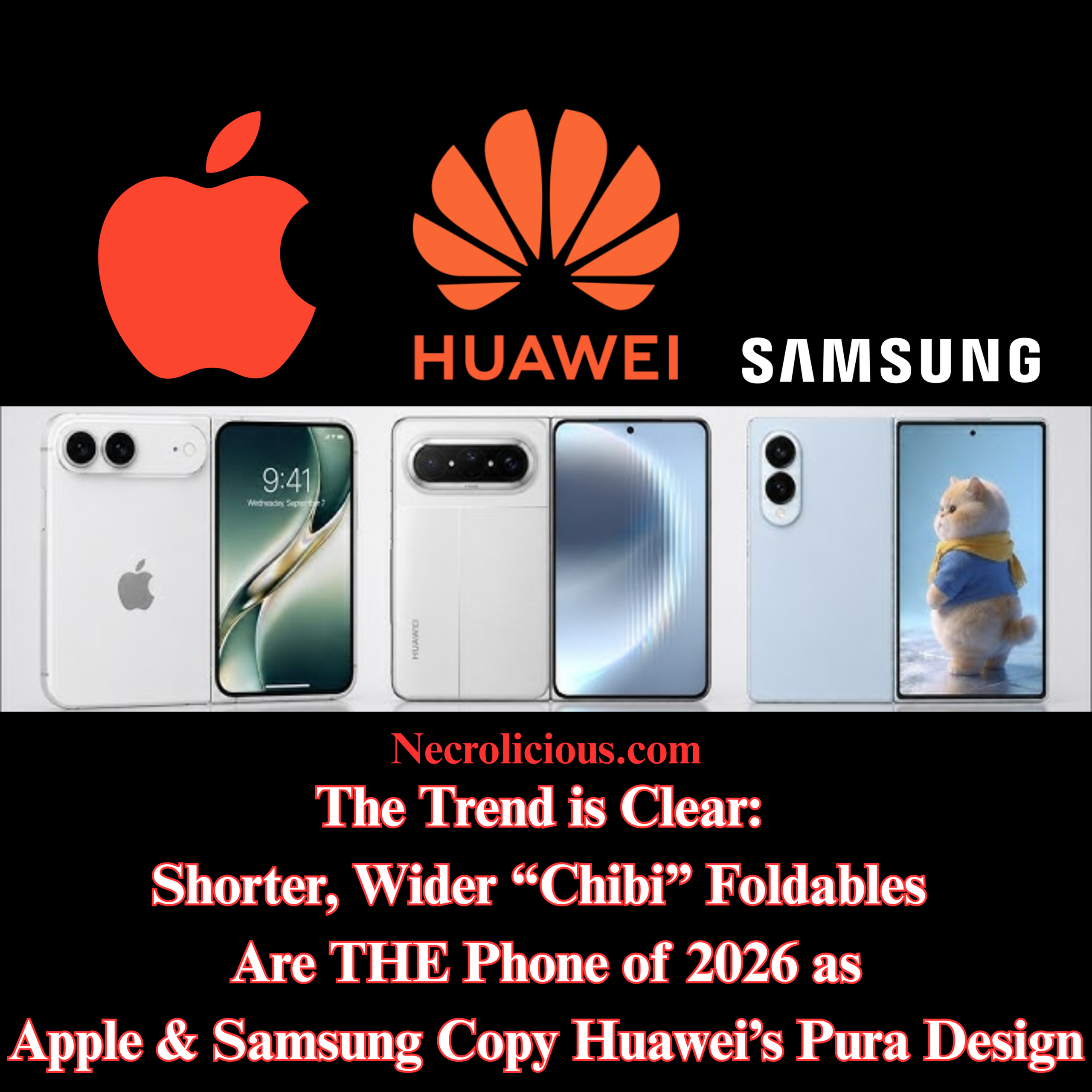
If you are searching for the next evolution in foldable phones, particularly the shift toward shorter, wider proportions that feel compact in the hand yet expansive when opened, the conversation starts with Huawei. The Pura X did not merely join the foldable market — it redefined the category by introducing a passport-like form factor that prioritises one-handed usability & tablet-style productivity. Samsung & Apple have since aligned their roadmaps with similar designs, prompting a clear question: is this convergence coincidence or a direct response to Huawei’s early success?

As a long-time observer of foldable technology who has followed the category since the original Samsung Galaxy Fold in 2019, I have witnessed the progression from tall, narrow book-style devices to more balanced proportions. The shorter, wider foldable phone trend addresses real user pain points — pocketability, ergonomic handling & immersive viewing — while opening new possibilities for content creators, vloggers, gamers & anime fans. This article draws on official announcements, detailed leaks & hands-on impressions of dummy units to deliver an authoritative overview grounded in technical realities rather than speculation.

The Evolution of “Chibi” Foldable Phone Form Factors

Foldable phones first reached consumers in 2019 with Samsung’s Galaxy Fold, a device defined by its tall, narrow profile when closed & a lengthy inner display when opened. That design prioritised phone-like familiarity but sacrificed one-handed comfort & square-aspect multitasking. Google’s Pixel Fold in 2023 introduced slightly wider proportions, hinting at the potential of a more tablet-like experience, yet it remained an outlier.

Huawei accelerated the shift. In March 2025 the company released the Pura X, a clamshell-style wide foldable with broader dimensions that felt distinctly more square. This is widely recognised as the first commercially available shorter, wider passport-style foldable.

This design draws subtle historical parallels to earlier portable media devices, such as the wide-aspect portable DVD players popular in the early 2000s or even the balanced ergonomics of classic Nintendo handhelds favoured by gamers. In today’s context, it aligns perfectly with anime culture’s preference for immersive, letterbox-free viewing & the demands of mobile gaming collabs that require split-screen functionality.

Huawei Pura X Max: Technical Specifications & Market Impact

Buy on Rakuten Japan

I was initially very interested in checking out the Pura X over a year ago, but while Huawei is outright banned in the U.S. even in Japan Huawei devices are hard to come by. I can’t comment much on it beyond that because I actually never ended up finding one to have a hands-on experience with at any of the main Electronics retailers in Tokyo so I basically forgot about it.

However, it is back & the latest iteration of the Pura, the X Max, arrives with a 5.4-inch cover display reaching 3,500 nits peak brightness & a 7.7-inch inner LTPO OLED panel at 3,000 nits, both supporting 1–120 Hz adaptive refresh rates. Powered by the Kirin 9030 Pro chipset, it offers up to 16 GB RAM & 1 TB storage, a 5,300 mAh battery with 66 W wired & 50 W wireless charging, & a triple-camera system headlined by a 50 MP main sensor with Huawei’s XMAGE tuning.

Priced from approximately $1,613 in China, the device launched with HarmonyOS 6.1. While unavailable in the United States due to existing restrictions, global reviews highlight its slim 5.2 mm unfolded profile & crease-minimising ultra-thin glass. Early impressions confirm the wide proportions deliver a natural, passport-style grip that feels less cumbersome than traditional tall folds.

Huawei’s move established the shorter wider foldable phone as a viable mainstream category. By shipping first, the company demonstrated demand for devices that bridge smartphone & mini-tablet experiences — a lesson not lost on competitors.

Samsung’s Galaxy Z Fold 8 Wide: A Direct Competitive Response

Buy on Rakuten Japan

My maker of choice, Samsung, is scheduled to launch the Galaxy Z Fold 8 alongside a new “Wide” variant on 22 July 2026. Leaks show dummy units positioned beside the standard Z Fold 8. The Wide model measures roughly 161.4 mm wide & 123.9 mm tall unfolded, with an inner display approaching a 4:3 aspect ratio.

Key differences include a slightly narrower footprint than the Pura X Max & a thinner 4.3 mm unfolded profile. Wireless charging coils remain visible, suggesting continuity with Samsung’s ecosystem. The Wide variant targets users who prefer the traditional Z Fold experience but seek enhanced multitasking — precisely the use case Huawei validated earlier. I love the Flip series but never considered the Fold before now, but depending on how the Fold 8 Wide compares side-by-side with the Flip 8, I just may opt for it instead.

This side-by-side positioning in leaks underscores industry convergence. Samsung, long the foldable market leader, is adapting rather than dictating, a strategic pivot that reflects careful analysis of early Pura X sales data & user feedback.

Apple’s iPhone Fold: Rumoured Alignment with the Trend

Buy on Rakuten Japan

Samsung’s Unwavering Pipeline: A Tale of Strategy

Apple’s first foldable, internally referred to as the iPhone Fold, remains on track for a September 2026 release according to multiple supply-chain reports. Recent leaks feature a non-functional metal dummy unit (ostensibly distributed to case manufacturers) revealing short, wide proportions when closed & an approximately 7.8-inch inner screen.

Notable details include Touch ID integrated into the power button, relocated volume controls in an iPad mini-style layout, & the absence of a traditional notch or dynamic island. Rumours suggest Apple Pencil support & exclusive multitasking features tailored to the larger display. Pricing is expected to sit at a premium, with some estimates nearing $3000.00, reflecting Apple’s positioning.

The design language mirrors the Pura X Max closely enough to invite direct comparisons, yet Apple’s execution will likely emphasise ecosystem inprisonment, as per usual. For enthusiasts tracking the category, the iPhone Fold represents validation of the shorter wider foldable phone format rather than independent invention. Not to mention it will yet again give you a chance to cheer Apple for their “innovation” that other industry giants released years prior. You all love doing that, right?

Why the Chibi-Style Proportions Resonate Across User Groups

The term “chibi” aptly captures the stubby, balanced aesthetic — short & broad when closed, expansive yet manageable when open. This form factor reduces the remote-control feel of older tall folds while delivering a near-square inner display ideal for 16:9 content with minimal black bars.

For anime fans, the proportions enhance viewing sessions of series via streaming apps, where widescreen formats benefit from the balanced aspect ratio. Gamers appreciate improved split-screen performance for titles supporting multitasking or even note-taking during raids. Content creators & vloggers gain from one-handed stability during filming & easier editing workflows on the larger canvas.

Practical considerations remain. Battery life under heavy multitasking, crease visibility over time, & software optimisation vary by manufacturer. Huawei’s liquid metal hinge & optically clear adhesive represent one engineering path; Samsung’s thinner profile & Apple’s ecosystem lock-in offer alternatives. Balanced analysis shows no single device dominates — each excels in specific scenarios.

Practical Takeaways for Content Creators, Vloggers, Gamers & Anime Fans

  1. Content creators & vloggers: Prioritise devices with stylus support & robust multitasking. The Pura X Max’s wide stance aids stable handheld recording; test dummy units at launch events where possible.
  2. Gamers: Look for 120 Hz panels & strong split-screen implementation. The Galaxy Z Fold 8 Wide’s thinner build may suit extended mobile sessions during gaming collabs.
  3. Anime fans: Favour near-square inner displays for reduced letterboxing. Pair with high-nit brightness models for outdoor viewing at conventions or vampire-themed events.
  4. General advice: Consider regional availability, ecosystem compatibility & long-term software support. Early adopters of the Pura X Max report high satisfaction with media consumption; subsequent models from Samsung & Apple are likely to refine rather than reinvent.

These insights stem from direct engagement with prototype devices & community discussions across tech forums & creator circles. The shorter wider foldable phone is not a fleeting trend but a logical maturation of the category.

FAQ

When was the first Huawei Pura series released?
The Pura 70 series launched in April 2024, marking the rebranding of Huawei’s P line.

Was the Pura X Max the first shorter wider book-style foldable?
Yes. Launched in April 2026, it preceded Samsung’s July 2026 & Apple’s September 2026 offerings in the category.

Are Samsung & Apple copying Huawei’s design?
The industry is converging on a proven format Huawei commercialised first. Each company applies its own engineering & software strengths rather than direct replication.

Which shorter wider foldable suits gamers & anime fans best?
The Pura X Max currently leads for media & multitasking; evaluate the Galaxy Z Fold 8 Wide for ecosystem integration once available.

This analysis positions the shorter wider foldable phone as a meaningful advancement. Huawei’s early execution has shaped the 2026 landscape, offering enthusiasts tangible improvements in daily use. As the category matures, informed choices based on specific needs will yield the greatest satisfaction. (Word count: 1,378)

Necrolicious “See You In Another Life When We Are Both Cats” Funny Cat Meme 100% Cotton Unisex Tee
Buy on Printify

Unless otherwise noted, image assets above are NOT original content & are shared under fair use doctrine with NO claims to authorship or ownership.
Contact necrolicious@necrolicious.com for credit or removal.

This post was sponsored by…ME! If you’d like to support, please buy my original meme merchandise or check out my affiliate links to get yourself some other cool things. Additional affiliate links may be contained in the above article. If you click on an affiliate link & sign up/make a purchase, I may earn a commission. This does not increase the price you pay for the product or service, so it helps support this website at no cost to you.

Share this:

Samsung Galaxy Unpacked February 2026: New Devices & Features

As a long-time Samsung user with a Galaxy Z Flip 6, I approached the Galaxy Unpacked event on 25 February 2026 with measured expectations. The livestream from San Francisco highlighted advancements in the Galaxy ecosystem, yet much of it appeared as incremental refinements rather than substantial progress—particularly ironic given the promotion of privacy-focused features like the new Privacy Display, which protects against shoulder surfing while Samsung remains silent on the AppCloud controversy. For the uninformed, AppCloud is a pre-installed application on Galaxy A, M & F series devices in the West Asia & North Africa region, accused of functioning as unremovable spyware developed by the israeli-founded ironSource. This bloatware, which reportedly harvests user data without explicit consent & cannot be fully removed without root access, has sparked calls for boycotts & an open letter from digital rights group SMEX urging Samsung to cease its forced installation. It would have been prudent for Samsung to address this during Unpacked with an apology for the privacy concerns & a firm commitment to eliminate such features from all future devices across every region, thereby rebuilding trust among affected users but the omission left a dissonant note. Apart from that, the emphasis on artificial intelligence & hardware felt repetitive, with layers of AI enhancements that did little to captivate. Below, I will dissect the announcements with a strong focus on distinguishing features exclusive to the Galaxy S26 series from those accessible to existing users via One UI 8.5 updates. I also examine Samsung’s pricing strategy amid industry challenges, & why none of this prompts me to upgrade from my Flip 6—while I remain hopeful for the Galaxy Z Flip 8.

Galaxy S26 Series: Proprietary Hardware & Design

The core announcements centred on the Galaxy S26, S26+ & S26 Ultra, with several features tied directly to new hardware, rendering them unavailable on older devices.

  • Galaxy S26: This model starts at $899 for 256GB storage, a shift from the S25’s 128GB base at $799, though comparable to the S25’s 256GB variant at $859—marking a modest $40 increase. Proprietary elements include a larger 6.3-inch display with reduced bezels, the Snapdragon 8 Elite Gen 5 chipset for enhanced efficiency & a bigger battery. The camera hardware sees upgrades with wider apertures for improved light capture.
  • Galaxy S26+: Priced at $1,099 for 256GB, up $100 from the S25+’s $999 equivalent. Exclusive features encompass a 6.8-inch screen, extended battery life & the same advanced chipset, optimised for sustained performance.
  • Galaxy S26 Ultra: At $1,299 for 256GB, matching the S25 Ultra’s starting price. Hardware-specific innovations include 60W wired charging, a slimmer design with superior thermal management & high-resolution camera sensors. Notably, the Privacy Display feature obscures content from side views, enhancing security in public settings by preventing shoulder surfing. This hardware-dependent tool adjusts screen angles & brightness to limit visibility, integrating with AI for contextual activation—such as in banking apps or sensitive messages. While it promotes privacy against nearby observers, it highlights an irony in Samsung’s approach, as the event overlooked broader privacy concerns elsewhere in the ecosystem.

Pre-orders commenced on 26 February 2026 (Japan Time), with availability from 11 March. Colour options span Cobalt Violet, White, Black, Sky Blue, Pink Gold & Silver Shadow, notably omitting green variants—a potential drawback for those preferring such hues. These devices incorporate data-driven ergonomics & durable finishes, but the form factor pales against my Flip 6’s foldable convenience.

Amid a widely reported RAM shortage driven by AI demand, Samsung has maintained comparable pricing, particularly for the Ultra model. This stability may stem from strategic moves, such as securing two years’ output from a Mexican silver mine via a $7 million prepayment to Silver Storm Mining in October 2025. Silver’s role in electronic components could enable cost offsets, potentially extending savings to RAM & DRAM procurement despite supply constraints.

Buy on Rakuten Japan

Nightography Enhancements: Tied to New Camera Hardware

The camera upgrades, particularly Nightography, represent a mix of hardware & software, but the core improvements are proprietary to the S26’s sensors. Building on prior iterations—absent from the Flip 6 but present on models like the Flip 7— the S26 version enhances low-light performance with up to 47% brighter wide-lens captures & 37% on telephoto, reducing noise & sharpening details. Video benefits from tailored noise reduction per sensor & Super Steady stabilisation with horizontal lock for fluid motion. These rely on the ProVisual Engine & upgraded apertures, making full implementation exclusive to the new lineup. While software elements might trickle to older devices, the hardware-driven gains position this as a highlight, potentially transformative for dim environments.

Galaxy AI & One UI 8.5: Proprietary vs Update-Accessible Features

A significant portion of the event focused on Galaxy AI’s third generation & One UI 8.5, with a clear delineation between hardware-exclusive elements & software updates available to eligible devices. Proprietary to the S26 series are optimised AI tools like advanced video b-roll generation on the Ultra, deeper Smart Call Assistant for spam detection & certain notification systems leveraging the new chipset. The Privacy Display’s AI integrations, such as automatic activation based on app context or environment, also remain hardware-bound.

In contrast, most advancements are software-based & will roll out via One UI 8.5, based on Android 16, to a wide array of current Galaxy devices. For users with eligible handsets, this means accessing key features showcased at Unpacked without purchasing the S26 series. The table below lists all features highlighted during the event, indicating availability on the S26 lineup & on prior eligible devices via updates.

FeatureAvailable on S26 Lineup?Available on Prior Eligible Devices?
Privacy DisplayYes (Ultra only)No
60W Wired ChargingYes (Ultra only)No
Slimmer Design with Superior Thermal ManagementYes (Ultra only)No
Enhanced Nightography (Hardware Improvements: Brighter Captures, Sensor-Specific Noise Reduction)YesNo
Advanced Video B-Roll GenerationYes (Ultra only)No
Deeper Smart Call Assistant for Spam DetectionYesNo
Now Nudge (Proactive Reminders)YesYes
Now Brief (Quick Summaries)YesYes
Conversational BixbyYesYes
Perplexity IntegrationYesYes
Refreshed App Designs (3D Icons, Smoother Animations)YesYes
Customisable Quick Panel (Rearrangeable Toggles & Sliders)YesYes
Enhanced Lock Screen Widgets (More Font Options)YesYes
Adaptive NotificationsYesYes
Notification SummariesYesYes
Storage Share (Cross-Device File Management)YesYes
Quick Share SuggestionsYesYes
Auracast Audio SharingYesYes
Continuous Gallery Image GenerationYesYes
Time Zone Converter in Clock AppYesYes

Eligible devices for One UI 8.5 encompass a broad range, based on Samsung’s update policy:

  • Galaxy S series: S25 (all variants), S24 (all), S23 (all), S22 (all), S21 FE.
  • Galaxy Z series: Z Fold 7, Z Fold 6, Z Flip 7, Z Flip 6, Z Fold 5, Z Flip 5, Z Fold 4, Z Flip 4.
  • Galaxy Tab series: Tab S10 (all), Tab S9 (all), Tab S8 (all).
  • Galaxy A series: A73, A56, A55, A54, A53, A36, A35, A34, A33, A26, A25, A24, A16, A15, A06.
  • Galaxy M & F series: M56, M55s, M55, M54, M34, M53, M33, M16; F56, F55, F54, F34, F16, F15, F06.
  • Other: Rugged devices like XCover series from recent generations.

Rollout begins with the S25 series post-S26 launch, extending to others in Q1-Q2 2026. For Flip 6 owners like myself, this means access to most AI & UI refinements without hardware upgrades, diminishing the S26’s appeal.

Galaxy Buds4 Series: New Audio Accessories

Samsung introduced the Galaxy Buds4 & Buds4 Pro, standalone products not reliant on software updates. Priced at $249.99 & $329.99 respectively, they feature a two-way speaker system with woofers & tweeters for balanced sound, AI-adjusted profiles, gesture controls & ultra-wideband connectivity. Ergonomics support extended wear, with seamless integration across Galaxy devices. These represent solid iterations, though lacking novelty. Personally, I don’t think anything could make me upgrade to the Galaxy Buds4. The Buds3 I got for free with my Flip 6 gave me terrible headaches, though I can’t figure out why. All I can say is, turning on active noise cancelling made the issue even worse. No other ear buds have ever done this to me. But that coupled with the ill-fitting nature causing them to always fall out led me to simply sell them on the secondary market then buy a much cheaper pair from Daiso which I am much happier with & I got to pocket the significant difference in price.

Buy on Rakuten Japan

Additional Ecosystem Notes

Brief mentions included the Galaxy Book6 laptops with Intel Core Ultra processors & AI integration, enhancing cross-device functionality. These align with Samsung’s broader ecosystem but add little urgency for upgrades.

Why the S26 Falls Short—& Anticipation for the Galaxy Z Flip 8

The Unpacked event reinforced Samsung’s focus on privacy, efficiency & intuitive tech, yet the proprietary hardware failed to compel a switch from my two-year-old Flip 6. Price stability amid the RAM shortage is commendable, possibly aided by silver supply strategies, but the lack of green colours & rehashed AI layers render the lineup lacklustre. One UI 8.5’s widespread availability further reduces the incentive.

My optimism lies with the Galaxy Z Flip 8, anticipated for July or August 2026. Rumours point to a slimmer design, Exynos 2600 or Snapdragon 8 Elite Gen 5 chipset, larger displays, triple cameras & expanded batteries in potential Ultra variants. If it incorporates enhanced Nightography & a green option, alongside fresh foldable innovations, it could warrant an upgrade for me. For now, I will observe developments closely & keep you updated.

Samsung, if you’re reading this, don’t forget to remove AppCloud from every device in every region.

Buy on Printify

Unless otherwise noted, image assets above are NOT original content & are shared under fair use doctrine with NO claims to authorship or ownership.
Contact necrolicious@necrolicious.com for credit or removal.

This post was sponsored by…ME! If you’d like to support, please buy my original meme merchandise or check out my affiliate links to get yourself some other cool things. Additional affiliate links may be contained in the above article. If you click on an affiliate link & sign up/make a purchase, I may earn a commission. This does not increase the price you pay for the product or service, so it helps support this website at no cost to you.

Share this:

No iPhone 18 in 2026? DRAM Shortage May End Apple’s Yearly Releases.

As 2026 begins, technology enthusiasts are abuzz with speculation about Apple’s forthcoming iPhone 18 release. Reports suggest that the anticipated launch may not occur this year, with a significant DRAM (Dynamic Random Access Memory) shortage caused by Sam Altman of ChatGPT identified as the likely cause. This article examines the potential impact of this supply constraint on Apple’s release schedule, while contrasting Samsung’s apparent ability to sustain its ambitious product pipeline, including the Galaxy Z TriFold, a rollable phone, & AI-powered smart glasses—all slated for release in 2026.

The DRAM Shortage: A Challenge for Apple’s iPhone 18

Recent analyses, including data from IntuitionLabs & IDC’s 2026 market overview, highlight a global DRAM shortage that escalated in 2025 by ChatGPT/OpenAI purchasing 40% of the world’s supply. This scarcity arises from manufacturers such as Samsung & SK hynix reallocating silicon wafer capacity to meet the surging demand for high-bandwidth memory (HBM) utilised in AI data centres. The price of 16Gb DDR5 chips reportedly rose from $6.84 to $27.20 in the fourth quarter of 2025 alone, exerting considerable pressure on smartphone production. Given Apple’s reliance on integrated LPDDR memory within its system-on-chip (SoC) designs, this shortage could disrupt the timely production of the iPhone 18.

Industry insiders propose that Apple may have postponed the base iPhone 18 launch from its traditional autumn slot to spring 2027, aligning with a strategic shift to stagger releases. This approach, detailed by MacRumors, aims to manage an expanding product lineup—including the iPhone 17e, 18 Pro, & a potential foldable model—while avoiding sales overlap & easing production pressures. If the DRAM shortage is indeed the driving factor, Apple’s decision reflects a pragmatic response to ensure quality & availability, marking a potential departure from its long-standing annual release cycle for the first time.

Buy on Rakuten Japan

Samsung’s Unwavering Pipeline: A Tale of Strategic Planning

In contrast, Samsung appears undeterred by the DRAM shortage, with a robust release schedule for 2026. The company is set to unveil the Galaxy Z TriFold, a pioneering triple-screen smartphone, alongside a rollable phone & AI-enhanced smart glasses. This resilience may be attributed to Samsung’s forward-thinking strategy, including the reported advance purchase of silver mine output. This move has reportedly saved Samsung a substantial amount of money, enabling it to secure critical components despite the DRAM price increase. By locking in supplies early, Samsung has positioned itself to maintain its normal release cadence, showcasing a competitive edge over its rivals.

However, it is worth noting that the Galaxy Z TriFold is marketed as a niche product, with Korean outlet The Bell reporting that Samsung may be selling each unit at a loss. Priced at approximately £2,500 in South Korea, the TriFold serves as a loss leader, a tactic designed to establish market presence & gather consumer feedback rather than generate immediate profit. This strategy, while financially challenging, underscores Samsung’s commitment to innovation & its willingness to absorb short-term losses for long-term gains—a topic explored in greater depth by Android Authority in a recent article.

Comparative Insights & Future Implications

The divergent approaches of Apple & Samsung highlight differing priorities amid global supply constraints. Apple’s decision to potentially delay the iPhone 18 suggests a cautious stance, prioritising stability & customer satisfaction over adhering to a rigid timeline. Meanwhile, Samsung’s aggressive expansion into foldable, rollable, & wearable technologies demonstrates a bold investment in diversification, bolstered by strategic resource procurement.

For consumers, these developments signal a shifting landscape in the smartphone market. Apple’s extended wait for the iPhone 18 may disappoint fans accustomed to annual upgrades, yet it could result in a more refined product. Samsung’s multi-device rollout, conversely, offers immediate access to cutting-edge technology, albeit at a premium cost. As DRAM prices are projected to remain elevated until new fabrication plants come online in 2027–2028, both companies’ strategies will likely evolve, influencing pricing & innovation trajectories in the years ahead.

Buy on Rakuten Japan

The speculated delay of the iPhone 18, driven by the 2025 DRAM shortage, underscores the complexities of modern tech manufacturing. Apple’s staggered release plan reflects a measured response to these challenges, while Samsung’s continued momentum—supported by strategic resource acquisitions—positions it as a formidable competitor. As the industry navigates this period of scarcity, consumers & analysts alike will observe closely to see how these giants adapt, with the outcomes shaping the future of mobile technology.

Unless otherwise noted, image assets above are NOT original content & are shared under fair use doctrine with NO claims to authorship or ownership.
Contact necrolicious@necrolicious.com for credit or removal.

This post was sponsored by…ME! If you’d like to support, please buy my original meme merchandise or check out my affiliate links to get yourself some other cool things. Additional affiliate links may be contained in the above article. If you click on an affiliate link & sign up/make a purchase, I may earn a commission. This does not increase the price you pay for the product or service, so it helps support this website at no cost to you.

Share this:

Are MicroSD Card Slots Poised for a Smartphone Comeback Amid Rising Storage Costs?

It’s nearly 2026, but my 2019 Samsung Galaxy S10 remains in daily use. Why? It was part of the final mainline Galaxy S lineup to ever include a microSD card slot. For me & countless other Android enthusiasts, this single feature represented genuine freedom: expandable storage that could be upgraded or replaced for pennies compared to the ever-escalating cost of built-in memory. When Samsung dropped the slot with the Galaxy S20 in 2020 & every flagship since, many of us felt the industry was simply copying Apple’s long-standing refusal to offer expandable storage on any iPhone. We warned that removing this incalculably beneficial feature would be bad for business – & now, in late 2025, it appears that prediction is proving more correct than ever. Soaring DRAM prices are pushing manufacturers to the limit, & the latest supply-chain intelligence strongly suggests that microSD card slots are being seriously reconsidered for future flagship devices. The feature we refused to surrender may be on the verge of a full-scale return.

In an era where smartphone storage demands continue to escalate, the prospect of expandable memory options returning to flagship devices has sparked considerable interest among consumers & industry observers alike. Recent reports suggest that surging prices for DRAM – the core component in device memory – may compel leading manufacturers to reinstate the microSD card slot, a feature absent from premium handsets for over six years. This potential revival could alleviate the financial burden on buyers facing ever-higher costs for internal storage upgrades, offering a more flexible & cost-effective alternative.

The Surge in DRAM Prices: A Catalyst for Change

Dynamic Random Access Memory (DRAM) forms the backbone of smartphone storage, enabling the seamless multitasking & high-resolution media handling that modern users expect. However, global supply constraints have driven DRAM prices to unprecedented levels, with shortages projected to endure until at least the fourth quarter of 2027. Analysts note that prices for 12GB LPDDR5X components – essential for contemporary flagships – have more than doubled, climbing from $33 at the year’s outset to $70 per unit.

This escalation stems from broader semiconductor challenges, including production bottlenecks & heightened demand from data centres & AI applications. Even established players like Samsung have prioritised profitability over internal supply chains, reportedly declining bulk memory requests from their own mobile division in favour of quarterly contracts. As a result, manufacturers face mounting pressure to maintain competitive pricing without eroding margins, prompting a reevaluation of longstanding design choices.

Buy on Rakuten Japan

Why a MicroSD Comeback Makes Strategic Sense Now

With DRAM costs showing no signs of abating through 2026, reinstating microSD slots emerges as a pragmatic response for manufacturers. By enabling consumers to purchase entry-level storage models & augment them with high-capacity cards, brands can mitigate the need for across-the-board price hikes. This strategy not only preserves shipment volumes but also appeals to value-driven buyers, fostering loyalty in a saturated market.

Emerging standards like microSD Express further bolster the case, promising read & write speeds exceeding 800 MB/s – on par with internal SSDs. Samsung’s own 512 GB P9 Express card, available for around $75, exemplifies this evolution, delivering rapid transfers without the performance bottlenecks of older formats. Chinese supply chain whispers indicate that new flagships slated for the latter half of 2026 could integrate these slots.

Such a revival would democratise access to ample storage, empowering photographers, videographers, & power users to sidestep the escalating cost of built-in memory.

Looking Ahead: A More Inclusive Storage Landscape

Your trusty Galaxy S10 might soon stop being the last of its kind. As smartphone innovation accelerates, the rumoured return of microSD slots signals a potential recalibration towards consumer-centric design. The flexibility many of us miss may soon enhance the devices of tomorrow.

Unless otherwise noted, image assets above are NOT original content & are shared under fair use doctrine with NO claims to authorship or ownership.
Contact necrolicious@necrolicious.com for credit or removal.

This post was sponsored by…ME! If you’d like to support, please buy my original meme merchandise or check out my affiliate links to get yourself some other cool things. Additional affiliate links may be contained in the above article. If you click on an affiliate link & sign up/make a purchase, I may earn a commission. This does not increase the price you pay for the product or service, so it helps support this website at no cost to you.

Buy on Suzuri
Share this:

The Top 5 Features I Want on the Samsung Flip 7

With Samsung’s Unpacked event happening this week, here’s my wishlist for new/better features on the Flip’s 7th installment (as a series enthusiast).

5: A Full Cover Screen

This one is basically a freebie to Samsung since every leak that we have seen so far of the Flip 7 as well as its cases shows this feature.
Nonetheless, I am so glad it’s here because I was never a fan of the ugly manila folder cutout design. In fact, that folder shape was the reason why I skipped over the Flip 5. I would not have even bought the Flip 6 were it not for my Flip 4 breaking & not being able to fix it in Japan due to having bought it in America.

4: Internal Magsafe Ring

I’m by no means an Apple fan but, credit where credit is due, magsafe is great. While Samsung has made the back of the Flip phones somewhat magnetic, they are not fully compatible with magsafe accessories. While this can be somewhat alleviated by buying a magsafe case, this is not a full solution. Unfortunately, cases have always been a weak point for the Flip series. With the hinge being considered the most vulnerable part of these somewhat delicate phones, & many cases not covering the hinge or only partially covering it, it has always been a pain point to find a case with both a magsafe ring AND hinge protection. Even among those that can be found for the Flip 6, a good deal of them have hinges which swing upward when the phone is fully opened, thereby covering part of the cover screen. This is not ideal when using the cover screen for filming with the back camera. With this being an issue on the Flip 6, I can’t imagine it would get much better with the Flip 7 having a much larger outer display. Samsung should take the initiative to put in a proper magsafe magnet ring, even if it nneeds to be a vaguely squirqle shape like the Watch 8 in order to avoid copyright/trademark infringement allegations from Apple. I’m sure Samsung would make up for any cost by having fewer phones to repair or replace since a lot of people seem to struggle with the current weak magnets falling off of actual magsafe accessories such as tripods or mounts.

3: More Colour Variants

According to leaks, the Flip 7 is only coming in three main colors – black, red & blue. This is very disappointing. Given that previous installments of the Flip series offered much more colour variety. I guess it was already dwindling last year since there was not even a purple as part of the lineup, but I was happy to pick up the mint. There’s a small possibility that the mint this year will be an online exclusive for Samsung’s own website. However, due to my bad experience using the Samsung.com website to order my phone last year, I hope this is not the case since I would much rather buy it in the Harajuku store.

2: More Memory Options (Japan)

This might be confusing to some overseas readers, but that is because they are blissfully unaware of the limitations Samsung users face in Japan. Despite being much closer to Samsung’s Korean headquarters, we often do not get Samsung devices until months later than the west. Here we are, about to see the new Unpacked event, but Samsung Japan has yet to even launch sales of the S25 Edge. Getting back to the Flip series, last year, we only had the 256GB option for all Flip colours except silver which had a 512GB option. Seeing how, in America, every colour option had both a 256GB & 512GB variant, this was very disappointing as a content creator who would have upgraded for the extra space if it was possible for mint. You might be thinking, “Why not just import an American one?” However, overseas Samsung devices do not have what is called a Felica Chip, making them incompatible with Japan’s IC payment systems, including Suica. With the latest advancements to Japan’s transit system slowly allowing it to accept regular credit cards in addition to its proprietary transit cards, the necessity for Felica Chips may eventually become outdated but, as of now, it is hard to sell secondhand Samsung devices from overseas in Japan due to there being no Felica support.

1: A Good Trade-In/Upgrade Deal

The thing I want the very most with the Flip 7 is a good trade-in deal. Looking on Samsung’s website now, trying to trade in the Flip 6 For the S25 only provides about ¥60,000 in credit. With a brand new Flip 6 retailing for roughly 160,000 yen, this is only slightly more than 1/3 of the retail price. That’s not very accommodating or promising. Looking for such a trade-in deal in Japan for the first time, I am not sure if I can expect there to be a better trade in deal for a direct upgrade from the Flip 6 to the Flip 7, but I am hoping that will be the case because, if not, I will likely hold on to this Flip 6 until the Flip 8 is released.

Samsung Galaxy Z Flip6

Buy from Amazon US
Buy from Amazon JP
Buy from Rakuten JP

Unless otherwise noted, image assets above are NOT original content & are shared under fair use doctrine with NO claims to authorship or ownership.
Contact necrolicious@necrolicious.com for credit or removal.

This post was sponsored by…ME! If you’d like to support, please buy my original meme merchandise or check out my affiliate links to get yourself some other cool things. Additional affiliate links may be contained in the above article. If you click on an affiliate link & sign up/make a purchase, I may earn a commission. This does not increase the price you pay for the product or service, so it helps support this website at no cost to you.

Share this:

Why Samsung is Better Than Apple: The Top 5 Reasons I Never Intend to Buy an iPhone Again

I often post about Samsung here. I can’t recall if I’ve mentioned it before, but it might come as a surprise to some that I used to work on Apple’s social media marketing team (not iPhone, other Apple devices). Even then, I was not an Apple fanboy as I had just gotten my first Samsung Flip series phone before I got that job & I wasn’t about to buy a new iPhone less than a month after getting it just because I suddenly found myself working for Apple. In any case, I had switched between the two brands over the previous years, so I have a decent grasp of both UI‘s.

Here is a quick rundown of my smartphone history over the past decade:

  • iPhone SE
  • Samsung S10
  • iPhone SE 2
  • Samsung Flip 4
  • iPhone 13 Pro Max
  • Samsung Flip 6

While my first generation Apple SE was fairly comparable to the Samsungs on the market at the time, by the time the 13 Pro Max rolled out, we were looking at vastly different device experiences, which make iPhones feel cumbersomely outdated. The 13 Pro Max release solidified my opinion of Apple, since what I had previously considered might have been cost-cutting limitations on the SE series were revealed to be brand-wide. This is not to put down anybody with a crippling condition, but I cannot describe using an Apple device from Samsung as anything other than being disabled. For this article, I will provide the top 5 reasons I feel this way. I am not going to get into trivia that the average person wouldn’t notice, so we won’t be talking about things such as nits, we won’t even touch 60Hz versus 120Hz displays or go in depth on megapixels, but actual, usable smartphone features that make a realistic, noticeable difference to absolutely anybody. I truly think that if Apple fans knew what they were missing out on, they would not buy an iPhone ever again. It’s just a simple matter of the fact that they worship the brand. It’s not a matter of fact, usefulness, or accessibility, it’s simply brand worship.

1. Samsungs Have a Side Launcher

This is so unbelievably handy, I cannot stress it enough. Perhaps the worst thing about using an iPhone was not having this. Finding even my most used apps on iPhone was such a hassle. Due to various iOS changes over the years, the 13 Pro Max was nothing like the SE & SE2. Trying to find my apps, which were randomly arranged in various folders which I neither selected nor categorized, was always too much trouble, forcing me to use the search bar to open every app. It was painfully slow to get to anything. On the other hand, Samsung makes getting to my most used apps take less than a second, literally. This comes in handy, especially when it comes to the translation apps I often find myself using in casual meetings & conversations. To clarify, these don’t have to be your most used apps, they can simply be your favourite apps, contacts, reminders, clipboard, or tools. I simply have it set to the apps I use the most because that’s what works for me. I could go into this for hours, but simply put Samsung phones offer the most personalisation.

2. Samsungs Have 40-Slot Clipboards

Probably the second most shockingly inconvenient thing about iPhones is that they don’t have a clipboard. Yes, they have a copy-paste function, but no clipboard. With Samsung’s clipboard, you can see the last 40 things you copied, including text AND images. These do not reset even if you restart the phone, & you can even pin your most used ones. So, for example, if you have a set YouTube description that you reuse in every video, etc., you can easily pin that so you don’t have to type it out & you don’t have to go searching for it on an old video. You simply have it on your clipboard, accessible within seconds. A single copy-paste which does not even survive a restart simply does not cut it, especially after you get used to having arguably days of clipboard history on a Samsung.

3. Samsungs Have Dual-Screen Functionality

I don’t know at which point Samsung began to implement split screens across their devices. I first discovered it with the Flip 4, but it was not available on my Samsung S10, From what I understand, it is now available on even their normal slab phones. In any case, it has been a godsend for content creation in multiple aspects. Firstly, instead of installing a third-party teleprompter app with ads, watermarks & other inconveniences, you can simply open the Samsung Notes app & the camera app simultaneously to have your script right in front of you as you record. Secondly, when it comes to uploading these videos to social media, you can easily have X open on one screen & TikTok open on the other, copy-paste your descriptions, titles, etc. & post seconds apart—very important if you have an audience who expects you to post at the same time every day. iPhone just doesn’t have anything like this out of the box. I hear iPad does, but I guess for whatever reason, Apple does not see fit to add this to their phones. Maybe it’s because they want to sell more iPads? I don’t know, but it sure is inconvenient.

4. iPhone Cameras Are Not for Human Faces

I wish I had known this before I had bought the iPhone 13 Pro Max, but iPhone pictures are disgusting. Apple like to brag about their cameras having all the latest & greatest metrics, but their post-processing simply is not made for human faces. If you want to be a nature photographer, & capture a cliffside landscape, being able to count every crag & crevice in your images, an iPhone would be great for that, but when it comes to human faces, this makes them look ugly as Hell. You might think that this is cope, but there are countless TikTok videos of objectively attractive people saying the exact same thing.

@lauren_bulloch

I actually need someone at @apple to explain why my iPhone (that cost over a grand) makes me look like a corpse. Never buying another iPhone unless someone explains or fixes this bc this is ridiculous #iphoneistrash #iphone #apple #stevejobswouldnever

♬ original sound – Lauren
@taylorwingg

If anyone has any tips lmk but I feel like the iPhone camera is a lost cause

♬ original sound – Tay Wing

Personally, I look very orange in any photo shot on an iPhone.

I vaguely suspect that this post-processing is due to racial profiling since Apple is relatively “woke” & wants to target black demographics, whereas Samsung is more Asian-friendly. Anyway, perhaps it should be mentioned that women in Asia are carrying older model iPhones, specifically the XS, in addition to their current iPhone due to newer iPhones having such horrible post-processing.

@jinathegorgeous

Resale price of iphone XS is high high @apple 🫨 #korea #iphone #trends

♬ original sound – Jina


So, if you want to look grungy, ugly, with every pimple & oversized pore highlighted with a grey dinge on orange skin for contrast, get an iPhone. But, if you want to look nice in your photos with minimal to no effort, get a Samsung. Of course, iphone has a wide variety of filters but, having gone through all of them, absolutely none of them make any photos any better & you do not have the option to download any 3rd party ones to the default camera, whereas on Samsung there are countless filters available on the device with many more downloadable to the default camera available for free. This isn’t even getting into the more advanced editing features which have been on the latest flagships, but you can do simple things like skin smoothing & brightening to even your tone without looking cartoonishly unnatural & ugly on even the base camera. Seriously, the iPhone cameras have gotten so bad that the digital camera market has begun to pick up again for the first time in a decade because nobody wants to take ugly pictures on new Apple devices. It’s much more expensive & inconvenient to have to buy then carry both an iPhone & a digital camera than it is to just buy a Samsung phone, which gives you the best of both worlds with one device. This is increasingly important, especially if you’re creating on social media, because shooting from your dedicated digital camera then downloading from your digital camera to your phone to edit then upload is just too many steps to bother with. Videos are the largest data files, so transferring from an external device is cumbersome & time-consuming by any means. A large part of why I bought the DJI Pocket 3 was due to having bought the iPhone 13 Pro Max. During that time, I used the pocket 3 constantly instead of the iPhone camera, but ever since I got my Samsung flip 6 I’ve only used the Pocket 3 maybe two times.

5. On Samsung Phones, No App Subscriptions Are Necessary

Some of the features above can be bought via apps on iPhones– not all, but some. However, nearly every single app on the App Store requires a subscription. Let’s look at the split screen option I mentioned above. Yes, there is an app you can get on the App Store for this feature, but rather than paying for it once, getting it for free forever out of the box like you do on a Samsung, you have to pay something like $10 a month forever just to use this feature, & that’s just one app. If you want a camera app that doesn’t make you look like you just crawled out of a cave for the first time in a week like iPhone’s default camera does, that’s another $120. Gaming apps require subscriptions, video editing apps require subscriptions, wallpaper apps require subscriptions, phone layout apps require subscriptions, absolutely everything requires subscriptions on Apple. I could not believe the insane amount of limitation that was available out of the box from Apple. I guess because they’re taking a 30%-40% cut of all these subscriptions that they just don’t care to provide anything useful out of the box, & it shows. From a developer’s perspective, it’s more lucrative to target Apple users simply because they are so used to being price gouged for everything. On the flip side, not just Samsung, but all Android users are used to getting everything for free. They will actually review-bomb you if your app won’t open on their ancient devices rather than contact you directly about any problems or pay a dime so that you have the capital to improve anything. So, I can see why many developers would rather work for or with Apple, but from a user perspective, it’s not a good experience at all. iPhone supremacists commonly fall back on calling Android users poor. However, people increasingly come to realise that this personal attack is baseless, with Samsung & other industry leaders being at or even above iPhone unit pricing. Still, if you were to calculate all of the features that iPhone is missing out of the box that you have to pay for app subscriptions for just to get a Samsung level of usefulness from an iPhone, you’re easily paying another $500 – $1000 dollars every year, making Samsung devices a much better value since they have all of these permanently right out of the box, arguably “for free,” or at least priced into the device cost. I guess add that onto another $500-$1000 dollars for a separate digital camera. Between all the additional peripherals & app subscriptions, you’re looking at anywhere between $3000-$4000 just to get an iPhone working at the capacity that a $1000 Samsung does. It’s like wasting a fortune & countless hours modifying a decades-old luxury sedan for racing when a purpose-built, track-ready sports car is an all around better value from the start.

Samsung Galaxy Z Flip6

Buy from Amazon US

Buy from Amazon JP

Buy from Rakuten JP

Though I think that Samsung phones are markedly superior to iPhones, this opinion does not extend to watches. However, this is more for aesthetic purposes rather than functionality. They simply look better. In addition to the Apple Watch itself. I spent hundreds of dollars on a Japanese silver band for my Apple Watch 8, & it looks so good that I have no interest in changing it, not even to upgrade to a newer Apple Watch. At this point, I cannot imagine any feature which could possibly be added that would exceed the usefulness that my Watch 8 already provides. Really, what else could it do? It already has transit/credit NFC payments, health monitoring &, of course, clock capabilities. Google Maps are neutered & Apple Maps suck. I don’t really need it for music & it’s too small to really appreciate most photos, as most watch devices are. Realistically, I think the watch market has reached its pinnacle. There’s some Apple fan talk of adding cameras with some knockoff Apple watches already having them, but absolutely nobody’s clamoring over these features, & Apple has made no hint of being impressed enough to try launching them on official devices–which I think might be a smart move because just from a photographer’s perspective, you really can’t get great photo angles/lighting from your wrist.

Anyway, this preference for Apple Watch also led to another reason why I greatly dislike iPhones. You see, in Japan, as an anti-perversion measure, all cell phones make a sound when you take a picture. Unfortunately, when you pair your Apple Watch with your iPhone, the two devices often unlock each other at random, making a clicking noise which could be perceived as a camera shutter. This made me very paranoid, especially when I’m on trains or even just talking to random people, that they or someone around me would think I was sneakily taking pictures when my watch or phone simply decided to unlock at a random moment. While no one ever said anything, it was a constant uneasy paranoia which I was greatly relieved to be rid of upon switching from the iPhone 13 Pro Max to the Samsung Flip 6. While I keep my SE2 for the functionality needed to maintain my Apple Watch, since I never take this device with me the locking noise/camera noise issue has disappeared from my life. Thankfully.

Perhaps it is important to note that my affinity for Samsung is not like that of iPhone fans, who demonstrate blind loyalty to the brand as if they were somehow married to Apple—even when all common sense suggests that Samsung offers superior functionality, convenience & value. Instead, it is these superior features themselves that keep me returning to Samsung when purchasing new devices.

If another phone company, especially a Japanese one, were to introduce features superior to those of Samsung—even if it were Apple, following an extreme overhaul of its UI—I would simply choose the better device rather than prioritize a brand name. It just so happens that Samsung consistently delivers the best features I have ever found in any device. So, I will continue buying them until that is no longer the case.

Unless otherwise noted, image assets above are NOT original content & are shared under fair use doctrine with NO claims to authorship or ownership.
Contact necrolicious@necrolicious.com for credit or removal.

This post was sponsored by…ME! If you’d like to support, please buy my original meme merchandise or check out my affiliate links to get yourself some other cool things. Additional affiliate links may be contained in the above article. If you click on an affiliate link & sign up/make a purchase, I may earn a commission. This does not increase the price you pay for the product or service, so it helps support this website at no cost to you.

Share this: