Japan’s $2.1B Trading Card Boom Sparks Regulation

As children we laughed at the melodrama. In Yu-Gi-Oh!, Grandpa collapsed into hospital after losing a single card. Weevil hurled Exodia’s piece cards into the ocean. Kaiba Corp treated rare cards as instruments of corporate & global power. Team Four Star’s abridged series drove the joke home, labelling it all a “children’s card game.” Two decades later the satire has been all but lost as trading cards are are increasingly considered real-world hard assets of extraordinary value. In 2026 the same intensity, corporate manoeuvring & outright crime have spilled from anime screens into Japanese streets & parliamentary chambers.

The domestic trading card market has grown 90 percent to ¥338 billion ($2.1 billion) in the four years to 2025. Rare Pokémon cards now change hands for the equivalent of millions of dollars. Lawmakers are forming special groups to regulate the sector. Shops in Tokyo have been hit by smash-&-grab robberies that target display cases while leaving cash registers untouched. What once felt like pure fantasy has become a high-stakes industry with real financial, legal & security consequences.

From Anime Exaggeration to Market Reality

The cultural roots run deep. Yu-Gi-Oh! (known in Japan as Yu-Gi-Oh! Official Card Game) & Pokémon TCG both originated in Japan & built global followings by blending gameplay with narrative intensity. It also served as a major point of inspiration for the trading card game I made. Collectors who followed Japanese releases through the 2010s & early 2020s watched secondary-market prices climb steadily. Graded vintage cards, limited promotional prints & popular modern singles began attracting investors alongside traditional hobbyists.

By 2025 the asset-like behaviour of the highest-value cards had become impossible to ignore. A single Pikachu Illustrator linked to influencer Logan Paul sold for approximately $16 million. Grading companies, primarily based in the United States, exert significant influence over perceived value even though the intellectual property remains Japanese. This dynamic has not gone unnoticed in Tokyo.

As a long-time observer of Japanese trading card games and a creator of my own trading card game, it has not escaped my notice that shops in Tokyo continue to evolve from casual hobby spaces into venues that increasingly resemble specialised retail for high-value goods. Security shutters, reinforced cases & identity checks are no longer unusual. The shift mirrors the very corporate competition once played for laughs in anime.

The Regulatory Response Takes Shape

In July 2026, Japan’s ruling Liberal Democratic Party established a parliamentary caucus chaired by Seiji Kihara, former deputy chief cabinet secretary. The group’s stated purpose is to examine “appropriate rule-making” for the trading card sector while promoting the industry as part of Japan’s broader content economy.

Official statements emphasise that trading cards “are no longer simply consumer products.” Rapid expansion & rising asset values have produced problems that cannot be ignored: scalping through bulk purchasing, circulation of counterfeits & potential misuse for money laundering. The caucus plans to consult manufacturers, retailers & the Ministry of Economy, Trade & Industry before issuing recommendations.

Importantly the discussion is not limited to Pokémon. Coverage & official remarks regularly reference Yu-Gi-Oh! & other Japanese-origin titles such as the One Piece Card Game. The Japan Toy Association’s market figures cover the sector as a whole. Lawmakers have expressed a desire to support Japanese intellectual property without repeating the overly restrictive approach that previously pushed domestic cryptocurrency activity overseas.

Parallel industry measures are already under way. Pokémon Japan announced that from approximately August 2026 customers will need to verify identity with the government-issued My Number Card to enter certain lotteries & purchase selected products via Pokémon Center Online. The system also applies to some official events. The stated aim is fairer access for genuine collectors & reduced opportunity for organised scalping.

These steps reflect a pragmatic recognition that the secondary market’s scale now exceeds traditional self-regulation by individual shops.

Crime Follows the Value

High prices have attracted criminals. Multiple incidents in recent years demonstrate a clear pattern of targeted thefts.

In December 2023 two masked individuals broke into Trading Card Highlight in Ikebukuro, Tokyo. They smashed glass display cases with a hammer & removed more than 300 Pokémon cards valued by the shop at approximately 20 million yen. The entire operation lasted roughly two minutes. Cash registers were left untouched. Surveillance footage captured the thieves timing themselves aloud.

On 31 December 2025 three men entered another East Ikebukuro shop during business hours. One used a hammer-like object to break a showcase while the others intimidated staff & a customer. They escaped with around a dozen high-value cards. The shop estimated losses between 30 million & 40 million yen. No injuries were reported.

Further afield a June 2026 overnight break-in in Niigata saw approximately 5,000 Pokémon cards stolen, with losses around 10 million yen. Again the cash register remained undisturbed. In Gifu Prefecture in 2025 a knife-point robbery of cards & cash worth roughly $94,000 led to arrests that included a manager from a rival nearby shop.

These cases are not isolated. Police have investigated additional bulk thefts from buyback stores & even delivery vehicles. The common thread is selectivity: thieves focus on portable, high-resale-value singles rather than general merchandise. Shops have responded with stronger physical security, better safes & tighter purchase protocols, yet the incentives created by secondary-market prices remain strong.

Broader Implications for Collectors & the Industry

The convergence of regulation, crime & soaring values creates both risks & opportunities.

For everyday collectors, the practical effects are already visible. Identity verification will limit some online purchases to those holding Japanese government ID. Purchase limits & lottery systems reduce the chance of walking into a shop & simply buying popular new product on release day. At the same time, these measures may improve long-term access for local players & reduce the frustration of empty shelves caused by organised resale.

For the industry the LDP caucus represents an attempt to formalise oversight while preserving growth. Success will depend on avoiding rules that freeze the secondary market or drive activity underground. Transparent grading standards, clearer anti-counterfeit measures & cooperation with online platforms appear more promising than blunt price controls.

International collectors face secondary effects. Japanese product has long been prized for print quality & exclusive cards. Tighter domestic controls may reduce the volume of cards reaching overseas markets through grey channels, potentially supporting higher prices for remaining stock. Conversely any perception of excessive regulation could encourage some capital to shift toward Western or other Asian releases.

Culturally the moment invites reflection. The same properties that once provided light-hearted escapism now sit at the intersection of entertainment, investment & public policy. The anime’s exaggerated stakes have been realised through ordinary market forces rather than ancient Egyptian artefacts or shadow games.

Practical Takeaways for Enthusiasts

Collectors navigating the current environment can take several concrete steps:

  • Prioritise purchases through official channels that already implement identity or lottery systems; these are less likely to face sudden disruption.
  • Store high-value cards in secure locations rather than shop-style display cases at home.
  • Follow official announcements from Pokémon Japan, Konami (for Yu-Gi-Oh!) & the relevant ministries rather than relying solely on secondary reporting.
  • Consider the broader collecting ecosystem. Limited collaborations & physical media remain vibrant parts of Japanese pop culture, as seen in recent cross-promotions & figure releases.
  • Maintain realistic expectations about secondary-market liquidity. Cards that trade at extreme premiums can also experience sharp corrections.

The trading card sector’s transformation offers a case study in how digital-age attention & scarcity can elevate a hobby into an asset class with corresponding responsibilities. Regulation, when carefully designed, can protect both intellectual property & ordinary participants. Crime targeting the same goods underscores the need for proportionate security.

What began as childhood entertainment has matured into a multi-billion-yen industry that Japanese lawmakers now treat with seriousness once reserved for more traditional sectors. The irony is complete: the “children’s card game” has grown up, & the real world has matched the drama that once seemed confined to anime.

For further reading on related Japanese collectibles culture see our examination of the Yu-Gi-Oh! & Cup Noodle Instant Fusion collaboration, analysis of McFarlane Toys’ Q-Figs impact on the anime & Japan market, coverage of record attendance at L.A. Anime Expo 2026 & discussion of Japanese reactions to changes in physical game media.

FAQ

Is the regulation focused only on Pokémon cards?
No. Official discussion covers the broader trading card market, including Yu-Gi-Oh! & other Japanese titles. Pokémon receives the most attention because of its scale & extreme secondary prices.

Have card shop robberies been limited to Tokyo?
No. Confirmed incidents have occurred in Ikebukuro (Tokyo), Niigata, Gifu & other locations. The common pattern is targeted theft of high-value cards.

Will My Number Card requirements affect foreign collectors?
The announced Pokémon Center Online system is designed around Japanese government ID. Overseas buyers are already restricted in many official lotteries; further limits are likely.

Could regulation damage the secondary market?
Lawmakers have explicitly stated an intention to avoid overly strict rules that previously hindered other sectors. The final recommendations will determine the balance between oversight & growth.

Unless otherwise noted, image assets above are NOT original content & are shared under fair use doctrine with NO claims to authorship or ownership.
Contact necrolicious@necrolicious.com for credit or removal.

This post was sponsored by…ME! If you’d like to support, please buy my original meme merchandise or check out my affiliate links to get yourself some other cool things. Additional affiliate links may be contained in the above article. If you click on an affiliate link & sign up/make a purchase, I may earn a commission. This does not increase the price you pay for the product or service, so it helps support this website at no cost to you.

If you would like to support my work more directly, I accept voluntary cryptocurrency donations in BTC, ETH, XRP & XLM sent directly to necrolicious.x. necrolicious.x is an Unstoppable Domains name that resolves to the wallet addresses I have configured. Simply enter necrolicious.x as the recipient in a supported wallet (such as Trust Wallet, Blockchain.com or others that support Unstoppable Domains). Donation Disclaimer: All cryptocurrency donations sent to me are final, voluntary gifts & are non-refundable & irreversible. These donations are not tax-deductible since I am not a registered charitable organization, & no tax receipts will be issued. No memo or destination tag is required for XRP or XLM donations, as the domain resolves directly to a wallet address. By sending a donation you acknowledge & accept all associated risks, including cryptocurrency price volatility, network fees & potential loss of funds due to incorrect network selection or transaction errors. I am not responsible or liable for any loss related to your donation. No goods, services or other benefits are provided in exchange for donations. This is not financial, tax, legal or investment advice. Please consult a qualified professional regarding any implications of your donation.
Share this:

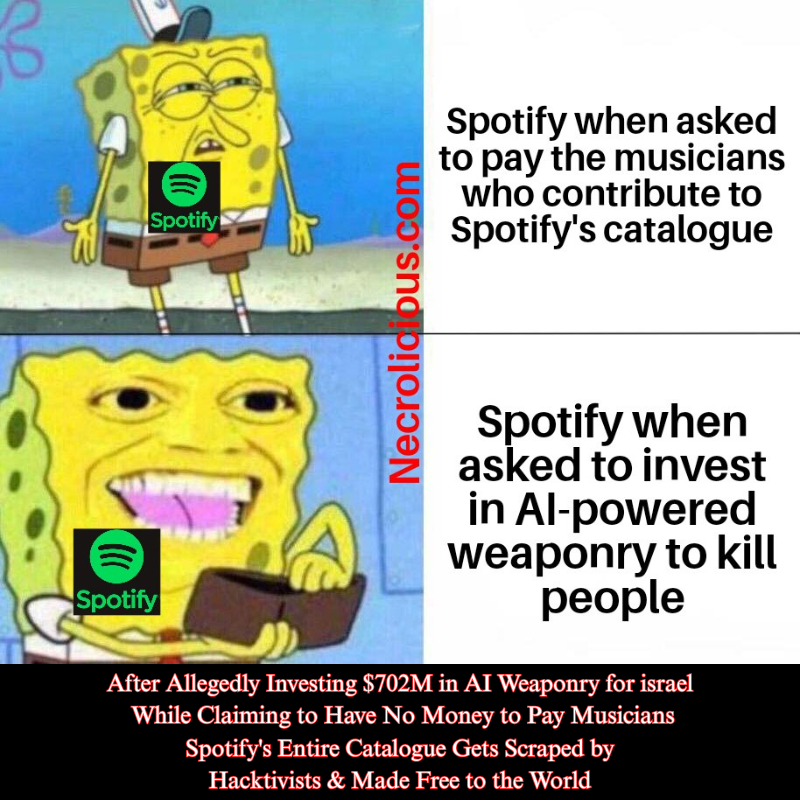
After Allegedly Investing $702M in AI Weaponry for israel While Claiming to Have No Money to Pay Musicians, Spotify’s Entire Catalogue Gets Scraped by Hacktivists & Made Free to the World

@necroliciouseng

After Allegedly Investing $702M in AI Weaponry for israel While Claiming to Have No Money to Pay Musicians, Spotify’s Entire Catalogue Gets Scraped by Hacktivists & Made Free to the World #Spotify #spotifyhack #spotifyleak #nomusicforgenocide #creatorsearchinsights

♬ оригинальный звук – MUSIC 90-2010s – JUST GOOD MUSIC

Spotify—the global music streaming giant—faces an unprecedented crisis. With a reported $1.33 billion profit in 2024, CEO Daniel Ek diverted $702 million to Helsing, a defence tech firm developing AI-powered weaponry. Allegations of ties to israeli military technology have fuelled a fierce Spotify boycott, amplified by the “No Music for Genocide” movement, which sees artists withdrawing their catalogues in protest. Meanwhile, artists fume over payments as low as fractions of a cent per stream. In a stunning twist, activist group Anna’s Archive scraped Spotify’s entire 300TB catalogue—86 million tracks—releasing it free for all. This bold move exposes the chasm between corporate greed & artist welfare.

Spotify’s Pitiful Payouts—Artists Left Penniless

Spotify’s payment model is a scandal, leaving most artists unpaid. The platform’s 1,000-stream minimum threshold excludes the majority, meaning countless musicians receive $0 for their contributions. For those who qualify, payouts average a meagre $0.0018 translating to $1,800–$3,000 for 1 million streams, far below a living wage for full-time professionals. Touring, a common survival tactic, is cost-prohibitive for most, with travel, equipment & promotion costs often exceeding earnings, particularly in high-cost markets. Spotify cites costs like taxes & fees as justification, but this rings hollow against its billion-dollar profits, sparking outrage among creators worldwide. As someone who has known & worked with a large number of musicians, I can say most are not rich. Those that can afford to have pulled their music, but many cannot. Even among those who can’t afford to, all who have chosen to leave their music on the platform in hopes of generating any sort of income are strongly against their songs being used to generate investments in killer machines rather than contributing to the music industry.

Nearly a Billion Dollars Diverted to Weaponry While Artists Starve

While Spotify claims financial constraints, its actions tell a different tale. Daniel Ek’s $702 million investment in Helsing, crafting lethal AI drones, dwarfs the pittances paid to artists and has drawn ire from the “No Music for Genocide” movement, which links it to alleged support for israeli weaponry. This massive investment in a single entity, made via his personal fund Prima Materia, contrasts sharply with the $11.7 billion paid to rights holders in 2024, of which its estimated 15,000,000 musicians see mere crumbs. The hypocrisy is glaring, as Ek’s war tech investment in a single entity matches 6% of that sum, prompting accusations of prioritising destruction over the livelihoods of those who fuel Spotify’s success. Saab’s supply chain links to israel, as a Helsing partner, further stokes speculation, intensifying the boycott.

The Activist’s Defiant Strike—Free Music for All

On December 20, 2025, Anna’s Archive, a pirate group famed for book digitisation, struck back. They scraped Spotify’s full catalogue, extracting 86 million audio files and 256 million metadata rows via public APIs, bypassing DRM. Released as a 300TB torrent, this “preservation archive” offers free access, challenging Spotify’s profits & future weapons investments. Prioritising 99.6% of popular streams, the scrape includes detailed artist data & audio features, now circulating on P2P networks. This empowers fans but threatens Spotify’s legal & financial stability, with supporters hailing it as a stand against greed & critics warning of piracy’s legal fallout. Timed with the boycott’s peak, this act amplifies the call for fairness.

The Fallout—Will Spotify Reform or Collapse?

Spotify confirms the scrape and investigates, hinting at tighter security measures. The boycott, backed by the “No Music for Genocide” movement & artists like Massive Attack, risks eroding its 600 million-plus user base. For fans, the 300TB torrent offers free music, though downloading invites legal risks. Musicians, especially in Japan, push for higher royalties, while competitors like Tidal gain traction. Searches for “Spotify boycott 2025,” “free music torrent,” and “Spotify artist pay” spike, boosting this topic’s relevance. The industry holds its breath, wondering if Spotify will raise payouts or lose ground in the face of this dual challenge.

Spotify’s saga, marred by a boycott over alleged israeli weaponry funding and a massive scrape, marks a turning point. The “No Music for Genocide” movement highlights the betrayal as billions fund war tech, while its 15,000,000 musician, particularly in Japan, languish on fractions of cents if they receive anything at all. Anna’s Archive’s free catalogue offers a defiant alternative, forcing a reckoning. The future of music streaming hangs in the balance.

What’s your stance? Should Spotify prioritise artists over weaponry or is the activist scrape justified? Share below & subscribe for more news!

Unless otherwise noted, image assets above are NOT original content & are shared under fair use doctrine with NO claims to authorship or ownership.
Contact necrolicious@necrolicious.com for credit or removal.

This post was sponsored by…ME! If you’d like to support, please buy my original meme merchandise or check out my affiliate links to get yourself some other cool things. Additional affiliate links may be contained in the above article. If you click on an affiliate link & sign up/make a purchase, I may earn a commission. This does not increase the price you pay for the product or service, so it helps support this website at no cost to you.

If you would like to support my work more directly, I accept voluntary cryptocurrency donations in BTC, ETH, XRP & XLM sent directly to necrolicious.x. necrolicious.x is an Unstoppable Domains name that resolves to the wallet addresses I have configured. Simply enter necrolicious.x as the recipient in a supported wallet (such as Trust Wallet, Blockchain.com or others that support Unstoppable Domains). Donation Disclaimer: All cryptocurrency donations sent to me are final, voluntary gifts & are non-refundable & irreversible. These donations are not tax-deductible since I am not a registered charitable organization, & no tax receipts will be issued. No memo or destination tag is required for XRP or XLM donations, as the domain resolves directly to a wallet address. By sending a donation you acknowledge & accept all associated risks, including cryptocurrency price volatility, network fees & potential loss of funds due to incorrect network selection or transaction errors. I am not responsible or liable for any loss related to your donation. No goods, services or other benefits are provided in exchange for donations. This is not financial, tax, legal or investment advice. Please consult a qualified professional regarding any implications of your donation.

Buy on SUZURI
Share this:

Are MicroSD Card Slots Poised for a Smartphone Comeback Amid Rising Storage Costs?

It’s nearly 2026, but my 2019 Samsung Galaxy S10 remains in daily use. Why? It was part of the final mainline Galaxy S lineup to ever include a microSD card slot. For me & countless other Android enthusiasts, this single feature represented genuine freedom: expandable storage that could be upgraded or replaced for pennies compared to the ever-escalating cost of built-in memory. When Samsung dropped the slot with the Galaxy S20 in 2020 & every flagship since, many of us felt the industry was simply copying Apple’s long-standing refusal to offer expandable storage on any iPhone. We warned that removing this incalculably beneficial feature would be bad for business – & now, in late 2025, it appears that prediction is proving more correct than ever. Soaring DRAM prices are pushing manufacturers to the limit, & the latest supply-chain intelligence strongly suggests that microSD card slots are being seriously reconsidered for future flagship devices. The feature we refused to surrender may be on the verge of a full-scale return.

In an era where smartphone storage demands continue to escalate, the prospect of expandable memory options returning to flagship devices has sparked considerable interest among consumers & industry observers alike. Recent reports suggest that surging prices for DRAM – the core component in device memory – may compel leading manufacturers to reinstate the microSD card slot, a feature absent from premium handsets for over six years. This potential revival could alleviate the financial burden on buyers facing ever-higher costs for internal storage upgrades, offering a more flexible & cost-effective alternative.

The Surge in DRAM Prices: A Catalyst for Change

Dynamic Random Access Memory (DRAM) forms the backbone of smartphone storage, enabling the seamless multitasking & high-resolution media handling that modern users expect. However, global supply constraints have driven DRAM prices to unprecedented levels, with shortages projected to endure until at least the fourth quarter of 2027. Analysts note that prices for 12GB LPDDR5X components – essential for contemporary flagships – have more than doubled, climbing from $33 at the year’s outset to $70 per unit.

This escalation stems from broader semiconductor challenges, including production bottlenecks & heightened demand from data centres & AI applications. Even established players like Samsung have prioritised profitability over internal supply chains, reportedly declining bulk memory requests from their own mobile division in favour of quarterly contracts. As a result, manufacturers face mounting pressure to maintain competitive pricing without eroding margins, prompting a reevaluation of longstanding design choices.

Buy on Rakuten Japan

Why a MicroSD Comeback Makes Strategic Sense Now

With DRAM costs showing no signs of abating through 2026, reinstating microSD slots emerges as a pragmatic response for manufacturers. By enabling consumers to purchase entry-level storage models & augment them with high-capacity cards, brands can mitigate the need for across-the-board price hikes. This strategy not only preserves shipment volumes but also appeals to value-driven buyers, fostering loyalty in a saturated market.

Emerging standards like microSD Express further bolster the case, promising read & write speeds exceeding 800 MB/s – on par with internal SSDs. Samsung’s own 512 GB P9 Express card, available for around $75, exemplifies this evolution, delivering rapid transfers without the performance bottlenecks of older formats. Chinese supply chain whispers indicate that new flagships slated for the latter half of 2026 could integrate these slots.

Such a revival would democratise access to ample storage, empowering photographers, videographers, & power users to sidestep the escalating cost of built-in memory.

Looking Ahead: A More Inclusive Storage Landscape

Your trusty Galaxy S10 might soon stop being the last of its kind. As smartphone innovation accelerates, the rumoured return of microSD slots signals a potential recalibration towards consumer-centric design. The flexibility many of us miss may soon enhance the devices of tomorrow.

Unless otherwise noted, image assets above are NOT original content & are shared under fair use doctrine with NO claims to authorship or ownership.
Contact necrolicious@necrolicious.com for credit or removal.

This post was sponsored by…ME! If you’d like to support, please buy my original meme merchandise or check out my affiliate links to get yourself some other cool things. Additional affiliate links may be contained in the above article. If you click on an affiliate link & sign up/make a purchase, I may earn a commission. This does not increase the price you pay for the product or service, so it helps support this website at no cost to you.

If you would like to support my work more directly, I accept voluntary cryptocurrency donations in BTC, ETH, XRP & XLM sent directly to necrolicious.x. necrolicious.x is an Unstoppable Domains name that resolves to the wallet addresses I have configured. Simply enter necrolicious.x as the recipient in a supported wallet (such as Trust Wallet, Blockchain.com or others that support Unstoppable Domains). Donation Disclaimer: All cryptocurrency donations sent to me are final, voluntary gifts & are non-refundable & irreversible. These donations are not tax-deductible since I am not a registered charitable organization, & no tax receipts will be issued. No memo or destination tag is required for XRP or XLM donations, as the domain resolves directly to a wallet address. By sending a donation you acknowledge & accept all associated risks, including cryptocurrency price volatility, network fees & potential loss of funds due to incorrect network selection or transaction errors. I am not responsible or liable for any loss related to your donation. No goods, services or other benefits are provided in exchange for donations. This is not financial, tax, legal or investment advice. Please consult a qualified professional regarding any implications of your donation.

Buy on Suzuri
Share this:

American SEC Ends Its Lawsuit Against Ripple, XRP Price Shows Little Reaction

The American Security Exchange Commission finally ended its lawsuit on 8/8 by dropping any further attempts at appealing the case.

One might rightfully expect major upward price action for XRP following such a landmark occasion. However, as of this writing, the price is only up 9%, at $3.33 USD. While a 9%-10% asset appreciation would be welcome in nearly any sector of finance, this is a far cry from the $100 per XRP the proponents have long said would be the immediate result of the lawsuit ending, let alone the $589 per XRP that maximalists have sworn would happen.

Meanwhile, Stellar XLM prices are up 25% more than XRP, appreciating 12%, for no particular reason as it was not directly subject to the SEC lawsuit.

Will we ever see $100, $589 or $1000 XRP prices?

I’m not a financial advisor & this is not financial advice, I’m just invested in XRP.

If you want to start investing in cryptocurrency & want a FREE half-ounce of silver, sign up for Kinesis using my link!

Share this:

Nintendo Switch Price Hikes in America: A Gaming Sector Symptom with Wider Tech Implications

In a groundbreaking move, Nintendo has raised prices for its original Switch consoles in the United States, defying the industry norm of reducing last-generation console prices until they’re phased out. This unprecedented shift, currently limited to America, signals broader economic pressures that could soon impact Japan & the entire tech sector, from computers to smartphones. With potential price hikes looming for both older & next-generation tech, buyers in Japan should act swiftly to secure their purchases.

Nintendo Switch Price Hikes: Old vs. New Prices in the US

Product                 Old Price (USD)  New Price (USD)  Price Increase (USD)
Original Nintendo Switch  $299.99          $339.99          $40.00
Nintendo Switch OLED      $349.99          $399.99          $50.00
Nintendo Switch Lite      $199.99          $229.99          $30.00
Alarmo                    $99.99           $109.99          $10.00
Switch 1 Joy-Cons (Pair)  $79.99           $89.99           $10.00

Notes:
- Prices for the Nintendo Switch 2 console and all Switch games (physical and digital) remain unchanged.
- The price hikes reflect “market conditions” and new tariffs, including a 20% levy on goods from Vietnam.
- While Japan is currently unaffected, global economic trends suggest potential future increases for both legacy and next-generation tech.

A Historic Price Increase in Gaming

The original Nintendo Switch, priced at $299.99 since 2017, now retails for $339.99 on Nintendo’s US online store. The Switch OLED has climbed from $349.99 to $399.99, & the Switch Lite has risen from $199.99 to $229.99. Accessories like the Alarmo ($109.99, up $10) & first-generation Switch Joy-Cons ($89.99, up $10) are also affected. However, the Switch 2 console & all Switch games—physical or digital—remain unchanged. This marks an industry first. Typically older console prices get marked down as new models launch, so Nintendo’s decision to increase them instead is a bold departure. With the Switch OLED now just $50 less than the $449.99 Switch 2 (which lacks an OLED display), the newer console may draw more buyers. The Switch 2 has sold over 6 million units despite supply challenges.

A Symptom of Broader Tech Trends

Nintendo attributes the hikes to “market conditions,” announced after similar increases in Canada on 1 August 2025. This follows President Donald Trump’s new “reciprocal” tariffs, including a 20% levy on goods from Vietnam, where Nintendo manufactures most products. These economic pressures aren’t unique to gaming—computers, smartphones, & other tech could soon see price increases, whether for last-generation models or cutting-edge releases.

Japan & the Global Outlook

While Japan is currently unaffected, global supply chain issues & tariffs could drive up costs for Japanese consumers, impacting not just legacy devices like the Switch but also upcoming tech like next-gen consoles, laptops, & phones. Waiting may mean paying more.

Buy Now to Stay Ahead

This gaming sector price hike is a warning sign for the broader tech industry. Whether you’re after a Switch Lite, an OLED model, or accessories, purchasing now could save you from future increases.

Unless otherwise noted, image assets above are NOT original content & are shared under fair use doctrine with NO claims to authorship or ownership.
Contact necrolicious@necrolicious.com for credit or removal.

This post was sponsored by…ME! If you’d like to support, please buy my original meme merchandise or check out my affiliate links to get yourself some other cool things. Additional affiliate links may be contained in the above article. If you click on an affiliate link & sign up/make a purchase, I may earn a commission. This does not increase the price you pay for the product or service, so it helps support this website at no cost to you.

If you would like to support my work more directly, I accept voluntary cryptocurrency donations in BTC, ETH, XRP & XLM sent directly to necrolicious.x. necrolicious.x is an Unstoppable Domains name that resolves to the wallet addresses I have configured. Simply enter necrolicious.x as the recipient in a supported wallet (such as Trust Wallet, Blockchain.com or others that support Unstoppable Domains). Donation Disclaimer: All cryptocurrency donations sent to me are final, voluntary gifts & are non-refundable & irreversible. These donations are not tax-deductible since I am not a registered charitable organization, & no tax receipts will be issued. No memo or destination tag is required for XRP or XLM donations, as the domain resolves directly to a wallet address. By sending a donation you acknowledge & accept all associated risks, including cryptocurrency price volatility, network fees & potential loss of funds due to incorrect network selection or transaction errors. I am not responsible or liable for any loss related to your donation. No goods, services or other benefits are provided in exchange for donations. This is not financial, tax, legal or investment advice. Please consult a qualified professional regarding any implications of your donation.

Share this:

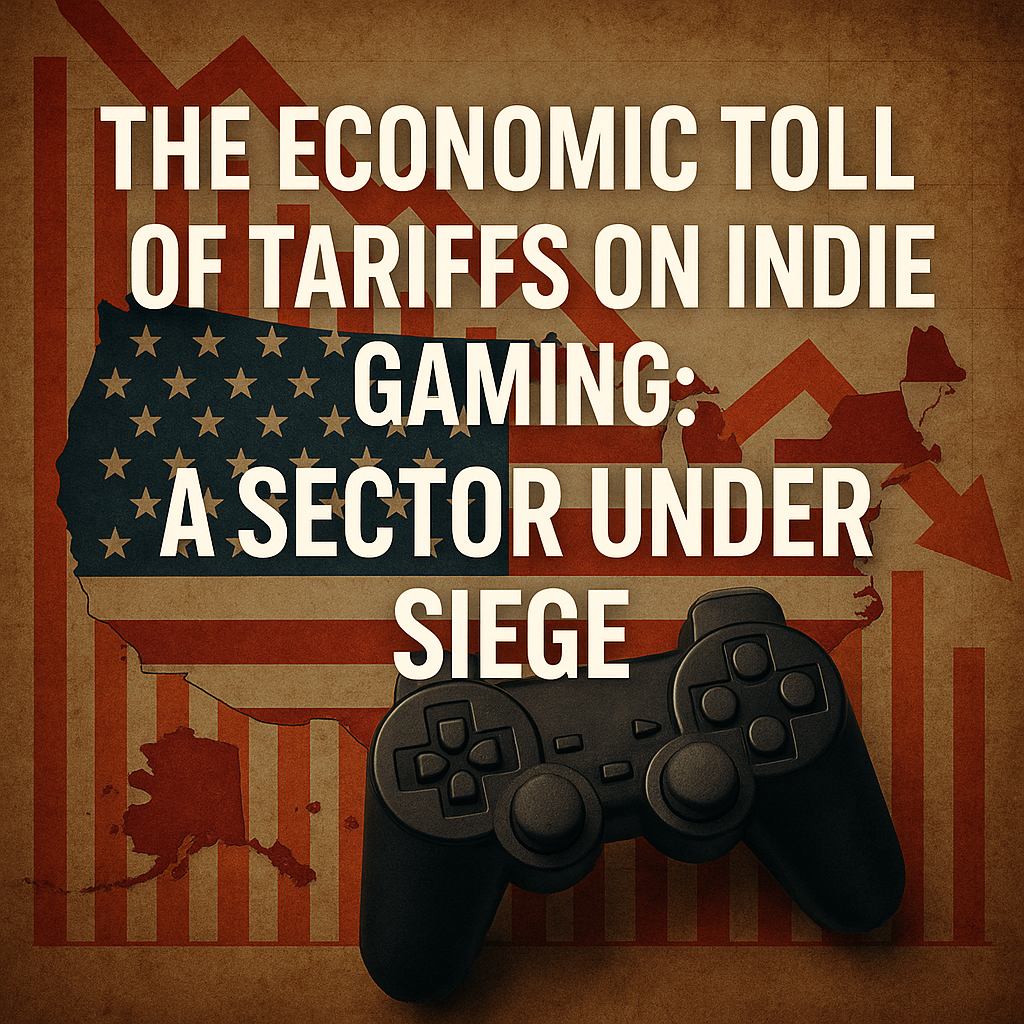
The Economic Toll of Tariffs on Indie Gaming: A Sector Under Siege

As trade wars escalate, tariffs on imported goods have sent shockwaves through global markets, with the gaming industry emerging as an unforeseen casualty. Independent game developers—the lifeblood of innovation within this sector—are grappling with unprecedented challenges. Operating on limited budgets & reliant on international supply chains, these creators face mounting pressures that threaten their sustainability. This article examines the far-reaching impact of tariffs on indie gaming, analysing rising production costs, shifting price dynamics, adaptive strategies, & the broader implications for the industry’s future.

Escalating Costs: A Barrier to Creativity

For indie developers, affordable hardware is essential. Graphics processing units (GPUs), development kits, & other critical components, often sourced from tariff-targeted nations like China, have seen price surges—sometimes exceeding 30%. Such increases strain the finances of small studios, which lack the reserves of larger firms. The consequences are severe: projects may be deferred, features scaled back, or, in extreme cases, abandoned entirely. As one industry observer noted, “These costs are inevitably passed on to consumers, & this is going to make your games more expensive,” highlighting the direct link between tariffs & the economic pressures facing developers.

Price Sensitivity & Consumer Response

Rising production costs inevitably affect game pricing, a sensitive issue for indie titles traditionally positioned as budget-friendly alternatives to AAA offerings. As developers pass on these expenses, consumers—already navigating tariff-driven inflation in other sectors—may resist higher prices, potentially reducing sales volumes. Compounding this, the uncertainty of ongoing trade disputes fosters market instability, prompting gamers to delay purchases. This hesitancy risks further eroding the revenue streams that indie studios depend upon, amplifying the tariffs’ disruptive impact.

Strategic Adaptations: Resilience in Adversity

In response, indie developers are deploying innovative strategies to mitigate these pressures. A shift towards digital-only releases leverages platforms like Steam & itch.io, circumventing the tariff-related costs of physical production & distribution. However, even this approach cannot fully insulate developers from rising hardware expenses. Some are exploring alternative suppliers or localised manufacturing, though such transitions demand time & resources that many lack. Larger players, such as Nintendo, have adjusted by delaying product launches—such as the anticipated Switch 2 preorders in the US—to assess tariff implications, a tactic smaller studios may struggle to emulate.

Long-Term Horizons: Transformation or Decline?

Should tariffs persist, the indie gaming landscape could undergo profound changes. A reduction in new releases seems likely as funding dwindles, though a pivot towards less resource-intensive games—such as narrative-driven or retro-style titles—might emerge as a cost-effective alternative. This shift could spark a wave of creative innovation, redefining the sector’s output. Concurrently, regions less encumbered by trade disputes may witness a rise in local gaming industries, diversifying the global market. However, these potential benefits hinge on developers’ ability to weather immediate financial challenges.

Preserving a Vital Ecosystem

The indie gaming sector stands at a critical juncture, its vibrancy imperilled by tariffs yet buoyed by its inherent adaptability. Community support remains a lifeline—crowdfunding & early access models offer avenues to offset costs, while player advocacy can sustain demand. The cultural stakes are high: a diminished indie scene risks stifling the creativity & diversity that define it. By prioritising indie titles, the gaming community can bolster this resilient ecosystem, ensuring that tariffs do not extinguish the innovative spirit that colours the industry’s future.

Unless otherwise noted, image assets above are NOT original content & are shared under fair use doctrine with NO claims to authorship or ownership.
Contact necrolicious@necrolicious.com for credit or removal.

This post was sponsored by…ME! If you’d like to support, please buy my original meme merchandise or check out my affiliate links to get yourself some other cool things. Additional affiliate links may be contained in the above article. If you click on an affiliate link & sign up/make a purchase, I may earn a commission. This does not increase the price you pay for the product or service, so it helps support this website at no cost to you.

If you would like to support my work more directly, I accept voluntary cryptocurrency donations in BTC, ETH, XRP & XLM sent directly to necrolicious.x. necrolicious.x is an Unstoppable Domains name that resolves to the wallet addresses I have configured. Simply enter necrolicious.x as the recipient in a supported wallet (such as Trust Wallet, Blockchain.com or others that support Unstoppable Domains). Donation Disclaimer: All cryptocurrency donations sent to me are final, voluntary gifts & are non-refundable & irreversible. These donations are not tax-deductible since I am not a registered charitable organization, & no tax receipts will be issued. No memo or destination tag is required for XRP or XLM donations, as the domain resolves directly to a wallet address. By sending a donation you acknowledge & accept all associated risks, including cryptocurrency price volatility, network fees & potential loss of funds due to incorrect network selection or transaction errors. I am not responsible or liable for any loss related to your donation. No goods, services or other benefits are provided in exchange for donations. This is not financial, tax, legal or investment advice. Please consult a qualified professional regarding any implications of your donation.

Share this:

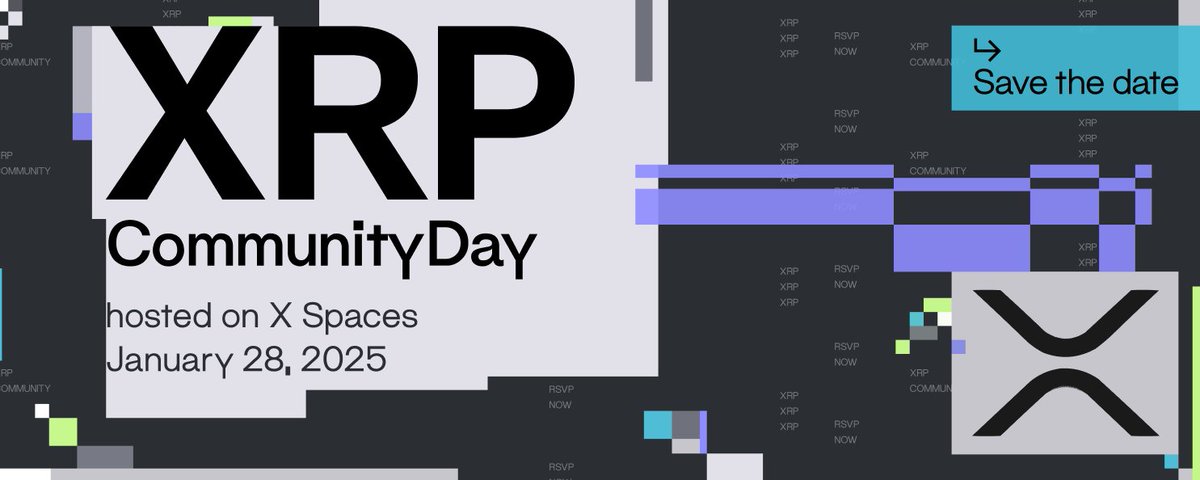
XRP Community Day 2025 Announced on X

“On January 28, 2025, XRP holders, builders, community leaders, and Ripple executives will come together for XRP Community Day—a global, virtual event celebrating the continued innovation, utility and growth across the digital asset XRP and the broader XRP Ledger (XRPL) ecosystem.”

Thus posted Ripple in a X article on January 21, 2025, further noting,

“The event will be accessible to a global audience, with sessions spread across EMEA, Americas, and APAC time zones. These sessions will cover key topics such as cross-chain innovation, institutional DeFi adoption, XRPL ecosystem growth and roadmap, Ripple’s priorities for blockchain innovation in 2025, and the future of crypto regulations. Innovation Spotlights will allow projects in the ecosystem to showcase what they’re building across various categories, including DeFi, tokenization, gaming, and more. Ripple leaders—including Brad Garlinghouse, Monica Long, David Schwartz, and Markus Infanger—will join XRP community members to reflect on key milestones, share news updates, and inspire the next wave of onchain innovation.”

For full details, including a breakdown of who will be discussing what at which time, please refer to the original post linked above.

Myself & other investors in XRP as well as the cryptocurrency space in general are hoping for the positive price action that we were disappointed to not see realised during Donald Trump’s inauguration as he failed to make any mention of crypto at all.

Unless otherwise noted, image assets above are NOT original content & are shared under fair use doctrine with NO claims to authorship or ownership.
Contact necrolicious@necrolicious.com for credit or removal.

This post was sponsored by…ME! If you’d like to support, please buy my original meme merchandise or check out my affiliate links to get yourself some other cool things. Additional affiliate links may be contained in the above article. If you click on an affiliate link & sign up/make a purchase, I may earn a commission. This does not increase the price you pay for the product or service, so it helps support this website at no cost to you.

If you would like to support my work more directly, I accept voluntary cryptocurrency donations in BTC, ETH, XRP & XLM sent directly to necrolicious.x. necrolicious.x is an Unstoppable Domains name that resolves to the wallet addresses I have configured. Simply enter necrolicious.x as the recipient in a supported wallet (such as Trust Wallet, Blockchain.com or others that support Unstoppable Domains). Donation Disclaimer: All cryptocurrency donations sent to me are final, voluntary gifts & are non-refundable & irreversible. These donations are not tax-deductible since I am not a registered charitable organization, & no tax receipts will be issued. No memo or destination tag is required for XRP or XLM donations, as the domain resolves directly to a wallet address. By sending a donation you acknowledge & accept all associated risks, including cryptocurrency price volatility, network fees & potential loss of funds due to incorrect network selection or transaction errors. I am not responsible or liable for any loss related to your donation. No goods, services or other benefits are provided in exchange for donations. This is not financial, tax, legal or investment advice. Please consult a qualified professional regarding any implications of your donation.

Share this: