The video game industry is currently undergoing a severe structural economic shift that marks the gradual death of the traditional console loss leader strategy, a dynamic I have tracked extensively through my coverage of the hardware market. For decades, the industry standard relied heavily on a predictable model where companies including Sony, Microsoft & Nintendo would intentionally sell their physical consoles at a significant financial loss to build a massive installed base, later recouping those initial capital expenditures through the sale of high-margin software, subscription services & proprietary accessories. Historically, I saw platforms like the PlayStation 2 launch at $299 before falling to $149 within a five-year window, while the PlayStation 4 dropped from $399 to $299 in a similar timeframe, reflecting efficient supply chain scaling, healthy market competition & stable component costs. However, the contemporary landscape paints a starkly different picture as modern semiconductor fabrication realities force corporations to rethink how they price entry-level hardware. The most telling difference today lies in how these industry titans are responding to the demise of this era, with Sony’s recent pricing strategies demonstrating a definitive pivot away from consumer accessibility. As I explored in my detailed coverage of the PS5 Price Hike 2026: Sony Confirms Global Increases Effective April 2 for US, UK, Europe & Japan, the staggering $899.99 price tag for the PlayStation 5 Pro, coupled with aggressive trade-in lowballing initiatives, indicates a corporate willingness to pass supply chain burdens directly onto the consumer. This approach shatters the generational expectation that gaming hardware will become cheaper over its lifecycle, establishing a new baseline for high-performance computing components that forces enthusiasts to re-evaluate their total cost of ownership in a market increasingly hostile to the average player.
The DRAM Shortage & the Initial Switch 2 Price Revision
Nintendo is certainly not entirely immune to these macroeconomic pressures, yet their approach to market volatility reveals a starkly different corporate philosophy regarding consumer respect. As I detailed extensively earlier this year in my analysis of the Nintendo Switch 2 Price Increase: How ChatGPT & the DRAM Shortage Are Driving Worldwide Electronics Costs Higher, the United States base model of the hybrid console rose from $449.99 to $499.99 in September as a direct result of severe supply chain constraints. This initial price revision was driven almost entirely by the ChatGPT-fuelled global DRAM shortage, an economic anomaly where OpenAI’s aggressive data-centre expansion consumed an unprecedented share of global memory production to prioritise high-bandwidth memory modules essential for large language models over the standard LPDDR & DDR variants used in consumer devices. When the initial price hike hit Japan first, pushing the domestic model to ¥59,980, it sent a shockwave through a culture where the average salaryman commuter allocates discretionary income across train fares, convenience-store bento & monthly gacha games, signalling a structural shift in an otaku economy uniquely sensitive to value. Consequently, Nintendo faced significantly higher fabrication bills for the RAM that powers the Switch 2’s enhanced chipset, forcing a single calculated adjustment to absorb the supply chain shock without completely abandoning their core demographic.
Navigating Component Constraints in 2026
The AI-driven demand spike has effectively become a broad tax on all consumer electronics, a dynamic I accurately predicted in my piece detailing how a Chat GPT-Caused DRAM Shortage Could Delay Next-Generation Game Console Releases & Raise Prices of Current Consoles. While competitors continue to struggle with these constraints by enacting consecutive consumer price penalties, Nintendo chose to lock in their component pipelines early to insulate its community from the severe volatility of the spot memory market. This approach reflects the advice I urged consumers to follow in my guide on Why Buying 2025 Devices Now is Smarter Than Waiting: Avoid Higher Prices for Lower Specs in 2026 regarding the necessity of securing stable hardware configurations. By actively securing these memory quantities in advance, the Japanese gaming giant effectively shielded itself from the ongoing fabrication turbulence that continues to plague its rivals, proving that proactive corporate strategy can still yield hardware accessibility even during periods of intense semiconductor scarcity.
Sustained Momentum for the Switch 2
This forward-looking supply chain management is now paying dividends for both the corporation & its player base, cementing Nintendo’s position as a consumer-conscious market leader. According to Nintendo president Shuntaro Furukawa during a recent financial results briefing, the company is not currently considering another price increase for the Nintendo Switch 2, citing a stable memory supply chain that positions the company to weather ongoing fabrication shortages without demanding additional capital from its audience. By actively resisting the trend of multiple consecutive price hikes that define Sony’s current hardware strategy, Nintendo is demonstrating a sustained respect for the consumer’s wallet that translates directly into remarkable sales momentum on a global scale. Despite a recent quarterly dip in overall profits, the Switch 2 continues to outpace the original Switch in launch-aligned hardware sales, proving that when a corporation values hardware accessibility & refuses to perpetually penalise its audience for macroeconomic manufacturing hurdles, the community will respond with unwavering financial support. For enthusiasts navigating this complex landscape, the practical takeaways are clear: buyers must monitor supply chain realities, evaluate the long-term total cost of ownership rather than just the initial entry price & prioritise stable ecosystems managed by companies that do not implement surprise mid-generation price hikes. While the traditional loss leader model may be fading into history, Nintendo’s strategic navigation of the modern semiconductor market proves that industry titans do not need to resort to hostile pricing structures to maintain profitability & cultural relevance.
FAQ
Will the Nintendo Switch 2 receive another price increase in 2026?
According to Nintendo president Shuntaro Furukawa, the company is not currently considering any further price increases for the Switch 2, citing a stable memory supply chain.
How does the Switch 2 pricing strategy differ from the PS5?
While Sony has implemented multiple global price hikes & introduced the PS5 Pro at an $899.99 premium due to supply chain pressures, Nintendo has opted for a single transparent price adjustment while refusing to pass further manufacturing burdens onto players.
What caused the initial price hike for the Switch 2 earlier this year?
The initial price adjustment was primarily driven by the global DRAM shortage, an economic issue heavily exacerbated by the aggressive expansion of AI data centres requiring vast amounts of high-bandwidth memory.
Is the console loss leader model completely dead?
While not entirely extinct, the traditional model of selling hardware at a massive loss to build an installed base is becoming increasingly unsustainable due to permanently elevated semiconductor fabrication costs.
Unless otherwise noted, image assets above are NOT original content & are shared under fair use doctrine with NO claims to authorship or ownership. Contact necrolicious@necrolicious.com for credit or removal.
This post was sponsored by…ME! If you’d like to support, please buy my original meme merchandise or check out my affiliate links to get yourself some other cool things. Additional affiliate links may be contained in the above article. If you click on an affiliate link & sign up/make a purchase, I may earn a commission. This does not increase the price you pay for the product or service, so it helps support this website at no cost to you.
If you would like to support my work more directly, I accept voluntary cryptocurrency donations in BTC, ETH, XRP & XLM sent directly to necrolicious.x. necrolicious.x is an Unstoppable Domains name that resolves to the wallet addresses I have configured. Simply enter necrolicious.x as the recipient in a supported wallet (such as Trust Wallet, Blockchain.com or others that support Unstoppable Domains). Donation Disclaimer: All cryptocurrency donations sent to me are final, voluntary gifts & are non-refundable & irreversible. These donations are not tax-deductible since I am not a registered charitable organization, & no tax receipts will be issued. No memo or destination tag is required for XRP or XLM donations, as the domain resolves directly to a wallet address. By sending a donation you acknowledge & accept all associated risks, including cryptocurrency price volatility, network fees & potential loss of funds due to incorrect network selection or transaction errors. I am not responsible or liable for any loss related to your donation. No goods, services or other benefits are provided in exchange for donations. This is not financial, tax, legal or investment advice. Please consult a qualified professional regarding any implications of your donation.
On 3 November 2026, Culture Day, Japan’s Emperor presented the Order of Culture at the Imperial Palace in Tokyo. Seven of the eight recipients attended the formal ceremony in the Matsu-no-Ma hall. Shigeru Miyamoto, Nintendo’s executive fellow & the first person from the video game industry to receive the honour, was absent. No official explanation has been issued by Miyamoto, Nintendo or the Imperial Household Agency. The award itself stands: Miyamoto remains one of the 2026 recipients, recognised for decades of work that helped establish interactive entertainment as a cultural form in Japan & beyond.
The Order of Culture, established in 1937, is Japan’s highest cultural distinction. It is conferred on individuals who have made remarkable contributions to the advancement of Japanese culture in fields such as art, literature, science & technology. Recipients are typically drawn from those previously named Persons of Cultural Merit. The presentation is a closed ceremony; members of the public do not attend. In 2026 the other recipients included Nobel chemistry laureate Kenso Soai, lighting designer Motoko Ishii, architect Toyo Ito, biologist Tsuneyoshi Kuroiwa, French literature scholar Tetsuya Shiokawa, composer Shunichi Tokura & immunologist Shigekazu Nagata. Miyamoto’s selection marked the first time the media arts category explicitly recognised gaming.
Nintendo’s Long Path from Hanafuda Cards to National Recognition
Nintendo was founded in 1889 in Kyoto by Fusajiro Yamauchi as a manufacturer of hanafuda playing cards. For much of the twentieth century the company produced traditional Japanese cards & later diversified into toys & arcade machines. The decisive shift into home video games came in the late 1970s, after Shigeru Miyamoto joined in 1977. Titles such as Donkey Kong, Super Mario Bros. & The Legend of Zelda established Nintendo as a global force & demonstrated that games could reach audiences across generations.
From the company’s founding to Miyamoto’s 2026 award is 137 years, not the roughly 200 years sometimes assumed. The gap is still substantial. During that period Japanese cultural institutions gradually expanded the categories considered worthy of the highest honours. Film director Akira Kurosawa received the Order of Culture in 1985. Manga artist Tetsuya Chiba became the first recipient from the manga field in 2024. No anime director has yet received the Order of Culture itself, although several, including Rintaro (Shigeyuki Hayashi), have been named Persons of Cultural Merit, a lower-tier recognition.
Miyamoto had already received the Person of Cultural Merit award in 2019, the first for anyone in the games industry. The 2026 elevation to the Order of Culture therefore represents a further step. In comments after the October announcement he emphasised collaboration: the work was not the achievement of one person but the result of many people over decades. He accepted the honour on their behalf. That stance is consistent with Nintendo’s long-standing public posture of shared creation rather than individual authorship.
What the Absence Does & Does Not Change
The decision not to attend the 3 November ceremony does not revoke or diminish the award. Official announcements from the Ministry of Education, Culture, Sports, Science & Technology list Miyamoto among the eight recipients. Contemporary reporting from Jiji Press, The Japan Times & Nippon.com notes the absence without attributing a cause. Possible explanations—scheduling, health or preference for a lower-profile reception—remain speculative. In the absence of a statement, the only verifiable fact is that he did not receive the medal in person from the Emperor on Culture Day.
This practical detail is useful for anyone tracking the event. The ceremony is not open to the public. Coverage comes from pooled press photographs of the seven attendees & from subsequent remarks by those present. Miyamoto’s earlier press conference in Kyoto on 22 October remains the primary public statement associated with the honour.
Broader Context & Practical Observations
The recognition arrives at a moment when games are consumed across three generations in many Japanese households. Miyamoto has noted this shift himself. Parents & grandparents who grew up with Nintendo systems now play with children, a demographic reality that strengthens the argument for treating interactive media as culture rather than mere entertainment. At the same time, the industry continues to face questions about labour practices, intellectual-property control & the balance between commercial success & artistic risk. An imperial honour does not resolve those issues; it simply registers that the medium has crossed a formal cultural threshold in Japan.
For readers interested in the longer arc, Nintendo’s evolution from 1889 card maker to global games publisher is documented in company histories & in Miyamoto’s own interviews. The 2019 Person of Cultural Merit award & the 2026 Order of Culture form two clear markers on that timeline. Comparable milestones in adjacent media include Chiba’s 2024 manga recognition & earlier film honours. Tracking these awards offers a concrete way to observe how Japanese institutions gradually incorporate newer forms.
The absence of an official reason for non-attendance is itself noteworthy. Japanese public figures & organisations often issue brief statements in such cases. The lack of one leaves the record incomplete on a minor but visible point. It does not, however, alter the fact of the award or the historical sequence that led to it.
Key Timeline Points
1889: Nintendo founded as a hanafuda card manufacturer
1977: Shigeru Miyamoto joins the company
1985: Akira Kurosawa receives the Order of Culture
2019: Miyamoto named Person of Cultural Merit (first from games)
2024: Tetsuya Chiba receives the Order of Culture (first from manga)
3 November 2026: Order of Culture ceremony; Miyamoto absent, award still conferred
FAQ
Is the Order of Culture ceremony open to the public? No. It is a formal presentation by the Emperor at the Imperial Palace & is not open to the general public.
Did Miyamoto still receive the award? Yes. He is listed among the official 2026 recipients. Only the in-person presentation on 3 November was missed.
Has any reason been given for his absence? No official reason has been reported by Miyamoto, Nintendo or government sources.
How long has Nintendo existed? The company was founded in 1889, 137 years before the 2026 award.
Have other interactive or popular media figures received the same honour? Tetsuya Chiba (manga, 2024) is the clearest recent parallel. No anime director has received the Order of Culture itself.
This account draws on contemporaneous reporting from Jiji Press, The Japan Times & Nippon.com, together with the October government announcement of the 2026 recipients. It aims to separate verified facts from the speculation that inevitably surrounds a high-profile absence.
Unless otherwise noted, image assets above are NOT original content & are shared under fair use doctrine with NO claims to authorship or ownership. Contact necrolicious@necrolicious.com for credit or removal.
This post was sponsored by…ME! If you’d like to support, please buy my original meme merchandise or check out my affiliate links to get yourself some other cool things. Additional affiliate links may be contained in the above article. If you click on an affiliate link & sign up/make a purchase, I may earn a commission. This does not increase the price you pay for the product or service, so it helps support this website at no cost to you.
If you would like to support my work more directly, I accept voluntary cryptocurrency donations in BTC, ETH, XRP & XLM sent directly to necrolicious.x. necrolicious.x is an Unstoppable Domains name that resolves to the wallet addresses I have configured. Simply enter necrolicious.x as the recipient in a supported wallet (such as Trust Wallet, Blockchain.com or others that support Unstoppable Domains). Donation Disclaimer: All cryptocurrency donations sent to me are final, voluntary gifts & are non-refundable & irreversible. These donations are not tax-deductible since I am not a registered charitable organization, & no tax receipts will be issued. No memo or destination tag is required for XRP or XLM donations, as the domain resolves directly to a wallet address. By sending a donation you acknowledge & accept all associated risks, including cryptocurrency price volatility, network fees & potential loss of funds due to incorrect network selection or transaction errors. I am not responsible or liable for any loss related to your donation. No goods, services or other benefits are provided in exchange for donations. This is not financial, tax, legal or investment advice. Please consult a qualified professional regarding any implications of your donation.
The modern gaming landscape is undergoing an aggressive structural shift. Sony Interactive Entertainment, once the undisputed champion of consumer-friendly console hardware, is increasingly signalling a pivot towards aggressive monetisation at the expense of player autonomy. The latest symptom of this transition is a newly published patent detailing a PlayStation controller equipped with NFC technology designed specifically to read credit cards & process instant payments. While corporate patents often serve merely as speculative intellectual property hoarding, this specific filing arrives amid a cascade of anti-consumer decisions from the manufacturer. From the quiet confirmation that physical disc production will cease by 2028 to the eye-watering $900 price tag attached to the PS5 Pro, the brand is systematically dismantling the goodwill it spent decades cultivating.
Players are beginning to notice. As the industry grapples with the fallout of the $457 million class-action lawsuit concerning digital pricing monopolies, the historical loyalty that kept fans tethered to the PlayStation ecosystem is fracturing. In this analysis, we will examine the mechanics of Sony’s new controller patent, dissect the company’s controversial legal stance on digital ownership, explore the broader implications of its recent hardware pricing strategies & explain why so many disillusioned gamers are now migrating to the Nintendo Switch 2.
The “Video Game Controller-Driven Information Transfer” Patent
On 17 September 2026, the United States Patent & Trademark Office published a Sony application originally filed in March 2025. Titled “Video Game Controller-Driven Information Transfer,” the document outlines a system wherein a standard gaming controller acts as a direct bridge between a payment method & the console itself. Using NFC or Bluetooth communication protocols, the device would allow players to hold a smartphone, credit card or gift card near their controller to instantly authorise purchases for digital games, cosmetic add-ons or premium battle passes.
At first glance, this technology masquerades as mere convenience. Typing sixteen digits, an expiration date & a CVV code using a clumsy directional pad is universally despised. However, that manual data entry serves a critical biological function for the consumer: it provides friction. That friction offers approximately 45 seconds of post-loss clarity. It grants a player the necessary pause to ask themselves whether they genuinely need a $20 glowing weapon skin at two o’clock in the morning.
By eliminating this barrier, Sony aims to capitalise on impulse. Whether a player has just been eliminated in a competitive match, exhausted their gacha pulls or hit an artificial progression paywall, the friction of typing is replaced by the thoughtless action of tapping a contactless Visa against a DualSense touchpad. This sits comfortably in the pantheon of unhinged corporate patents, right alongside Sony’s previous concepts for loading-screen advertisements & controllers that alter their temperature during gameplay. It represents a clear desire to transform the primary instrument of play into a literal point-of-sale terminal.
The 2028 Physical Disc Phase-Out & The Illusion of Ownership
The tap-to-pay controller concept does not exist in a vacuum. It is part of a broader, meticulously calculated push toward an all-digital future where Sony dictates the terms of engagement. Earlier this year, the company quietly confirmed that it would halt physical disc production for new PlayStation games by January 2028. This move effectively sounds the death knell for game preservation, the second-hand market, local lending between friends & offline archival. For decades, the ability to trade or resell a completed title helped mitigate the high cost of entry for lower-income players. Eradicating that option fundamentally alters the medium’s accessibility.
The transition to digital-only ecosystems might be palatable if the platform holders respected consumer rights, yet recent legal proceedings suggest the opposite. During court hearings in August 2026, Sony’s legal representatives explicitly argued that “no reasonable consumer” expects to actually own the digital games they purchase. They stated the quiet part out loud: a digital purchase is merely a revocable licence. When coupled with the recent incident where Sony arbitrarily deleted hundreds of purchased movies from user libraries without offering refunds, the all-digital future looks less like a modern convenience & more like a hostage situation.
This systemic restriction of ownership is central to the ongoing $457 million class-action lawsuit directed at Sony’s PlayStation Store practices. The suit alleges that by banning third-party retailers from selling digital download codes, the company established a monopoly that artificially inflates software prices. When players are trapped in an ecosystem with a single storefront, zero physical alternatives & a controller designed to bypass financial restraint, the corporate strategy becomes undeniably clear.
Hardware Inflation, Studio Closures & Strategic Blunders
Historically, the lifecycle of a gaming console followed a predictable trajectory: hardware became cheaper to manufacture over time, allowing the manufacturer to pass those savings onto the consumer via price cuts. Sony has completely inverted this historical script. In March 2026, the company hiked the price of the base PS5 to $650 & launched the iterative PS5 Pro at an eye-watering $900. These are staggering numbers for a console entering the twilight years of its generation. Historically, players could rely on mid-generation price drops to offset the initial investment, yet today they face aggressive premium pricing for marginal technical upgrades.
Blaming tariffs, macroeconomic pressures or supply chain inefficiencies does not make these price hikes easier to swallow, especially when juxtaposed with the company’s internal management decisions. While asking players to pay unprecedented sums for ageing hardware, Sony has been actively shutting down beloved development houses such as Bluepoint Games. Furthermore, they fumbled major third-party exclusives, most notably allowing Hideo Kojima’s highly anticipated espionage thriller PHYSINT to land straight into Xbox’s lap.
Sony is currently operating with the arrogance of a market leader that believes it possesses a captive audience. Pushing players into a closed digital ecosystem, jacking up the price of admission, dissolving talented studios & attempting to monetise the controller itself is a massive gamble on uncritical player loyalty.
The Tokyo Shift: Why Gamers Are Flocking to Nintendo Switch 2
Jumping ship to a competitor is sound logic when the company you championed for years begins treating its community merely as a captive revenue stream. Nintendo is certainly not flawless, but their current strategy provides a stark, refreshing contrast to Sony’s relentless monetisation. The Kyoto-based giant seems to understand that its primary directive is to sell engaging experiences, refusing to favour a closed loop where digital ownership is a corporate illusion.
Here in Shibuya, Tokyo, the momentum shift is palpable. Observing the local gaming culture reveals a community actively voting with their wallets. The newly launched Nintendo Switch 2 is currently outselling the PlayStation 5 by a ratio of more than three-to-one across the country. Walk through any electronics retailer in Akihabara or Shinjuku, & the enthusiasm is heavily skewed toward Nintendo’s hybrid ecosystem. This dominance is bolstered by Nintendo’s seamless integration with broader Japanese pop culture, featuring extensive collaborations across anime, manga & character merchandise that resonate deeply with local enthusiasts. Nintendo refuses to participate in an unsustainable arms race for maximum visual fidelity, choosing instead to prioritise compelling art direction, stable frame rates & accessible fun.
Gamers are choosing a platform that still respects basic consumer choices. Nintendo continues to support robust physical media, allowing for a thriving second-hand market & long-term preservation. When a market leader spends its resources fighting consumer protection laws in court just to squeeze more margin out of digital storefronts, walking away is not a betrayal of old console loyalties. It is the only logical defence.
The Future of the Living Room Console
The trajectory established by Sony’s recent patent filings, aggressive pricing models & hostile legal postures points towards a highly restrictive future for the PlayStation brand. While the tap-to-pay controller remains a theoretical piece of hardware for now, it perfectly encapsulates the corporate ethos currently driving the company. They are testing the limits of consumer patience, banking on the assumption that players are too heavily invested in their digital trophies, existing libraries & online ecosystems to walk away.
However, the rapid ascension of the Nintendo Switch 2 proves that brand loyalty has limits. When a platform holder fundamentally forgets that it is in the entertainment business rather than the financial extraction business, players will inevitably seek out alternatives that respect their time, their wallets & their basic consumer rights.
Practical Takeaways for Navigating the Digital Transition
As the industry accelerates toward a strictly digital paradigm, players must adopt defensive purchasing habits to protect their investments.
Prioritise Physical Media While You Can: With the 2028 cutoff looming, purchase physical copies of essential single-player titles. These discs guarantee offline access regardless of future server shutdowns, internet outages or licensing disputes.
Decentralise Your Library: Avoid tying your entire gaming catalogue to a single digital storefront. Diversify your purchases across platforms like Steam, GOG or Nintendo’s eShop where possible.
Remove Saved Payment Methods: To counter impulse mechanics like those proposed in the tap-to-pay patent, manually delete stored credit card details from your console. Forcing yourself to re-enter details adds necessary friction.
Monitor the Legal Landscape: Stay informed regarding the $457 million class-action lawsuit. The outcome could significantly alter how digital licences are enforced & priced in Europe & North America.
Frequently Asked Questions
What exactly is the Sony controller tap-to-pay patent?
Filed in March 2025 & published in September 2026, the “Video Game Controller-Driven Information Transfer” patent describes a system using NFC or Bluetooth to allow players to make digital purchases by tapping a credit card, gift card or smartphone directly against their PlayStation controller.
When is Sony ending the production of physical game discs?
Sony has confirmed that physical disc production for new PlayStation games will cease in January 2028. After this date, all new releases will be exclusively digital.
Why is there a $457 million lawsuit against PlayStation?
The class-action lawsuit alleges that Sony established an illegal monopoly by preventing third-party retailers from selling digital game codes. This restriction forces players to buy directly from the PlayStation Store, which the suit claims leads to artificially inflated prices.
Why are players switching to the Nintendo Switch 2 over the PS5?
Many consumers cite Sony’s aggressive digital monetisation, the $900 price of the PS5 Pro & the loss of digital ownership rights as reasons for leaving. The Switch 2 offers a contrasting approach, maintaining strong support for physical media & focusing heavily on exclusive gameplay experiences.
Further Reading on Necrolicious
Expand your understanding of the shifting cultural & gaming landscape with these related articles from our archives:
Unless otherwise noted, image assets above are NOT original content & are shared under fair use doctrine with NO claims to authorship or ownership. Contact necrolicious@necrolicious.com for credit or removal.
This post was sponsored by…ME! If you’d like to support, please buy my original meme merchandise or check out my affiliate links to get yourself some other cool things. Additional affiliate links may be contained in the above article. If you click on an affiliate link & sign up/make a purchase, I may earn a commission. This does not increase the price you pay for the product or service, so it helps support this website at no cost to you.
If you would like to support my work more directly, I accept voluntary cryptocurrency donations in BTC, ETH, XRP & XLM sent directly to necrolicious.x. necrolicious.x is an Unstoppable Domains name that resolves to the wallet addresses I have configured. Simply enter necrolicious.x as the recipient in a supported wallet (such as Trust Wallet, Blockchain.com or others that support Unstoppable Domains). Donation Disclaimer: All cryptocurrency donations sent to me are final, voluntary gifts & are non-refundable & irreversible. These donations are not tax-deductible since I am not a registered charitable organization, & no tax receipts will be issued. No memo or destination tag is required for XRP or XLM donations, as the domain resolves directly to a wallet address. By sending a donation you acknowledge & accept all associated risks, including cryptocurrency price volatility, network fees & potential loss of funds due to incorrect network selection or transaction errors. I am not responsible or liable for any loss related to your donation. No goods, services or other benefits are provided in exchange for donations. This is not financial, tax, legal or investment advice. Please consult a qualified professional regarding any implications of your donation.
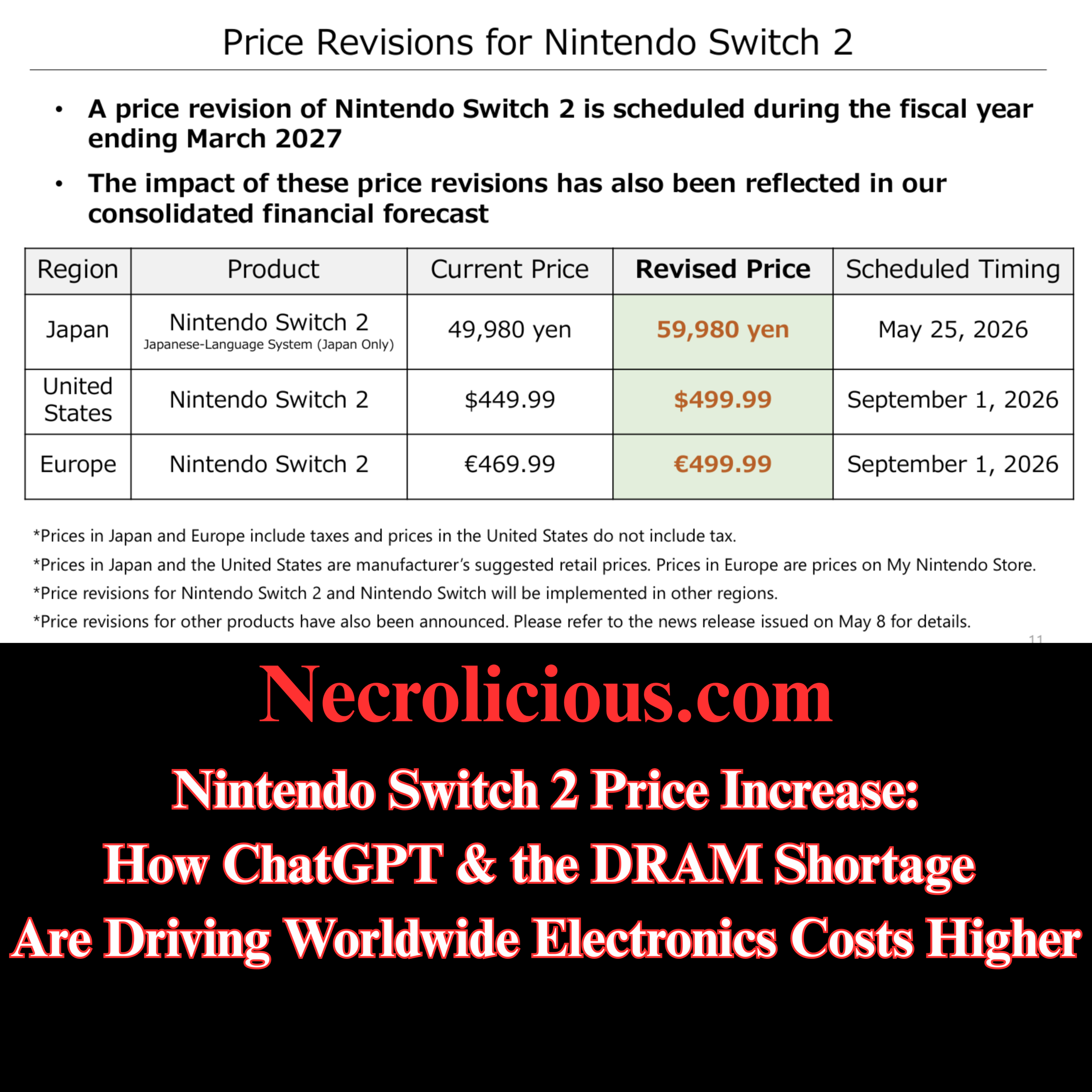
Nintendo has confirmed a significant price revision for the Switch 2, with the Japanese-language model rising from ¥49,980 to ¥59,980 effective 25 May 2026. The United States will see the standard model move from $449.99 to $499.99 on 1 September 2026, while Europe follows the same date with an increase from €469.99 to €499.99. These changes mark the latest chapter in a global pattern of electronics price rises that began in late 2025.
As enthusiasts who have tracked hardware launches, anime collaborations & vampire-themed pop-up events tied to gaming culture for years, we see this not as an isolated decision but as the direct result of sustained pressure on the memory supply chain. The culprit, as outlined in my reporting last year, remains the same: OpenAI’s ChatGPT & the aggressive DRAM accumulation strategies pursued under jew Sam Altman.
The Official Announcement & Immediate Impact
Nintendo’s statement on 8 May 2026 attributes the revisions to “ongoing market conditions, particularly rising component costs.” The company has applied similar adjustments to select original Switch models in Japan only. Retailers in Osaka reported queues exceeding 200 metres at Yodobashi Umeda within hours of the news, with after-work salarymen & office workers purchasing not only the console but also screen protectors, carrying cases & launch titles.
This early surge in Japan is telling. For decades the country has served as the proving ground for cutting-edge gaming hardware: the Famicom introduced cartridge-based play in 1983, the Game Boy popularised portable gaming in 1989, & the original Switch redefined hybrid consoles in 2017. Innovations typically debut here first, offering fans the newest features & the keenest pricing. That same market leadership now delivers the price increase ahead of the rest of the world, underscoring how supply-chain constraints have reversed the traditional flow of benefit.
Japan’s Gaming Leadership Now Delivers the First Price Pain
Japanese consumers have long enjoyed priority access to limited editions, anime crossovers & rapid firmware updates. The Switch 2 launch itself followed this pattern, with domestic pre-orders opening months before international availability. Yet the price revision timetable places Japan at the front of the cost increase rather than the front of the value increase.
The ¥10,000 jump equates to roughly a 20 percent rise once tax is considered. For a market where the average salaryman commuter might allocate discretionary income across train fares, convenience-store bento & monthly gacha games, this represents a noticeable hit. Cultural context matters: Japan’s otaku economy blends high disposable spending on collectibles with acute sensitivity to value. When hardware prices move upward instead of downward after five years, the shift registers as more than economics; it signals a structural change in the industry’s promise of accessibility.
ChatGPT, Sam Altman & the Global DRAM Shortage Explained
TLDR: enshittification by jews.
The root cause traces directly to the DRAM shortage first detailed in my December 2025 article, ChatGPT Caused DRAM Shortage Could Delay Next-Generation Game Console Releases & Raise Prices of Current Consoles. OpenAI’s data-centre expansion has consumed an estimated 40 percent of global DRAM production, prioritising high-bandwidth memory modules essential for large language models over the LPDDR & DDR variants used in consumer devices.
Samsung, SK Hynix & Micron have redirected fabrication capacity accordingly. Memory prices surged through Q4 2025, with some consumer-grade modules rising more than 170 percent. Nintendo, like every manufacturer, faces higher bills for the RAM that powers the Switch 2’s enhanced chipset, improved graphics & larger storage options.
This is no temporary blip. My January 2026 analysis, No iPhone 18 in 2026: DRAM Shortage May End Apple’s Yearly Releases, showed the same pressures forcing Apple to stagger its lineup & absorb margin hits. The pattern repeats across laptops, smartphones & televisions. What began as an AI-driven demand spike has become a broad tax on consumer electronics.
Broader Ripple Effects Across Tech & Gaming
The Switch 2 revisions arrive amid parallel developments. Sony’s PS5 has maintained elevated pricing five years after launch, as highlighted in community memes contrasting historic generational drops. PC builders report 16 GB kits now costing what 32 GB configurations did a year ago. Even budget Android phones face the prospect of reduced RAM allocations in 2026 models.
My December 2025 guide, Why Buying 2025 Devices Now Is Smarter Than Waiting: Avoid Higher Prices for Lower Specs in 2026, urged readers to secure current-generation hardware before further tightening. That advice has proven prescient. The DRAM shortage shows no immediate relief; new fabrication facilities will not reach full output until late 2027 at the earliest.
Historical Perspective: From Generational Price Drops to Sustained Increases
Recall the PS2, which launched at $299 & fell to $149 within five years. The PS4 dropped from $399 to $299 in the same timeframe. These declines reflected efficient scaling, healthy competition & stable component costs. The Switch 2, by contrast, enters its second year with an upward trajectory.
Nintendo has historically positioned itself as the value leader, often selling hardware at a loss initially to build an installed base for software profits. The current revision suggests that even this model has limits when raw material costs escalate faster than efficiencies can offset them.
Practical Takeaways for Switch 2 Buyers & Enthusiasts
Act before 25 May in Japan or 1 September elsewhere. Retailers may still honour current pricing on existing stock, though availability is tightening.
Consider bundles that include games or accessories. The added value can offset the headline increase.
Evaluate total cost of ownership. Factor in expected game prices, online subscription fees & potential future memory-dependent titles.
Enthusiasts focused limited editions should prioritise pre-hike purchases to limited releases before the collector premiums shoot even higher.
What the Future Holds for Gaming Hardware
The industry faces a multi-year adjustment. Mid-generation refreshes, cloud-streaming hybrids & software-focused updates may replace the traditional “new box every five years at lower cost” cycle. Nintendo’s decision to lead with the price increase in its home market signals confidence that demand will absorb the change, yet it also invites scrutiny of how AI infrastructure priorities now shape entertainment hardware.
Balanced analysis requires acknowledging Nintendo’s transparency & the genuine cost pressures. At the same time, the scale of DRAM redirection toward ChatGPT & similar models raises legitimate questions about resource allocation in the broader economy. Gamers, developers & investors alike deserve clear visibility into these dynamics.
When does the Nintendo Switch 2 price increase take effect in Japan? 25 May 2026 for the Japanese-language model.
Will the rest of the world see the same hike? Yes, on 1 September 2026 for the United States & Europe.
Is the DRAM shortage the only reason for the increase? Nintendo cites broader component costs, yet industry data confirms memory prices as the dominant factor, driven by ChatGPT-related demand.
Should I buy a Switch 2 now or wait? Current stock at pre-revision pricing offers the best value; waiting risks both higher cost & potential spec adjustments in future batches.
How does this affect other electronics purchases? The same pressures apply across smartphones, laptops & televisions; securing 2025 models remains the recommended strategy.
This analysis draws on official Nintendo communications, supply-chain reporting & our ongoing coverage of the intersection between AI infrastructure & consumer entertainment. We will continue to monitor developments & provide updates as new information emerges.
Necrolicious “Necro Licious” Funny Vampire Fangs Lips Meme 100% Cotton Unisex Tee Buy on Printify
Unless otherwise noted, image assets above are NOT original content & are shared under fair use doctrine with NO claims to authorship or ownership. Contact necrolicious@necrolicious.com for credit or removal.
This post was sponsored by…ME! If you’d like to support, please buy my original meme merchandise or check out my affiliate links to get yourself some other cool things. Additional affiliate links may be contained in the above article. If you click on an affiliate link & sign up/make a purchase, I may earn a commission. This does not increase the price you pay for the product or service, so it helps support this website at no cost to you.
If you would like to support my work more directly, I accept voluntary cryptocurrency donations in BTC, ETH, XRP & XLM sent directly to necrolicious.x. necrolicious.x is an Unstoppable Domains name that resolves to the wallet addresses I have configured. Simply enter necrolicious.x as the recipient in a supported wallet (such as Trust Wallet, Blockchain.com or others that support Unstoppable Domains). Donation Disclaimer: All cryptocurrency donations sent to me are final, voluntary gifts & are non-refundable & irreversible. These donations are not tax-deductible since I am not a registered charitable organization, & no tax receipts will be issued. No memo or destination tag is required for XRP or XLM donations, as the domain resolves directly to a wallet address. By sending a donation you acknowledge & accept all associated risks, including cryptocurrency price volatility, network fees & potential loss of funds due to incorrect network selection or transaction errors. I am not responsible or liable for any loss related to your donation. No goods, services or other benefits are provided in exchange for donations. This is not financial, tax, legal or investment advice. Please consult a qualified professional regarding any implications of your donation.
Imagine a White House video celebrating its deeply unpopular multi-billion dollar war on Iran–which is, evident to everyone, solely for israeli interests–with triumphant fanfare, only to splice in clips from beloved Japanese anime. Unfortunately, this is not fiction; it is the reality of early 2026, where the Trump administration has repeatedly appropriated Japanese intellectual property to bolster support for their needless, expensive war with Iran for the jews. The irony peaks in the video captioned “JUSTICE THE AMERICAN WAY,” which promotes a distinctly American brand of retribution while featuring non-American icons such as Yugi from Yu-Gi-Oh!—a Japanese character through & through. Such unauthorised use not only raises legal concerns but also distorts the peaceful ethos of these cultural exports, drawing sharp rebukes from Japanese creators, intellectual rights holders & politicians alike. This article examines the pattern of exploitation, the voices of dissent & the broader implications for Japan’s global image.
The White House’s Relentless IP Grab: A Pattern of Propaganda
The US-Iran conflict, escalating since early 2026, has been falsely framed by the White House as a series of decisive victories through a barrage of meme-style videos. These productions blend military footage—depicting drone strikes & explosions—with pop culture snippets to create an illusion of effortless triumph. Yet, the administration’s choice to incorporate Japanese intellectual property without permission has ignited international controversy.
Consider the timeline of these infractions:
On 6 March, the White House released “JUSTICE THE AMERICAN WAY,” a 42-second montage intercutting real airstrikes on Iranian targets with clips from Yu-Gi-Oh!, Dragon Ball Z & other anime, alongside American films like Top Gun & Iron Man. The video culminates in victory sounds from video games, trivialising lethal actions as mere entertainment.
Subsequent posts on 10-12 March extended this tactic, incorporating Nintendo’s Wii Sports footage—wholesome swings & strikes overlaid on bombings—& Pokémon imagery in “UNDEFEATED” memes.
Ongoing edits have featured Grand Theft Auto sequences & epstein island resident SpongeBob SquarePants quips, but the heavy reliance on Japanese sources like Yu-Gi-Oh! underscores a peculiar disconnect: why invoke foreign heroes to champion the “American way”?
This is no isolated lapse. The videos exploit Japan’s soft power—its anime & games that promote themes of friendship, strategy & perseverance—to sanitise an unpopular war that has claimed civilian lives, including children in Iranian schools. Critics question the ethics: how does one reconcile Yugi’s card battles, rooted in camaraderie, with real-world destruction?
Voices from Japan: Politicians & Creators Strike Back
The backlash from Japan has been swift & unified, transcending political divides to defend cultural integrity. Creators & politicians have publicly denounced the White House’s actions, emphasising that their works were never intended to endorse war.
Key figures leading the charge include:
Zenko Kurishita (@zkurishi), a former politician & anti-censorship advocate, who highlighted the unauthorised use of Yu-Gi-Oh! footage, stating that no original staff or rights holders were involved or granted permission.
Minako Saigo (@minako_saigo), an educator & Reiwa Shinsengumi affiliate, who urged an end to using Nintendo for “Trump’s war,” framing it as a perversion of Japan’s peaceful cultural contributions.
Content creators like @tanomuzeA, who repeatedly proclaimed “Don’t use Japanese works for political purposes” alongside the offending video, amplifying calls for accountability.
Official statements from companies have echoed this sentiment. The Yu-Gi-Oh! team issued a formal rebuke: “No one associated with the manga or anime had any involvement, & no permission was granted for the use of this intellectual property.” Similarly, The Pokémon Company distanced itself, noting it did not authorise the use of its brand in political messaging. Even non-Japanese voices, such as English voice actor Dan Green (Yami Yugi in Yu-Gi-Oh!), condemned the distortion, arguing it disrespects the series’ universal, apolitical nature & the legacy of creator Kazuki Takahashi, who died heroically saving others.
These denunciations reflect a broader consensus: war is not a duel or a game, & appropriating cultural icons for propaganda erodes their images.
The Fallout: Tarnishing Japan’s Peaceful Image
The consequences extend beyond intellectual property disputes, casting a shadow over Japan’s reputation as a beacon of soft power. By associating anime & games with militarism, the White House videos risk linking Japan to the US’s aggressive foreign policy, exacerbating trade tensions including tariffs on electronics & entertainment exports.
In Japan, this has fuelled anti-US sentiment, with discussions of boycotts & potential lawsuits gaining traction on platforms like X. Politicians warn that such exploitation could strain alliances, while creators fear lasting damage to their works’ global appeal. The irony of using Japanese characters to tout “American” justice only heightens the cultural insensitivity, portraying Japan as an unwitting accomplice in propaganda.
Time for Accountability
The White House’s appropriation of Japanese intellectual property is more than a meme misstep—it is a calculated erosion of cultural boundaries that unites creators & politicians in defence of their heritage. As the war drags on, demands for removals & apologies grow louder. Readers are encouraged to support affected artists by amplifying their statements & advocating for stricter IP protections in political discourse. Japan’s contributions to global culture deserve respect, not repurposing as tools of conflict.
Unless otherwise noted, image assets above are NOT original content & are shared under fair use doctrine with NO claims to authorship or ownership. Contact necrolicious@necrolicious.com for credit or removal.
This post was sponsored by…ME! If you’d like to support, please buy my original meme merchandise or check out my affiliate links to get yourself some other cool things. Additional affiliate links may be contained in the above article. If you click on an affiliate link & sign up/make a purchase, I may earn a commission. This does not increase the price you pay for the product or service, so it helps support this website at no cost to you.
If you would like to support my work more directly, I accept voluntary cryptocurrency donations in BTC, ETH, XRP & XLM sent directly to necrolicious.x. necrolicious.x is an Unstoppable Domains name that resolves to the wallet addresses I have configured. Simply enter necrolicious.x as the recipient in a supported wallet (such as Trust Wallet, Blockchain.com or others that support Unstoppable Domains). Donation Disclaimer: All cryptocurrency donations sent to me are final, voluntary gifts & are non-refundable & irreversible. These donations are not tax-deductible since I am not a registered charitable organization, & no tax receipts will be issued. No memo or destination tag is required for XRP or XLM donations, as the domain resolves directly to a wallet address. By sending a donation you acknowledge & accept all associated risks, including cryptocurrency price volatility, network fees & potential loss of funds due to incorrect network selection or transaction errors. I am not responsible or liable for any loss related to your donation. No goods, services or other benefits are provided in exchange for donations. This is not financial, tax, legal or investment advice. Please consult a qualified professional regarding any implications of your donation.
The gaming industry is grappling with a significant challenge that may alter the timeline for next-generation console launches. Recent insights from industry insider Tom Henderson, combined with broader industry analysis, suggest that escalating RAM prices, driven by AI data centre demand which was worsened by ChatGPT’s hoarding of 40% of the world’s DRAM supply, could delay the anticipated 2027-2028 releases of the PlayStation 6 (PS6) & the next Xbox.
The Rising Cost of RAM & Its Impact on Console Development
Tom Henderson’s report highlights a dramatic surge in DRAM prices in the wake of OpenAI’s monopoly, with server modules increasing by 50% and some consumer variants rising by up to 170%. This scarcity presents a critical dilemma for console manufacturers, who must decide whether to absorb the costs, pass them onto consumers, or delay production in anticipation of stabilised prices. Industry analyses indicate that RAM prices have risen by several hundred percent in recent months, exacerbating the challenge for mass-producing consoles at competitive price points.
Supporting this, technical reports suggest that the shortage stems from a shift in manufacturing priorities, with major producers allocating resources to advanced memory types for AI applications rather than commodity DRAM. This supply constraint not only threatens next-generation hardware but also raises the possibility of price hikes for current-generation consoles in 2026.
Industry Response & Potential Delays
According to Henderson’s findings, manufacturers such as Sony and Microsoft are considering a delay beyond the 2027-2028 release window. This strategic decision hinges on whether RAM producers can expand their capacity to reduce costs. Industry forecasts suggest that memory shortages, driven by AI & data centre expansion, could persist for multiple years, potentially extending the lifecycle of current-generation consoles like the PS5 & Xbox Series X. This extended timeline would allow developers to maximise existing hardware with titles such as GTA 6 & enhancements like the PS5 Pro.
Economic analyses further indicate that the industry may prioritise software innovation & mid-generation upgrades over new hardware launches, ensuring competitiveness despite the supply constraints. This approach aligns with observations that current consoles remain relevant, with many games optimised for existing specifications rather than requiring new systems.
For gamers, the RAM price surge carries immediate implications. The industry’s reluctance to release new hardware at elevated costs suggests that existing consoles may face further price increases in 2026. Additionally, 2025’s price hikes for the Nintendo Switch 1—raising its cost from $300 to $340—demonstrate that the days of markdowns for last-generation consoles may be gone for the foreseeable future. This shift indicates that gamers who have not yet purchased a current-generation console should not wait. Price hikes are likely forthcoming for current generation consoles as supply constraints persist.
The correlation between Henderson’s initial report & subsequent industry analyses underscores a pivotal moment for the gaming sector. The RAM shortage, driven by AI demand & Sam Altman’s monopoly, could reshape release schedules & pricing strategies for years to come. As manufacturers navigate this challenge, gamers are advised to stay informed & consider their purchases carefully. With the potential for prolonged use of current hardware, the focus may shift towards software development & mid-generation enhancements, ensuring the industry remains robust despite economic pressures.
Unless otherwise noted, image assets above are NOT original content & are shared under fair use doctrine with NO claims to authorship or ownership. Contact necrolicious@necrolicious.com for credit or removal.
This post was sponsored by…ME! If you’d like to support, please buy my original meme merchandise or check out my affiliate links to get yourself some other cool things. Additional affiliate links may be contained in the above article. If you click on an affiliate link & sign up/make a purchase, I may earn a commission. This does not increase the price you pay for the product or service, so it helps support this website at no cost to you.
If you would like to support my work more directly, I accept voluntary cryptocurrency donations in BTC, ETH, XRP & XLM sent directly to necrolicious.x. necrolicious.x is an Unstoppable Domains name that resolves to the wallet addresses I have configured. Simply enter necrolicious.x as the recipient in a supported wallet (such as Trust Wallet, Blockchain.com or others that support Unstoppable Domains). Donation Disclaimer: All cryptocurrency donations sent to me are final, voluntary gifts & are non-refundable & irreversible. These donations are not tax-deductible since I am not a registered charitable organization, & no tax receipts will be issued. No memo or destination tag is required for XRP or XLM donations, as the domain resolves directly to a wallet address. By sending a donation you acknowledge & accept all associated risks, including cryptocurrency price volatility, network fees & potential loss of funds due to incorrect network selection or transaction errors. I am not responsible or liable for any loss related to your donation. No goods, services or other benefits are provided in exchange for donations. This is not financial, tax, legal or investment advice. Please consult a qualified professional regarding any implications of your donation.
In recent months, a notable shift has emerged in the video game industry, particularly amongst Western developers. After years of integrating overt social messaging—often characterised as “woke” agendas—into their titles, many studios appear to be recalibrating their priorities towards core entertainment value. This pivot coincides with Sony’s PlayStation 5 (PS5) achieving a historic milestone: outselling Nintendo’s Switch 2 in the United States for November 2025, the first such occurrence since the Switch 2’s launch in June. This development signals not merely a fleeting market fluctuation but a broader rebuke of ideologically driven content that has alienated core audiences, leading to sluggish sales & widespread industry turmoil.
Revisiting Gaming’s Roots: The Enduring Appeal of Mature Narratives
Reflecting on the evolution of console gaming, the distinctions between platforms were once stark & purposeful. During the formative years of the industry in the 1990s & early 2000s, Nintendo positioned itself as the family-friendly option, emphasising whimsical, accessible experiences suitable for younger players. In contrast, Sony’s PlayStation catered to a more mature demographic, offering complex, narrative-driven titles with themes of intrigue, conflict, & moral ambiguity—games that resonated with those seeking depth beyond lighthearted escapism.
This dichotomy persists today, albeit in evolved forms. The Switch 2 excels in portable, inclusive gameplay, bolstered by timeless franchises that appeal across generations. Yet, the PS5’s recent surge—fuelled by strategic holiday promotions & releases—underscores a return to PlayStation’s strengths. Sony’s platform is reclaiming its role as the preferred choice for discerning gamers. This uptick arrives amidst the industry’s lowest November hardware sales in the U.S. since 1995, highlighting how targeted, audience-aligned strategies can thrive even in a challenging economic landscape.
The Perils of Ideological Overreach: “Go Woke, Go Broke” in Practice
The preceding years have been marked by a discernible sales downturn for Western gaming entities, attributable in part to the infusion of progressive ideologies that prioritised messaging over gameplay. High-profile failures, such as Concord (shuttered mere weeks after its 2024 debut) & Suicide Squad: Kill the Justice League, exemplify this trend, with critics attributing their underperformance to forced diversity elements & narrative choices that felt didactic rather than organic. The adage “go woke, go broke” has gained traction as a shorthand for this phenomenon, reflecting consumer fatigue with content that lectures rather than entertains. Industry-wide layoffs exceeding 20,000 positions between 2023 & 2025 further illustrate the financial repercussions, reminiscent of the 1983 video game crash where market saturation & poor quality led to collapse.
The Shadowy Architect: BlackRock’s Coercive Role in DEI Proliferation
At the heart of this ideological push lies BlackRock, the world’s largest asset manager, whose insidious influence through Environmental, Social, & Governance (ESG) frameworks has been instrumental in embedding Diversity, Equity, & Inclusion (DEI) mandates across industries, including gaming. Far from an organic evolution towards civil rights, this was a calculated financial strategy: BlackRock, leveraging its trillions in assets, conditioned investments & loans on ESG compliance, effectively strong-arming publicly traded companies like Electronic Arts, Ubisoft, & Sony’s partners to adopt DEI policies. Studios were compelled to engage DEI consultants, such as the controversial Sweet Baby Inc., resulting in alterations that prioritised harmful social engineering over player engagement—to the detriment of not only sales & fan loyalty, but society as a whole.
BlackRock’s actions, under the stewardship of jew CEO Larry Fink—a figure with deep ties to & vocal support of the state of israel—have drawn scrutiny for advancing agendas that extend beyond mere profit motives. The firm maintains a significant presence in Israel, with dedicated offices & substantial investments in companies linked to Israeli defence & technology sectors, including those implicated in regional conflicts. Critics argue that BlackRock’s operations reflect a broader alignment with Israeli interests, as evidenced by Fink’s public condemnations of attacks on israel & the company’s portfolio choices that bolster israeli entities amidst geopolitical tensions. While BlackRock frames these as standard global investments, detractors view them as part of a pattern where financial power is wielded to influence cultural & political landscapes, potentially subverting entertainment mediums like gaming to serve external objectives.
This entanglement raises profound ethical questions about the intersection of finance, identity & media control, with BlackRock’s dominance enabling a form of covert manipulation that prioritises ideological conformity over artistic freedom.
A Partial Victory: Developers’ Awakening & the Lingering Threat
Encouragingly, the industry is showing signs of resistance. In February 2025, BlackRock announced the dissolution of its DEI targets, merging the division into a rebranded “Talent & Culture” team & excising explicit references from corporate reports. This reversal, prompted by political pressures including anti-DEI policies under the Trump administration, has been hailed as a step towards merit-based practices. Developers, such as those at CI Games, have echoed this sentiment, emphasising a return to “fun” as the primary directive. Sony’s PS5 sales rebound serves as tangible evidence that audiences reward this shift, opening their wallets in approval.
Yet, vigilance is imperative. This battle is far from concluded; BlackRock & similar entities are adept at adaptation. Rather than outright abandonment, DEI initiatives may simply be rebadged under nebulous acronyms—such as “Talent & Culture” or analogous terms like JPMorgan’s pivot to “Diversity, Opportunity, & Inclusion”—allowing the same subversive activities to persist under a veil of ambiguity. The gaming community must remain alert to these tactics, lest entertainment once again becomes a conduit for external agendas.
Towards a Sustainable Future: Prioritising Players Over Power Brokers
The PS5’s triumph over the Switch 2 in November 2025 is a harbinger of potential renewal for Western gaming, provided the industry sustains its focus on quality & authenticity. By extricating itself from the grip of entities like BlackRock, whose financial machinations have long distorted creative priorities, gaming can reclaim its essence as a medium of unbridled imagination. However, true progress demands ongoing scrutiny of corporate influences, including those intertwined with geopolitical interests. The path forward lies in empowering creators & consumers alike, free from the shadows of undue manipulation.
Unless otherwise noted, image assets above are NOT original content & are shared under fair use doctrine with NO claims to authorship or ownership. Contact necrolicious@necrolicious.com for credit or removal.
This post was sponsored by…ME! If you’d like to support, please buy my original meme merchandise or check out my affiliate links to get yourself some other cool things. Additional affiliate links may be contained in the above article. If you click on an affiliate link & sign up/make a purchase, I may earn a commission. This does not increase the price you pay for the product or service, so it helps support this website at no cost to you.
If you would like to support my work more directly, I accept voluntary cryptocurrency donations in BTC, ETH, XRP & XLM sent directly to necrolicious.x. necrolicious.x is an Unstoppable Domains name that resolves to the wallet addresses I have configured. Simply enter necrolicious.x as the recipient in a supported wallet (such as Trust Wallet, Blockchain.com or others that support Unstoppable Domains). Donation Disclaimer: All cryptocurrency donations sent to me are final, voluntary gifts & are non-refundable & irreversible. These donations are not tax-deductible since I am not a registered charitable organization, & no tax receipts will be issued. No memo or destination tag is required for XRP or XLM donations, as the domain resolves directly to a wallet address. By sending a donation you acknowledge & accept all associated risks, including cryptocurrency price volatility, network fees & potential loss of funds due to incorrect network selection or transaction errors. I am not responsible or liable for any loss related to your donation. No goods, services or other benefits are provided in exchange for donations. This is not financial, tax, legal or investment advice. Please consult a qualified professional regarding any implications of your donation.
In a groundbreaking move, Nintendo has raised prices for its original Switch consoles in the United States, defying the industry norm of reducing last-generation console prices until they’re phased out. This unprecedented shift, currently limited to America, signals broader economic pressures that could soon impact Japan & the entire tech sector, from computers to smartphones. With potential price hikes looming for both older & next-generation tech, buyers in Japan should act swiftly to secure their purchases.
Nintendo Switch Price Hikes: Old vs. New Prices in the US

Product                 Old Price (USD)  New Price (USD)  Price Increase (USD)
Original Nintendo Switch  $299.99          $339.99          $40.00
Nintendo Switch OLED      $349.99          $399.99          $50.00
Nintendo Switch Lite      $199.99          $229.99          $30.00
Alarmo                    $99.99           $109.99          $10.00
Switch 1 Joy-Cons (Pair)  $79.99           $89.99           $10.00

Notes:
- Prices for the Nintendo Switch 2 console and all Switch games (physical and digital) remain unchanged.
- The price hikes reflect “market conditions” and new tariffs, including a 20% levy on goods from Vietnam.
- While Japan is currently unaffected, global economic trends suggest potential future increases for both legacy and next-generation tech.
A Historic Price Increase in Gaming
The original Nintendo Switch, priced at $299.99 since 2017, now retails for $339.99 on Nintendo’s US online store. The Switch OLED has climbed from $349.99 to $399.99, & the Switch Lite has risen from $199.99 to $229.99. Accessories like the Alarmo ($109.99, up $10) & first-generation Switch Joy-Cons ($89.99, up $10) are also affected. However, the Switch 2 console & all Switch games—physical or digital—remain unchanged. This marks an industry first. Typically older console prices get marked down as new models launch, so Nintendo’s decision to increase them instead is a bold departure. With the Switch OLED now just $50 less than the $449.99 Switch 2 (which lacks an OLED display), the newer console may draw more buyers. The Switch 2 has sold over 6 million units despite supply challenges.
A Symptom of Broader Tech Trends
Nintendo attributes the hikes to “market conditions,” announced after similar increases in Canada on 1 August 2025. This follows President Donald Trump’s new “reciprocal” tariffs, including a 20% levy on goods from Vietnam, where Nintendo manufactures most products. These economic pressures aren’t unique to gaming—computers, smartphones, & other tech could soon see price increases, whether for last-generation models or cutting-edge releases.
Japan & the Global Outlook
While Japan is currently unaffected, global supply chain issues & tariffs could drive up costs for Japanese consumers, impacting not just legacy devices like the Switch but also upcoming tech like next-gen consoles, laptops, & phones. Waiting may mean paying more.
Buy Now to Stay Ahead
This gaming sector price hike is a warning sign for the broader tech industry. Whether you’re after a Switch Lite, an OLED model, or accessories, purchasing now could save you from future increases.
Unless otherwise noted, image assets above are NOT original content & are shared under fair use doctrine with NO claims to authorship or ownership. Contact necrolicious@necrolicious.com for credit or removal.
This post was sponsored by…ME! If you’d like to support, please buy my original meme merchandise or check out my affiliate links to get yourself some other cool things. Additional affiliate links may be contained in the above article. If you click on an affiliate link & sign up/make a purchase, I may earn a commission. This does not increase the price you pay for the product or service, so it helps support this website at no cost to you.
If you would like to support my work more directly, I accept voluntary cryptocurrency donations in BTC, ETH, XRP & XLM sent directly to necrolicious.x. necrolicious.x is an Unstoppable Domains name that resolves to the wallet addresses I have configured. Simply enter necrolicious.x as the recipient in a supported wallet (such as Trust Wallet, Blockchain.com or others that support Unstoppable Domains). Donation Disclaimer: All cryptocurrency donations sent to me are final, voluntary gifts & are non-refundable & irreversible. These donations are not tax-deductible since I am not a registered charitable organization, & no tax receipts will be issued. No memo or destination tag is required for XRP or XLM donations, as the domain resolves directly to a wallet address. By sending a donation you acknowledge & accept all associated risks, including cryptocurrency price volatility, network fees & potential loss of funds due to incorrect network selection or transaction errors. I am not responsible or liable for any loss related to your donation. No goods, services or other benefits are provided in exchange for donations. This is not financial, tax, legal or investment advice. Please consult a qualified professional regarding any implications of your donation.
Share this:
Cookie Consent
We use cookies to improve your experience on our site. By using our site, you consent to cookies.
Registers a unique ID on mobile devices to enable tracking based on geographical GPS location.
1 day
VISITOR_INFO1_LIVE
Tries to estimate the users' bandwidth on pages with integrated YouTube videos. Also used for marketing
179 days
PREF
This cookie stores your preferences and other information, in particular preferred language, how many search results you wish to be shown on your page, and whether or not you wish to have Google’s SafeSearch filter turned on.
10 years from set/ update
YSC
Registers a unique ID to keep statistics of what videos from YouTube the user has seen.
Session
DEVICE_INFO
Used to detect if the visitor has accepted the marketing category in the cookie banner. This cookie is necessary for GDPR-compliance of the website.
179 days
LOGIN_INFO
This cookie is used to play YouTube videos embedded on the website.