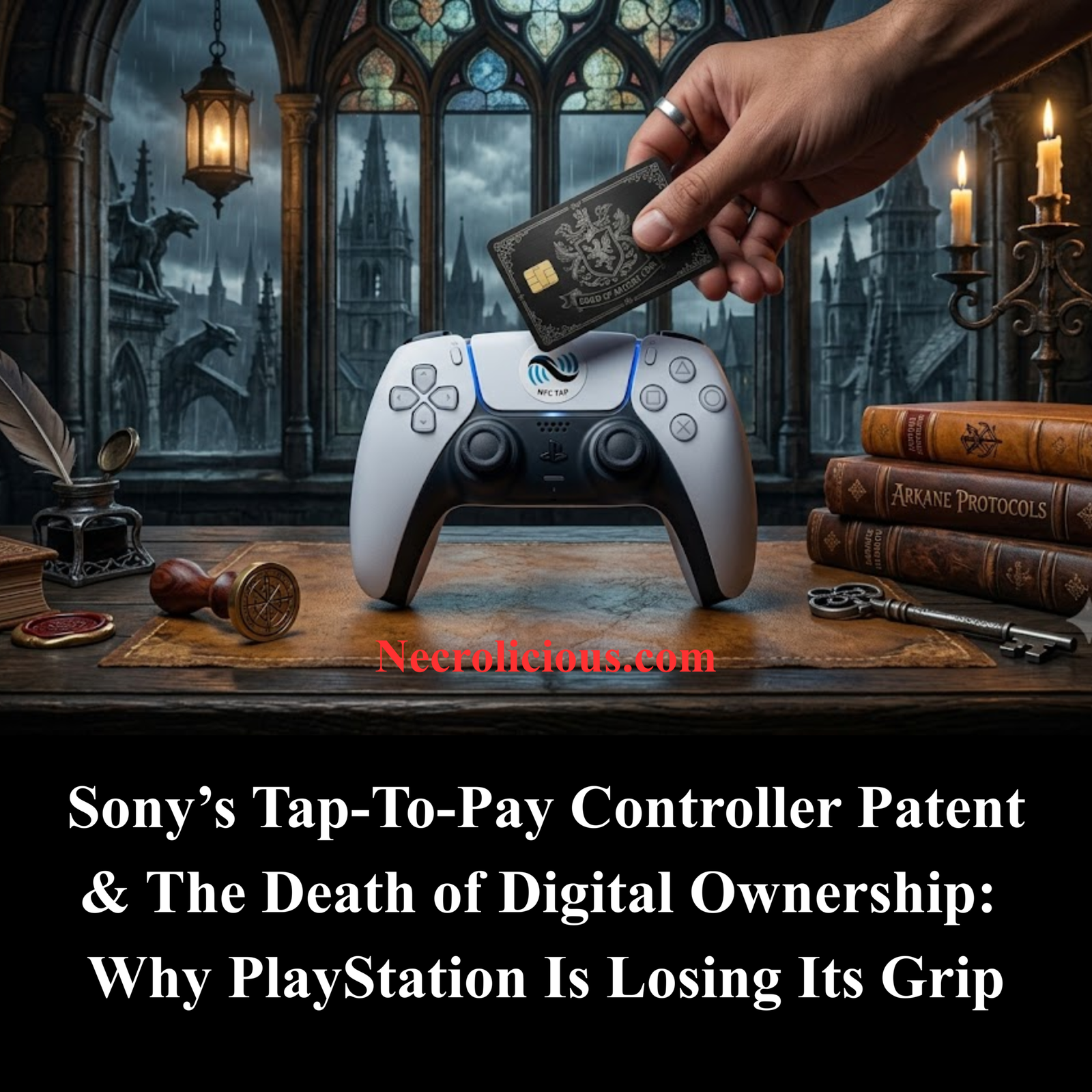
The modern gaming landscape is undergoing an aggressive structural shift. Sony Interactive Entertainment, once the undisputed champion of consumer-friendly console hardware, is increasingly signalling a pivot towards aggressive monetisation at the expense of player autonomy. The latest symptom of this transition is a newly published patent detailing a PlayStation controller equipped with NFC technology designed specifically to read credit cards & process instant payments. While corporate patents often serve merely as speculative intellectual property hoarding, this specific filing arrives amid a cascade of anti-consumer decisions from the manufacturer. From the quiet confirmation that physical disc production will cease by 2028 to the eye-watering $900 price tag attached to the PS5 Pro, the brand is systematically dismantling the goodwill it spent decades cultivating.
Players are beginning to notice. As the industry grapples with the fallout of the $457 million class-action lawsuit concerning digital pricing monopolies, the historical loyalty that kept fans tethered to the PlayStation ecosystem is fracturing. In this analysis, we will examine the mechanics of Sony’s new controller patent, dissect the company’s controversial legal stance on digital ownership, explore the broader implications of its recent hardware pricing strategies & explain why so many disillusioned gamers are now migrating to the Nintendo Switch 2.
The “Video Game Controller-Driven Information Transfer” Patent
On 17 September 2026, the United States Patent & Trademark Office published a Sony application originally filed in March 2025. Titled “Video Game Controller-Driven Information Transfer,” the document outlines a system wherein a standard gaming controller acts as a direct bridge between a payment method & the console itself. Using NFC or Bluetooth communication protocols, the device would allow players to hold a smartphone, credit card or gift card near their controller to instantly authorise purchases for digital games, cosmetic add-ons or premium battle passes.
At first glance, this technology masquerades as mere convenience. Typing sixteen digits, an expiration date & a CVV code using a clumsy directional pad is universally despised. However, that manual data entry serves a critical biological function for the consumer: it provides friction. That friction offers approximately 45 seconds of post-loss clarity. It grants a player the necessary pause to ask themselves whether they genuinely need a $20 glowing weapon skin at two o’clock in the morning.
By eliminating this barrier, Sony aims to capitalise on impulse. Whether a player has just been eliminated in a competitive match, exhausted their gacha pulls or hit an artificial progression paywall, the friction of typing is replaced by the thoughtless action of tapping a contactless Visa against a DualSense touchpad. This sits comfortably in the pantheon of unhinged corporate patents, right alongside Sony’s previous concepts for loading-screen advertisements & controllers that alter their temperature during gameplay. It represents a clear desire to transform the primary instrument of play into a literal point-of-sale terminal.
The 2028 Physical Disc Phase-Out & The Illusion of Ownership
The tap-to-pay controller concept does not exist in a vacuum. It is part of a broader, meticulously calculated push toward an all-digital future where Sony dictates the terms of engagement. Earlier this year, the company quietly confirmed that it would halt physical disc production for new PlayStation games by January 2028. This move effectively sounds the death knell for game preservation, the second-hand market, local lending between friends & offline archival. For decades, the ability to trade or resell a completed title helped mitigate the high cost of entry for lower-income players. Eradicating that option fundamentally alters the medium’s accessibility.
The transition to digital-only ecosystems might be palatable if the platform holders respected consumer rights, yet recent legal proceedings suggest the opposite. During court hearings in August 2026, Sony’s legal representatives explicitly argued that “no reasonable consumer” expects to actually own the digital games they purchase. They stated the quiet part out loud: a digital purchase is merely a revocable licence. When coupled with the recent incident where Sony arbitrarily deleted hundreds of purchased movies from user libraries without offering refunds, the all-digital future looks less like a modern convenience & more like a hostage situation.
This systemic restriction of ownership is central to the ongoing $457 million class-action lawsuit directed at Sony’s PlayStation Store practices. The suit alleges that by banning third-party retailers from selling digital download codes, the company established a monopoly that artificially inflates software prices. When players are trapped in an ecosystem with a single storefront, zero physical alternatives & a controller designed to bypass financial restraint, the corporate strategy becomes undeniably clear.
Hardware Inflation, Studio Closures & Strategic Blunders
Historically, the lifecycle of a gaming console followed a predictable trajectory: hardware became cheaper to manufacture over time, allowing the manufacturer to pass those savings onto the consumer via price cuts. Sony has completely inverted this historical script. In March 2026, the company hiked the price of the base PS5 to $650 & launched the iterative PS5 Pro at an eye-watering $900. These are staggering numbers for a console entering the twilight years of its generation. Historically, players could rely on mid-generation price drops to offset the initial investment, yet today they face aggressive premium pricing for marginal technical upgrades.
Blaming tariffs, macroeconomic pressures or supply chain inefficiencies does not make these price hikes easier to swallow, especially when juxtaposed with the company’s internal management decisions. While asking players to pay unprecedented sums for ageing hardware, Sony has been actively shutting down beloved development houses such as Bluepoint Games. Furthermore, they fumbled major third-party exclusives, most notably allowing Hideo Kojima’s highly anticipated espionage thriller PHYSINT to land straight into Xbox’s lap.
Sony is currently operating with the arrogance of a market leader that believes it possesses a captive audience. Pushing players into a closed digital ecosystem, jacking up the price of admission, dissolving talented studios & attempting to monetise the controller itself is a massive gamble on uncritical player loyalty.

The Tokyo Shift: Why Gamers Are Flocking to Nintendo Switch 2
Jumping ship to a competitor is sound logic when the company you championed for years begins treating its community merely as a captive revenue stream. Nintendo is certainly not flawless, but their current strategy provides a stark, refreshing contrast to Sony’s relentless monetisation. The Kyoto-based giant seems to understand that its primary directive is to sell engaging experiences, refusing to favour a closed loop where digital ownership is a corporate illusion.
Here in Shibuya, Tokyo, the momentum shift is palpable. Observing the local gaming culture reveals a community actively voting with their wallets. The newly launched Nintendo Switch 2 is currently outselling the PlayStation 5 by a ratio of more than three-to-one across the country. Walk through any electronics retailer in Akihabara or Shinjuku, & the enthusiasm is heavily skewed toward Nintendo’s hybrid ecosystem. This dominance is bolstered by Nintendo’s seamless integration with broader Japanese pop culture, featuring extensive collaborations across anime, manga & character merchandise that resonate deeply with local enthusiasts. Nintendo refuses to participate in an unsustainable arms race for maximum visual fidelity, choosing instead to prioritise compelling art direction, stable frame rates & accessible fun.
Gamers are choosing a platform that still respects basic consumer choices. Nintendo continues to support robust physical media, allowing for a thriving second-hand market & long-term preservation. When a market leader spends its resources fighting consumer protection laws in court just to squeeze more margin out of digital storefronts, walking away is not a betrayal of old console loyalties. It is the only logical defence.
The Future of the Living Room Console
The trajectory established by Sony’s recent patent filings, aggressive pricing models & hostile legal postures points towards a highly restrictive future for the PlayStation brand. While the tap-to-pay controller remains a theoretical piece of hardware for now, it perfectly encapsulates the corporate ethos currently driving the company. They are testing the limits of consumer patience, banking on the assumption that players are too heavily invested in their digital trophies, existing libraries & online ecosystems to walk away.
However, the rapid ascension of the Nintendo Switch 2 proves that brand loyalty has limits. When a platform holder fundamentally forgets that it is in the entertainment business rather than the financial extraction business, players will inevitably seek out alternatives that respect their time, their wallets & their basic consumer rights.
Practical Takeaways for Navigating the Digital Transition
As the industry accelerates toward a strictly digital paradigm, players must adopt defensive purchasing habits to protect their investments.
- Prioritise Physical Media While You Can: With the 2028 cutoff looming, purchase physical copies of essential single-player titles. These discs guarantee offline access regardless of future server shutdowns, internet outages or licensing disputes.
- Decentralise Your Library: Avoid tying your entire gaming catalogue to a single digital storefront. Diversify your purchases across platforms like Steam, GOG or Nintendo’s eShop where possible.
- Remove Saved Payment Methods: To counter impulse mechanics like those proposed in the tap-to-pay patent, manually delete stored credit card details from your console. Forcing yourself to re-enter details adds necessary friction.
- Monitor the Legal Landscape: Stay informed regarding the $457 million class-action lawsuit. The outcome could significantly alter how digital licences are enforced & priced in Europe & North America.
Frequently Asked Questions
What exactly is the Sony controller tap-to-pay patent?
Filed in March 2025 & published in September 2026, the “Video Game Controller-Driven Information Transfer” patent describes a system using NFC or Bluetooth to allow players to make digital purchases by tapping a credit card, gift card or smartphone directly against their PlayStation controller.
When is Sony ending the production of physical game discs?
Sony has confirmed that physical disc production for new PlayStation games will cease in January 2028. After this date, all new releases will be exclusively digital.
Why is there a $457 million lawsuit against PlayStation?
The class-action lawsuit alleges that Sony established an illegal monopoly by preventing third-party retailers from selling digital game codes. This restriction forces players to buy directly from the PlayStation Store, which the suit claims leads to artificially inflated prices.
Why are players switching to the Nintendo Switch 2 over the PS5?
Many consumers cite Sony’s aggressive digital monetisation, the $900 price of the PS5 Pro & the loss of digital ownership rights as reasons for leaving. The Switch 2 offers a contrasting approach, maintaining strong support for physical media & focusing heavily on exclusive gameplay experiences.
Further Reading on Necrolicious
Expand your understanding of the shifting cultural & gaming landscape with these related articles from our archives:
- Explore our detailed breakdown of how different regions are handling the digital transition in Japanese & Western Reactions to Sony Ending Physical PlayStation Discs.
- Read about how major franchises are executing successful crossovers in Diablo Immortal x Spawn.
- Discover how gaming & gothic aesthetics intersect at Tokyo’s famous themed venues in Explore the Revamped Vampire Cafe with Exclusive Halloween 2025 Dining in Tokyo.
- Dive into the massive cultural impact of Japanese media abroad in L.A. Anime Expo 2026 Smashes Records with Over 422,000 Attendees.
Unless otherwise noted, image assets above are NOT original content & are shared under fair use doctrine with NO claims to authorship or ownership.
Contact necrolicious@necrolicious.com for credit or removal.
This post was sponsored by…ME! If you’d like to support, please buy my original meme merchandise or check out my affiliate links to get yourself some other cool things. Additional affiliate links may be contained in the above article. If you click on an affiliate link & sign up/make a purchase, I may earn a commission. This does not increase the price you pay for the product or service, so it helps support this website at no cost to you.
If you would like to support my work more directly, I accept voluntary cryptocurrency donations in BTC, ETH, XRP & XLM sent directly to necrolicious.x. necrolicious.x is an Unstoppable Domains name that resolves to the wallet addresses I have configured. Simply enter necrolicious.x as the recipient in a supported wallet (such as Trust Wallet, Blockchain.com or others that support Unstoppable Domains). Donation Disclaimer: All cryptocurrency donations sent to me are final, voluntary gifts & are non-refundable & irreversible. These donations are not tax-deductible since I am not a registered charitable organization, & no tax receipts will be issued. No memo or destination tag is required for XRP or XLM donations, as the domain resolves directly to a wallet address. By sending a donation you acknowledge & accept all associated risks, including cryptocurrency price volatility, network fees & potential loss of funds due to incorrect network selection or transaction errors. I am not responsible or liable for any loss related to your donation. No goods, services or other benefits are provided in exchange for donations. This is not financial, tax, legal or investment advice. Please consult a qualified professional regarding any implications of your donation.