
Japan’s $2.1B Trading Card Boom Sparks Regulation

As children we laughed at the melodrama. In Yu-Gi-Oh!, Grandpa collapsed into hospital after losing a single card. Weevil hurled Exodia’s piece cards into the ocean. Kaiba Corp treated rare cards as instruments of corporate & global power. Team Four Star’s abridged series drove the joke home, labelling it all a “children’s card game.” Two decades later the satire has been all but lost as trading cards are are increasingly considered real-world hard assets of extraordinary value. In 2026 the same intensity, corporate manoeuvring & outright crime have spilled from anime screens into Japanese streets & parliamentary chambers.

The domestic trading card market has grown 90 percent to ¥338 billion ($2.1 billion) in the four years to 2025. Rare Pokémon cards now change hands for the equivalent of millions of dollars. Lawmakers are forming special groups to regulate the sector. Shops in Tokyo have been hit by smash-&-grab robberies that target display cases while leaving cash registers untouched. What once felt like pure fantasy has become a high-stakes industry with real financial, legal & security consequences.

From Anime Exaggeration to Market Reality

The cultural roots run deep. Yu-Gi-Oh! (known in Japan as Yu-Gi-Oh! Official Card Game) & Pokémon TCG both originated in Japan & built global followings by blending gameplay with narrative intensity. It also served as a major point of inspiration for the trading card game I made. Collectors who followed Japanese releases through the 2010s & early 2020s watched secondary-market prices climb steadily. Graded vintage cards, limited promotional prints & popular modern singles began attracting investors alongside traditional hobbyists.

By 2025 the asset-like behaviour of the highest-value cards had become impossible to ignore. A single Pikachu Illustrator linked to influencer Logan Paul sold for approximately $16 million. Grading companies, primarily based in the United States, exert significant influence over perceived value even though the intellectual property remains Japanese. This dynamic has not gone unnoticed in Tokyo.

As a long-time observer of Japanese trading card games and a creator of my own trading card game, it has not escaped my notice that shops in Tokyo continue to evolve from casual hobby spaces into venues that increasingly resemble specialised retail for high-value goods. Security shutters, reinforced cases & identity checks are no longer unusual. The shift mirrors the very corporate competition once played for laughs in anime.

The Regulatory Response Takes Shape

In July 2026, Japan’s ruling Liberal Democratic Party established a parliamentary caucus chaired by Seiji Kihara, former deputy chief cabinet secretary. The group’s stated purpose is to examine “appropriate rule-making” for the trading card sector while promoting the industry as part of Japan’s broader content economy.

Official statements emphasise that trading cards “are no longer simply consumer products.” Rapid expansion & rising asset values have produced problems that cannot be ignored: scalping through bulk purchasing, circulation of counterfeits & potential misuse for money laundering. The caucus plans to consult manufacturers, retailers & the Ministry of Economy, Trade & Industry before issuing recommendations.

Importantly the discussion is not limited to Pokémon. Coverage & official remarks regularly reference Yu-Gi-Oh! & other Japanese-origin titles such as the One Piece Card Game. The Japan Toy Association’s market figures cover the sector as a whole. Lawmakers have expressed a desire to support Japanese intellectual property without repeating the overly restrictive approach that previously pushed domestic cryptocurrency activity overseas.

Parallel industry measures are already under way. Pokémon Japan announced that from approximately August 2026 customers will need to verify identity with the government-issued My Number Card to enter certain lotteries & purchase selected products via Pokémon Center Online. The system also applies to some official events. The stated aim is fairer access for genuine collectors & reduced opportunity for organised scalping.

These steps reflect a pragmatic recognition that the secondary market’s scale now exceeds traditional self-regulation by individual shops.

Crime Follows the Value

High prices have attracted criminals. Multiple incidents in recent years demonstrate a clear pattern of targeted thefts.

In December 2023 two masked individuals broke into Trading Card Highlight in Ikebukuro, Tokyo. They smashed glass display cases with a hammer & removed more than 300 Pokémon cards valued by the shop at approximately 20 million yen. The entire operation lasted roughly two minutes. Cash registers were left untouched. Surveillance footage captured the thieves timing themselves aloud.

On 31 December 2025 three men entered another East Ikebukuro shop during business hours. One used a hammer-like object to break a showcase while the others intimidated staff & a customer. They escaped with around a dozen high-value cards. The shop estimated losses between 30 million & 40 million yen. No injuries were reported.

Further afield a June 2026 overnight break-in in Niigata saw approximately 5,000 Pokémon cards stolen, with losses around 10 million yen. Again the cash register remained undisturbed. In Gifu Prefecture in 2025 a knife-point robbery of cards & cash worth roughly $94,000 led to arrests that included a manager from a rival nearby shop.

These cases are not isolated. Police have investigated additional bulk thefts from buyback stores & even delivery vehicles. The common thread is selectivity: thieves focus on portable, high-resale-value singles rather than general merchandise. Shops have responded with stronger physical security, better safes & tighter purchase protocols, yet the incentives created by secondary-market prices remain strong.

Broader Implications for Collectors & the Industry

The convergence of regulation, crime & soaring values creates both risks & opportunities.

For everyday collectors, the practical effects are already visible. Identity verification will limit some online purchases to those holding Japanese government ID. Purchase limits & lottery systems reduce the chance of walking into a shop & simply buying popular new product on release day. At the same time, these measures may improve long-term access for local players & reduce the frustration of empty shelves caused by organised resale.

For the industry the LDP caucus represents an attempt to formalise oversight while preserving growth. Success will depend on avoiding rules that freeze the secondary market or drive activity underground. Transparent grading standards, clearer anti-counterfeit measures & cooperation with online platforms appear more promising than blunt price controls.

International collectors face secondary effects. Japanese product has long been prized for print quality & exclusive cards. Tighter domestic controls may reduce the volume of cards reaching overseas markets through grey channels, potentially supporting higher prices for remaining stock. Conversely any perception of excessive regulation could encourage some capital to shift toward Western or other Asian releases.

Culturally the moment invites reflection. The same properties that once provided light-hearted escapism now sit at the intersection of entertainment, investment & public policy. The anime’s exaggerated stakes have been realised through ordinary market forces rather than ancient Egyptian artefacts or shadow games.

Practical Takeaways for Enthusiasts

Collectors navigating the current environment can take several concrete steps:

  • Prioritise purchases through official channels that already implement identity or lottery systems; these are less likely to face sudden disruption.
  • Store high-value cards in secure locations rather than shop-style display cases at home.
  • Follow official announcements from Pokémon Japan, Konami (for Yu-Gi-Oh!) & the relevant ministries rather than relying solely on secondary reporting.
  • Consider the broader collecting ecosystem. Limited collaborations & physical media remain vibrant parts of Japanese pop culture, as seen in recent cross-promotions & figure releases.
  • Maintain realistic expectations about secondary-market liquidity. Cards that trade at extreme premiums can also experience sharp corrections.

The trading card sector’s transformation offers a case study in how digital-age attention & scarcity can elevate a hobby into an asset class with corresponding responsibilities. Regulation, when carefully designed, can protect both intellectual property & ordinary participants. Crime targeting the same goods underscores the need for proportionate security.

What began as childhood entertainment has matured into a multi-billion-yen industry that Japanese lawmakers now treat with seriousness once reserved for more traditional sectors. The irony is complete: the “children’s card game” has grown up, & the real world has matched the drama that once seemed confined to anime.

For further reading on related Japanese collectibles culture see our examination of the Yu-Gi-Oh! & Cup Noodle Instant Fusion collaboration, analysis of McFarlane Toys’ Q-Figs impact on the anime & Japan market, coverage of record attendance at L.A. Anime Expo 2026 & discussion of Japanese reactions to changes in physical game media.

FAQ

Is the regulation focused only on Pokémon cards?
No. Official discussion covers the broader trading card market, including Yu-Gi-Oh! & other Japanese titles. Pokémon receives the most attention because of its scale & extreme secondary prices.

Have card shop robberies been limited to Tokyo?
No. Confirmed incidents have occurred in Ikebukuro (Tokyo), Niigata, Gifu & other locations. The common pattern is targeted theft of high-value cards.

Will My Number Card requirements affect foreign collectors?
The announced Pokémon Center Online system is designed around Japanese government ID. Overseas buyers are already restricted in many official lotteries; further limits are likely.

Could regulation damage the secondary market?
Lawmakers have explicitly stated an intention to avoid overly strict rules that previously hindered other sectors. The final recommendations will determine the balance between oversight & growth.

Unless otherwise noted, image assets above are NOT original content & are shared under fair use doctrine with NO claims to authorship or ownership.
Contact necrolicious@necrolicious.com for credit or removal.

This post was sponsored by…ME! If you’d like to support, please buy my original meme merchandise or check out my affiliate links to get yourself some other cool things. Additional affiliate links may be contained in the above article. If you click on an affiliate link & sign up/make a purchase, I may earn a commission. This does not increase the price you pay for the product or service, so it helps support this website at no cost to you.

If you would like to support my work more directly, I accept voluntary cryptocurrency donations in BTC, ETH, XRP & XLM sent directly to necrolicious.x. necrolicious.x is an Unstoppable Domains name that resolves to the wallet addresses I have configured. Simply enter necrolicious.x as the recipient in a supported wallet (such as Trust Wallet, Blockchain.com or others that support Unstoppable Domains). Donation Disclaimer: All cryptocurrency donations sent to me are final, voluntary gifts & are non-refundable & irreversible. These donations are not tax-deductible since I am not a registered charitable organization, & no tax receipts will be issued. No memo or destination tag is required for XRP or XLM donations, as the domain resolves directly to a wallet address. By sending a donation you acknowledge & accept all associated risks, including cryptocurrency price volatility, network fees & potential loss of funds due to incorrect network selection or transaction errors. I am not responsible or liable for any loss related to your donation. No goods, services or other benefits are provided in exchange for donations. This is not financial, tax, legal or investment advice. Please consult a qualified professional regarding any implications of your donation.

Share this:

Looney Tunes Gets the Silent Treatment in Japan

この記事の日本語版を読む/Read this article in Japanese

As a lifelong admirer of Looney Tunes classics alongside a deep appreciation for Japanese culture & anime, the emergence of Looney Tunes Gokko prompts cautious reflection rather than immediate celebration. Released in late April 2026 on Japanese YouTube platforms, this dialogue-free series presents the beloved characters in an adorable chibi anime style under the “gokko” (make-believe) concept. While visually charming, the complete removal of spoken language invites scrutiny over whether it honours the source material, the Japanese language or broader cultural exchange. This article offers a measured examination of the project’s approach, its comparison with Tom & Jerry adaptations, & the wider implications for classic cartoon legacies in Japan.

Understanding the Gokko Format & Its Silent Presentation

るーにー・てゅーんず ごっこ delivers short episodes filled with soft murmurs, giggles & visual gags. The debut instalment reinterprets the familiar “rabbit season, duck season” sequence with Bugs Bunny & Daffy Duck in stylised anime form. Additional characters, including Lola Bunny, Tweety, Sylvester, the Tasmanian Devil & the Road Runner, appear in similarly gentle, wordless scenarios. Production draws from the earlier Tom & Jerry Gokko model, which achieved notable viewership through its accessible, dialogue-free format.

Creators position the series as suitable for global audiences, eliminating any need for subtitles or dubbing. Yet this choice represents a significant departure from the verbal sharpness that long defined Looney Tunes as a whole. For enthusiasts who value character-driven wit, the silence can feel less like creative evolution & more like supression.

Tom & Jerry’s Silent Success Versus Looney Tunes Adaptation Challenges

Tom & Jerry has long maintained stronger popularity than Looney Tunes in Japan & many if not most international markets. A 2005 TV Asahi survey ranked it as the only non-Japanese entry in the top 100 anime of all time, reflecting its enduring presence in merchandise, reruns & cultural memory. Its format relies entirely on visual slapstick, chases & sound effects — elements present from the very first shorts in 1940. The silent Gokko version thus feels like a natural extension rather than a fundamental alteration.

Looney Tunes, by contrast, built its identity on rapid dialogue, puns & distinctive voices. Bugs Bunny’s wry remarks, Daffy Duck’s expressive rants & other verbal flourishes formed the core of its appeal. Removing all spoken language creates content that feels distinctly removed from its origins. This excision does not emerge organically from the source material but imposes a uniform quietness that risks diminishing the chaotic energy longtime fans associate with the series.

Such an approach appears to respect neither the Japanese language — with its rich potential for localised humour & cultural nuance — nor the vibrant verbal tradition of the originals. Instead of integrating Japanese voice acting, slang or everyday settings that could enrich the experience, the production opts for universal murmurs. This leaves many enthusiasts, including those who cherish both Japanese anime traditions & classic American cartoons, disappointed.

The Broader Debate: Caution, Accessibility & Potential Pandering

The decision to excise dialogue entirely invites wider discussion about creative choices in cross-cultural adaptations. Some observers note parallels with contemporary media tendencies where content creators avoid spoken words to minimise any risk of offence. As Elbert Hubbard observed in 1898, “If you would escape moral and physical assassination, do nothing, say nothing, be nothing.” Though often misattributed, the sentiment captures a real concern: excessive caution can result in works of little substance.

In this instance, the silence may verge on pandering to small but loud outrage-addicted woke crowd rather than boldly embracing Japanese linguistic & cultural strengths. A more integrated version could feature full Japanese voice acting, localised catchphrases & references to daily life in Japan. Such an effort would demonstrate genuine assimilation instead of surface-level kawaii aesthetics.

Japan has successfully dubbed & adapted Looney Tunes in the past, with local voice talents bringing personality to the characters on television since the 1960s. Those versions preserved much of the wit even when adapting American idioms. The current silent direction contrasts with that history & with the potential for meaningful cultural dialogue. It prioritises broad, risk-averse accessibility over depth or authenticity, which alienates fans & cultural enthusiasts alike.

Looney Tunes DVD Box Set
Buy on Rakuten Japan

Historical & Cultural Context of Cartoon Adaptations in Japan

Japanese audiences have long engaged with foreign cartoons through thoughtful localisation. Early broadcasts introduced characters with care for local sensibilities, & successful examples often incorporated native voice work or thematic adjustments. Tom & Jerry’s wordless nature allowed seamless travel, reinforcing its status without alteration. Looney Tunes, however, thrived on personality-driven comedy that translation & dubbing could enhance when handled creatively.

The Gokko approach, while technically competent, sidesteps these opportunities. By making all characters silent, it creates distance from both the American origins & Japanese expressive traditions. This stands in contrast to many anime productions that confidently use dialogue to build character & humour. Longtime fans may appreciate the visual redesign yet feel the result lacks the soul that made the franchise distinctive for very close to a century.

Practical Considerations for Fans Navigating the New Release

Viewers drawn to the visual charm can enjoy the shorts as light entertainment, particularly for family settings or relaxed viewing. However, those seeking the full original experience would do well to revisit older dubbed episodes available through various channels. These retain the verbal comedy & offer a more satisfying connection to the legacy.

The project highlights ongoing tensions in global media: the pull toward universal, inoffensive content versus the value of distinctive voices & cultural specificity. Fans might advocate for future iterations that incorporate Japanese dialogue & settings, demonstrating confidence in both the source material & local creativity.

A cautious outlook suggests monitoring audience reception. If the series achieves strong engagement, it may encourage bolder follow-ups. Should feedback highlight the loss of personality, creators might reconsider the silent constraint in favour of more integrated adaptations.

Related Reads on Necrolicious

FAQ

Why was dialogue removed from Looney Tunes Gokko?
The format follows the successful Tom & Jerry Gokko model to ensure maximum accessibility for young children & international viewers, though this creates challenges for a dialogue-dependent series.

Does the silent approach respect Japanese culture?
Critics argue it misses an opportunity to feature the Japanese language prominently, opting instead for wordless universality that may not fully honour local linguistic or cultural strengths.

How does this compare with Tom & Jerry adaptations?
Tom & Jerry’s original silence makes the Gokko version a natural fit, whereas applying the same treatment to Looney Tunes feels more disruptive to its core identity.

Will future versions include Japanese dialogue?
No announcements exist at present, but fan interest could encourage more culturally integrated approaches in subsequent projects.


Necrolicious “地雷系” Funny Jirai Kei Bat Meme 100% Cotton Unisex Tee

Unless otherwise noted, image assets above are NOT original content & are shared under fair use doctrine with NO claims to authorship or ownership.
Contact necrolicious@necrolicious.com for credit or removal.

This post was sponsored by…ME! If you’d like to support, please buy my original meme merchandise or check out my affiliate links to get yourself some other cool things. Additional affiliate links may be contained in the above article. If you click on an affiliate link & sign up/make a purchase, I may earn a commission. This does not increase the price you pay for the product or service, so it helps support this website at no cost to you.

If you would like to support my work more directly, I accept voluntary cryptocurrency donations in BTC, ETH, XRP & XLM sent directly to necrolicious.x. necrolicious.x is an Unstoppable Domains name that resolves to the wallet addresses I have configured. Simply enter necrolicious.x as the recipient in a supported wallet (such as Trust Wallet, Blockchain.com or others that support Unstoppable Domains). Donation Disclaimer: All cryptocurrency donations sent to me are final, voluntary gifts & are non-refundable & irreversible. These donations are not tax-deductible since I am not a registered charitable organization, & no tax receipts will be issued. No memo or destination tag is required for XRP or XLM donations, as the domain resolves directly to a wallet address. By sending a donation you acknowledge & accept all associated risks, including cryptocurrency price volatility, network fees & potential loss of funds due to incorrect network selection or transaction errors. I am not responsible or liable for any loss related to your donation. No goods, services or other benefits are provided in exchange for donations. This is not financial, tax, legal or investment advice. Please consult a qualified professional regarding any implications of your donation.

Share this:

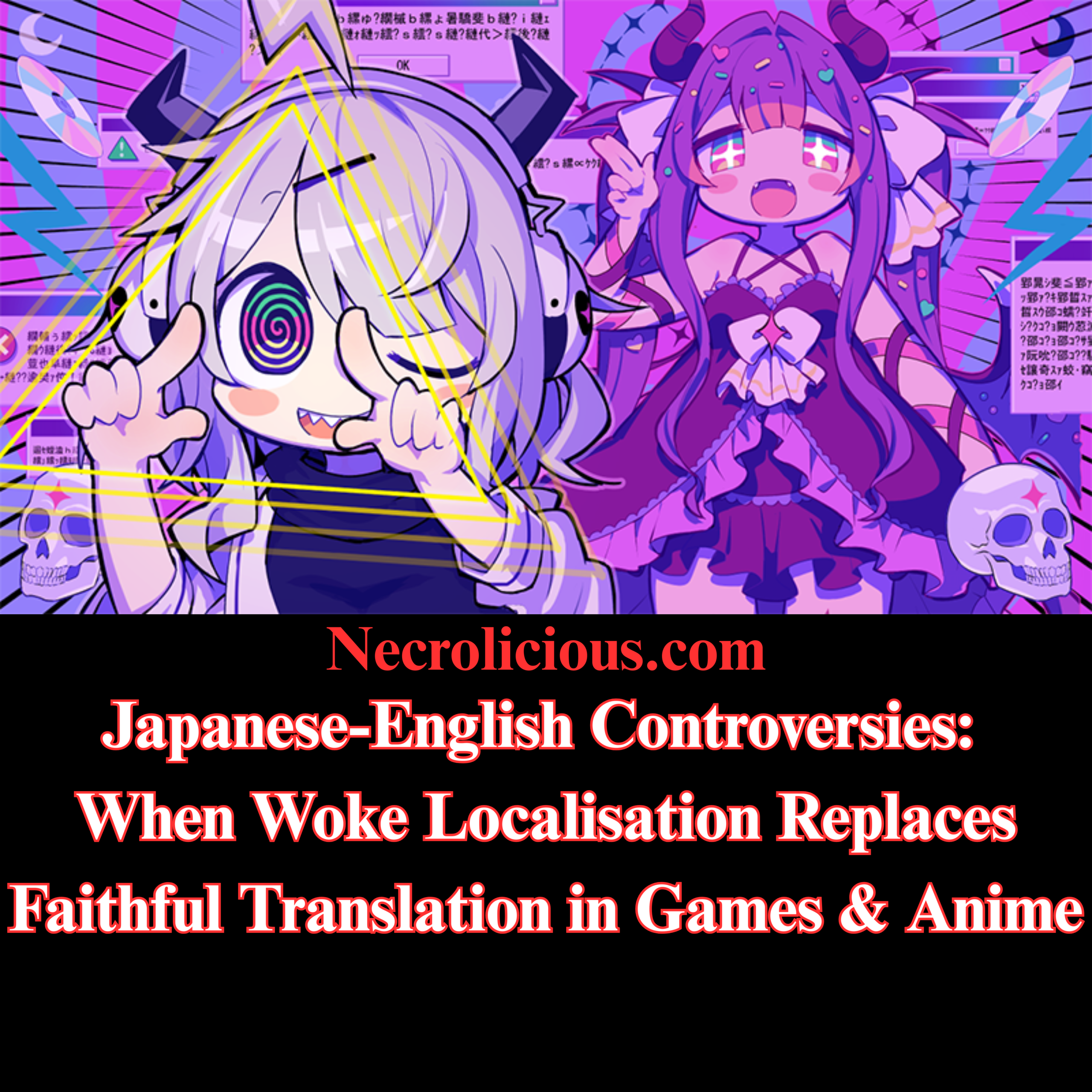
Japanese-English Controversies: When Woke Localisation Replaces Faithful Translation in Games & Anime

@necroliciouseng

Japanese-English Controversies: When Woke Localisation Replaces Faithful Translation in Games & Anime #games #anime #localisation #antiwoke #anticommie

♬ オリジナル楽曲 – Necrolicious ENG🇺🇲🇬🇧 – Necrolicious ENG🇺🇲🇬🇧

Fans of Japanese games & anime have long celebrated the quirky humour, cultural nuance & escapist worlds that define the medium. Yet a growing number of players report that the English versions they encounter often feel altered, with dialogue rewritten to include modern political messaging which was totally absent from the original Japanese text. This pattern has sparked heated debate across Steam forums, social platforms & enthusiast communities, raising questions about creative intent, cultural respect & the role of localisers.

As someone who has followed anime & gaming culture for years, tracking everything from major studio releases to quirky indie rhythm adventures, the latest controversies stand out not as isolated errors but as symptoms of deeper industry tensions. Japanese creators pour their vision into works that frequently embrace unfiltered tropes, denpa aesthetics & apolitical escapism. When localisations deviate sharply, they risk undermining the very appeal that draws international audiences. This article examines the evidence, historical context & practical steps forward, drawing on official developer statements, community feedback & calls for reform.

Recent Flashpoint: The Yunyun Syndrome!? Rhythm Psychosis Localisation Scandal

The April 2026 release of Yunyun Syndrome!? Rhythm Psychosis, an indie rhythm adventure game developed by WHO YOU under WSS Playground & co-published by Alliance Arts, quickly became a case study in localisation friction. The title, which pays homage to 2000s Japanese otaku culture through high-energy denpa songs & eccentric storytelling, launched with an English version handled by Tokyo-based firm Dragonbaby.

Within days, players flagged egregious changes. Casual Japanese pleas such as “やめろ…” (yamero, roughly “stop it” or “cut it out”) appeared rewritten as “END FASCISM” or “i will NEVER be victimized under fascism again.” References to classic otaku touchstones like Rance, Haruhi Suzumiya & Digimon were reportedly stripped or reframed, while tone & intent shifted toward activist phrasing. Developer Fuyuki Hayashi addressed the issue directly via a Steam announcement on 25 April 2026, acknowledging player concerns & confirming that the team had “worked closely” with localisers yet still required fixes.

Patch 1.0.6 rolled out swiftly, revising specific lines with more updates promised after a full review. The dev statement, communicated partly through machine translation due to language barriers, emphasised restoring the original vision. Community archives & side-by-side comparisons circulated widely, highlighting how simple, playful text had been transformed into unrelated political statements. Reports from Niche Gamer & Noisy Pixel corroborated the timeline, noting the game’s rapid pivot to damage control.

Dragonbaby Under Fire: Patterns of Alleged Vandalism

Critics zeroed in on Dragonbaby as the responsible party. The firm’s own website lists past projects including Silent Hill 2, Signalis, Mouthwashing & even legacy titles like Metal Gear Solid, describing client studios as “sacrifices” in a section titled “Games we have touched with our fingers.” Community sleuths linked the company president to earlier translation disputes, including a high-profile Metal Gear Solid incident detailed in archived video analyses.

Replies to key discussions on X amplified the pattern. One post labelled the work outright vandalism, urging a full blacklist & potential legal recourse. Supporters pointed to similar complaints in other titles, where feminine characters received gender-identity rewrites or casual dialogue gained feminist or anti-capitalist framing. While some defenders argue localisation requires cultural adaptation, the volume of documented insertions without developer approval suggests otherwise.

Community Response & Calls for Contractual Safeguards

The backlash extended beyond one game. A widely shared social media post endorsed a detailed proposal outlining ironclad contract clauses for Japanese developers. These include a “Strict Fidelity Clause” mandating preservation of original meaning, tone, style & intent, with explicit bans on unauthorised political additions or cultural rewrites.

Penalty provisions were equally specific: localisers must redo affected content at their expense plus fixed dissuasive fines, with developers empowered to withhold payments, impose liquidated damages per breach & claim full reimbursement for re-localisation or marketing costs. The post stressed scepticism toward Western intermediaries & the need to treat localisation as a controlled business relationship.

A welcome trend of further calls for accountability is forming. Japanese users noted that platforms like X have increased domestic awareness, with some developers already employing AI back-translation for quality checks. Government discussions on supporting translators & overseas business controls were referenced in comments as positive signals.

The Ideological Asymmetry: Why Left-Wing Insertions Dominate

Observers have noted a striking one-sidedness. High-profile cases involving insertions of progressive/woke messaging, equity language or reframed “problematic” elements consistently trace to localisers operating within Western creative industries that skew left-leaning. Firms face little internal pushback when altering content to align with contemporary sensitivities around gender, politics or social norms.

Right-wing or centrist translators, by contrast, rarely appear in equivalent controversies. Their approach tends toward minimal intervention: preserving fanservice, edgy humour or traditional tropes that define much Japanese media. Historical precedents from the 1990s & 2000s involved conservative market-driven cuts, such as removing alcohol references or toning down violence for family audiences, yet these were publisher mandates rather than individual ideological overlays. Today’s complaints centre on additions rather than excisions.

Industry demographics help explain the imbalance. Localisation roles in anime dubbing, manga publishing & game adaptation often attract professionals embedded in progressive cultural circles in the US, UK & Europe. Japanese source material, rich in escapist elements that can clash with modern Western norms, becomes a canvas for “fixes.” Without ideological diversity or contractual guardrails, the incentive for agenda insertion persists.

Historical Context: Censorship Then & Now

Early Western releases of Japanese media faced heavy conservative censorship driven by religious or retail pressures. Games lost religious symbols, outfits were desexualised & dialogue was sanitised to avoid controversy. The shift to activist additions reflects changing societal currents: from broad prudishness to targeted ideological reframing. Both erode creator intent, but the current wave draws sharper fan ire because it replaces Japanese cultural specificity with imported commentary.

Practical Takeaways for Creators, Vloggers, Gamers & Anime Fans

For Japanese developers & publishers:

  • Embed fidelity clauses with financial penalties in every localisation contract.
  • Require written approval from the original team for any deviation.
  • Incorporate AI-assisted back-translation & native Japanese oversight before final sign-off.
  • Consider direct machine-translation options or neutral partners for smaller titles.

For vloggers & content creators: spotlight side-by-side comparisons, interview affected developers & amplify official patch announcements to drive accountability.

For gamers & anime fans: leave detailed Steam reviews citing specific changes, support patched versions & vote with wallets by researching localisation teams in advance. Community spreadsheets tracking disputed firms already exist & prove valuable.

Looking Ahead: Growing Japanese Awareness & Solutions

Replies across platforms suggest momentum. Japanese developers increasingly recognise the issue through global feedback loops. Some studios explore AI tools, while broader industry talks include government-backed training for ethical translators. The Yunyun Syndrome response, with its rapid patch & public statement, sets a precedent: public pressure works.

Ultimately, faithful localisation benefits everyone. International audiences seek the authentic Japanese perspective, not a localised manifesto. By prioritising contracts, technology & oversight, the industry can protect creative vision while expanding reach.

FAQ

What exactly happened with Yunyun Syndrome localisation?
The English version inserted political slogans absent from the Japanese original, such as changing casual pleas into anti-fascism statements. Developers issued patch 1.0.6 with fixes & promised further revisions after community outcry.

Why do some localisers add political messaging?
Many operate in Western creative fields that lean progressive. Japanese media often features elements clashing with those sensitivities, leading to unsolicited “updates” rather than neutral adaptation.

Are right-wing translators doing the same?
No comparable pattern exists. Right-leaning or centrist approaches typically preserve original tone & content, drawing criticism only when accused of insufficient adaptation rather than ideological rewriting.

What can fans do to support better localisations?
Provide specific feedback on Steam, share side-by-side evidence & back developers who issue patches. Research localisation credits before purchase.

Will AI replace human localisers?
AI already aids quality checks & back-translation. Combined with strict contracts, it offers a scalable path toward fidelity without activist influence.

Necrolicious “No Filter” Witch Goth Meme 100% Cotton Unisex Tee
Buy on Printify

Unless otherwise noted, image assets above are NOT original content & are shared under fair use doctrine with NO claims to authorship or ownership.
Contact necrolicious@necrolicious.com for credit or removal.

This post was sponsored by…ME! If you’d like to support, please buy my original meme merchandise or check out my affiliate links to get yourself some other cool things. Additional affiliate links may be contained in the above article. If you click on an affiliate link & sign up/make a purchase, I may earn a commission. This does not increase the price you pay for the product or service, so it helps support this website at no cost to you.

If you would like to support my work more directly, I accept voluntary cryptocurrency donations in BTC, ETH, XRP & XLM sent directly to necrolicious.x. necrolicious.x is an Unstoppable Domains name that resolves to the wallet addresses I have configured. Simply enter necrolicious.x as the recipient in a supported wallet (such as Trust Wallet, Blockchain.com or others that support Unstoppable Domains). Donation Disclaimer: All cryptocurrency donations sent to me are final, voluntary gifts & are non-refundable & irreversible. These donations are not tax-deductible since I am not a registered charitable organization, & no tax receipts will be issued. No memo or destination tag is required for XRP or XLM donations, as the domain resolves directly to a wallet address. By sending a donation you acknowledge & accept all associated risks, including cryptocurrency price volatility, network fees & potential loss of funds due to incorrect network selection or transaction errors. I am not responsible or liable for any loss related to your donation. No goods, services or other benefits are provided in exchange for donations. This is not financial, tax, legal or investment advice. Please consult a qualified professional regarding any implications of your donation.
Share this: