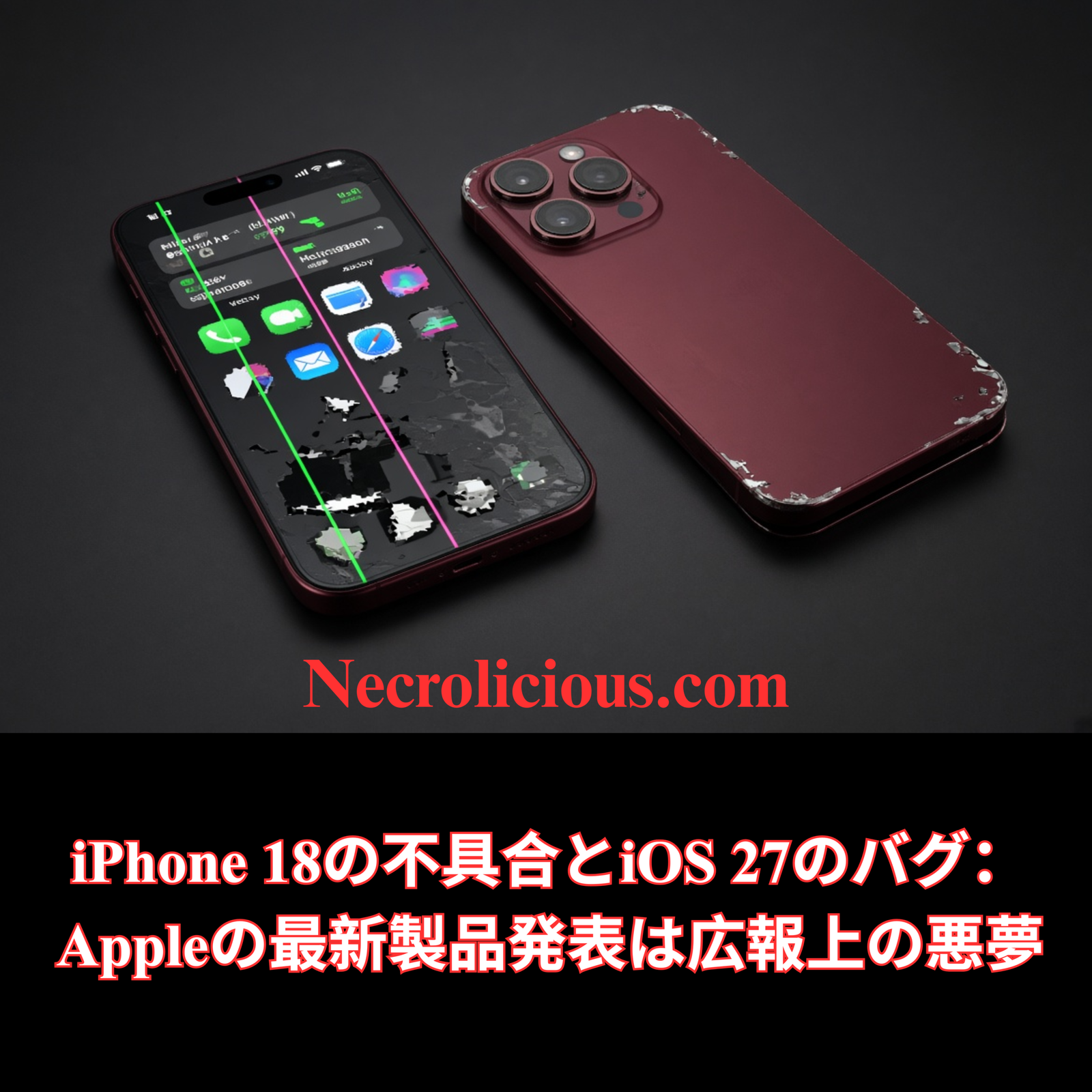
Reports emerging from financial outlets like Nikkei Asia reveal that Apple has abruptly instructed its manufacturing partners to slash component orders for the iPhone 18 Pro & Pro Max by 15% to 20% for October 2026. Predictably, corporate analysts are attempting to sanitise this crisis, framing the scale-backs as mere routine post-launch calibrations or harmless reactions to soft consumer demand following an exorbitant price hike. Do not be deceived by the corporate spin.
The reality is far uglier. Apple has rushed a fundamentally defective product line to market, charging exorbitant flagship prices while forcing loyal consumers to act as unpaid beta testers. Between catastrophic quality control failures on the factory floor, a fragile chassis that degrades within days & an operating system running rampant with critical bugs, Apple is not facing a simple sales dip; it is frantically shutting down production lines to contain a mounting hardware catastrophe.
If the standard slab iPhone 18 is already falling apart in buyers’ hands, anyone daring to purchase the experimental iPhone Duo is actively cruising for a bruising.
The Quality Control Crisis Apple Cannot Hide
When a company as ruthlessly efficient as Apple slams the brakes on its supply chain mere weeks after a launch, it points to severe structural panic. Halting assembly lines at Foxconn costs millions of dollars per hour. Apple is doing so because a frightening percentage of these units are unfit for retail shelves.
As I recently exposed, the dual-screen form factor is suffering from a shocking 40% failure rate to pass basic quality control on the iPhone Duo. Nearly half of the devices coming off the line are being sent directly to the scrap heap because experimental hinges fail, panels delaminate & tolerances disintegrate. Pushing forward with an untested design when you cannot even manufacture it reliably is the height of corporate arrogance.
The 20% component cuts for the Pro & Pro Max are Apple’s desperate attempt at damage control. Rather than fulfilling non-existent demand, Apple is retooling its factories to stem the financial bleeding of widespread manufacturing defects. The narrative of “calculated supply chain management” is a transparent facade masking assembly lines choked by defective hardware.
For years, Apple justified its extortionate price tags by boasting of unmatched industrial design & premium materials. With the iPhone 18 generation, that boast has collapsed. Apple discarded the robust titanium chassis of previous iterations in favour of a cheapened aluminium unibody, masquerading the downgrade behind claims of better thermal dissipation for its internal vapour chamber.
The consequences have been immediate & disgraceful:
Severe Cosmetic Degradation: The anodised aluminium finish chips & scratches under the gentlest everyday contact. Resting the device on a clean desk or placing it in an empty coat pocket is enough to strip paint from the raised camera plateau, leaving an expensive flagship looking battered within forty-eight hours.
Separating Back Panels: Due to rampant thermal buildup from the processor & wireless charging, the adhesive ring securing the rear glass softens under heat & the mechanical pull of MagSafe accessories. Brand-new phones are exhibiting lifting glass panels that compromise structural integrity & nullify water resistance.
Catastrophic Display Striping: Permanent pink, red & green vertical stripes are appearing across OLED panels worldwide. This is not a glitch; it is an irreparable hardware failure where the power drive to individual subpixel columns snaps permanently.
Apple’s official response has been to dismiss severe manufacturing flaws as standard “wear & tear.” Expecting consumers to swallow a $100 price hike for metal that scars & glass that unglues is nothing short of insulting.
iOS 27: A Broken Promise That “It Just Works”
Apple’s long-standing marketing mantra—that its devices “just work”—has become a punchline. The software ship is sinking just as quickly as the hardware. iOS 27 arrived in a profoundly broken state, transforming flagship handsets into glitch-ridden paperweights.
As detailed in my breakdown of the critical iOS 27 bugs turning Apple’s launch into a PR nightmare, basic everyday interactions are triggering catastrophic software panics:
The Under-Display Face ID Crash Loop: Apple relocated the infrared array beneath the glass to shrink the display cut-out, but the launch firmware cannot communicate with the hardware properly. A single failed biometric check within a locked application frequently causes the screen to freeze entirely before throwing the phone into a forced kernel reboot.
Interface Paralysis: Swiping down the Notification Centre & quickly invoking the Control Centre completely locks the touch digitiser, forcing users to wait for a timeout or execute a hard button combination.
The Widget Home-Screen Blackout: Simply rearranging app icons or dragging a widget across screen pages causes the springboard layout to tear violently or crash into a black display of death.
These are not obscure edge cases; they are fundamental operating system crashes occurring on display models right inside Apple Stores. Word-of-mouth has turned toxic because consumers are sick of paying four-figure sums for software that feels like an early developer alpha.
The Arrogant $100 Price Hike Backfires
To add insult to injury, Apple decided to hike prices across the board, pushing the entry price of the iPhone 18 Pro to $1,199 & the Pro Max to $1,299.
As I warned in Winter of 2025, when examining how DRAM shortages would drive up consumer tech prices, Apple has chosen to shift component inflation entirely onto its customers while systematically stripping back hardware durability.
Furthermore, Apple’s calculated decision to hold back the base iPhone 18 & the thinner iPhone Air until spring 2027 was an aggressive gambit to force everyone into buying the overpriced Pro models. That gambit has failed. Buyers see a transitional, compromised lineup plagued by defects & they are closing their wallets. The weak demand is a direct, deliberate rejection of Apple’s predatory pricing & declining standards.
Cruising for a Bruising: Do Not Touch the iPhone Duo
If Apple cannot even assemble a rigid, traditional glass-and-metal slab without displays failing, rear panels detaching & software crashing, what sane person would trust them with a dual-screen device?
The dual-screen iPhone Duo represents the absolute worst impulses of modern Apple: an experimental, high-margin gimmick pushed to store shelves before the engineering has matured. With a horrific 40% defect rate on the factory floor, Apple is essentially tossing a coin on whether every manufactured unit will survive assembly. If a handset struggles to survive the controlled environment of a cleanroom, it cannot be expected to survive your pocket.
Buying the iPhone Duo is an exercise in reckless optimism. You are paying thousands of dollars for experimental hinges that Apple refuses to discuss, complex dual panels prone to unfixable line defects & an operating system that cannot even handle basic widgets without crashing. Purchasing one is practically begging for buyer’s remorse. You are setting yourself up for an expensive, frustrating disaster. Keep your wallet firmly shut.
Frequently Asked Questions (FAQ)
Why is Apple cutting iPhone 18 production by 15% to 20%?
Apple is scaling back production because the iPhone 18 lineup is suffering from intense consumer rejection & severe manufacturing bottlenecks. Rather than a routine supply adjustment, Apple is halting assembly lines to contain the financial damage of defective units & address widespread hardware flaws.
Why is the iPhone Duo considered a terrible purchase?
The iPhone Duo is experiencing an unprecedented 40% failure rate during quality control checks at manufacturing plants. If nearly half of these devices cannot pass factory inspections, real-world durability will be disastrous. Buying this experimental dual-screen phone is a massive financial risk.
What are the primary hardware defects on the iPhone 18 Pro?
The aluminium frame scuffs & chips almost immediately, the rear glass panel detaches due to heat softening the internal adhesive & the OLED displays suffer from permanent vertical green & pink line failures caused by broken subpixel connections.
Is iOS 27 stable enough for daily use?
No. iOS 27 is plagued by severe bugs, including kernel-level reboot loops caused by under-display Face ID errors, touch-screen freezes when opening control panels & complete home-screen crashes when moving basic widgets.
Unless otherwise noted, image assets above are NOT original content & are shared under fair use doctrine with NO claims to authorship or ownership. Contact necrolicious@necrolicious.com for credit or removal.
This post was sponsored by…ME! If you’d like to support, please buy my original meme merchandise or check out my affiliate links to get yourself some other cool things. Additional affiliate links may be contained in the above article. If you click on an affiliate link & sign up/make a purchase, I may earn a commission. This does not increase the price you pay for the product or service, so it helps support this website at no cost to you.
If you would like to support my work more directly, I accept voluntary cryptocurrency donations in BTC, ETH, XRP & XLM sent directly to necrolicious.x. necrolicious.x is an Unstoppable Domains name that resolves to the wallet addresses I have configured. Simply enter necrolicious.x as the recipient in a supported wallet (such as Trust Wallet, Blockchain.com or others that support Unstoppable Domains). Donation Disclaimer: All cryptocurrency donations sent to me are final, voluntary gifts & are non-refundable & irreversible. These donations are not tax-deductible since I am not a registered charitable organization, & no tax receipts will be issued. No memo or destination tag is required for XRP or XLM donations, as the domain resolves directly to a wallet address. By sending a donation you acknowledge & accept all associated risks, including cryptocurrency price volatility, network fees & potential loss of funds due to incorrect network selection or transaction errors. I am not responsible or liable for any loss related to your donation. No goods, services or other benefits are provided in exchange for donations. This is not financial, tax, legal or investment advice. Please consult a qualified professional regarding any implications of your donation.
Apple is at it again, rushing another fundamentally flawed product to market while expecting consumers to pay a premium for the privilege of being beta testers. Reports have recently surfaced that the highly anticipated dual-screen iPhone Duo is facing catastrophic production issues, with a staggering 40% of manufactured devices failing to pass basic quality control. For a company that constantly touts its superior engineering and premium build quality, this massive failure rate is a glaring red flag. If nearly half of these highly expensive devices can’t even survive the factory floor, there is absolutely no reason anyone should trust them to survive daily life in the real world.
What is most concerning about this production nightmare is the complete lack of transparency regarding what is actually going wrong. While the 40% failure metric has made its way to the press, the specific defects responsible for this bottleneck remain a closely guarded secret. Are the experimental hinges failing? Are the dual screens breaking under pressure? Apple remains tight-lipped, effectively asking consumers to blindly hand over their money for a device that is demonstrably defective at its core. This silence speaks volumes, proving that the iPhone Duo is a half-baked experiment rather than a finished, reliable product.
Samsung Galaxy Z Fold8 Unlocked 512GB Graphite Buy on Amazon
Given this disastrous rollout, I strongly advise everyone to keep their wallets closed and absolutely avoid buying the iPhone Duo. Unfortunately, this is just the latest in a growing trend of Apple releasing severely compromised hardware. As I’ve previously documented, the iPhone 18 has been plagued with extreme durability issues, severely scratching and scuffing under even the lightest, most careful usage. Combine that hardware fragility with the unfixable green and pink lines randomly appearing across users’ screens and the absolute disaster that is iOS 27—which is actively glitching and bricking devices right inside Apple Stores—and the pattern is undeniable. Skip the iPhone Duo; Apple’s current hardware simply isn’t worth your money or your frustration.
Unless otherwise noted, image assets above are NOT original content & are shared under fair use doctrine with NO claims to authorship or ownership. Contact necrolicious@necrolicious.com for credit or removal.
This post was sponsored by…ME! If you’d like to support, please buy my original meme merchandise or check out my affiliate links to get yourself some other cool things. Additional affiliate links may be contained in the above article. If you click on an affiliate link & sign up/make a purchase, I may earn a commission. This does not increase the price you pay for the product or service, so it helps support this website at no cost to you.
If you would like to support my work more directly, I accept voluntary cryptocurrency donations in BTC, ETH, XRP & XLM sent directly to necrolicious.x. necrolicious.x is an Unstoppable Domains name that resolves to the wallet addresses I have configured. Simply enter necrolicious.x as the recipient in a supported wallet (such as Trust Wallet, Blockchain.com or others that support Unstoppable Domains). Donation Disclaimer: All cryptocurrency donations sent to me are final, voluntary gifts & are non-refundable & irreversible. These donations are not tax-deductible since I am not a registered charitable organization, & no tax receipts will be issued. No memo or destination tag is required for XRP or XLM donations, as the domain resolves directly to a wallet address. By sending a donation you acknowledge & accept all associated risks, including cryptocurrency price volatility, network fees & potential loss of funds due to incorrect network selection or transaction errors. I am not responsible or liable for any loss related to your donation. No goods, services or other benefits are provided in exchange for donations. This is not financial, tax, legal or investment advice. Please consult a qualified professional regarding any implications of your donation.
If you have just unboxed an iPhone 18 or are staring at the iOS 27 update prompt on an older handset, you want a straightforward answer. The new devices went on sale on 18 September 2026. Within days, social media was flooded with reports of freezes, coloured lines, Face ID reboots & aluminium frames that look visibly worn after just a weekend of use.
These complaints are not confined to a single expensive SKU. Reports cover the base iPhone 18, the Pro & the Pro Max. Throughout this article, “iPhone 18” refers to the entire 2026 lineup. Do not assume the Pro or Pro Max is the safe option; in several cases, these are the exact models buyers paid a premium for before filming their defects.
This is not a mere handful of unlucky review units. It is a launch-week accumulation of hardware compromises & unfinished software, all sold at a price point that assumes Apple still delivers a polished product. Having covered numerous autumn iPhone cycles, I recognise the usual release noise. This cycle is notably louder because the company is charging flagship prices for aluminium that easily scars, an operating system that can lock the home screen & a design language that was already showing its age on last year’s devices.
I previously argued that consumers should purchase capable devices before 2026 component inflation pushed prices up & quality sideways. That warning on Apple pricing & the memory squeeze now looks far less like speculation. The iPhone 18 is the exact product that warning described: dearer, softer & inherently unfinished.
The aluminium frame is the first tell
Apple has returned this generation to an aluminium unibody after two years of using titanium on the Pro line. Aluminium conducts heat efficiently & supports the internal vapour chamber design. However, it also marks easily. The anodised colour coating is prone to chipping. The raised camera plateau loses paint simply from resting on a desk or sharing a pocket with keys. Independent scratch tests continue to reveal the same disparity: the front glass is durable, but the metal frame is not.
Apple dismisses this as standard wear & tear. Owners transitioning from a caseless titanium handset rightly call it a visible downgrade within the first week. If your iPhone 17 or earlier is still functioning, you are not missing out on a tougher device. You are simply being asked to pay more for a finish that ages faster. This reality applies whether your box says 18, Pro or Pro Max.
The back-glass lip is a familiar problem
Even before the new handsets reached store shelves, owners of last year’s models were removing their cases & discovering the rear glass sitting slightly out of the frame. It is enough to catch on a nearby surface or even fingernail then actually fall out. The working theory points to a combination of heat from the processor, wireless charging & the pulling force of MagSafe accessories softening a thin adhesive ring.
The iPhone 18 continues to use a glass back bonded to an aluminium frame. While a larger vapour chamber might mitigate some of the heat, it does not fundamentally improve the joint. A brand-new unit featuring a raised, movable rear panel is defective out of the box. A generation that requires a warning label about magnets has not earned its premium price tag.
Green & pink lines denote a hardware failure
The most widely shared photos are the simplest to understand. They show a vertical pink or green stripe, & sometimes a red one, running down the display. A factory reset accomplishes nothing. On an OLED screen, this pattern typically indicates a damaged column on the panel. Apple’s green subpixels are arranged in vertical lines; if the drive to one column breaks, the stripe remains permanently.
While social media evidence should always be treated with caution—at least one viral image appears edited since the line passes behind status-bar icons, which a physical fault cannot do—the remaining videos are compelling enough. Some owners have already walked out of retail stores with replacement units. Apple has yet to identify a faulty batch or a specific supplier, but silence does not equate to a clean bill of health.
If a coloured line persists after a reset, photograph the screen & book a warranty appointment. Do not accept a software explanation for a dead column of pixels, & do not convince yourself that the higher-cost models are immune to the issue.
Face ID features a smaller island & messier logins
Apple relocated the infrared hardware beneath the display to reduce the size of the cut-out. Unfortunately, a failed Face ID check within a locked app could freeze the screen & force the phone to reboot. The specialist tech press successfully reproduced the error, & panic logs appeared in user analytics. This is not user error. It is a clear case of launch firmware failing to interface properly with new hardware.
There is a secondary, quieter complaint regarding more passcode prompts than users expected, which is often blamed on screen protectors. Even after the initial software patch, these leftover misses represent a genuine reliability issue. The reboot loop was a fundamental product defect, & paying for a Pro or Pro Max badge did not offer an escape.
iOS 27 launched on the iPhone 18 & disrupted everything else
This is the section that owners of older iPhones cannot afford to ignore. iOS 27 is the factory software for the new lineup, but it is also the public build that older supported models installed. When the home screen breaks, an iPhone 17 that only wanted software features inherits the exact same dead interface.
Two everyday gestures were responsible for the damage seen in the viral videos.
Notification Centre into Control Centre. Pull down from the top left, then immediately from the top right before the first panel finishes its animation. The touch interface stops responding. You cannot swipe between pages, & lock-screen shortcuts can become stuck. This bug affected more than just the new phones, prompting Apple to address it in the 27.0.1 release notes.
Moving a widget & tapping the page dots. Long-press the screen until the icons jiggle. Drag a widget with one finger, then tap the dots at the bottom or drop the widget onto another stack. The display either goes black or the layout tears completely. The only way to regain control is to force-restart the device. This specific sequence was still causing problems even after the 27.0.1 update.
While these bugs do not permanently brick the phone, they are infuriating in a different way. They reduce a flagship device to something that feels like beta software. It is highly advised not to rearrange widgets just to see if it crashes.
A PR nightmare caused by a broken brand promise
Apple’s central pitch has always been straightforward: you pay a premium, & you receive a device that simply works. Launch week entirely inverted that promise. Social media highlighted metal that scars, rear glass that can lift off & fall out, display panels suffering from coloured lines, Face ID modules that force reboots & home screens that die from moving a widget.
None of these issues emerged from thin air. The cosmetic flaws of aluminium were entirely predictable after last year. The adhesive concerns were already public knowledge when the iPhone 18 became available for pre-order. Furthermore, iOS 27 was not a quiet beta test limited to a single SKU; Apple pushed it out to its entire supported base.
This explains why the current public mood is significantly nastier than during a typical point-release week. Consumers are not merely frustrated by software bugs. They are angry because this extensive bug list appeared on a product priced as though it were meticulously finished.
Samsung Galaxy Z Fold8 Unlocked 512GB Graphite Buy on Amazon
Do not buy an iPhone 18, consider leaving the ecosystem
If you currently own an iPhone 17 or an earlier model, keep it. The new lineup does not offer a durability upgrade. Instead, it is a more expensive aluminium handset running software that required a hotfix in under two weeks. The Pro & Pro Max variants are not safe havens; they are frequently the exact models featured in the most troubling defect videos.
Rather than simply waiting for an update, give serious thought to leaving the Apple ecosystem entirely. Samsung represents the most logical first alternative, offering mature foldables, refined software & file-sharing capabilities that do not require everyone in your social circle to own a device with the same logo. Galaxy Quick Share can seamlessly communicate with iPhones. Which specific Galaxy model you choose is entirely up to you; the overarching recommendation is to find an exit ramp, not to endorse a specific SKU.
Even a competent budget Android device currently offers better value than a faulty object priced as luxury. You will not be paying titanium-era prices for aluminium-era blemishes, & you will certainly not be forced to debug a home screen that crashes over a widget. Overpaying for defective technology is a habit that this specific launch should finally break.
For some readers, the argument regarding quality is sufficient on its own. For others, a parallel boycott has been gaining momentum since the previous hardware cycle. This movement urges consumers to skip Apple because Israeli engineering facilities assisted in designing connectivity silicon used in recent models, most notably the in-house C1X modem & the N1 wireless chip credited to israeli R&D teams. That research footprint is entirely real. If you personally refuse to fund companies with deep Israeli tech ties, this serves as yet another reason to avoid the iPhone 18.
Whether you join the boycott for quality, for personal values or for suspicions of secretly embedded detonators, the choice is clear. israeli tech, scuffed frames, lifted glass, display lines & iOS 27 freezes…it all points to the exact same conclusion for this publication: do not reward Apple with another upgrade cycle.
This aligns perfectly with the logic of securing a solid device in 2025 before the DRAM squeeze & the wider price climb altered the market, making “new” synonymous with “lower quality at higher prices” The iPhone 18 is the physical manifestation of that exact forecast.
Apple’s attempts to contain the damage
Apple released iOS 27.0.1 in late September 2026. The patch notes address unexpected restarts caused by Face ID failures on the new hardware, a colour artefact present on certain 2x photos shot at f/1.48 & unresponsive touch controls occurring when the Notification Centre & Control Centre are opened simultaneously.
Additionally, some users suffering from lines on their screens have received replacement handsets under standard warranty procedures. However, Apple has not announced an official repair programme for the easily marked frames, a recall for the failing adhesive or a definitive fix for the widget crash within that specific point release. Cosmetic damage to the aluminium is still officially classified as normal wear.
This response amounts to a software patch alongside a few quiet hardware swaps. While it may have halted the influx of Face ID panic videos, it certainly did not make the launch look competent, nor did it refund the time buyers wasted force-restarting their brand-new phones.
If a standard slab phone can arrive in retail stores in this condition, it is wise not to romanticise the upcoming dual-screen iPhone Duo. Adding extra glass & a mechanical hinge will not magically fix rushed, impolite software. The industry is already crowding into the market for squat foldables. Apple arriving late with a messy, traditional bar phone serves as a grim preview. If this was supposed to be the straightforward device, the first fortnight of the Duo’s lifespan will likely be far worse.
Frequently Asked Questions
Should I buy an iPhone 18 right now? No, not if you expect a finished product. This advice applies to the base model, the Pro & the Pro Max. While update 27.0.1 resolved the Face ID reboot & one specific freeze gesture, the widget crash, the soft aluminium frame & the screen line reports remain active issues. It is best to wait or spend your money outside of the Apple ecosystem.
Will iOS 27 disrupt my iPhone 17? It certainly can. The freeze caused by opening the Notification Centre & Control Centre simultaneously was not limited to the new phones. Several reproductions of the widget crash also involved older models. Simply stating “I only updated the software” will not protect your device from these bugs.
Are the green screen lines just a software bug? Not if they survive a factory reset. A persistent line indicates failing panel hardware. Book a warranty repair immediately, & do not wait around hoping the next iOS build will magically fix a physical defect.
Is the Pro or Pro Max a safer purchase? Do not make that assumption. Several of the most concerning launch videos featured the more expensive models. View the “iPhone 18” label as a broad warning for the entire 2026 lineup.
Is Samsung the only alternative? No, but it represents the clearest full-system off-ramp. You should compare foldables, standard slates & mid-range Android devices based on your own specific needs. The ultimate goal is to stop assuming that the next iPhone release will serve as an apology for the current one.
Should I skip the iPhone 18 & wait for the iPhone Duo? No. A traditional bar phone that required an immediate hotfix, still crashes when you move a widget & wears down its paint in a matter of days is a terrible rehearsal for a company’s first foldable device. Expect a significantly harder launch, not a cleaner one.
Unless otherwise noted, image assets above are NOT original content & are shared under fair use doctrine with NO claims to authorship or ownership. Contact necrolicious@necrolicious.com for credit or removal.
This post was sponsored by…ME! If you’d like to support, please buy my original meme merchandise or check out my affiliate links to get yourself some other cool things. Additional affiliate links may be contained in the above article. If you click on an affiliate link & sign up/make a purchase, I may earn a commission. This does not increase the price you pay for the product or service, so it helps support this website at no cost to you.
If you would like to support my work more directly, I accept voluntary cryptocurrency donations in BTC, ETH, XRP & XLM sent directly to necrolicious.x. necrolicious.x is an Unstoppable Domains name that resolves to the wallet addresses I have configured. Simply enter necrolicious.x as the recipient in a supported wallet (such as Trust Wallet, Blockchain.com or others that support Unstoppable Domains). Donation Disclaimer: All cryptocurrency donations sent to me are final, voluntary gifts & are non-refundable & irreversible. These donations are not tax-deductible since I am not a registered charitable organization, & no tax receipts will be issued. No memo or destination tag is required for XRP or XLM donations, as the domain resolves directly to a wallet address. By sending a donation you acknowledge & accept all associated risks, including cryptocurrency price volatility, network fees & potential loss of funds due to incorrect network selection or transaction errors. I am not responsible or liable for any loss related to your donation. No goods, services or other benefits are provided in exchange for donations. This is not financial, tax, legal or investment advice. Please consult a qualified professional regarding any implications of your donation.
Apple has signalled that memory & storage costs have become unsustainable. Price increases for iPhones & other Apple products now appear unavoidable. In Japan, the weak yen will likely make these price increases more noticeable for local buyers.
This development fits a wider pattern across consumer electronics. It stems from a global DRAM shortage. The shortage has already affected consoles & other devices.
What Drives the Current DRAM Shortage
Artificial intelligence demands have redirected memory production. Data centres require large volumes of high-bandwidth memory. As a result manufacturers have shifted capacity away from standard DRAM used in phones & consoles.
For example, reports indicate that a significant share of global output now serves AI needs. Prices for certain memory types rose sharply in late 2025. In addition, supply for consumer devices has tightened.
Therefore, companies face higher bills of materials. This situation differs from past shortages. Those episodes proved shorter. The current pressure appears more sustained because AI investment continues.
Moreover, new fabrication plants will take time to come online. Relief may arrive only in 2027 or later. On the other hand, consumer products must absorb costs in the meantime.
Tim Cook stated in a Wall Street Journal interview that price increases are unavoidable. The company has tried to shield customers. However, the scale of memory cost rises has made that approach difficult.
Estimates suggest increases around 20% for higher-end models. These figures come from component cost modelling. Memory costs in particular have climbed substantially. Storage components follow the same trend.
As a result, upcoming iPhones may carry higher starting prices. Adjustments could appear with the next major refresh. In addition, Macs & iPads may see changes earlier. Apple retains strong pricing power. Nevertheless, the pressure on margins is real.
Japan Pricing & the Role of Yen Depreciation
Japan has offered competitive iPhone pricing when converted to dollars. Current models rank among lower-cost options globally. However, the yen has stayed weak against the dollar. Rates hover near 162 yen per dollar.
This weakness raises the local cost of imported components. Apple has adjusted Japan prices during earlier yen weakness. For instance, notable increases occurred in 2022 across several product lines. When the yen weakened sharply, Apple raised iPhone prices in Japan by up to 25% (e.g., iPhone 13 starting price jumped from ¥98,800 to ¥117,800). Similar adjustments occurred for other products.
Those moves protected dollar margins.
Therefore, the new memory-driven costs will likely translate into higher yen prices. The percentage rise in Japan may match or exceed global figures. In addition yen volatility adds uncertainty for buyers.
Current comparisons show Japan prices only modestly above US list figures before tax. The gap largely reflects consumption tax. Nevertheless, yen effects amplify the impact for Japanese consumers. Having followed these trends the pattern is clear. Local buyers often feel currency movements more acutely than headline percentages suggest.
Sony has already confirmed price increases for PlayStation 5 models. These took effect in April 2026 across regions. In Japan the disc edition rose from ¥79,980 to ¥97,980. The Pro model moved from ¥119,980 to ¥137,980.
Nintendo announced Switch 2 adjustments. Japan saw the change first. The price moved from ¥49,980 to ¥59,980. Company statements cited rising component costs.
These examples show consistent industry responses. Earlier console generations often saw price drops over time. Current conditions point in the opposite direction. In addition, some personal computer makers have signalled specification adjustments for 2026 models.
Therefore, enthusiasts may see fewer aggressive price reductions. On the other hand, demand for current stock remains strong in Japan. Retail queues during launches illustrate this point.
Practical Advice for Buyers
Current-generation devices, especially non-Apple ones, may offer better value before further adjustments. Stock from 2025 can secure established specifications. Trade-in programmes & promotions can offset part of any increase.
Moreover, monitoring exchange rates helps with timing. Refurbished options from authorised sellers continue to deliver reliable performance. In addition, devices with expandable storage provide future flexibility.
Nevertheless, waiting carries risk. Some 2026 models may carry higher prices alongside similar or lower specifications in certain areas. As a result, many enthusiasts now consider purchasing sooner rather than later.
Necrolicious “Abundant” Funny Luxury Skeleton Skull Meme 100% Cotton Unisex Tee Buy on Printify
Frequently Asked Questions
Will iPhone prices rise in Japan? Yes. Global memory costs & yen weakness point to higher local prices. Historical adjustments during similar periods support this outlook.
How large might the increases be? Estimates centre on around 20 per cent for higher-end models. Exact figures will depend on final component costs & currency movements at launch.
Are other products affected? Yes. PlayStation 5 & Nintendo Switch 2 have already seen confirmed regional price rises. Similar dynamics appear across laptops & other electronics.
When might costs ease? Additional memory production capacity is expected from 2027. Interim periods may involve continued elevated pricing.
Should buyers act now? Current stock offers a window. Trade-ins & promotions can help secure value before potential further changes.
Unless otherwise noted, image assets above are NOT original content & are shared under fair use doctrine with NO claims to authorship or ownership. Contact necrolicious@necrolicious.com for credit or removal.
This post was sponsored by…ME! If you’d like to support, please buy my original meme merchandise or check out my affiliate links to get yourself some other cool things. Additional affiliate links may be contained in the above article. If you click on an affiliate link & sign up/make a purchase, I may earn a commission. This does not increase the price you pay for the product or service, so it helps support this website at no cost to you.
If you would like to support my work more directly, I accept voluntary cryptocurrency donations in BTC, ETH, XRP & XLM sent directly to necrolicious.x. necrolicious.x is an Unstoppable Domains name that resolves to the wallet addresses I have configured. Simply enter necrolicious.x as the recipient in a supported wallet (such as Trust Wallet, Blockchain.com or others that support Unstoppable Domains). Donation Disclaimer: All cryptocurrency donations sent to me are final, voluntary gifts & are non-refundable & irreversible. These donations are not tax-deductible since I am not a registered charitable organization, & no tax receipts will be issued. No memo or destination tag is required for XRP or XLM donations, as the domain resolves directly to a wallet address. By sending a donation you acknowledge & accept all associated risks, including cryptocurrency price volatility, network fees & potential loss of funds due to incorrect network selection or transaction errors. I am not responsible or liable for any loss related to your donation. No goods, services or other benefits are provided in exchange for donations. This is not financial, tax, legal or investment advice. Please consult a qualified professional regarding any implications of your donation.
Quickly sharing photos, videos & files should strengthen connections rather than create technical hurdles. When one person uses a Samsung Galaxy device & another relies on an iPhone, the process of exchanging files has often required extra steps, cables or third-party services. The arrival of One UI 8.5 on compatible Samsung phones removes much of that friction through direct integration between Quick Share & Apple’s AirDrop protocol.
This development allows wireless transfers in both directions without additional applications or accounts. It focuses on real-world interactions between people who simply prefer different phones. The feature uses Apple Wireless Direct Link for nearby, peer-to-peer exchanges, building on earlier work by Google to extend Quick Share beyond pure Android environments. Samsung first detailed support for the Galaxy S26 series in March 2026, with availability expanding through One UI 8.5 updates.
How the Integration Supports Everyday Connections
Quick Share on supported Galaxy devices can now discover & connect with nearby iPhones, iPads & Macs. Apple devices appear in the Quick Share interface in the same way they would during native AirDrop sessions. The reverse process works equally well: a Samsung phone shows up when an Apple user starts an AirDrop transfer, once the Galaxy device is prepared to receive.
Transfers remain local & direct. They do not depend on internet access or cloud storage once devices locate each other. Both Wi-Fi & Bluetooth need to stay active, & devices function best when kept within approximately 10 metres. No extra software is required on the Apple side, & the experience mirrors familiar AirDrop behaviour for the recipient.
Official statements from Samsung & Google confirm that the capability is expanding gradually. Early releases targeted the newest flagships, while broader device support depends on additional chipset optimisation. Owners of some older models may install One UI 8.5 yet still lack the dedicated toggle until further refinements are released.
Support is currently limited to specific recent Galaxy models following the One UI 8.5 update. The feature is not available on every device that receives the broader One UI 8.5 software upgrade. Availability remains subject to phased rollouts that can vary by region & market. The table below summarises the confirmed range based on Samsung announcements & subsequent updates.
Device Series
Specific Models
Availability Notes
Galaxy S26
S26, S26+, S26 Ultra
Initial rollout from March 2026; pre-installed on many units
Galaxy S25
S25, S25+, S25 Ultra, S25 FE
Via One UI 8.5 update; expanded rollout in spring 2026
Galaxy S24
S24, S24+, S24 Ultra, S24 FE
Via One UI 8.5 update; available on most units after May 2026
Galaxy Z Fold
Z Fold 7, Z Fold 6
Via One UI 8.5 update; both generations supported
Galaxy Z Flip
Z Flip 7, Z Flip 6
Via One UI 8.5 update; both generations supported
Devices such as the Galaxy S23 series receive the One UI 8.5 update but do not include the AirDrop compatibility toggle. Mid-range & older models outside the listed series generally lack the feature at present. Users should open Quick Share settings after updating to confirm whether the “Share with Apple devices” option appears.
Preparation on the Samsung side involves confirming the update has installed through Settings > Software update. Related Quick Share components should also be current via the Galaxy Store & Google Play. The key setting appears under Connected devices > Quick Share as “Share with Apple devices” & is typically enabled by default when supported.
On Apple devices, users simply adjust AirDrop visibility to “Everyone for 10 minutes” for the duration of the exchange. Both phones or tablets require adequate battery & storage space.
Activating the Option on a Compatible Samsung Phone
Navigate to Settings, then Connected devices > Quick Share. Locate & confirm the “Share with Apple devices” toggle is active. Should the option remain absent after the update, a restart or check for component updates often resolves the matter.
Open the Quick Share panel from the notification shade. Adjust the visibility setting to “Everyone” or “Everyone for 10 minutes” when expecting files from Apple users. This temporary openness aligns with the requirement on the receiving Apple device.
Sending Content from a Galaxy Device to an Apple Device
Select the photo, video or file intended for sharing.
Tap the Share icon.
Choose Quick Share.
Allow discovery to complete; compatible Apple devices will then appear.
Select the target iPhone, iPad or Mac.
Accept the transfer on the Apple device when prompted.
The file arrives automatically in the appropriate location on the recipient’s device, such as the Photos app for images & videos. The process supports the simple act of passing memories between friends or relatives without added complexity.
Receiving Content from an Apple Device on a Samsung Phone
On the Galaxy device, swipe down twice from the top edge & tap Quick Share, or access it via Settings > Connected devices > Quick Share.
Ensure the panel indicates readiness to receive & visibility permits temporary access from others.
On the Apple device, choose the content & select Share > AirDrop.
Pick the Samsung Galaxy device from the list of nearby options.
The file lands on the Samsung side, usually in Downloads or the Quick Share folder, accompanied by a completion notification.
This direction completes the loop, allowing iPhone users to send files directly to Galaxy contacts with minimal effort.
File Size Considerations for Direct Transfers
Samsung documentation specifies that direct nearby sharing carries no official restriction on the quantity or size of files. The Quick Share–AirDrop mode follows the same principle because it operates through local wireless communication rather than link or cloud pathways. Apple’s AirDrop similarly publishes no maximum file size.
Real-world limits arise from available storage on each device & the stability of the connection during longer exchanges. Multi-gigabyte videos transfer successfully when devices remain powered & positioned appropriately. Limits associated with link-based Quick Share versions do not apply to these direct sessions.
Expected Performance with Larger Files
Small items such as individual photos or brief clips move efficiently across brands. Larger collections reveal differences compared with transfers that stay within one ecosystem. Reports from users & hands-on tests indicate that collections around 2–3 GB can require 10–15 minutes in cross-platform exchanges. Equivalent volumes often complete more quickly during native Samsung-to-Samsung Quick Share sessions or Apple-to-Apple AirDrop transfers.
Contributing elements include the additional handling required to bridge the two systems & slightly extended discovery phases when device types differ. Native implementations benefit from years of ecosystem-specific refinement. A documented test of a short video from a recent Galaxy model to a Mac via the new integration took several minutes, whereas the same file moved faster under native conditions. The distinction matters most when sharing extended event footage or high-resolution media with friends or family, yet remains secondary for typical personal exchanges.
Guidance for Consistent Results
Position devices close together & minimise movement during extended transfers. Avoid VPNs or power-saving features that could interrupt the link. Should a device fail to appear, cycling AirDrop visibility on the Apple side or refreshing the Quick Share panel on Samsung frequently restores discovery. A restart of the Galaxy device has also resolved absent options for some users following the initial update.
After an initial successful exchange, the Samsung visibility setting can often return to “Contacts only” for subsequent shares. Beginning with a small test file proves useful before moving important content.
Placing the Development in Context
AirDrop became available with iOS 7 in 2013 & established expectations for effortless local sharing inside Apple’s environment. Samsung evolved Quick Share from earlier Nearby Share foundations to serve Android users. Google’s November 2025 announcement introduced AirDrop interoperability on Pixel devices, after which Samsung incorporated similar support via One UI 8.5. The progression reflects a gradual shift toward greater compatibility between major mobile platforms.
The practical outcome allows device preferences to recede into the background during personal exchanges. Friends & family members maintain connections through shared images & videos without device type dictating the method. Privacy stays protected because data moves directly between devices rather than via intermediary servers.
Balanced Considerations & Next Steps
The update delivers clear value for routine sharing between people who use different phones. It reduces barriers that once complicated the simple act of passing along a photo or video. At the same time, very large files may still benefit from alternative approaches when time is limited. A direct cable connection provides the most predictable speed for substantial transfers. Open-source tools such as LocalSend offer additional cross-platform options that some users find efficient. Cloud services continue to serve situations where devices are not physically close.
Ongoing software updates are expected to refine performance further. Keeping system components & Quick Share modules current ensures access to improvements as they become available.
Necrolicious “Never Piss Off The Time Witch” Funny Goth Meme 100% Cotton Unisex Tee Buy on Printify
Frequently Asked Questions
Will every Samsung phone with One UI 8.5 support sharing with Apple devices? Support depends on the model. It is currently present on S24 series devices & later flagships plus selected foldables. Confirm the presence of the “Share with Apple devices” toggle in Quick Share settings after updating.
Are there file size restrictions when using the cross-platform feature? No official limits apply to direct nearby transfers. Practical factors such as storage space & connection quality determine what succeeds in a single session.
Do larger files take noticeably longer when moving between brands? Yes, reports & tests show extended times for multi-gigabyte content compared with transfers kept inside one ecosystem. The difference stems from additional compatibility handling & is most evident with extended videos or large media collections.
How can discovery issues be resolved if a device does not appear? Verify Wi-Fi & Bluetooth remain active on both devices & that visibility settings are set appropriately. Restarting the Quick Share panel or toggling AirDrop on the Apple device commonly restores visibility.
Does the transfer depend on an internet connection? No. Exchanges use direct wireless communication once devices locate each other.
Unless otherwise noted, image assets above are NOT original content & are shared under fair use doctrine with NO claims to authorship or ownership. Contact necrolicious@necrolicious.com for credit or removal.
This post was sponsored by…ME! If you’d like to support, please buy my original meme merchandise or check out my affiliate links to get yourself some other cool things. Additional affiliate links may be contained in the above article. If you click on an affiliate link & sign up/make a purchase, I may earn a commission. This does not increase the price you pay for the product or service, so it helps support this website at no cost to you.
If you would like to support my work more directly, I accept voluntary cryptocurrency donations in BTC, ETH, XRP & XLM sent directly to necrolicious.x. necrolicious.x is an Unstoppable Domains name that resolves to the wallet addresses I have configured. Simply enter necrolicious.x as the recipient in a supported wallet (such as Trust Wallet, Blockchain.com or others that support Unstoppable Domains). Donation Disclaimer: All cryptocurrency donations sent to me are final, voluntary gifts & are non-refundable & irreversible. These donations are not tax-deductible since I am not a registered charitable organization, & no tax receipts will be issued. No memo or destination tag is required for XRP or XLM donations, as the domain resolves directly to a wallet address. By sending a donation you acknowledge & accept all associated risks, including cryptocurrency price volatility, network fees & potential loss of funds due to incorrect network selection or transaction errors. I am not responsible or liable for any loss related to your donation. No goods, services or other benefits are provided in exchange for donations. This is not financial, tax, legal or investment advice. Please consult a qualified professional regarding any implications of your donation.
In April 2026, the DJI Osmo Pocket 4 captured 21.5 percent of Japan’s entire video camera market in just nine days. When combined with the still-popular Osmo Pocket 3 the two models together represented nearly 39 percent of sales in the category. Overall DJI achieved a record 72.5 percent share according to official BCN+R point-of-sale data. These results stand out in a nation where iPhone adoption remains high among younger users. The figures point to a practical response to everyday frustrations with smartphone photography rather than mere gadget enthusiasm.
DJI’s Record-Breaking Performance in Japan’s Video Camera Market
BCN+R rankings from mid-May 2026 confirm the scale of the launch effect. The Osmo Pocket 4 launch drove a 158 percent year-on-year rise in overall video camera unit sales for April. DJI models claimed the top four positions with the Pocket 4 in first place & the Pocket 3 in second. Additional DJI entries such as the Osmo Action 4 & Osmo Nano rounded out the list.
Sony, Canon & Nikon together with Panasonic & GoPro held only single-digit shares within the BCN-tracked “video camera” segment. This category covers compact action cameras, pocket gimbals & similar portable devices rather than larger mirrorless systems or professional camcorders. DJI’s focus on mechanical stabilisation & creator-friendly features has allowed it to define the segment over multiple generations.
Japan’s strong gadget culture & active vlogging community have sustained demand for dedicated devices even as global compact camera sales declined after 2010. The Pocket series delivers smooth cinematic footage through built-in three-axis gimbals, flip screens & one-handed operation that smartphones cannot replicate without extra equipment.
The Persistent Shortcomings of iPhone Computational Photography for Human Subjects
Recent iPhone models incorporate advanced hardware & sophisticated algorithms yet they repeatedly fail to deliver natural results when photographing people. Despite substantial research & development investment the post-processing produces orange or yellowish skin tones, excessive sharpening that highlights every pore & texture, & unnatural smoothing that can thin or erase eyebrows under common lighting conditions.
These outcomes feel particularly inconsiderate because most users capture images of themselves, family members & friends far more often than landscapes or wildlife. Daily life involves selfies, group photos & casual video calls while national park excursions or scenic holidays occur only once or twice a year for the average person. When a flagship device costing 200,000 yen consistently distorts the human form — the subject people care about most — it creates ongoing dissatisfaction.
I personally encountered this directly with the iPhone 13 Pro Max. Self-portraits appeared unrecognisable with pronounced orange casts & vanishing eyebrows. My immediate response was to purchase a DJI Osmo Pocket 3 to obtain reliable, non-distorted/tinged video & stills for content creation. Only after switching to a Samsung Galaxy Z Flip 6 did native phone photography become consistently usable without these distortions. The Pocket 3 now sees occasional use at most, demonstrating how one well-tuned device can eliminate the need for workarounds.
Such issues are not unique to one model. Similar complaints appear across all iPhones since the 13 series regarding camera rendering & video. Apple excels in metrics such as dynamic range & low-light performance yet these strengths matter less for the predominant use case of human-centred photography.
Korean Beauty Standards, Pale Complexions & Camera Processing Preferences
Korean beauty ideals emphasise strikingly pale, porcelain-like skin even more prominently than in Japan. This preference, often described as “glass skin” with a dewy yet luminous translucency, traces back to historical associations of fair skin with higher social status & has been amplified by K-pop, dramas & the global K-beauty industry. Japanese standards also value pale, even complexions through the concept of “bihaku” but tend toward a softer “mochi skin” texture that appears naturally nurtured rather than intensely luminous. These distinct preferences are clearly reflected in the camera features on Samsung devices, whereas iPhone cameras are oddly tailored to African diaspora & other darker skinned demographics on the global market at the expense of anyone who values pale beauty.
Samsung’s image processing aligns more closely with these regional preferences. It delivers smoother skin tones, balanced warmth & less aggressive sharpening that supports the desired pale, flawless appearance without introducing orange casts or over-emphasised texture. Whether this stems from deliberate optimisation for Asian markets or broader tuning differences remains open to discussion. Nevertheless, this is not just my opinion. Many users in Korea & across East Asia report more pleasing results for self-portraits & video with Samsung devices compared with recent iPhones.
This cultural emphasis on pale, harmonious skin makes accurate & flattering rendering essential. When smartphone cameras fail to support these daily beauty expectations users seek alternatives such as pocket gimbals that preserve natural tones & deliver smooth footage suitable for social media.
In South Korea the “young-tro” movement sees many young women carrying both a current flagship & an older iPhone model such as the XS, X or SE 1. The older hardware provides gentler, more film-like processing that avoids the heavy computational interventions of newer iPhones. While the trend is most visible in Korean social media it reflects wider East Asian sensitivities around natural skin rendering.
In Japan high iPhone status & ecosystem integration mean many users retain their devices & simply add a dedicated camera for critical moments. The Osmo Pocket series popularity arises partly from this compensatory behaviour. Its pocketable design allows seamless pairing with an iPhone for vlogging or family videos where flattering human subjects matter most.
Samsung maintains a leading 54 percent market share in Korea versus Apple’s 32 percent. Its processing & in-app editing tools resonate strongly with users who prioritise daily self & family documentation over occasional nature photography.
Balanced Perspective on Market Trends & Future Outlook
DJI’s success combines genuine innovation with responses to smartphone shortcomings. iPhone dissatisfaction contributes but does not explain the full picture. Japan’s electronics enthusiasm, short-form video growth & the sheer convenience of pocket gimbals play equally important roles.
While racial or demographic tuning in Apple’s algorithms has never been formally announce, likely to avoid lawsuits, persistent user feedback across regions highlights the need for better adaptation to common portrait scenarios. Samsung’s approach demonstrates that alternatives exist & can build loyalty in key Asian markets.
Canon’s recent patent for a compact gimbal camera suggests Japanese manufacturers recognise the gap. Whether they can translate patents into market-ready products quickly enough to challenge DJI remains to be seen.
Practical Advice for Everyday Creators
Test any new smartphone extensively in real-world lighting before relying on it for portraits.
Adjust settings such as HDR or smoothing features to minimise unwanted effects.
Prioritise devices that match your most frequent subjects — typically people rather than scenery.
For social media creators, the combination of convenience & flattering output often outweighs raw technical specifications.
Necrolicious “Photogenic” Funny Nosferatu Vampire Meme 100% Cotton Unisex Tee Buy on Printify
FAQ
How significant is the DJI Osmo Pocket 4’s market performance in Japan? BCN+R data shows it achieved 21.5 percent share in nine days with the Pocket 3 & 4 together nearing 39 percent. DJI’s total category share reached 72.5 percent in April 2026.
Why do iPhone cameras struggle with human faces despite advanced hardware? Aggressive post-processing prioritises sharpness & metrics over natural rendering. This creates orange casts, over-emphasised texture & distortions that affect the daily use case of self & family photography far more than occasional landscape shots.
Does Korean beauty culture influence camera preferences more than in Japan? Yes, the stronger emphasis on pale, glass-like skin in Korea amplifies demand for processing that supports even, luminous complexions. Samsung devices often meet this expectation more readily although the link to camera tuning remains partly speculative.
Is carrying an older iPhone alongside a new one a common practice? It is well documented in South Korea’s “young-tro” trend & echoes preferences in other Asian markets for softer, less processed results from earlier iPhone models.
Should content creators consider a DJI Pocket even if they own a Samsung or iPhone? It depends on priorities. For mechanical stabilisation & efficient video workflows the Pocket series remains superior regardless of phone improvements.
Unless otherwise noted, image assets above are NOT original content & are shared under fair use doctrine with NO claims to authorship or ownership. Contact necrolicious@necrolicious.com for credit or removal.
This post was sponsored by…ME! If you’d like to support, please buy my original meme merchandise or check out my affiliate links to get yourself some other cool things. Additional affiliate links may be contained in the above article. If you click on an affiliate link & sign up/make a purchase, I may earn a commission. This does not increase the price you pay for the product or service, so it helps support this website at no cost to you.
If you would like to support my work more directly, I accept voluntary cryptocurrency donations in BTC, ETH, XRP & XLM sent directly to necrolicious.x. necrolicious.x is an Unstoppable Domains name that resolves to the wallet addresses I have configured. Simply enter necrolicious.x as the recipient in a supported wallet (such as Trust Wallet, Blockchain.com or others that support Unstoppable Domains). Donation Disclaimer: All cryptocurrency donations sent to me are final, voluntary gifts & are non-refundable & irreversible. These donations are not tax-deductible since I am not a registered charitable organization, & no tax receipts will be issued. No memo or destination tag is required for XRP or XLM donations, as the domain resolves directly to a wallet address. By sending a donation you acknowledge & accept all associated risks, including cryptocurrency price volatility, network fees & potential loss of funds due to incorrect network selection or transaction errors. I am not responsible or liable for any loss related to your donation. No goods, services or other benefits are provided in exchange for donations. This is not financial, tax, legal or investment advice. Please consult a qualified professional regarding any implications of your donation.
Share this:
Cookie Consent
We use cookies to improve your experience on our site. By using our site, you consent to cookies.
Registers a unique ID on mobile devices to enable tracking based on geographical GPS location.
1 day
VISITOR_INFO1_LIVE
Tries to estimate the users' bandwidth on pages with integrated YouTube videos. Also used for marketing
179 days
PREF
This cookie stores your preferences and other information, in particular preferred language, how many search results you wish to be shown on your page, and whether or not you wish to have Google’s SafeSearch filter turned on.
10 years from set/ update
YSC
Registers a unique ID to keep statistics of what videos from YouTube the user has seen.
Session
DEVICE_INFO
Used to detect if the visitor has accepted the marketing category in the cookie banner. This cookie is necessary for GDPR-compliance of the website.
179 days
LOGIN_INFO
This cookie is used to play YouTube videos embedded on the website.