When Koji Suzuki passed away on 8 May 2026 at the age of 68, the world of Japanese horror lost one of its most influential voices. His publisher KADOKAWA Horror Bunko confirmed the news, noting that the author of the Ring series died in a Tokyo hospital after a battle with illness, just days before his 69th birthday.
This article examines Suzuki’s remarkable career through a detailed timeline of his life & works, explores the cultural phenomenon his stories created, as well as the impact his work had on my own life.
Who Was Koji Suzuki? The Man Behind Modern J-Horror
Koji Suzuki, born Suzuki Kōji on 13 May 1957 in Hamamatsu, Shizuoka Prefecture, blended supernatural terror with contemporary anxieties in ways that resonated far beyond Japan. After graduating from Keio University’s Department of French Literature, he held various jobs before embracing full-time writing in the early 1990s. As a househusband who famously drafted early novels while caring for his two daughters, Suzuki infused his fiction with themes of family, technology & the unknown.
His breakthrough came not through traditional horror tropes but through stories that felt unsettlingly plausible. The Ring series, beginning with the 1991 novel, transformed a cursed videotape into a global symbol of dread, sparking a wave of J-horror films that influenced Hollywood & international cinema alike. Suzuki’s ability to merge folklore with modern fears earned him the 2022 Bram Stoker Award for Lifetime Achievement from the Horror Writers Association, cementing his status as a master of the genre.
Complete Timeline of Koji Suzuki’s Life & Major Works
A clear chronological view reveals how steadily Suzuki built his literary universe while balancing personal life & creative output.
13 May 1957: Born in Hamamatsu, Shizuoka Prefecture, Japan.
Late 1970s to early 1980s: Graduated from Keio University’s Department of French Literature & held various odd jobs.
Circa late 1980s to early 1990s: Married a high-school teacher; became a househusband while raising two daughters & writing with a baby on his lap.
1990: Debut novel Rakuen (Paradise) published; shared the Japan Fantasy Novel Award (Superior Prize).
1991: Ring (Ringu) released—the novel that launched the series & defined modern Japanese horror.
1995: Spiral (Rasen), the direct sequel, published alongside the short-story collection Death & the Flower.
1996: Short-story collection Dark Water (Dāku Wōtā) appeared.
1998: Loop (Rūpu) completed the original Ring trilogy.
1999: Birthday, a collection tying the trilogy together, released.
2003: Standalone novel Promenade of the Gods published.
2008: Edge released; later won the 2012 Shirley Jackson Award for Best Novel.
2012: S published as the fifth entry in the expanded Ring series.
2013: Tide concluded the series.
2022: Received the Bram Stoker Award for Lifetime Achievement; English re-release of earlier works such as The Shining Sea (original Japanese 1993) highlighted his international reach.
8 May 2026: Died in Tokyo at age 68, as confirmed by KADOKAWA Horror Bunko & reported by NHK World-Japan & Anime News Network.
This timeline underscores Suzuki’s disciplined productivity. From debut to final works, he consistently explored human vulnerability amid technological & supernatural threats, a hallmark that kept readers returning for more than three decades.
The Ring Series & Its Cultural Phenomenon
The Ring franchise remains Suzuki’s most recognisable achievement. Beginning with the 1991 novel, the story of a cursed videotape that kills viewers in seven days tapped into widespread fears of mass media & urban legends. Subsequent books—Spiral, Loop, Birthday, S & Tide—expanded the mythology with scientific, psychological & metaphysical layers, transforming a simple horror premise into a sprawling saga.
Critics & fans alike note how Suzuki wove Japanese folklore (the vengeful spirit) with contemporary concerns such as viral information & genetic engineering. The series sold millions worldwide, inspiring manga, video games & stage productions that sustained its relevance long after initial publication.
Media Adaptations That Shaped Global J-Horror
Suzuki’s novels quickly moved beyond the page, creating a multimedia legacy that introduced millions to Japanese horror.
1995: First screen version, a television movie adaptation of Ring.
1998: Hideo Nakata’s theatrical Ringu became a box-office sensation & ignited the J-horror boom.
1998–1999: Spiral film & Ring 2 (a direct sequel to the 1998 film) followed; a Korean remake, The Ring Virus, appeared in 1999.
2000: Prequel Ring 0: Birthday.
2002: Japanese Dark Water film & Hollywood’s The Ring starring Naomi Watts.
2005: The Ring Two & the American Dark Water remake.
2012–2013: Sadako 3D & its sequel modernised the franchise.
2016: Crossover Sadako vs. Kayako with Ju-On/The Grudge.
2017: Hollywood’s Rings.
2019: Standalone Sadako.
2022: Sadako DX.
These adaptations not only popularised Sadako’s image—the long-haired figure emerging from a well—but also demonstrated how Suzuki’s work transcended borders, influencing directors from around the world.
This is probably going to sound crazy to a number of people, probably even most, but I didn’t get interested the Ring as a fan. I first encountered a ghost or spirit that bore a striking resemblance to Sadako/Samara roughly a year before I had any knowledge of the film or novels. The apparition appeared in a condominium in Arizona, a location already marked by other unexplained activity–at night, despite being in the desert, the rooms would inexplicably fill with fog, & some nights slow, deliberate hoof-beat sounds emanated from the hallway—not the gallop of a horse but the slow walk of some creature that no one in my family was ever able to see. One morning, I awoke to find the Sadako-like figure sitting directly on my chest. I couldn’t move anything but my eyes &, when our eyes met, she appeared startled that I could see her. She then extended a single finger & pressed it against my forehead. It was as cold as ice. This mere skin contact forced me back to sleep against my entire will since I was in full fight or flight mode. I have never encountered anything similar before or since, & I have no explanation for what it was. I do not believe it was literally Sadako/Samara nor the Himeji Castle ghost who inspired her, given that Arizona lies nearly 10,000 miles from Japan, yet the visual match was unmistakable. This event sparked both a deep-seated fear & an enduring fascination with the character that surpasses any other in the horror genre. Anyway, that’s my story. You can think I’m crazy or not, but to me, she’s real. Now that that’s out of the way, I will provide a rough timeline below.
2003: Saw Sadako/Samara-like ghost.
2004: Saw the Ring for the First Time.
2006-2008: Read Kouji Suzuki’s Rings novels.
2017: Dressed up as Sadako for Halloween.
2020: Named female main character in Gothest “貞子” in honour of Suzuki’s character.
Needless to say Suzuki’s work has had a profound effect on me, so I was very shocked & dismayed to learn of his passing, but I remain grateful for everything he gave us & wish the best for him in whatever lies beyond.
Fans Honour the Legacy: Calls for a Tribute Statue in Japan
In the days following Suzuki’s passing, tributes poured in across social media. One particularly creative fan post from @ookiisamurai on 10 May 2026 proposed an interactive Sadako memorial statue in Izu—the very region where the cursed villa appears in the novels. Suggestions included well sounds triggered by approach & a QR code that plays the curse video, blending reverence with signature horror flair.
While the post has garnered hundreds of likes & supportive replies, it reflects a broader sentiment: many readers view Sadako as a cultural icon comparable to Godzilla or Pikachu & believe a permanent monument would honour both the character & her creator.
How Likely Is a Sadako Memorial Statue? Balanced Analysis
A public tribute statue is moderately possible in the medium term but remains unlikely in the immediate future. Japan has a strong tradition of commemorating fictional characters & authors through public art, especially when such installations boost tourism. Examples include life-size Doraemon statues in Kawasaki, the Godzilla head in Shinjuku & monuments to literary figures in their hometowns. An Izu-based Sadako statue could leverage the region’s connection to the novels & appeal to horror enthusiasts worldwide.
Yet practical considerations temper optimism. Suzuki’s death occurred only days ago; major memorials typically require years of planning, permits, funding & approval from rights holders such as KADOKAWA. Current fan momentum is genuine but localised, lacking the scale of organised petitions or corporate backing seen in past projects. Copyright clearance, maintenance costs for any interactive elements & the need for local government support in Shizuoka Prefecture add further layers of complexity.
On balance, the cultural fit is strong & the Ring franchise’s enduring popularity provides a solid foundation. If fan enthusiasm evolves into coordinated efforts—perhaps through crowdfunding or engagement with tourism boards—a tasteful memorial could materialise within three to ten years.
Cultural Context: Japan’s Tradition of Character & Author Monuments
Public art in Japan frequently celebrates pop-culture icons as living heritage. Anime & manga characters receive statues in author hometowns or filming locations because they drive visitor numbers & community pride. Literary memorials, though less common than character statues, exist for authors whose works shaped national identity. Suzuki’s blending of horror with universal themes of technology & family positions him well within this framework, much as Hayao Miyazaki’s Studio Ghibli creations have inspired physical tributes.
Practical Ways Fans Can Support a Memorial Project
Enthusiasts eager to contribute can take concrete steps. Sharing thoughtful proposals on social media, signing or starting petitions on platforms like Change.org, & contacting Shizuoka Prefecture tourism offices or KADOKAWA directly help build visibility. Organised fan events, such as Izu location tours or charity screenings, could generate both funds & public interest. Above all, respectful dialogue with rights holders ensures any memorial remains faithful to Suzuki’s vision.
Necrolicious “Necro Licious” Funny Vampire Fangs Lips Meme 100% Cotton Unisex Tee Buy on Printify
FAQ
When did Koji Suzuki die? He passed away on 8 May 2026 in Tokyo, as confirmed by his publisher KADOKAWA Horror Bunko.
What is the Ring series about? The original trilogy & its expansions centre on a cursed videotape that kills viewers in seven days, expanding into broader explorations of technology, curses & human fate.
Is there already a Sadako statue in Japan? No public memorial statue exists at present, though fan proposals for one in Izu have gained traction since Suzuki’s death.
Where can I learn more about Suzuki’s books? English translations of Ring, Dark Water & other titles are widely available through major publishers, with recent re-releases timed to his lifetime-achievement recognition.
Koji Suzuki’s stories continue to terrify & captivate because they tap into timeless fears. Whether or not a Sadako statue rises in Izu, his legacy as the father of modern J-horror is already set in stone—through the pages he wrote & the imaginations he haunted.
Unless otherwise noted, image assets above are NOT original content & are shared under fair use doctrine with NO claims to authorship or ownership. Contact necrolicious@necrolicious.com for credit or removal.
This post was sponsored by…ME! If you’d like to support, please buy my original meme merchandise or check out my affiliate links to get yourself some other cool things. Additional affiliate links may be contained in the above article. If you click on an affiliate link & sign up/make a purchase, I may earn a commission. This does not increase the price you pay for the product or service, so it helps support this website at no cost to you.
If you would like to support my work more directly, I accept voluntary cryptocurrency donations in BTC, ETH, XRP & XLM sent directly to necrolicious.x. necrolicious.x is an Unstoppable Domains name that resolves to the wallet addresses I have configured. Simply enter necrolicious.x as the recipient in a supported wallet (such as Trust Wallet, Blockchain.com or others that support Unstoppable Domains). Donation Disclaimer: All cryptocurrency donations sent to me are final, voluntary gifts & are non-refundable & irreversible. These donations are not tax-deductible since I am not a registered charitable organization, & no tax receipts will be issued. No memo or destination tag is required for XRP or XLM donations, as the domain resolves directly to a wallet address. By sending a donation you acknowledge & accept all associated risks, including cryptocurrency price volatility, network fees & potential loss of funds due to incorrect network selection or transaction errors. I am not responsible or liable for any loss related to your donation. No goods, services or other benefits are provided in exchange for donations. This is not financial, tax, legal or investment advice. Please consult a qualified professional regarding any implications of your donation.
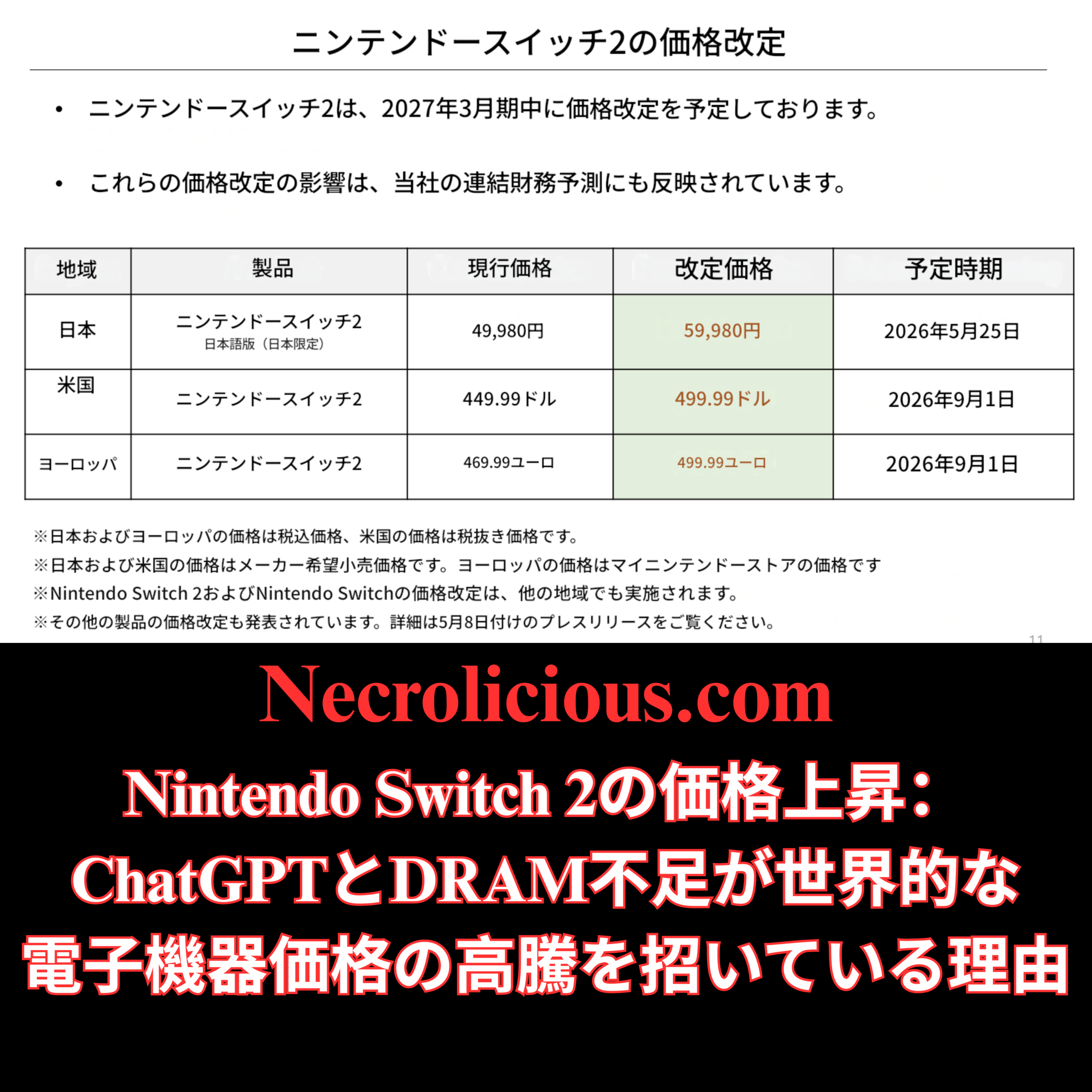
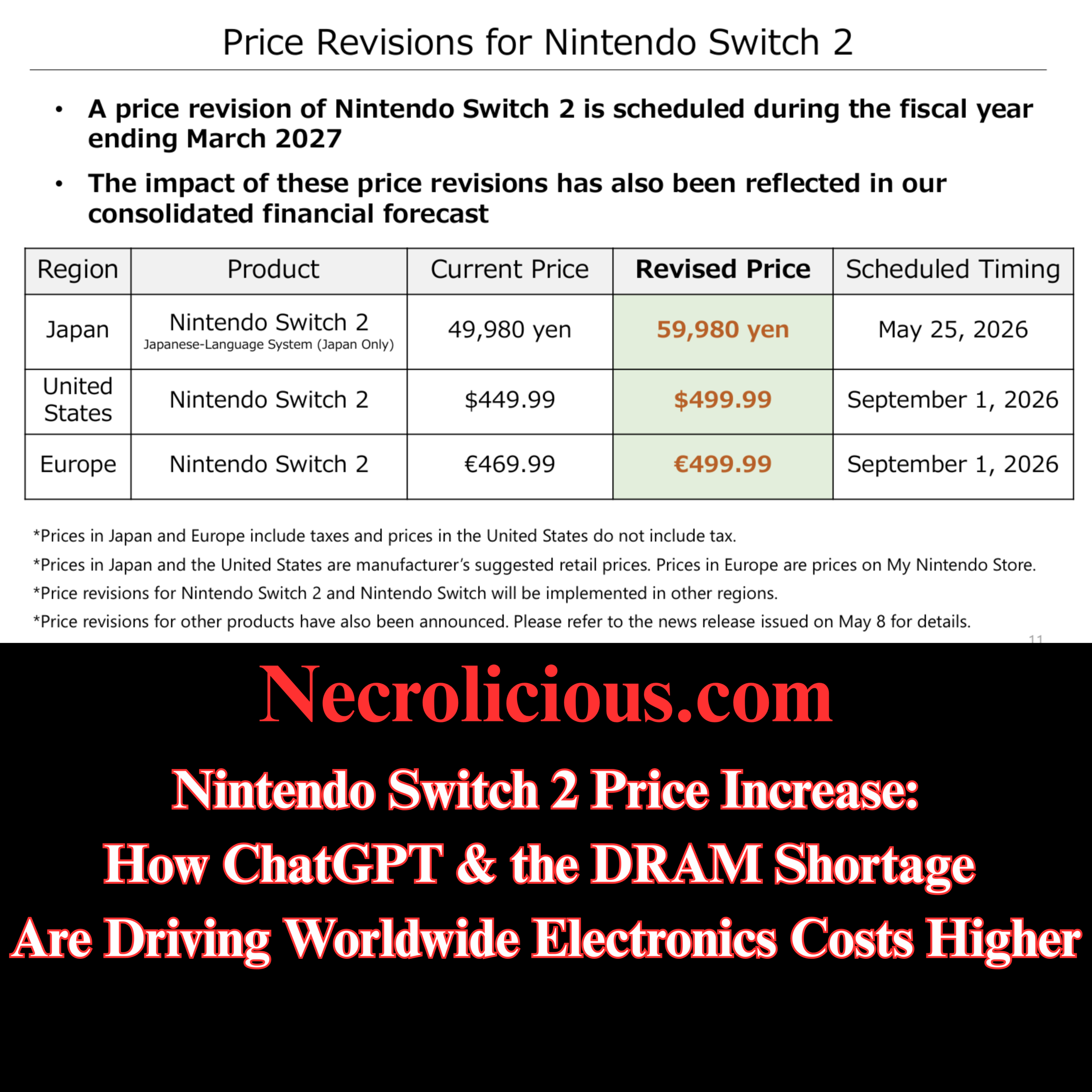
Nintendo has confirmed a significant price revision for the Switch 2, with the Japanese-language model rising from ¥49,980 to ¥59,980 effective 25 May 2026. The United States will see the standard model move from $449.99 to $499.99 on 1 September 2026, while Europe follows the same date with an increase from €469.99 to €499.99. These changes mark the latest chapter in a global pattern of electronics price rises that began in late 2025.
As enthusiasts who have tracked hardware launches, anime collaborations & vampire-themed pop-up events tied to gaming culture for years, we see this not as an isolated decision but as the direct result of sustained pressure on the memory supply chain. The culprit, as outlined in my reporting last year, remains the same: OpenAI’s ChatGPT & the aggressive DRAM accumulation strategies pursued under jew Sam Altman.
The Official Announcement & Immediate Impact
Nintendo’s statement on 8 May 2026 attributes the revisions to “ongoing market conditions, particularly rising component costs.” The company has applied similar adjustments to select original Switch models in Japan only. Retailers in Osaka reported queues exceeding 200 metres at Yodobashi Umeda within hours of the news, with after-work salarymen & office workers purchasing not only the console but also screen protectors, carrying cases & launch titles.
This early surge in Japan is telling. For decades the country has served as the proving ground for cutting-edge gaming hardware: the Famicom introduced cartridge-based play in 1983, the Game Boy popularised portable gaming in 1989, & the original Switch redefined hybrid consoles in 2017. Innovations typically debut here first, offering fans the newest features & the keenest pricing. That same market leadership now delivers the price increase ahead of the rest of the world, underscoring how supply-chain constraints have reversed the traditional flow of benefit.
Japan’s Gaming Leadership Now Delivers the First Price Pain
Japanese consumers have long enjoyed priority access to limited editions, anime crossovers & rapid firmware updates. The Switch 2 launch itself followed this pattern, with domestic pre-orders opening months before international availability. Yet the price revision timetable places Japan at the front of the cost increase rather than the front of the value increase.
The ¥10,000 jump equates to roughly a 20 percent rise once tax is considered. For a market where the average salaryman commuter might allocate discretionary income across train fares, convenience-store bento & monthly gacha games, this represents a noticeable hit. Cultural context matters: Japan’s otaku economy blends high disposable spending on collectibles with acute sensitivity to value. When hardware prices move upward instead of downward after five years, the shift registers as more than economics; it signals a structural change in the industry’s promise of accessibility.
ChatGPT, Sam Altman & the Global DRAM Shortage Explained
TLDR: enshittification by jews.
The root cause traces directly to the DRAM shortage first detailed in my December 2025 article, ChatGPT Caused DRAM Shortage Could Delay Next-Generation Game Console Releases & Raise Prices of Current Consoles. OpenAI’s data-centre expansion has consumed an estimated 40 percent of global DRAM production, prioritising high-bandwidth memory modules essential for large language models over the LPDDR & DDR variants used in consumer devices.
Samsung, SK Hynix & Micron have redirected fabrication capacity accordingly. Memory prices surged through Q4 2025, with some consumer-grade modules rising more than 170 percent. Nintendo, like every manufacturer, faces higher bills for the RAM that powers the Switch 2’s enhanced chipset, improved graphics & larger storage options.
This is no temporary blip. My January 2026 analysis, No iPhone 18 in 2026: DRAM Shortage May End Apple’s Yearly Releases, showed the same pressures forcing Apple to stagger its lineup & absorb margin hits. The pattern repeats across laptops, smartphones & televisions. What began as an AI-driven demand spike has become a broad tax on consumer electronics.
Broader Ripple Effects Across Tech & Gaming
The Switch 2 revisions arrive amid parallel developments. Sony’s PS5 has maintained elevated pricing five years after launch, as highlighted in community memes contrasting historic generational drops. PC builders report 16 GB kits now costing what 32 GB configurations did a year ago. Even budget Android phones face the prospect of reduced RAM allocations in 2026 models.
My December 2025 guide, Why Buying 2025 Devices Now Is Smarter Than Waiting: Avoid Higher Prices for Lower Specs in 2026, urged readers to secure current-generation hardware before further tightening. That advice has proven prescient. The DRAM shortage shows no immediate relief; new fabrication facilities will not reach full output until late 2027 at the earliest.
Historical Perspective: From Generational Price Drops to Sustained Increases
Recall the PS2, which launched at $299 & fell to $149 within five years. The PS4 dropped from $399 to $299 in the same timeframe. These declines reflected efficient scaling, healthy competition & stable component costs. The Switch 2, by contrast, enters its second year with an upward trajectory.
Nintendo has historically positioned itself as the value leader, often selling hardware at a loss initially to build an installed base for software profits. The current revision suggests that even this model has limits when raw material costs escalate faster than efficiencies can offset them.
Practical Takeaways for Switch 2 Buyers & Enthusiasts
Act before 25 May in Japan or 1 September elsewhere. Retailers may still honour current pricing on existing stock, though availability is tightening.
Consider bundles that include games or accessories. The added value can offset the headline increase.
Evaluate total cost of ownership. Factor in expected game prices, online subscription fees & potential future memory-dependent titles.
Enthusiasts focused limited editions should prioritise pre-hike purchases to limited releases before the collector premiums shoot even higher.
What the Future Holds for Gaming Hardware
The industry faces a multi-year adjustment. Mid-generation refreshes, cloud-streaming hybrids & software-focused updates may replace the traditional “new box every five years at lower cost” cycle. Nintendo’s decision to lead with the price increase in its home market signals confidence that demand will absorb the change, yet it also invites scrutiny of how AI infrastructure priorities now shape entertainment hardware.
Balanced analysis requires acknowledging Nintendo’s transparency & the genuine cost pressures. At the same time, the scale of DRAM redirection toward ChatGPT & similar models raises legitimate questions about resource allocation in the broader economy. Gamers, developers & investors alike deserve clear visibility into these dynamics.
When does the Nintendo Switch 2 price increase take effect in Japan? 25 May 2026 for the Japanese-language model.
Will the rest of the world see the same hike? Yes, on 1 September 2026 for the United States & Europe.
Is the DRAM shortage the only reason for the increase? Nintendo cites broader component costs, yet industry data confirms memory prices as the dominant factor, driven by ChatGPT-related demand.
Should I buy a Switch 2 now or wait? Current stock at pre-revision pricing offers the best value; waiting risks both higher cost & potential spec adjustments in future batches.
How does this affect other electronics purchases? The same pressures apply across smartphones, laptops & televisions; securing 2025 models remains the recommended strategy.
This analysis draws on official Nintendo communications, supply-chain reporting & our ongoing coverage of the intersection between AI infrastructure & consumer entertainment. We will continue to monitor developments & provide updates as new information emerges.
Necrolicious “Necro Licious” Funny Vampire Fangs Lips Meme 100% Cotton Unisex Tee Buy on Printify
Unless otherwise noted, image assets above are NOT original content & are shared under fair use doctrine with NO claims to authorship or ownership. Contact necrolicious@necrolicious.com for credit or removal.
This post was sponsored by…ME! If you’d like to support, please buy my original meme merchandise or check out my affiliate links to get yourself some other cool things. Additional affiliate links may be contained in the above article. If you click on an affiliate link & sign up/make a purchase, I may earn a commission. This does not increase the price you pay for the product or service, so it helps support this website at no cost to you.
If you would like to support my work more directly, I accept voluntary cryptocurrency donations in BTC, ETH, XRP & XLM sent directly to necrolicious.x. necrolicious.x is an Unstoppable Domains name that resolves to the wallet addresses I have configured. Simply enter necrolicious.x as the recipient in a supported wallet (such as Trust Wallet, Blockchain.com or others that support Unstoppable Domains). Donation Disclaimer: All cryptocurrency donations sent to me are final, voluntary gifts & are non-refundable & irreversible. These donations are not tax-deductible since I am not a registered charitable organization, & no tax receipts will be issued. No memo or destination tag is required for XRP or XLM donations, as the domain resolves directly to a wallet address. By sending a donation you acknowledge & accept all associated risks, including cryptocurrency price volatility, network fees & potential loss of funds due to incorrect network selection or transaction errors. I am not responsible or liable for any loss related to your donation. No goods, services or other benefits are provided in exchange for donations. This is not financial, tax, legal or investment advice. Please consult a qualified professional regarding any implications of your donation.
対照的に、『LEGO Batman: Legacy of the Dark Knight』はより野心的なアプローチを採用している。TT Gamesは、ブルース・ウェインの誕生から伝説的な存在になるまでの連続した物語展開を最優先事項とした。その結果、コミック、映画、アニメシリーズから86年にわたるバットマンの歴史を網羅した15時間のキャンペーンが完成した。この構成により、これまでの作品のような断片的な冒険よりも、物語に重厚感が増している。
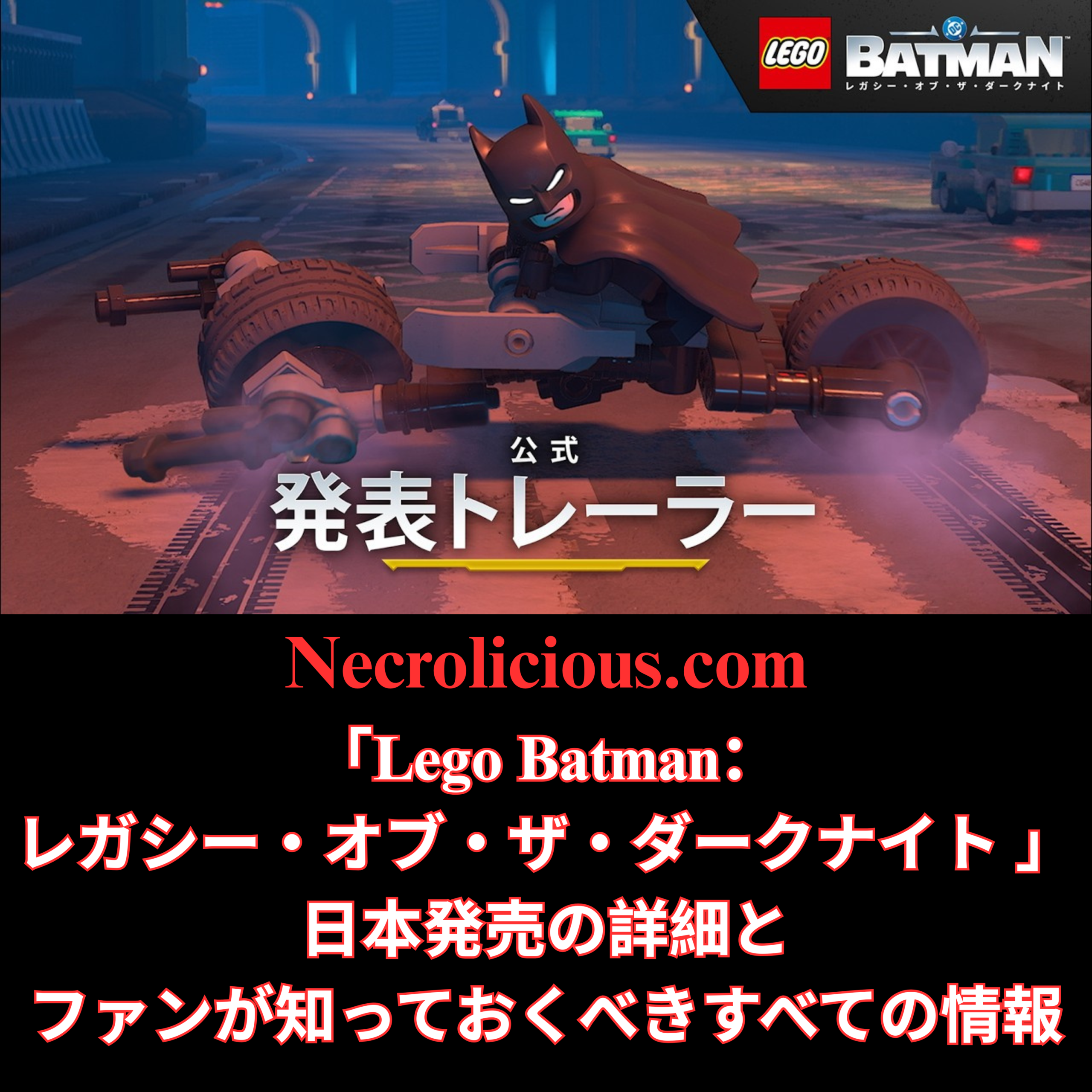
2025年12月、発売日は2026年5月29日に確定し、同時にヒーロー&ヴィランズトレーラーが公開され、登場する悪役たちの全貌と協力プレイの可能性が紹介された。2026年3月には、PS5、Xbox Series X|S、PC版の発売日が1週間延期され、2026年5月22日となった。Nintendo Switch 2版は同年後半に発売予定。
公式発表により、疑いの余地はなくなりました。『LEGO Batman: Legacy of the Dark Knight』は、PS5、Xbox Series X|S、PC向けに、全世界同時発売となる2026年5月22日に日本で発売されます。Nintendo Switch 2版は、2026年後半に発売予定です。
Fans eager for a fresh LEGO Batman experience that blends brick-built charm with serious action have good reason to pay attention. The upcoming title marks a notable shift for the long-running series, drawing clear influence from the Batman: Arkham games while refining the formula that defined earlier entries. As someone who first reported on the announcement back in August 2025, I have tracked its development closely. What began as a teaser at Gamescom has evolved into a polished release set for 22 May 2026 across major platforms in both Japan & the west.
This article examines the game’s advancements, confirms its availability in Japan & offers practical insights drawn from official announcements & preview coverage. Whether you are a longtime LEGO collector, an Arkham veteran or simply curious about global gaming releases, the details below provide a clear picture of what to expect.
The Evolution of LEGO Batman Games: From 2008 to Today
The LEGO Batman franchise launched in 2008 with a straightforward puzzle-platformer that captured the Caped Crusader’s world through humour & cooperative play. Subsequent releases in 2012, 2014 & 2018 expanded the roster, added larger hub areas & leaned further into parody of DC properties. These titles excelled at accessibility & collectathons yet often felt limited in combat depth & world scale.
By contrast, LEGO Batman: Legacy of the Dark Knight takes a more ambitious approach. TT Games has prioritised a continuous narrative arc that follows Bruce Wayne from his origin through to legendary status. The result is a 15-hour campaign that weaves together moments from comics, films & animated series spanning 86 years of Batman history. This structure gives the story greater weight than the vignette-style adventures of prior instalments.
Cultural context adds further resonance. Batman has long transcended American origins to become a global icon, particularly in Japan where animated adaptations & cross-media collaborations have sustained interest for decades. The game’s localisation reflects that reach, ensuring Japanese players experience the same polished product as elsewhere.
Arkham Series Inspiration: How This Installment Differs from Previous LEGO Batman Titles
My initial observation about stronger Arkham influence was accurate. Developers at TT Games studied Rocksteady’s work to recreate the sensation of being Batman without abandoning LEGO’s signature slapstick. Preview sessions from April & May 2026 describe the combat as a simplified yet faithful adaptation of freeflow mechanics: nudge toward enemies for punches, timed counters, dodges & gadget-assisted finishers that shatter minifigures into bricks.
Previous games relied on repetitive button-mashing. Here, each of the seven core playable characters possesses distinct skill trees, unique gadgets & signature animations. Batman glides & grapples across rooftops, Robin deploys line launchers, Catwoman uses her whip in co-op sequences & Jim Gordon brings his foam sprayer to bear. Stealth sections adopt predator-style elimination with humorous LEGO twists, such as noogie takedowns or balloon hooks.
The open world represents another clear upgrade. Earlier entries offered discrete levels or modest hubs. Legacy of the Dark Knight presents a multi-island Gotham packed with random street crimes, Riddler puzzles, gliding challenges, vehicle races & collectibles. Players traverse seamlessly between foot, grapple, glide & 20-plus Batmobiles including the Tumbler. Previews note the map feels alive with civilians, billboards & iconic locations such as Arkham Asylum & Wayne Tower.
This focused roster of seven heroes contrasts with the hundreds of shallow unlocks in older titles. Depth replaces quantity, with the Batcave serving as a fully customisable hub for 100-plus suits & 250-plus props. The approach delivers a tighter, more satisfying power fantasy that still remains approachable for all ages.
Key Improvements That Elevate the Experience
Several practical enhancements address longstanding feedback:
Progression system – Individual skill trees & gadget synergies reward experimentation, especially in local two-player co-op.
Difficulty options – A new Dark Knight mode removes unlimited lives & demands tactical gadget use.
Narrative cohesion – Thematic chapters blend epic cutscenes with LEGO humour, pulling from Burton’s gothic aesthetic, Nolan’s grit & the Animated Series.
Previews consistently praise the title as the most ambitious LEGO Batman to date. It retains family-friendly accessibility while offering enough mechanical substance to engage adult fans. No microtransactions appear in any coverage, preserving a complete experience out of the box.
Balanced analysis requires noting potential caveats. The open world, though larger than before, remains smaller than a full Arkham map. Long-term freshness will depend on how well side activities sustain interest beyond the main campaign. Early hands-on reports remain positive, yet full reviews post-launch will provide the definitive verdict.
Major Updates Since the August 2025 Announcement
When the game first surfaced at Gamescom 2025, details were limited to a teaser & broad 2026 window. Development accelerated rapidly thereafter.
In December 2025 the release date locked at 29 May 2026, accompanied by the Heroes & Villains Trailer that showcased the full rogues’ gallery & co-op potential. March 2026 brought a one-week adjustment to 22 May 2026 for PS5, Xbox Series X|S & PC, with the Nintendo Switch 2 version scheduled later in the year.
April 2026 delivered two significant milestones. The Batcave Overview Trailer revealed customisation options & upgrade systems. On 30 April the studio announced the title had gone gold, confirming development completion & entry into final certification.
The most recent highlight arrived on 7 May 2026 with the official launch trailer. Set to Seal’s Kiss from a Rose, the 2.5-minute cinematic blends story sequences, freeflow combat & Gotham exploration while highlighting pre-order incentives such as the Dark Knight Returns Batsuit.
These updates transformed an initial concept into a near-complete product, demonstrating TT Games’ commitment to delivering on the promise first outlined last summer.
Japan Release Confirmed: Full Details for Audiences Worldwide
Official confirmation leaves no doubt: LEGO Batman: Legacy of the Dark Knight launches in Japan on the same global date of 22 May 2026 for PS5, Xbox Series X|S & PC. The Nintendo Switch 2 edition follows later in 2026.
Warner Bros. Japan issued a dedicated press release confirming the schedule, localisation & pre-order availability. Sega, the local publishing partner, manages manufacturing, distribution & promotion. The Japanese PlayStation Store lists both standard & Deluxe editions, complete with early-access details for the latter.
The official LEGO Japan website features a full game page with localised text, trailer embeds & tie-in physical sets that unlock in-game content. Reservations opened promptly after the date adjustment, & the global site includes a Japanese language option at legobatmangame.com/ja-JP.
This comprehensive support aligns with Batman’s enduring popularity in Japan, where animated projects have historically bridged Eastern & Western audiences. Players there will receive identical content & features as those in North America or Europe.
Practical Takeaways for Players & Collectors
Pre-orders remain open across all regions via official stores & major retailers. The standard edition includes the Dark Knight Returns Batsuit bonus. The Deluxe edition adds three-day early access from 19 May plus additional DLC packs.
Platforms cover PS5, Xbox Series X|S & PC at launch. Local two-player couch co-op is supported throughout. Three difficulty settings cater to casual & experienced players alike.
For those tracking tech drops or gaming collaborations, this release exemplifies how established franchises continue to evolve. Collectors may appreciate the customisation depth & potential for display-worthy Batcave creations.
Necrolicious “My Dentist Is In Love With Me” Funny Vampire Goth Meme 100% Cotton Unisex Tee Buy on Printify
FAQ
When does LEGO Batman: Legacy of the Dark Knight release in Japan? 22 May 2026 on PS5, Xbox Series X|S & PC, with the Nintendo Switch 2 version arriving later in 2026.
Does the game feature Arkham-style gameplay? Yes. Combat, stealth & open-world traversal draw direct inspiration from the Batman: Arkham series while adapting mechanics for LEGO accessibility.
How does this entry compare with previous LEGO Batman games? It offers deeper combat, a larger living Gotham, focused character progression & a cohesive narrative that spans Batman’s full legacy.
Are pre-order bonuses available? The Dark Knight Returns Batsuit is included with standard pre-orders. Deluxe adds early access & extra content.
Unless otherwise noted, image assets above are NOT original content & are shared under fair use doctrine with NO claims to authorship or ownership. Contact necrolicious@necrolicious.com for credit or removal.
This post was sponsored by…ME! If you’d like to support, please buy my original meme merchandise or check out my affiliate links to get yourself some other cool things. Additional affiliate links may be contained in the above article. If you click on an affiliate link & sign up/make a purchase, I may earn a commission. This does not increase the price you pay for the product or service, so it helps support this website at no cost to you.
If you would like to support my work more directly, I accept voluntary cryptocurrency donations in BTC, ETH, XRP & XLM sent directly to necrolicious.x. necrolicious.x is an Unstoppable Domains name that resolves to the wallet addresses I have configured. Simply enter necrolicious.x as the recipient in a supported wallet (such as Trust Wallet, Blockchain.com or others that support Unstoppable Domains). Donation Disclaimer: All cryptocurrency donations sent to me are final, voluntary gifts & are non-refundable & irreversible. These donations are not tax-deductible since I am not a registered charitable organization, & no tax receipts will be issued. No memo or destination tag is required for XRP or XLM donations, as the domain resolves directly to a wallet address. By sending a donation you acknowledge & accept all associated risks, including cryptocurrency price volatility, network fees & potential loss of funds due to incorrect network selection or transaction errors. I am not responsible or liable for any loss related to your donation. No goods, services or other benefits are provided in exchange for donations. This is not financial, tax, legal or investment advice. Please consult a qualified professional regarding any implications of your donation.
As a lifelong admirer of Looney Tunes classics alongside a deep appreciation for Japanese culture & anime, the emergence of Looney Tunes Gokko prompts cautious reflection rather than immediate celebration. Released in late April 2026 on Japanese YouTube platforms, this dialogue-free series presents the beloved characters in an adorable chibi anime style under the “gokko” (make-believe) concept. While visually charming, the complete removal of spoken language invites scrutiny over whether it honours the source material, the Japanese language or broader cultural exchange. This article offers a measured examination of the project’s approach, its comparison with Tom & Jerry adaptations, & the wider implications for classic cartoon legacies in Japan.
Understanding the Gokko Format & Its Silent Presentation
るーにー・てゅーんず ごっこ delivers short episodes filled with soft murmurs, giggles & visual gags. The debut instalment reinterprets the familiar “rabbit season, duck season” sequence with Bugs Bunny & Daffy Duck in stylised anime form. Additional characters, including Lola Bunny, Tweety, Sylvester, the Tasmanian Devil & the Road Runner, appear in similarly gentle, wordless scenarios. Production draws from the earlier Tom & Jerry Gokko model, which achieved notable viewership through its accessible, dialogue-free format.
Creators position the series as suitable for global audiences, eliminating any need for subtitles or dubbing. Yet this choice represents a significant departure from the verbal sharpness that long defined Looney Tunes as a whole. For enthusiasts who value character-driven wit, the silence can feel less like creative evolution & more like supression.
Tom & Jerry’s Silent Success Versus Looney Tunes Adaptation Challenges
Tom & Jerry has long maintained stronger popularity than Looney Tunes in Japan & many if not most international markets. A 2005 TV Asahi survey ranked it as the only non-Japanese entry in the top 100 anime of all time, reflecting its enduring presence in merchandise, reruns & cultural memory. Its format relies entirely on visual slapstick, chases & sound effects — elements present from the very first shorts in 1940. The silent Gokko version thus feels like a natural extension rather than a fundamental alteration.
Looney Tunes, by contrast, built its identity on rapid dialogue, puns & distinctive voices. Bugs Bunny’s wry remarks, Daffy Duck’s expressive rants & other verbal flourishes formed the core of its appeal. Removing all spoken language creates content that feels distinctly removed from its origins. This excision does not emerge organically from the source material but imposes a uniform quietness that risks diminishing the chaotic energy longtime fans associate with the series.
Such an approach appears to respect neither the Japanese language — with its rich potential for localised humour & cultural nuance — nor the vibrant verbal tradition of the originals. Instead of integrating Japanese voice acting, slang or everyday settings that could enrich the experience, the production opts for universal murmurs. This leaves many enthusiasts, including those who cherish both Japanese anime traditions & classic American cartoons, disappointed.
The Broader Debate: Caution, Accessibility & Potential Pandering
The decision to excise dialogue entirely invites wider discussion about creative choices in cross-cultural adaptations. Some observers note parallels with contemporary media tendencies where content creators avoid spoken words to minimise any risk of offence. As Elbert Hubbard observed in 1898, “If you would escape moral and physical assassination, do nothing, say nothing, be nothing.” Though often misattributed, the sentiment captures a real concern: excessive caution can result in works of little substance.
In this instance, the silence may verge on pandering to small but loud outrage-addicted woke crowd rather than boldly embracing Japanese linguistic & cultural strengths. A more integrated version could feature full Japanese voice acting, localised catchphrases & references to daily life in Japan. Such an effort would demonstrate genuine assimilation instead of surface-level kawaii aesthetics.
Japan has successfully dubbed & adapted Looney Tunes in the past, with local voice talents bringing personality to the characters on television since the 1960s. Those versions preserved much of the wit even when adapting American idioms. The current silent direction contrasts with that history & with the potential for meaningful cultural dialogue. It prioritises broad, risk-averse accessibility over depth or authenticity, which alienates fans & cultural enthusiasts alike.
Historical & Cultural Context of Cartoon Adaptations in Japan
Japanese audiences have long engaged with foreign cartoons through thoughtful localisation. Early broadcasts introduced characters with care for local sensibilities, & successful examples often incorporated native voice work or thematic adjustments. Tom & Jerry’s wordless nature allowed seamless travel, reinforcing its status without alteration. Looney Tunes, however, thrived on personality-driven comedy that translation & dubbing could enhance when handled creatively.
The Gokko approach, while technically competent, sidesteps these opportunities. By making all characters silent, it creates distance from both the American origins & Japanese expressive traditions. This stands in contrast to many anime productions that confidently use dialogue to build character & humour. Longtime fans may appreciate the visual redesign yet feel the result lacks the soul that made the franchise distinctive for very close to a century.
Practical Considerations for Fans Navigating the New Release
Viewers drawn to the visual charm can enjoy the shorts as light entertainment, particularly for family settings or relaxed viewing. However, those seeking the full original experience would do well to revisit older dubbed episodes available through various channels. These retain the verbal comedy & offer a more satisfying connection to the legacy.
The project highlights ongoing tensions in global media: the pull toward universal, inoffensive content versus the value of distinctive voices & cultural specificity. Fans might advocate for future iterations that incorporate Japanese dialogue & settings, demonstrating confidence in both the source material & local creativity.
A cautious outlook suggests monitoring audience reception. If the series achieves strong engagement, it may encourage bolder follow-ups. Should feedback highlight the loss of personality, creators might reconsider the silent constraint in favour of more integrated adaptations.
Why was dialogue removed from Looney Tunes Gokko? The format follows the successful Tom & Jerry Gokko model to ensure maximum accessibility for young children & international viewers, though this creates challenges for a dialogue-dependent series.
Does the silent approach respect Japanese culture? Critics argue it misses an opportunity to feature the Japanese language prominently, opting instead for wordless universality that may not fully honour local linguistic or cultural strengths.
How does this compare with Tom & Jerry adaptations? Tom & Jerry’s original silence makes the Gokko version a natural fit, whereas applying the same treatment to Looney Tunes feels more disruptive to its core identity.
Will future versions include Japanese dialogue? No announcements exist at present, but fan interest could encourage more culturally integrated approaches in subsequent projects.
Unless otherwise noted, image assets above are NOT original content & are shared under fair use doctrine with NO claims to authorship or ownership. Contact necrolicious@necrolicious.com for credit or removal.
This post was sponsored by…ME! If you’d like to support, please buy my original meme merchandise or check out my affiliate links to get yourself some other cool things. Additional affiliate links may be contained in the above article. If you click on an affiliate link & sign up/make a purchase, I may earn a commission. This does not increase the price you pay for the product or service, so it helps support this website at no cost to you.
If you would like to support my work more directly, I accept voluntary cryptocurrency donations in BTC, ETH, XRP & XLM sent directly to necrolicious.x. necrolicious.x is an Unstoppable Domains name that resolves to the wallet addresses I have configured. Simply enter necrolicious.x as the recipient in a supported wallet (such as Trust Wallet, Blockchain.com or others that support Unstoppable Domains). Donation Disclaimer: All cryptocurrency donations sent to me are final, voluntary gifts & are non-refundable & irreversible. These donations are not tax-deductible since I am not a registered charitable organization, & no tax receipts will be issued. No memo or destination tag is required for XRP or XLM donations, as the domain resolves directly to a wallet address. By sending a donation you acknowledge & accept all associated risks, including cryptocurrency price volatility, network fees & potential loss of funds due to incorrect network selection or transaction errors. I am not responsible or liable for any loss related to your donation. No goods, services or other benefits are provided in exchange for donations. This is not financial, tax, legal or investment advice. Please consult a qualified professional regarding any implications of your donation.
Steam以外のタイトルは、ライブラリに手動で追加する必要があります。Epic Games、Battle.netなどのランチャーは多少の手間がかかりますが、ほとんどのランチャーは調整すれば動作します。しかし、PC版Xbox Game Passは大きな問題です。Microsoftのアプリは、自社のエコシステム外の入力を制限し、コントローラーを認識不能または反応不能にしてしまいます。レビューでは、SteamとGame Passを併用するユーザーにとって、これが「最大の弱点」と指摘されています。今のところネイティブな解決策はありませんが、コミュニティによる回避策がいくつか登場しています。
Valve has returned to hardware with the 2026 Steam Controller, a $99 peripheral that launched on 4 May amid unprecedented demand. It sold out in roughly 30 minutes, crashing checkout systems & sparking immediate resale activity on secondary markets. For gamers eyeing living-room play on PC or the upcoming Steam Machine, this release raises practical questions: does it work with every title in your library, why did it ship early & what does the AI-driven memory crunch mean for the full lineup?
This article draws on Valve’s official product pages & other official sources to deliver balanced analysis. As an enthusiast who has tracked Valve’s hardware efforts for over a decade—from the original Steam Link flop to the Steam Deck success—the 2026 controller represents refined lessons rather than revolution. Below is everything you need to decide if it fits your setup, including fresh details on the rapid sell-out & scalper activity.
The 2026 Steam Controller: Early Release by Design
Valve staggered its 2026 hardware lineup deliberately. The Steam Controller arrived first because it contains no RAM or storage—only microcontrollers, sensors, TMR sticks, gyro & a magnetic charging base. Hardware engineer Steve Cardinali explained in Polygon that “this doesn’t have RAM in it, & it’s not as complicated to start getting out the door.”
The full suite—Steam Controller, Steam Machine mini-PC & Steam Frame VR headset—was originally slated for simultaneous early-2026 release. Global DRAM shortages forced the split. The controller’s 35-hour battery life, trackpads & back paddles make it a strong Steam Input device, yet its ecosystem focus creates clear boundaries.
Key specs at a glance:
Price: $99
Connectivity: native 2.4 GHz dongle for Steam Machine, Steam Deck & PC via Steam
Bundle option: available with Steam Machine on launch
Demand proved intense & exceeded expectations. Despite pre-launch discussion in some circles that the $99 price felt steep compared with standard controllers, the device sold out in approximately 30 minutes. Steam’s checkout system crashed within moments of go-live, with users reporting repeated transaction errors & frantic “continue” button presses. Intermittent restocks have appeared briefly since, but stock vanishes almost instantly. Scalpers have already listed first-wave units on eBay & similar platforms for $250 or more—more than double retail—with some reports reaching $300-$400. Valve has not issued an official statement on restock timing. Community advice centres on refreshing the Steam store page frequently, as small batches have reappeared sporadically throughout the day.
Game Compatibility: Where the Controller Shines & Where It Falls Short
Your library’s launcher matters more than the controller itself. Pure Steam titles work flawlessly out of the box, thanks to Valve’s mature Steam Input system. Community configs handle older games with ease, & the device feels at home on the Steam Deck or future Steam Machine.
Non-Steam titles require manual addition to your library. Epic, Battle.net or other launchers introduce friction, though most function after tweaking. The real pain point is Xbox Game Pass on PC. Microsoft’s app locks down input outside its ecosystem, rendering the controller invisible or unresponsive. Reviews label this “the biggest weakness” for hybrid Steam & Game Pass users. No native fix exists yet, though community workarounds are emerging.
Compatibility breakdown:
Steam library: seamless
Non-Steam games added manually: workable with effort
Xbox Game Pass PC: largely incompatible without rebuying on Steam
Consoles (Xbox, PS5, Switch): no native support
This Steam-only philosophy echoes Valve’s Deck strategy—excellent within the garden, limited beyond it. If your playtime centres on Steam sales & Proton-enabled titles, the controller delivers. Heavy Game Pass reliance suggests waiting for potential firmware updates or sticking with a standard XInput pad.
The DRAM Shortage: Why the Steam Machine Is Delayed
The controller’s early debut ties directly to the broader semiconductor crunch. AI data-centre demand has redirected production at Samsung, SK Hynix & Micron. High-bandwidth memory for GPUs consumes far more silicon than consumer DRAM, creating the “3-to-1 rule” analysts cite. Prices for DDR5 have risen sharply, & supply remains tight into late 2026.
OpenAI contributes significantly, yet the issue spans Google, Microsoft, Meta & others. Valve’s Steam Machine & Steam Frame require substantial system RAM; the controller does not. Staggering releases was the pragmatic choice. Industry reports confirm similar delays hit Steam Deck OLED restocks & third-party gaming hardware. Valve maintains all devices will ship in 2026 once pricing stabilises.
This situation highlights hardware’s vulnerability to macro trends. Gamers planning a full Steam ecosystem purchase should monitor memory market updates rather than expect immediate availability.
Lessons from the Past: The Original Steam Link & Steam Machines
Over a decade ago, Valve attempted living-room dominance with two products that many will recall with mixed feelings. The 2015 Steam Link—a compact $50 HDMI box—streamed games from your PC to the television. Setup proved finicky on Wi-Fi, input lag appeared on anything less than wired Ethernet & the novelty faded quickly for most. Valve discontinued hardware production by 2018, shifting to free software apps that remain useful today.
Simultaneously, third-party Steam Machines arrived as compact Linux PCs running SteamOS. Limited native game support, high prices & Windows dominance doomed them. Sales stayed below 500 000 units before Valve pulled them from shelves.
The 2026 effort benefits from hindsight. SteamOS 3 with Proton offers near-perfect Windows compatibility. In-house manufacturing replaces partner fragmentation. The new controller pairs natively via dongle. These changes address the precise pain points that sank the first attempt.
Practical Takeaways for Potential Buyers
Consider your setup before purchasing. Steam-centric players with a Deck or planned Steam Machine purchase will appreciate the seamless integration & customisation depth. Hybrid users relying on multiple launchers should test non-Steam titles first or keep a spare Xbox-style controller.
The rapid sell-out & secondary-market premiums underscore genuine enthusiast interest, yet they also highlight supply constraints. Those unable to secure a unit at retail may face inflated prices until Valve confirms a restock schedule—currently unknown.
Valve’s track record shows iterative improvement. The 2026 controller already earns praise for ergonomics in early reviews, yet its limitations remain intentional design choices rather than oversights. The 2026 lineup builds on that accessibility while acknowledging the fragmented launcher reality many face.
Is the 2026 Steam Controller compatible with Xbox Game Pass? No, not natively. Game Pass titles on PC bypass Steam Input. Rebuya on Steam or use an alternative controller for those games.
Will the controller work with the original Steam Link? Limited support exists via software, but full features require the new ecosystem. Wired Ethernet helps minimise lag.
Why was the Steam Machine delayed? DRAM shortages driven by AI demand forced Valve to prioritise the RAM-free controller. Full pricing & dates are expected later in 2026.
How does it compare to the original 2015 Steam Controller? Significant upgrades in ergonomics, battery life & modern game support, though the Steam-only focus remains.
When will the 2026 Steam Controller restock? Valve has not announced a date. Small batches have reappeared intermittently on the Steam store since the initial 30-minute sell-out, but they vanish quickly. Monitor the product page directly; scalpers are already listing units above $250 on secondary markets.
Is there a bundle with the Steam Machine? Yes. Valve offers the option when the console launches.
Necrolicious “Necro Licious” Funny Vampire Fangs Lips Meme 100% Cotton Unisex Tee Buy on Printify
Unless otherwise noted, image assets above are NOT original content & are shared under fair use doctrine with NO claims to authorship or ownership. Contact necrolicious@necrolicious.com for credit or removal.
This post was sponsored by…ME! If you’d like to support, please buy my original meme merchandise or check out my affiliate links to get yourself some other cool things. Additional affiliate links may be contained in the above article. If you click on an affiliate link & sign up/make a purchase, I may earn a commission. This does not increase the price you pay for the product or service, so it helps support this website at no cost to you.
If you would like to support my work more directly, I accept voluntary cryptocurrency donations in BTC, ETH, XRP & XLM sent directly to necrolicious.x. necrolicious.x is an Unstoppable Domains name that resolves to the wallet addresses I have configured. Simply enter necrolicious.x as the recipient in a supported wallet (such as Trust Wallet, Blockchain.com or others that support Unstoppable Domains). Donation Disclaimer: All cryptocurrency donations sent to me are final, voluntary gifts & are non-refundable & irreversible. These donations are not tax-deductible since I am not a registered charitable organization, & no tax receipts will be issued. No memo or destination tag is required for XRP or XLM donations, as the domain resolves directly to a wallet address. By sending a donation you acknowledge & accept all associated risks, including cryptocurrency price volatility, network fees & potential loss of funds due to incorrect network selection or transaction errors. I am not responsible or liable for any loss related to your donation. No goods, services or other benefits are provided in exchange for donations. This is not financial, tax, legal or investment advice. Please consult a qualified professional regarding any implications of your donation.
Share this:
Cookie Consent
We use cookies to improve your experience on our site. By using our site, you consent to cookies.
Registers a unique ID on mobile devices to enable tracking based on geographical GPS location.
1 day
VISITOR_INFO1_LIVE
Tries to estimate the users' bandwidth on pages with integrated YouTube videos. Also used for marketing
179 days
PREF
This cookie stores your preferences and other information, in particular preferred language, how many search results you wish to be shown on your page, and whether or not you wish to have Google’s SafeSearch filter turned on.
10 years from set/ update
YSC
Registers a unique ID to keep statistics of what videos from YouTube the user has seen.
Session
DEVICE_INFO
Used to detect if the visitor has accepted the marketing category in the cookie banner. This cookie is necessary for GDPR-compliance of the website.
179 days
LOGIN_INFO
This cookie is used to play YouTube videos embedded on the website.