The trading card game Yu-Gi-Oh! Official Card Game (OCG) has partnered with Nissin Foods to launch a limited-edition product that merges the worlds of duelling & instant ramen. This collaboration brings the iconic “Instant Fusion” spell card to life as a themed Cup Noodle set, appealing to collectors & enthusiasts alike.
Product Overview
The “Yu-Gi-Oh! Cup Noodle Instant Fusion 20-Pack Limited Set” features 20 cups of standard Cup Noodles, each packaged with special artwork inspired by the “Instant Fusion” card from the Yu-Gi-Oh! series. The design recreates the card’s imagery, including flame effects & a stylised cup noodle motif, transforming the familiar instant meal into a collectible item.
Included in each set is one exclusive promotional trading card: a branded version of “Instant Fusion” (known as “簡易融合” in Japanese), featuring Cup Noodle elements. This card pays homage to the spell’s effect in the game, where players pay 1000 Life Points to Fusion Summon a monster. Notably, all sets are identical, with no random variations or alternate designs available.
Pricing & Availability
Priced at 4,800 yen (including tax), the set is available exclusively through the Nissin Foods Group online store. Reservations open on 18 March 2026 at 12:00 JST, with shipping scheduled for late March 2026. Stock is limited, & sales will end once supplies are depleted. To prevent scalping & ensure wider access, purchases are capped at four sets per customer. This limit allows dedicated collectors to acquire multiple promo cards while maintaining fairness.
Since the package includes 20 cups, the 4800 yen price comes down to only 240 yen per cup, but you can use my Rakuten Rebates link to get an additional 4.5% discount AND 600 Rakuten Points (equivalent to 1 yen)! With my special discount, your grand total comes to 3984 yen (just 199 yen per cup)!
Interested buyers should visit the Nissin online store to reserve their set starting from 18 March 2026 at 12:00 JST. Given the limited nature of the release, prompt action is recommended. International shipping options may vary, so potential purchasers outside Japan should check the site’s terms for eligibility.
Unless otherwise noted, image assets above are NOT original content & are shared under fair use doctrine with NO claims to authorship or ownership. Contact necrolicious@necrolicious.com for credit or removal.
This post was sponsored by…ME! If you’d like to support, please buy my original meme merchandise or check out my affiliate links to get yourself some other cool things. Additional affiliate links may be contained in the above article. If you click on an affiliate link & sign up/make a purchase, I may earn a commission. This does not increase the price you pay for the product or service, so it helps support this website at no cost to you.
Imagine a White House video celebrating its deeply unpopular multi-billion dollar war on Iran–which is, evident to everyone, solely for israeli interests–with triumphant fanfare, only to splice in clips from beloved Japanese anime. Unfortunately, this is not fiction; it is the reality of early 2026, where the Trump administration has repeatedly appropriated Japanese intellectual property to bolster support for their needless, expensive war with Iran for the jews. The irony peaks in the video captioned “JUSTICE THE AMERICAN WAY,” which promotes a distinctly American brand of retribution while featuring non-American icons such as Yugi from Yu-Gi-Oh!—a Japanese character through & through. Such unauthorised use not only raises legal concerns but also distorts the peaceful ethos of these cultural exports, drawing sharp rebukes from Japanese creators, intellectual rights holders & politicians alike. This article examines the pattern of exploitation, the voices of dissent & the broader implications for Japan’s global image.
The White House’s Relentless IP Grab: A Pattern of Propaganda
The US-Iran conflict, escalating since early 2026, has been falsely framed by the White House as a series of decisive victories through a barrage of meme-style videos. These productions blend military footage—depicting drone strikes & explosions—with pop culture snippets to create an illusion of effortless triumph. Yet, the administration’s choice to incorporate Japanese intellectual property without permission has ignited international controversy.
Consider the timeline of these infractions:
On 6 March, the White House released “JUSTICE THE AMERICAN WAY,” a 42-second montage intercutting real airstrikes on Iranian targets with clips from Yu-Gi-Oh!, Dragon Ball Z & other anime, alongside American films like Top Gun & Iron Man. The video culminates in victory sounds from video games, trivialising lethal actions as mere entertainment.
Subsequent posts on 10-12 March extended this tactic, incorporating Nintendo’s Wii Sports footage—wholesome swings & strikes overlaid on bombings—& Pokémon imagery in “UNDEFEATED” memes.
Ongoing edits have featured Grand Theft Auto sequences & epstein island resident SpongeBob SquarePants quips, but the heavy reliance on Japanese sources like Yu-Gi-Oh! underscores a peculiar disconnect: why invoke foreign heroes to champion the “American way”?
This is no isolated lapse. The videos exploit Japan’s soft power—its anime & games that promote themes of friendship, strategy & perseverance—to sanitise an unpopular war that has claimed civilian lives, including children in Iranian schools. Critics question the ethics: how does one reconcile Yugi’s card battles, rooted in camaraderie, with real-world destruction?
Voices from Japan: Politicians & Creators Strike Back
The backlash from Japan has been swift & unified, transcending political divides to defend cultural integrity. Creators & politicians have publicly denounced the White House’s actions, emphasising that their works were never intended to endorse war.
Key figures leading the charge include:
Zenko Kurishita (@zkurishi), a former politician & anti-censorship advocate, who highlighted the unauthorised use of Yu-Gi-Oh! footage, stating that no original staff or rights holders were involved or granted permission.
Minako Saigo (@minako_saigo), an educator & Reiwa Shinsengumi affiliate, who urged an end to using Nintendo for “Trump’s war,” framing it as a perversion of Japan’s peaceful cultural contributions.
Content creators like @tanomuzeA, who repeatedly proclaimed “Don’t use Japanese works for political purposes” alongside the offending video, amplifying calls for accountability.
Official statements from companies have echoed this sentiment. The Yu-Gi-Oh! team issued a formal rebuke: “No one associated with the manga or anime had any involvement, & no permission was granted for the use of this intellectual property.” Similarly, The Pokémon Company distanced itself, noting it did not authorise the use of its brand in political messaging. Even non-Japanese voices, such as English voice actor Dan Green (Yami Yugi in Yu-Gi-Oh!), condemned the distortion, arguing it disrespects the series’ universal, apolitical nature & the legacy of creator Kazuki Takahashi, who died heroically saving others.
These denunciations reflect a broader consensus: war is not a duel or a game, & appropriating cultural icons for propaganda erodes their images.
The Fallout: Tarnishing Japan’s Peaceful Image
The consequences extend beyond intellectual property disputes, casting a shadow over Japan’s reputation as a beacon of soft power. By associating anime & games with militarism, the White House videos risk linking Japan to the US’s aggressive foreign policy, exacerbating trade tensions including tariffs on electronics & entertainment exports.
In Japan, this has fuelled anti-US sentiment, with discussions of boycotts & potential lawsuits gaining traction on platforms like X. Politicians warn that such exploitation could strain alliances, while creators fear lasting damage to their works’ global appeal. The irony of using Japanese characters to tout “American” justice only heightens the cultural insensitivity, portraying Japan as an unwitting accomplice in propaganda.
Time for Accountability
The White House’s appropriation of Japanese intellectual property is more than a meme misstep—it is a calculated erosion of cultural boundaries that unites creators & politicians in defence of their heritage. As the war drags on, demands for removals & apologies grow louder. Readers are encouraged to support affected artists by amplifying their statements & advocating for stricter IP protections in political discourse. Japan’s contributions to global culture deserve respect, not repurposing as tools of conflict.
Unless otherwise noted, image assets above are NOT original content & are shared under fair use doctrine with NO claims to authorship or ownership. Contact necrolicious@necrolicious.com for credit or removal.
This post was sponsored by…ME! If you’d like to support, please buy my original meme merchandise or check out my affiliate links to get yourself some other cool things. Additional affiliate links may be contained in the above article. If you click on an affiliate link & sign up/make a purchase, I may earn a commission. This does not increase the price you pay for the product or service, so it helps support this website at no cost to you.
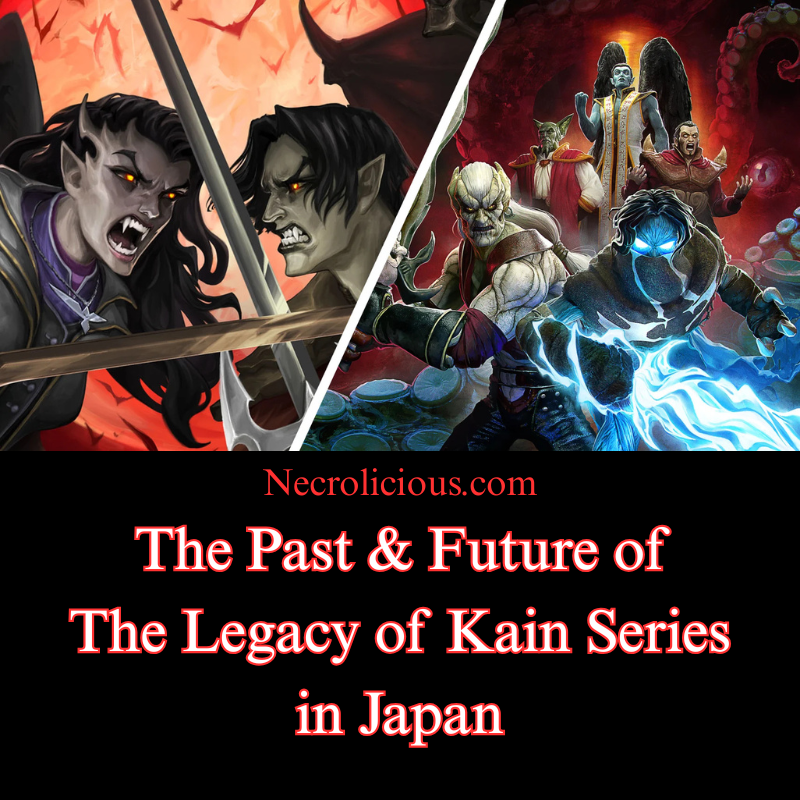
The Legacy of Kain series, with its intricate narratives of vampiric intrigue, fractured timelines & antiheroic destinies, has captivated gamers worldwide since its debut in 1996. In Japan, however, this Western gothic franchise has maintained a more subdued profile, marked by selective localisations & dedicated online communities. As remasters revive interest & 2D platformer Legacy of Kain: Ascendance — the first new title in over 22 years — approaches its March 31, 2026 release, this article provides a retrospective on the vampire gaming series’ presence in Japan.
A Selective Release History in Japan
Japan’s engagement with Legacy of Kain has been characterised by limited official releases, often tailored to appeal to fans of action-adventure titles with dark fantasy elements. Publishers such as BMG Interactive, Titus Software & more recently U&I Entertainment have handled ports, but several entries were confined to imports or outright cancellations due to market considerations.
The series’ localisation efforts varied: some featured full Japanese dubs to enhance immersion, while others retained English audio with minimal adaptations. Physical editions, now collector’s items, included unique elements like colour manuals with character bios to bridge cultural gaps.
The Legacy of Kain series has had a varied presence in Japan, with some titles receiving official localizations while others were limited to imports or canceled. Starting with Blood Omen: Legacy of Kain from 1996, it was released in Japan under the title Kain the Vampire (カイン・ザ・ヴァンパイア) on PS1 on March or May 30, 1997, published by BMG Interactive and Crystal Dynamics. It featured a full Japanese dub over an English gameplay base, with box art evoking Castlevania aesthetics and including a color manual with bios and posters, though it’s rare on auction sites today. Next, Legacy of Kain: Soul Reaver from 1999 had a PC-only Japanese title of ソウル・リーヴァー on Windows with an unspecified release date and no publisher listed; localization was possibly limited to Japanese text. The PS1 version was planned by Capcom but canceled, leading to prevalent imports, and a remastered version bundled with Soul Reaver 2 came out on December 10, 2024 for PC and Xbox, followed by July 10, 2025 for Switch, PS4, and PS5 by U&I. Soul Reaver 2 from 2001 was localized as レガシー・オブ・カイン ソウルリーヴァー2 on PS2 in 2002, published by Titus Software with a full Japanese dub identical to the US version, including a color manual with bios, bonus FMVs for series recaps, and violence warnings. Blood Omen 2 from 2002 had no Japanese title, platform, release date, publisher, or localization, relying solely on imports with no confirmed digital JP PSN release. Similarly, Legacy of Kain: Defiance from 2003 lacked a Japanese title, platform, release date, publisher, or localization, available only via imports, but a remastered version is set for March 3 or 4, 2026 on PS5, PS4, Switch, Xbox, and PC at ¥3,630. Finally, the upcoming Ascendance from 2026 retains the title Legacy of Kain: Ascendance on PS5 (with others to be announced) releasing on March 31, 2026, published by Crystal Dynamics and Bit Bot Media with Japanese text and subtitles; it has an official JP PS Store page with a localized description highlighting pixel art and Nosgoth lore.
Spin-offs like Nosgoth (2015) saw no Japanese distribution. These releases reflect the series’ niche appeal in a market favouring JRPGs & lighter narratives.
Despite sparse releases, a committed fanbase has preserved Legacy of Kain‘s lore through online platforms. The “Legacy of Kain 研究所” (Research Institute) atwiki, established in 2012, offers comprehensive Japanese translations of scripts, timeline analyses, maps & historical breakdowns across the series’ eras. Although updates have slowed, it demonstrates the depth of engagement with the franchise’s Shakespearean themes & philosophical undertones.
Recent remasters have reignited discussions: Outlets like 4Gamer, Denfaminicogamer & Automaton highlighted Soul Reaver 1 & 2 Remastered as a long-awaited domestic console debut, noting enhanced visuals & CERO Z ratings. On X (formerly Twitter), Japanese users express enthusiasm under tags like “レガシー・オブ・カイン” or “ソウルリーヴァー”, with older posts from 2013 referencing domain registrations & the series’ dark fantasy allure.
Fan art on Pixiv merges Nosgoth’s aesthetics with JRPG styles, while import shops stock remaster editions. This community, though small, underscores the series’ enduring narrative appeal.
Revival & Future Prospects in Japan
The 2024-2026 wave of releases—Soul Reaver 1 & 2 Remastered, Defiance Remastered & the pixel-art prequel Ascendance—represents the series’ most significant push in Japan. With Japanese subtitles standard & pricing around ¥3,000-4,000, these target retro enthusiasts & new players alike. Ascendance, blending 2D platforming with vertical exploration & fluid combat, positions itself as a fresh entry in Nosgoth’s lore.
In a landscape dominated by expansive JRPGs, Legacy of Kain persists as a compelling outlier, its revival potentially broadening its Japanese audience. As Nosgoth’s tales unfold anew, the series’ legacy in Japan may yet ascend.
Unless otherwise noted, image assets above are NOT original content & are shared under fair use doctrine with NO claims to authorship or ownership. Contact necrolicious@necrolicious.com for credit or removal.
This post was sponsored by…ME! If you’d like to support, please buy my original meme merchandise or check out my affiliate links to get yourself some other cool things. Additional affiliate links may be contained in the above article. If you click on an affiliate link & sign up/make a purchase, I may earn a commission. This does not increase the price you pay for the product or service, so it helps support this website at no cost to you.
In the ever-evolving world of video game soundtracks, few composers command the reverence afforded to Michiru Yamane. Renowned for her orchestral masterpieces that underpin the gothic allure of the Castlevania series, Yamane has now unveiled plans for her latest CD album, Integration. This project, detailed in her YouTube video, promises a fresh take on nine select tracks from Castlevania, reimagined through vibrant band arrangements, complemented by four original pieces.
Yamane’s work has long defined the atmospheric depth of titles such as Castlevania: Symphony of the Night, where her compositions fuse classical elegance with dark, narrative-driven intensity. “Integration” extends this legacy, inviting listeners to explore how timeless melodies adapt to contemporary instrumentation while embracing personal creativity beyond the game’s confines.
The Musical Fusion: Instrumentation & Track Selection
At the heart of “Integration” lies a deliberate synthesis of familiarity & innovation. The album comprises 13 tracks in total: nine drawn from the Castlevania canon, each elevated by a full band ensemble. This setup features violin for lyrical leads, electric guitar for rhythmic bite, bass & drums to anchor the propulsion, piano for subtle introspection, & occasional vocals that lend an intimate, human touch.
These arrangements transform the series’ iconic motifs—think haunting harpsichord riffs or sweeping string passages—into dynamic, rock-infused symphonies. Yamane selected these pieces as “ultimate” representations of the franchise’s sonic breadth, ensuring they resonate with long-time fans while remaining accessible to newcomers curious about “Castlevania music arrangements”.
Beyond the series, the inclusion of four original compositions signals Yamane’s expansion into non-game territories. These tracks, free from narrative constraints, delve into her individual artistic voice, exploring themes of introspection & renewal. Together, they form a cohesive collection that honours Castlevania‘s gothic roots while charting new expressive ground.
Thematic Depth: Unity in an Age of Transition
The title “Integration” is no mere label; it encapsulates Yamane’s philosophical outlook on personal & societal evolution. On an individual level, it reflects a reconciliation of inner elements—those persistent inspirations & experiences that shape one’s creative core. Yamane describes this as mending “remnants” within the heart, a process of harmonising disparate influences into a unified whole.
This personal narrative extends to broader currents, mirroring the structural shifts reshaping modern society. Industries witness the interchange of obsolete methods with cutting-edge approaches, organisations restructure amid flux, & a palpable sense of disarray coexists with untapped potential. Yamane perceives this era as one of disclosure: concealed societal shortcomings emerge alongside suppressed advancements, such as transformative technologies now entering public awareness.
In her announcement, Yamane expresses quiet optimism, anticipating “good times” ahead for both individuals & collectives. As a musician, she channels this conviction into “Integration”, viewing the album as her own progression to the “next stage”. For those researching “video game composers on societal change”, Yamane’s insights offer a compelling intersection of art & contemporary reflection, positioning the album as a thoughtful companion to personal reinvention or cultural pivots.
From Concept to Completion: The Production Journey
The origins of “Integration” stretch across several years, with initial recordings predating even the previous annum. Refined audio sources had been prepared since last year, yet Yamane awaited the precise moment for fruition. That alignment arrived recently, with the assembly of liner notes, bespoke artwork, & evocative jacket illustrations.
Designer Kaho played a crucial role, synthesising these components into a visually arresting package that echoes the album’s thematic unity. The cover art appears to be by Ayami Kojima, the illustrator synonymous with Castlevania‘s visual mystique—dark, intricate designs that evoke shadowed elegance & narrative intrigue.
The announcement’s timing enhances its symbolism. Delivered in early February 2026, just beyond Risshun—the Japanese calendar’s “Stand of Spring”—it aligns with notions of renewal & resolute beginnings. This seasonal nod underscores Yamane’s intent: to “stand up” fresh creative intentions amid seasonal & metaphorical rebirth.
Release Details & How to Acquire “Integration”
Set for a spring 2026 launch, “Integration” will materialise as a physical CD, preserving the tactile appeal cherished by collectors of “limited edition Castlevania albums”. Yamane has pledged forthcoming updates on exact dates, sales channels, & purchasing methods, ensuring accessibility for global audiences. Those tracking “Michiru Yamane CD release” can monitor her official YouTube channel for timely notifications.
In an age dominated by streaming, this emphasis on physical media reaffirms Yamane’s commitment to the album’s artefact-like quality. The liner notes promise deeper context on inspirations & arrangements, while the artwork invites prolonged admiration, making “Integration” a desirable addition to any soundtrack aficionado’s shelf.
Why “Integration” Matters for Castlevania Fans & Beyond
For devotees of Castlevania soundtracks, “Integration” delivers revitalised classics that honour the series’ legacy while injecting modern vitality. The band format amplifies the emotional range, turning solitary listens into immersive experiences suited for late-night reflections or communal gatherings. Concurrently, the original tracks unveil facets of Yamane’s oeuvre untethered to gameplay, appealing to explorers of “instrumental rock with orchestral elements”.
This release arrives at a juncture when video game music enjoys unprecedented acclaim, with composers like Yamane bridging gaming heritage & standalone artistry. It invites contemplation on integration itself—how disparate threads weave into enduring tapestries—resonating with listeners navigating their own transitions.
As Yamane concludes her video with a gentle exhortation to anticipate the album, the invitation extends to all: partake in this sonic dialogue. Whether your interest lies in “best Castlevania tracks rearranged” or the broader tapestry of Japanese game composers, “Integration” stands poised to enrich playlists & provoke thought.
What aspect of Yamane’s work draws you most—the gothic orchestration, the thematic layers, or the innovative arrangements? Share your perspectives in the comments below, & subscribe for ongoing coverage of video game music releases & artist spotlights. Until the spring unveiling, revisit her classics to build the anticipation.
Unless otherwise noted, image assets above are NOT original content & are shared under fair use doctrine with NO claims to authorship or ownership. Contact necrolicious@necrolicious.com for credit or removal.
This post was sponsored by…ME! If you’d like to support, please buy my original meme merchandise or check out my affiliate links to get yourself some other cool things. Additional affiliate links may be contained in the above article. If you click on an affiliate link & sign up/make a purchase, I may earn a commission. This does not increase the price you pay for the product or service, so it helps support this website at no cost to you.
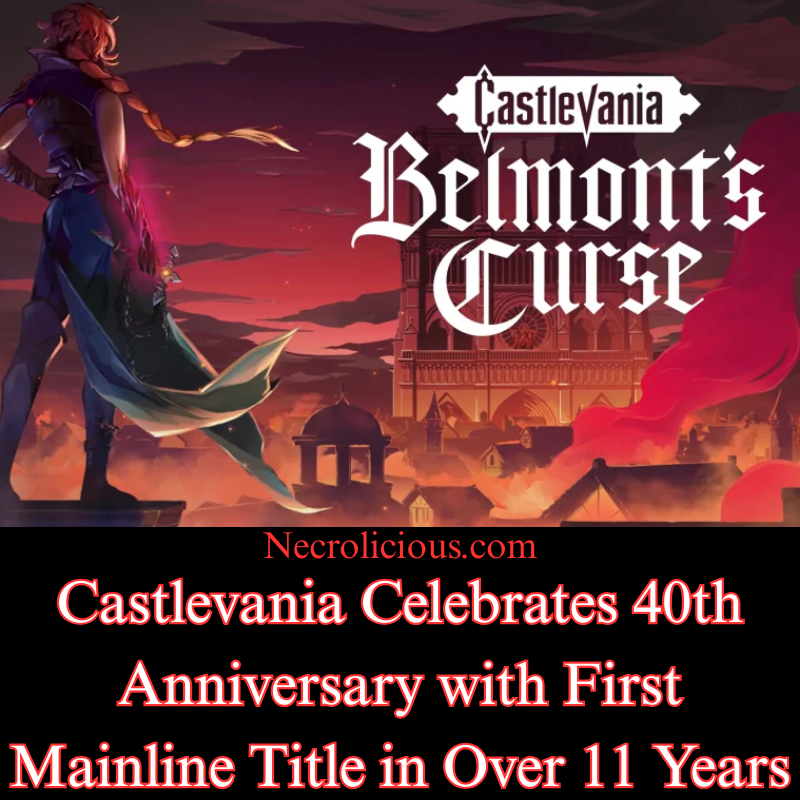
Konami has announced Castlevania: Belmont’s Curse, a brand new entry in the iconic Castlevania series. Scheduled for release in 2026, this 2D action-exploration game launches as the first project in the series’ 40th anniversary celebrations, which commemorate the original title’s debut in 1986.
The reveal took place during Sony’s State of Play livestream on 12 February 2026. Producer Tsutomu Taniguchi presented the project on stage, accompanied by a cinematic trailer that captured the gothic intensity fans have awaited for years.
Story & Setting
Castlevania: Belmont’s Curse acts as a direct sequel to Castlevania: Legacy of Darkness & unfolds 23 years later in 1499, at the centre of Paris, France. Players take control of Trevor Belmont’s young female successor, a new Belmont heir, who must wield the legendary Vampire Killer whip & a range of other weapons to confront demons that have overrun the city’s streets & raised Dracula’s castle amid a full-scale demonic outbreak.
The plot revolves around a mysterious “crimson curse” that leaves the fate of Paris – & potentially the wider world – suspended between despair & hope as flames consume the historic capital.
Gameplay Features
The title emphasises whip-based combat, enabling the protagonist to swing through environments like a trapeze for fluid mobility & strategic positioning. It offers a vast arsenal of weapons & abilities, alongside environmental puzzles, traps, hidden secrets & layered exploration typical of the Metroidvania genre.
A refreshed gothic art style merges the series’ traditional dark tones with vibrant colours, delivering a visually striking experience that respects its heritage while incorporating contemporary design sensibilities.
Development & Team
Konami oversees development in partnership with Evil Empire, the studio known for Dead Cells, with advisory support from Motion Twin. No director has been named at this stage, but the collaboration points to a focus on precise, polished action & exploration mechanics.
Producer Tsutomu Taniguchi has confirmed the project as the opening act in a broader slate of anniversary initiatives.
A Long-Awaited Return to Mainline Castlevania
Nearly 12 years (11 years, 11 months & 20 days to be exact) have passed since the last mainline Castlevania release, Castlevania: Lords of Shadow 2, which arrived in February 2014. In the intervening period the series has featured ports, collections & non-core projects such as the mobile MMO Grimoire of Souls, yet Belmont’s Curse marks the first original core entry in that time.
This substantial gap has amplified anticipation for a return to the classic 2D formula that defined the franchise.
More 40th Anniversary Plans?
Castlevania: Belmont’s Curse initiates Konami’s commemorative efforts for the series’ 40th year. Official portals carry an “Overture” message stating: “This is the beginning of numerous new products around Castlevania. Look forward to the return of the magnificent ‘nightmare’ lurking in the darkness.”
Further projects remain unannounced, but the studio has indicated a range of developments throughout 2026.
Pre-Order Details & Specials
Pre-orders became available on 13 February 2026, the day after the announcement. Digital Standard Edition copies are priced at approximately $39.99 & can be reserved on the PlayStation Store & Xbox Store, where some regions offer early-access discounts & minor reservation bonuses.
Physical editions are listed on some online retailers, but no deluxe editions, collector’s items or significant content bonuses have been confirmed, though additional details may surface closer to launch.
Platforms & Release Date
Castlevania: Belmont’s Curse will launch on PlayStation 5, Xbox Series X|S, Nintendo Switch & Steam in 2026.
Fans can view the official reveal trailer on YouTube & add the game to wishlists on the relevant digital storefronts to stay updated. As the first major title in what promises to be a landmark year for the series, Belmont’s Curse offers a compelling return to the Belmont legacy & the gothic world that has captivated players for four decades.
Unless otherwise noted, image assets above are NOT original content & are shared under fair use doctrine with NO claims to authorship or ownership. Contact necrolicious@necrolicious.com for credit or removal.
This post was sponsored by…ME! If you’d like to support, please buy my original meme merchandise or check out my affiliate links to get yourself some other cool things. Additional affiliate links may be contained in the above article. If you click on an affiliate link & sign up/make a purchase, I may earn a commission. This does not increase the price you pay for the product or service, so it helps support this website at no cost to you.
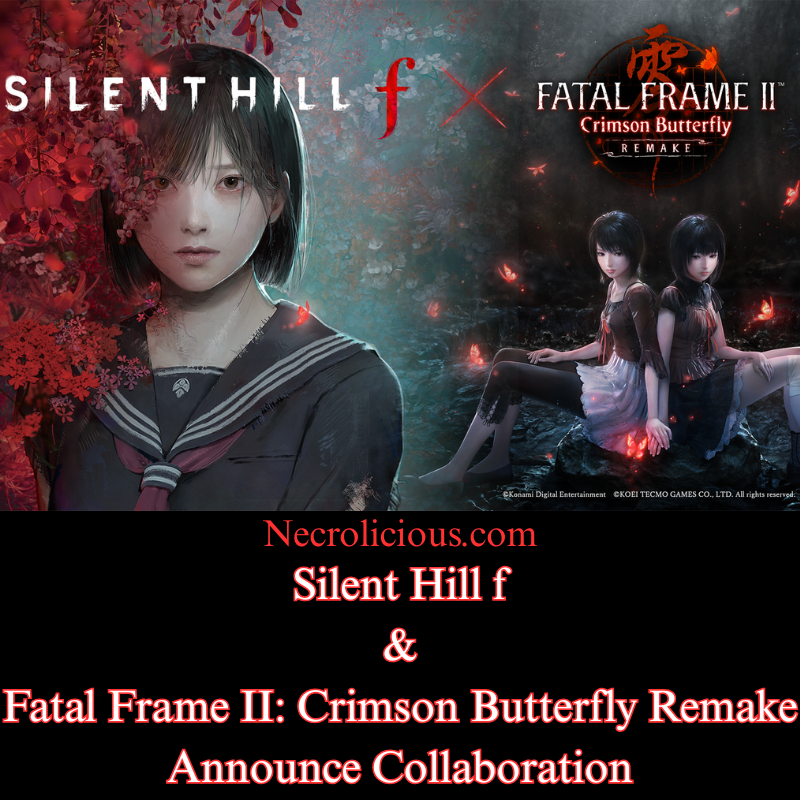
Konami & Koei Tecmo have announced a special collaboration between Silent Hill f & the forthcoming remake of Fatal Frame II: Crimson Butterfly. This partnership promises free downloadable content featuring themed costumes, bridging two iconic franchises in the survival horror genre. Set to enhance the atmospheric dread of both titles, the crossover highlights the shared heritage of psychological terror & supernatural elements that define these series.
Details of the Collaboration
The free DLC will introduce cosmetic items inspired by each game’s distinctive aesthetics. For Fatal Frame II: Crimson Butterfly Remake, players can expect costumes drawing from Silent Hill f‘s fog-enshrouded world, potentially including outfits reminiscent of protagonist Shimizu Hinako. Conversely, Silent Hill f is likely to receive attire influenced by the crimson butterflies & twin sisters central to Fatal Frame II‘s narrative. Promotional artwork released alongside the announcement blends these motifs, depicting fog-laden school uniforms intertwined with ethereal butterflies, evoking a sense of impending doom.
This rare alliance between Konami & Koei Tecmo underscores a commitment to revitalising classic horror experiences for modern audiences. While exact release dates for the DLC remain under wraps, further details are anticipated soon.
Silent Hill f, developed by Neobards Entertainment & published by Konami, continues the legacy of the Silent Hill series, which has captivated players since 1999 with its exploration of guilt, fear & the subconscious. The title immerses users in a nightmarish town where personal demons manifest as grotesque entities, demanding strategic survival & puzzle-solving.
Meanwhile, Fatal Frame II: Crimson Butterfly, originally released in 2003, is being remade by Team Ninja under Koei Tecmo’s banner. The story follows twin sisters Mio & Mayu as they navigate a cursed village haunted by vengeful spirits. Combat revolves around the Camera Obscura, a mystical device used to capture & exorcise ghosts, adding a layer of vulnerability to encounters. The remake promises updated graphics, refined mechanics & expanded content to appeal to both veterans & newcomers.
Release Schedule & Platforms
Excitement builds as Fatal Frame II: Crimson Butterfly Remake approaches its launch on 12 March 2026, across PlayStation 5, Xbox Series X|S, Nintendo Switch 2 & Steam. A demo will be available from 5 March, offering a taste of the remastered horrors ahead. This timing aligns perfectly with the collaboration, allowing players to experience the base game before integrating the crossover elements.
Fan Reactions & Community Buzz
The announcement has sparked widespread enthusiasm on social media platforms. Fans have expressed delight at the prospect of horror crossovers, with many suggesting extensions to other titles such as Dead by Daylight for additional skins featuring characters like Hinako. Comments highlight a desire for more interactions between beloved franchises, while some users continue to advocate for ports of classic Silent Hill games to contemporary systems.
This positive reception indicates strong potential for the DLC to boost engagement & sales, fostering a renewed interest in Japanese horror gaming.
Implications for the Horror Genre
Collaborations like this not only reward loyal fans but also introduce each series to new audiences, potentially expanding the reach of survival horror. As developers continue to remake & refresh classics, such partnerships could pave the way for innovative experiences that blend narratives & mechanics across titles.
For enthusiasts eager to delve into these chilling worlds, the upcoming releases & DLC represent a significant milestone in the evolution of the genre. Stay informed as more updates emerge & prepare for a season of spine-tingling adventures.
Unless otherwise noted, image assets above are NOT original content & are shared under fair use doctrine with NO claims to authorship or ownership. Contact necrolicious@necrolicious.com for credit or removal.
This post was sponsored by…ME! If you’d like to support, please buy my original meme merchandise or check out my affiliate links to get yourself some other cool things. Additional affiliate links may be contained in the above article. If you click on an affiliate link & sign up/make a purchase, I may earn a commission. This does not increase the price you pay for the product or service, so it helps support this website at no cost to you.
In the realm of video games, few events have illustrated the principle of karmic justice as starkly as the trajectory of Ubisoft following the release of Assassin’s Creed Shadows. This title, set in feudal Japan, drew widespread condemnation for its perceived disregard of historical accuracy & cultural sensitivity, particularly in its portrayal of Yasuke as a prominent black samurai. The ensuing backlash, especially from Japan, appears to have catalysed a cascade of misfortunes for the French gaming giant, culminating in financial turmoil, internal dissent, & structural collapse. As Ubisoft grapples with plummeting stock values, mass redundancies, & union strikes, one cannot overlook the irony: a company that sought to “diversify” history at the expense of authenticity now faces its own existential reckoning. This article examines the sequence of events, underscoring how cultural insensitivity can exact a heavy toll in the global market.
The Fabricated Legend: Thomas Lockley & the Yasuke Myth
At the heart of the controversy lies Thomas Lockley, a British academic at Nihon University whose 2019 book, African Samurai, reimagined Yasuke—a historical African retainer to Oda Nobunaga—as a legendary samurai warrior. Historical records, such as the Shinchōkōki chronicle & Jesuit accounts, depict Yasuke as a novelty bodyguard who served for roughly 15 months in the 1580s, with no evidence of samurai status, land grants, or heroic battles. Lockley, however, embellished these facts with speculative elements, including invented exploits, a fictional family, & dramatic feats, admitting on the book’s cover that much was “speculative fiction.”
Lockley’s influence extended beyond print; he allegedly used sockpuppet accounts to edit Wikipedia extensively, inserting his fabrications as established history. This astroturfing campaign gained traction, providing Ubisoft with a veneer of legitimacy for featuring Yasuke as a co-protagonist in Shadows. The game’s trailers portrayed him as a hyper-muscular figure engaging in anachronistic actions, such as skull-crushing violence & forcing villagers to bow—elements critics decried as caricatures that prioritised modern diversity agendas over Japanese cultural norms. When exposed in July 2024, Lockley deleted his social media profiles & faced a university investigation for misconduct, vanishing from public view.
Ubisoft’s reliance on this dubious scholarship amplified the insult. The company dismissed critics, including figures like Elon Musk, as “racist,” & delayed the game’s release from November 2024 to March 2025 to address the “Yasuke backlash.” Additional inaccuracies, such as the desecration of sacred torii gates & shrines without temple permissions, prompted outrage from Japanese politicians, priests, & even considerations of legal action by the prime minister’s office. Other elements, including Chinese architectural intrusions, stolen military banners, & non-binary characters, further alienated audiences who viewed the game as a Western imposition on Japanese heritage.
Japan’s Reprisal: Boycotts, Sales Collapse, & Global Repercussions
The karmic retribution manifested most acutely in Japan, where Assassin’s Creed Shadows was met with a resounding boycott. Despite Ubisoft’s efforts to polish the title post-delay, sales figures painted a grim picture. In its first week on PS5 in Japan, the game moved approximately 17,700 units—a mere 8% of the 212,000 units sold by Ghost of Tsushima in its debut three days. Globally, while it achieved a strong launch with over 3 million players in days & 5 million by July 2025, long-term performance faltered, reaching only about 4.3 million units by November 2025 & an estimated 4-5 million lifetime sales. This paled against predecessors like Assassin’s Creed Valhalla (over 20 million) & Odyssey (over 10 million).
The financial hit was exacerbated by development costs exceeding $300 million, compounded by prior flops like Star Wars Outlaws & Skull & Bones. On platforms like Amazon Japan, ratings plummeted, & social media echoed sentiments of cultural betrayal, with memes branding the game “woke slop.” This rejection not only tanked regional revenue but also amplified global “get woke, go broke” narratives, deterring potential buyers & eroding brand trust.
Ubisoft’s Implosion: From Internal Revolt to Financial Ruin
The fallout from Shadows accelerated Ubisoft’s broader decline, manifesting in a series of corporate setbacks that suggest a company in terminal stages. By January 2026, a “major reset” announcement on the 21st cancelled six projects, closed two studios, & delayed seven titles, triggering a 37% stock plunge to $0.91— a 40% year-to-date drop. Internal Slack channels overflowed with employee criticism of upper management, highlighting years of controversies, talent exodus, & creative stagnation.
French unions responded with unanimous approval for a three-day strike from 10-12 February 2026, protesting approximately 200 voluntary redundancies at Paris headquarters—representing 18% of its 1,100 staff. CEO Yves Guillemot faced demands for resignation amid accusations of oblivious leadership, no salary increases, & enforced remote work policies. Rumours of a Tencent bailout intensified, with the Guillemot family considering asset sales to avert total collapse.
This sequence underscores a direct link: the cultural affront in Shadows eroded market confidence, leading to revenue shortfalls & operational chaos.
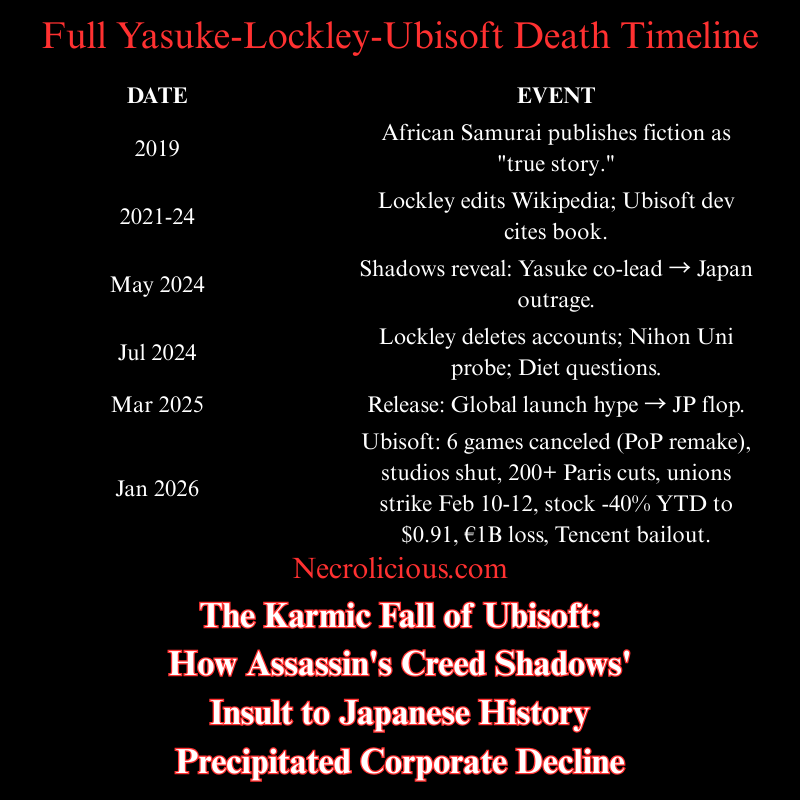
Full Yasuke-Lockley-Ubisoft Death Timeline
Date
Event
2019
African Samurai publishes fiction as “true story.”
2021-24
Lockley edits Wikipedia; Ubisoft dev cites book.
May 2024
Shadows reveal: Yasuke co-lead → Japan outrage.
Jul 2024
Lockley deletes accounts; Nihon Uni probe; Diet questions.
Mar 2025
Release: Global launch hype → JP flop (~4.5M lifetime vs. Valhalla 20M+).
Jan 2026
Ubisoft: 6 games canceled (PoP remake), studios shut, 200+ Paris cuts, unions strike Feb 10-12, stock -40% YTD to $0.91, €1B loss, Tencent bailout.
Verdict: Lockley’s grift for fame (pushed by DEI zealots) fed Ubisoft’s hubris—race-swapped Japanese history for “representation.” Japan/JP gamers boycotted, sales tanked, empire crumbles. “Get woke, Yasuke broke.” Tencent now owns AC lifeline; old Ubisoft RIP.
A Fortuitous Escape for Persian Heritage
In a parallel narrative, Iranians narrowly avoided a comparable cultural slight with the cancellation of the Prince of Persia: The Sands of Time remake. Developed primarily by Ubisoft’s Indian studios in Pune & Mumbai, leaks revealed a transformation of Persian protagonists into figures with “suspiciously Indian” features—darker skin tones, exaggerated eyes, & Bollywood-inspired aesthetics that deviated from ancient Iranian depictions. The prince resembled a “Bollywood dancer” rather than a historical Persian hero, while Princess Farah was amplified with henna motifs & “girlboss” traits. Announced in 2020 & rebooted in 2022 after a disastrous trailer, the project—plagued by outsourcing issues & unpolished visuals—was axed in January 2026’s reset, sparing Iran a potential boycott akin to Japan’s. While this averted a PR disaster, it highlighted Ubisoft’s pattern of prioritising cost-cutting & diversity mandates over cultural fidelity.
Reflections on Cultural Respect in Gaming
Ubisoft’s plight serves as a cautionary tale for the industry: disregarding historical & cultural integrity invites not only backlash but also tangible consequences. The insult to Japanese heritage through Assassin’s Creed Shadows—rooted in fabricated narratives & insensitive portrayals—has seemingly invoked karmic justice, propelling the company towards dissolution. With €1 billion in losses, ongoing strikes, & bailout speculations, Ubisoft’s future hangs in the balance. As gamers & developers alike reflect on this saga, the imperative for authentic representation becomes clear: true diversity honours history, rather than rewriting it.
Unless otherwise noted, image assets above are NOT original content & are shared under fair use doctrine with NO claims to authorship or ownership. Contact necrolicious@necrolicious.com for credit or removal.
This post was sponsored by…ME! If you’d like to support, please buy my original meme merchandise or check out my affiliate links to get yourself some other cool things. Additional affiliate links may be contained in the above article. If you click on an affiliate link & sign up/make a purchase, I may earn a commission. This does not increase the price you pay for the product or service, so it helps support this website at no cost to you.
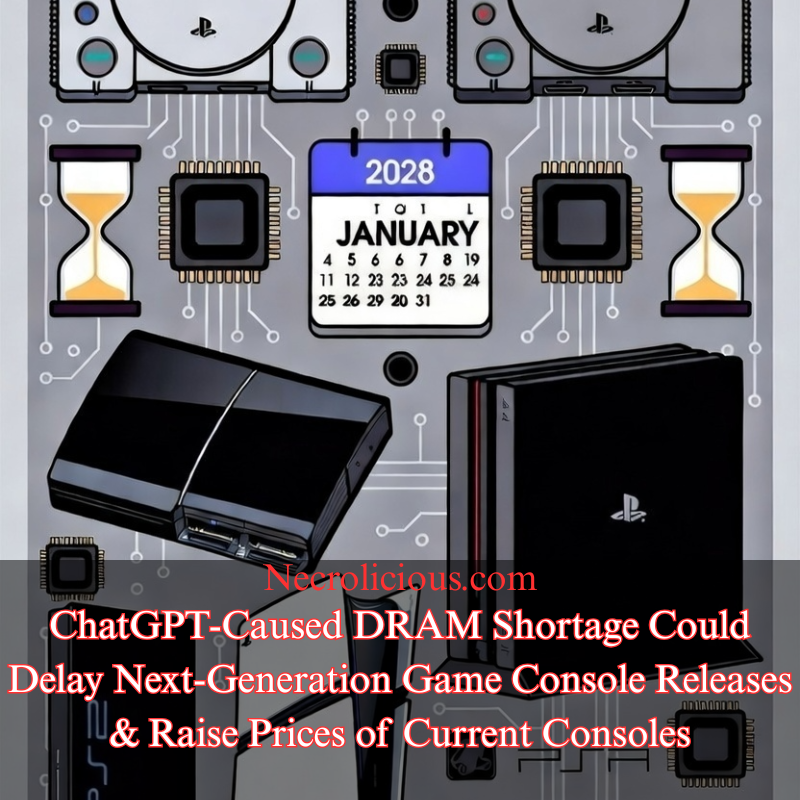
The gaming industry is grappling with a significant challenge that may alter the timeline for next-generation console launches. Recent insights from industry insider Tom Henderson, combined with broader industry analysis, suggest that escalating RAM prices, driven by AI data centre demand which was worsened by ChatGPT’s hoarding of 40% of the world’s DRAM supply, could delay the anticipated 2027-2028 releases of the PlayStation 6 (PS6) & the next Xbox.
The Rising Cost of RAM & Its Impact on Console Development
Tom Henderson’s report highlights a dramatic surge in DRAM prices in the wake of OpenAI’s monopoly, with server modules increasing by 50% and some consumer variants rising by up to 170%. This scarcity presents a critical dilemma for console manufacturers, who must decide whether to absorb the costs, pass them onto consumers, or delay production in anticipation of stabilised prices. Industry analyses indicate that RAM prices have risen by several hundred percent in recent months, exacerbating the challenge for mass-producing consoles at competitive price points.
Supporting this, technical reports suggest that the shortage stems from a shift in manufacturing priorities, with major producers allocating resources to advanced memory types for AI applications rather than commodity DRAM. This supply constraint not only threatens next-generation hardware but also raises the possibility of price hikes for current-generation consoles in 2026.
Industry Response & Potential Delays
According to Henderson’s findings, manufacturers such as Sony and Microsoft are considering a delay beyond the 2027-2028 release window. This strategic decision hinges on whether RAM producers can expand their capacity to reduce costs. Industry forecasts suggest that memory shortages, driven by AI & data centre expansion, could persist for multiple years, potentially extending the lifecycle of current-generation consoles like the PS5 & Xbox Series X. This extended timeline would allow developers to maximise existing hardware with titles such as GTA 6 & enhancements like the PS5 Pro.
Economic analyses further indicate that the industry may prioritise software innovation & mid-generation upgrades over new hardware launches, ensuring competitiveness despite the supply constraints. This approach aligns with observations that current consoles remain relevant, with many games optimised for existing specifications rather than requiring new systems.
For gamers, the RAM price surge carries immediate implications. The industry’s reluctance to release new hardware at elevated costs suggests that existing consoles may face further price increases in 2026. Additionally, 2025’s price hikes for the Nintendo Switch 1—raising its cost from $300 to $340—demonstrate that the days of markdowns for last-generation consoles may be gone for the foreseeable future. This shift indicates that gamers who have not yet purchased a current-generation console should not wait. Price hikes are likely forthcoming for current generation consoles as supply constraints persist.
The correlation between Henderson’s initial report & subsequent industry analyses underscores a pivotal moment for the gaming sector. The RAM shortage, driven by AI demand & Sam Altman’s monopoly, could reshape release schedules & pricing strategies for years to come. As manufacturers navigate this challenge, gamers are advised to stay informed & consider their purchases carefully. With the potential for prolonged use of current hardware, the focus may shift towards software development & mid-generation enhancements, ensuring the industry remains robust despite economic pressures.
Unless otherwise noted, image assets above are NOT original content & are shared under fair use doctrine with NO claims to authorship or ownership. Contact necrolicious@necrolicious.com for credit or removal.
This post was sponsored by…ME! If you’d like to support, please buy my original meme merchandise or check out my affiliate links to get yourself some other cool things. Additional affiliate links may be contained in the above article. If you click on an affiliate link & sign up/make a purchase, I may earn a commission. This does not increase the price you pay for the product or service, so it helps support this website at no cost to you.
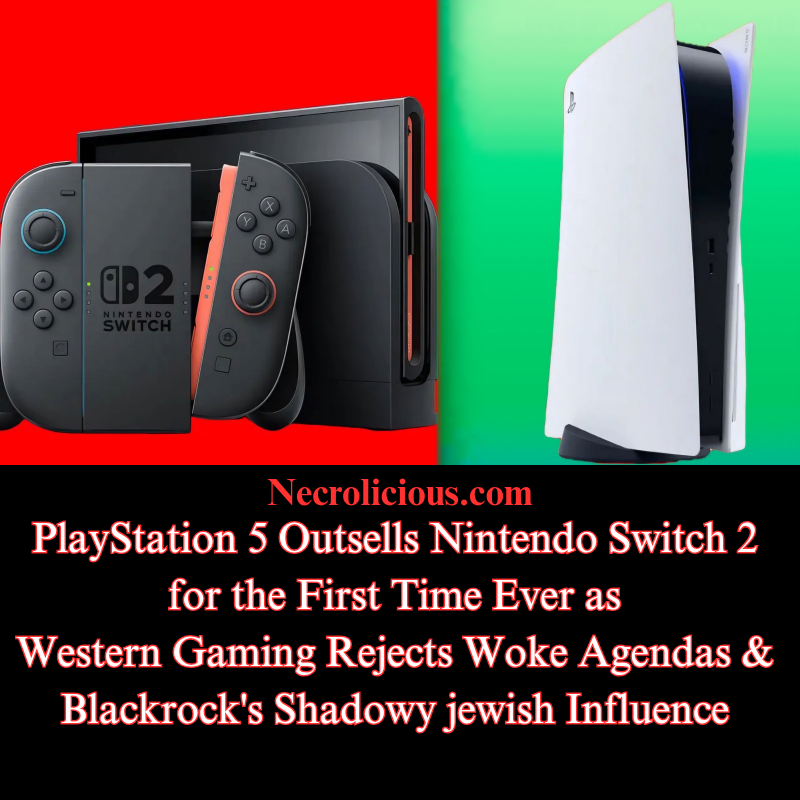
In recent months, a notable shift has emerged in the video game industry, particularly amongst Western developers. After years of integrating overt social messaging—often characterised as “woke” agendas—into their titles, many studios appear to be recalibrating their priorities towards core entertainment value. This pivot coincides with Sony’s PlayStation 5 (PS5) achieving a historic milestone: outselling Nintendo’s Switch 2 in the United States for November 2025, the first such occurrence since the Switch 2’s launch in June. This development signals not merely a fleeting market fluctuation but a broader rebuke of ideologically driven content that has alienated core audiences, leading to sluggish sales & widespread industry turmoil.
Revisiting Gaming’s Roots: The Enduring Appeal of Mature Narratives
Reflecting on the evolution of console gaming, the distinctions between platforms were once stark & purposeful. During the formative years of the industry in the 1990s & early 2000s, Nintendo positioned itself as the family-friendly option, emphasising whimsical, accessible experiences suitable for younger players. In contrast, Sony’s PlayStation catered to a more mature demographic, offering complex, narrative-driven titles with themes of intrigue, conflict, & moral ambiguity—games that resonated with those seeking depth beyond lighthearted escapism.
This dichotomy persists today, albeit in evolved forms. The Switch 2 excels in portable, inclusive gameplay, bolstered by timeless franchises that appeal across generations. Yet, the PS5’s recent surge—fuelled by strategic holiday promotions & releases—underscores a return to PlayStation’s strengths. Sony’s platform is reclaiming its role as the preferred choice for discerning gamers. This uptick arrives amidst the industry’s lowest November hardware sales in the U.S. since 1995, highlighting how targeted, audience-aligned strategies can thrive even in a challenging economic landscape.
The Perils of Ideological Overreach: “Go Woke, Go Broke” in Practice
The preceding years have been marked by a discernible sales downturn for Western gaming entities, attributable in part to the infusion of progressive ideologies that prioritised messaging over gameplay. High-profile failures, such as Concord (shuttered mere weeks after its 2024 debut) & Suicide Squad: Kill the Justice League, exemplify this trend, with critics attributing their underperformance to forced diversity elements & narrative choices that felt didactic rather than organic. The adage “go woke, go broke” has gained traction as a shorthand for this phenomenon, reflecting consumer fatigue with content that lectures rather than entertains. Industry-wide layoffs exceeding 20,000 positions between 2023 & 2025 further illustrate the financial repercussions, reminiscent of the 1983 video game crash where market saturation & poor quality led to collapse.
The Shadowy Architect: BlackRock’s Coercive Role in DEI Proliferation
At the heart of this ideological push lies BlackRock, the world’s largest asset manager, whose insidious influence through Environmental, Social, & Governance (ESG) frameworks has been instrumental in embedding Diversity, Equity, & Inclusion (DEI) mandates across industries, including gaming. Far from an organic evolution towards civil rights, this was a calculated financial strategy: BlackRock, leveraging its trillions in assets, conditioned investments & loans on ESG compliance, effectively strong-arming publicly traded companies like Electronic Arts, Ubisoft, & Sony’s partners to adopt DEI policies. Studios were compelled to engage DEI consultants, such as the controversial Sweet Baby Inc., resulting in alterations that prioritised harmful social engineering over player engagement—to the detriment of not only sales & fan loyalty, but society as a whole.
BlackRock’s actions, under the stewardship of jew CEO Larry Fink—a figure with deep ties to & vocal support of the state of israel—have drawn scrutiny for advancing agendas that extend beyond mere profit motives. The firm maintains a significant presence in Israel, with dedicated offices & substantial investments in companies linked to Israeli defence & technology sectors, including those implicated in regional conflicts. Critics argue that BlackRock’s operations reflect a broader alignment with Israeli interests, as evidenced by Fink’s public condemnations of attacks on israel & the company’s portfolio choices that bolster israeli entities amidst geopolitical tensions. While BlackRock frames these as standard global investments, detractors view them as part of a pattern where financial power is wielded to influence cultural & political landscapes, potentially subverting entertainment mediums like gaming to serve external objectives.
This entanglement raises profound ethical questions about the intersection of finance, identity & media control, with BlackRock’s dominance enabling a form of covert manipulation that prioritises ideological conformity over artistic freedom.
A Partial Victory: Developers’ Awakening & the Lingering Threat
Encouragingly, the industry is showing signs of resistance. In February 2025, BlackRock announced the dissolution of its DEI targets, merging the division into a rebranded “Talent & Culture” team & excising explicit references from corporate reports. This reversal, prompted by political pressures including anti-DEI policies under the Trump administration, has been hailed as a step towards merit-based practices. Developers, such as those at CI Games, have echoed this sentiment, emphasising a return to “fun” as the primary directive. Sony’s PS5 sales rebound serves as tangible evidence that audiences reward this shift, opening their wallets in approval.
Yet, vigilance is imperative. This battle is far from concluded; BlackRock & similar entities are adept at adaptation. Rather than outright abandonment, DEI initiatives may simply be rebadged under nebulous acronyms—such as “Talent & Culture” or analogous terms like JPMorgan’s pivot to “Diversity, Opportunity, & Inclusion”—allowing the same subversive activities to persist under a veil of ambiguity. The gaming community must remain alert to these tactics, lest entertainment once again becomes a conduit for external agendas.
Towards a Sustainable Future: Prioritising Players Over Power Brokers
The PS5’s triumph over the Switch 2 in November 2025 is a harbinger of potential renewal for Western gaming, provided the industry sustains its focus on quality & authenticity. By extricating itself from the grip of entities like BlackRock, whose financial machinations have long distorted creative priorities, gaming can reclaim its essence as a medium of unbridled imagination. However, true progress demands ongoing scrutiny of corporate influences, including those intertwined with geopolitical interests. The path forward lies in empowering creators & consumers alike, free from the shadows of undue manipulation.
Unless otherwise noted, image assets above are NOT original content & are shared under fair use doctrine with NO claims to authorship or ownership. Contact necrolicious@necrolicious.com for credit or removal.
This post was sponsored by…ME! If you’d like to support, please buy my original meme merchandise or check out my affiliate links to get yourself some other cool things. Additional affiliate links may be contained in the above article. If you click on an affiliate link & sign up/make a purchase, I may earn a commission. This does not increase the price you pay for the product or service, so it helps support this website at no cost to you.
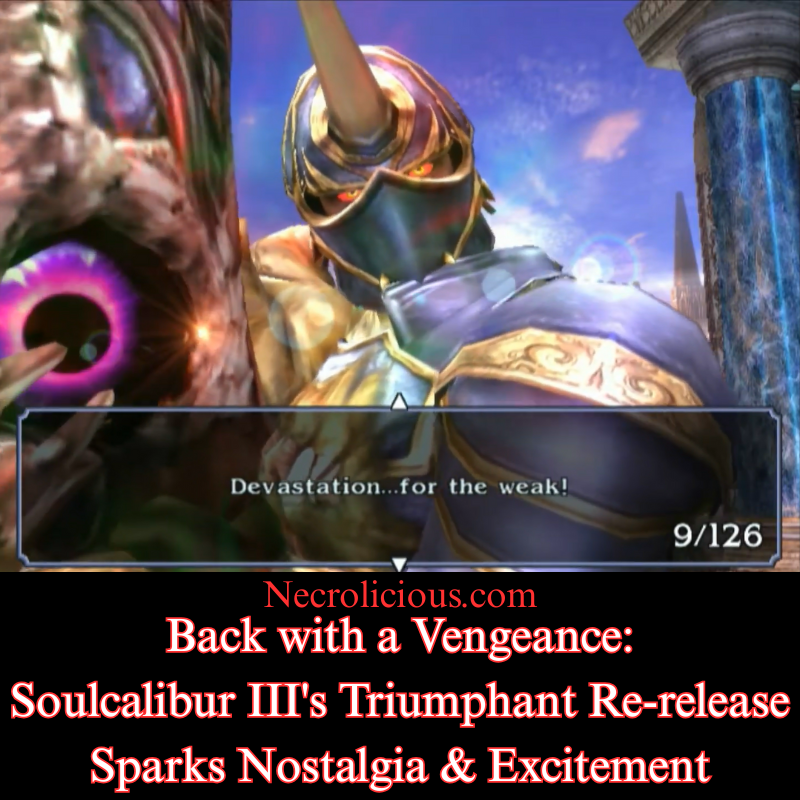
In a move that has reignited the passion of fighting game enthusiasts, Soulcalibur III has been confirmed for inclusion in PlayStation Plus Premium’s Classics Catalogue, available from December 16, 2025. Originally launched on the PlayStation 2 in 2005, this title stands as a pinnacle in the Soulcalibur series, celebrated for its innovative gameplay mechanics & deep narrative modes. This re-release on PS5 & PS4 not only revives a classic but also invites a new generation to experience its legacy. Let’s delve into what makes this addition significant & how it fits into the broader landscape of gaming nostalgia & modern accessibility.
The Legacy of Soulcalibur III
Soulcalibur III, developed by Namco, is often regarded as one of the finest entries in the series, thanks to its robust character creation system & the introduction of Chronicles of the Sword, a mode that blends real-time strategy with traditional fighting game mechanics. These features, combined with the game’s fluid 3D weapon-based combat, contributed to its commercial success, selling over one million copies worldwide. The game’s arrival on PlayStation Plus Premium marks a significant moment for fans who have long awaited a remastered or re-released version that leverages modern hardware capabilities.
Enhanced Experience on Modern Consoles
The porting of Soulcalibur III to PS5 & PS4 promises an enhanced experience, with improved visuals & performance that were not possible on the original PS2 hardware. Although the re-release does not include trophy support—a point of contention among some fans—it retains the core elements that made the game a favourite. The absence of trophies, however, does not detract from the game’s appeal, as its depth in gameplay & storytelling remains intact. For subscribers, this means accessing a title that not only holds historical value but also offers a fresh perspective through contemporary technology.
The announcement has sparked a wave of excitement across social media platforms, with fans expressing nostalgia & anticipation. The official Soulcalibur X account shared a video montage showcasing the game’s fighters & dynamic arenas, which has amassed significant engagement. Replies to the post reflect a mix of joy at the re-release & calls for further expansions, such as PC ports & the long-rumoured Soulcalibur VII. This community dialogue underscores the enduring popularity of the series & the desire for its continued evolution.
The Appeal of a Pre-“Wokeness” Era Gaming Experience:
Soulcalibur III’s re-release resonates deeply with many fans not only for its gameplay & nostalgic value but also because it hails from a period in gaming history that predates significant cultural & political shifts. Originally released in 2005, the game emerged during a time before the advent of movements like Gamergate & the broader discussions around “wokeness” in media. This era is often nostalgically remembered for offering what some perceive as simpler, purer forms of entertainment, unencumbered by the complex social & political debates that have since permeated the industry.
The absence of influences from entities like BlackRock & the DEI they force inject into their subsidiaries, Soulcalibur III’s original development is a point of note for some enthusiasts. These elements, which have become more prominent in recent years, are seen by some as having introduced new layers of complexity or controversy into game design & marketing. For these fans, Soulcalibur III represents a return to a time when the focus was primarily on crafting engaging gameplay & rich narratives without the overlay of contemporary social agendas. The game’s character roster, while diverse in its own right through its fantasy & historical inspirations, was not shaped by modern diversity mandates, allowing players to engage with its world on its own terms.
This re-release, therefore, offers a form of escapism—not just from the technological limitations of the past but also from the cultural battles that have divided gaming communities in recent years. The joy expressed by fans on social media platforms reflects a desire to revisit a title that embodies non-political fun, where the primary objective was to master combat techniques, explore creative character designs, & immerse oneself in the fictional histories of its warriors. The simplicity of this experience, untainted by external controversies, is a significant draw for those who yearn for the unadulterated joy of gaming as it once was.
Oh, Spawn Where Art Thou?
Additionally, the re-release evokes memories of the original console-specific characters that were a hallmark of the Soulcalibur series but are notably absent in this version. The PlayStation 2 version of Soulcalibur II, for instance, featured Tekken’s Heihachi Mishima, while the Nintendo GameCube had The Legend of Zelda’s Link, & the Xbox included Spawn from the comic book series. These characters, cancelled from Soulcalibur III due to a policy against repeating guest appearances, were a source of excitement & platform exclusivity that added to the game’s appeal. Their absence in this re-release is a reminder of the era’s unique marketing strategies & the distinct identities of each console’s gaming ecosystem.
Looking Forward: The Future of Soulcalibur:
While Soulcalibur III’s re-release is a cause for celebration, it also reignites discussions about the series’ future. Rumours of a potential Soulcalibur VII announcement, possibly at a Nintendo Direct in 2025, add an layer of intrigue. Whether these speculations hold true, the reintroduction of Soulcalibur III serves as a reminder of the series’ impact & the potential for its revival in new formats. Fans & newcomers alike are encouraged to explore this classic, which continues to offer a rich tapestry of combat & narrative.
Soulcalibur III’s addition to PlayStation Plus Premium’s Classics Catalogue is more than a mere re-release; it is a testament to the game’s lasting appeal & the enduring legacy of the Soulcalibur series. As players revisit its storied battles & creative modes, the title stands as a bridge between past & present gaming cultures. For those seeking a blend of nostalgia & innovation, this opportunity to engage with Soulcalibur III on modern consoles is not to be missed. Whether you are a long-time fan or a curious newcomer, the clash of swords & souls awaits, ready to etch new heroes into history.
Unless otherwise noted, image assets above are NOT original content & are shared under fair use doctrine with NO claims to authorship or ownership. Contact necrolicious@necrolicious.com for credit or removal.
This post was sponsored by…ME! If you’d like to support, please buy my original meme merchandise or check out my affiliate links to get yourself some other cool things. Additional affiliate links may be contained in the above article. If you click on an affiliate link & sign up/make a purchase, I may earn a commission. This does not increase the price you pay for the product or service, so it helps support this website at no cost to you.