Silent Hill f & Fatal Frame II: Crimson Butterfly Remake Announce Collaboration

Konami & Koei Tecmo have announced a special collaboration between Silent Hill f & the forthcoming remake of Fatal Frame II: Crimson Butterfly. This partnership promises free downloadable content featuring themed costumes, bridging two iconic franchises in the survival horror genre. Set to enhance the atmospheric dread of both titles, the crossover highlights the shared heritage of psychological terror & supernatural elements that define these series.

Details of the Collaboration

The free DLC will introduce cosmetic items inspired by each game’s distinctive aesthetics. For Fatal Frame II: Crimson Butterfly Remake, players can expect costumes drawing from Silent Hill f‘s fog-enshrouded world, potentially including outfits reminiscent of protagonist Shimizu Hinako. Conversely, Silent Hill f is likely to receive attire influenced by the crimson butterflies & twin sisters central to Fatal Frame II‘s narrative. Promotional artwork released alongside the announcement blends these motifs, depicting fog-laden school uniforms intertwined with ethereal butterflies, evoking a sense of impending doom.

This rare alliance between Konami & Koei Tecmo underscores a commitment to revitalising classic horror experiences for modern audiences. While exact release dates for the DLC remain under wraps, further details are anticipated soon.

Buy on Rakuten Japan

Background on the Games

Silent Hill f, developed by Neobards Entertainment & published by Konami, continues the legacy of the Silent Hill series, which has captivated players since 1999 with its exploration of guilt, fear & the subconscious. The title immerses users in a nightmarish town where personal demons manifest as grotesque entities, demanding strategic survival & puzzle-solving.

Meanwhile, Fatal Frame II: Crimson Butterfly, originally released in 2003, is being remade by Team Ninja under Koei Tecmo’s banner. The story follows twin sisters Mio & Mayu as they navigate a cursed village haunted by vengeful spirits. Combat revolves around the Camera Obscura, a mystical device used to capture & exorcise ghosts, adding a layer of vulnerability to encounters. The remake promises updated graphics, refined mechanics & expanded content to appeal to both veterans & newcomers.

Release Schedule & Platforms

Excitement builds as Fatal Frame II: Crimson Butterfly Remake approaches its launch on 12 March 2026, across PlayStation 5, Xbox Series X|S, Nintendo Switch 2 & Steam. A demo will be available from 5 March, offering a taste of the remastered horrors ahead. This timing aligns perfectly with the collaboration, allowing players to experience the base game before integrating the crossover elements.

Fan Reactions & Community Buzz

The announcement has sparked widespread enthusiasm on social media platforms. Fans have expressed delight at the prospect of horror crossovers, with many suggesting extensions to other titles such as Dead by Daylight for additional skins featuring characters like Hinako. Comments highlight a desire for more interactions between beloved franchises, while some users continue to advocate for ports of classic Silent Hill games to contemporary systems.

This positive reception indicates strong potential for the DLC to boost engagement & sales, fostering a renewed interest in Japanese horror gaming.

Implications for the Horror Genre

Collaborations like this not only reward loyal fans but also introduce each series to new audiences, potentially expanding the reach of survival horror. As developers continue to remake & refresh classics, such partnerships could pave the way for innovative experiences that blend narratives & mechanics across titles.

For enthusiasts eager to delve into these chilling worlds, the upcoming releases & DLC represent a significant milestone in the evolution of the genre. Stay informed as more updates emerge & prepare for a season of spine-tingling adventures.

Buy on SUZURI

Unless otherwise noted, image assets above are NOT original content & are shared under fair use doctrine with NO claims to authorship or ownership.
Contact necrolicious@necrolicious.com for credit or removal.

This post was sponsored by…ME! If you’d like to support, please buy my original meme merchandise or check out my affiliate links to get yourself some other cool things. Additional affiliate links may be contained in the above article. If you click on an affiliate link & sign up/make a purchase, I may earn a commission. This does not increase the price you pay for the product or service, so it helps support this website at no cost to you.
Share this:

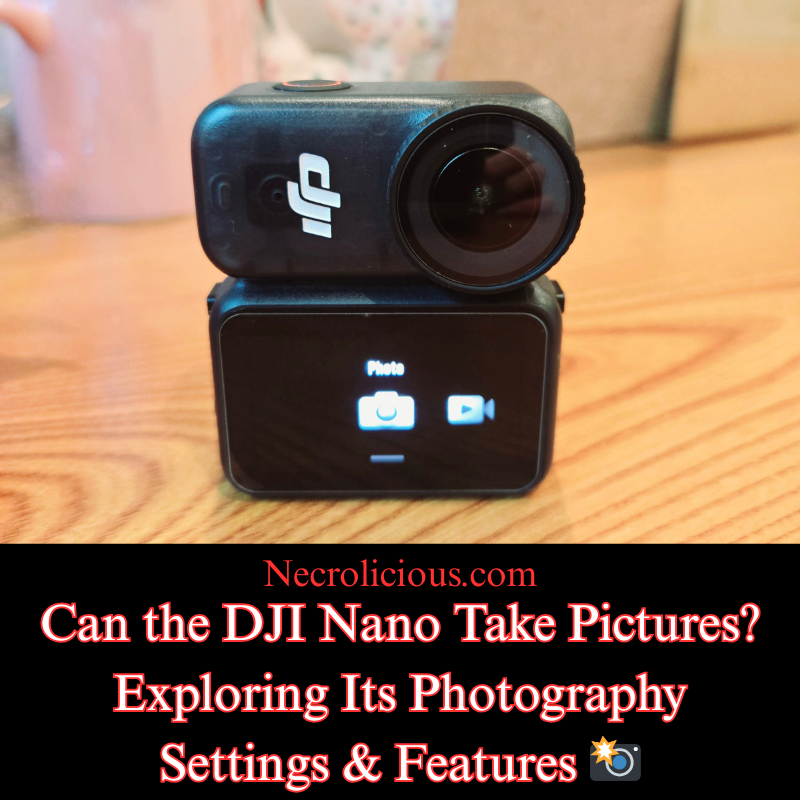
Can the DJI Nano Take Pictures? Exploring Its Photography Settings & Features 📸

In the realm of compact action cameras, the DJI Osmo Nano stands out for its versatility & portability. Designed for adventurers & content creators alike, this device combines advanced video recording with robust still photography capabilities. If you have been wondering whether the DJI Osmo Nano can take pictures, the short answer is yes. Beyond that, it offers a range of settings & features that make it a compelling choice for capturing high-quality images on the go. This article delves into the specifics, highlighting how these elements enhance your photographic experience.

An Overview of the DJI Osmo Nano

The DJI Osmo Nano is an ultra-compact, wearable action camera featuring a modular design with a 1/1.3-inch sensor & a 143° wide field of view. Weighing just 52 grams for the camera unit, it is ideal for mounting in various positions, whether for sports, travel or everyday documentation. While primarily known for its 4K/60fps video recording & 10-bit D-Log M colour performance, the device’s photography functions provide professional-grade results in a diminutive form factor.

8% off until February 2, 2026!
Buy on Rakuten Japan

Key Photography Settings & Features

The DJI Osmo Nano excels in still photography thanks to its dedicated sensor & lens configuration, which support detailed image capture across diverse conditions. Below is a summary of the primary photo specifications:

SpecificationDetails
Sensor1/1.3″ CMOS
LensFOV: 143°, Aperture: f/2.8, Focus Range: 0.35 m to ∞
ISO Range100-25600
Electronic Shutter Speed1/8000-30 s
Max Photo Resolution6880 × 5160 (approximately 35 MP)
Still Photography ModesSingle, Countdown (Off/0.5/1/2/3/5/10 s), Burst (up to 30 images in 3 s)
Photo FormatsJPEG/RAW

These settings allow users to adapt to various lighting scenarios & creative needs. For instance, the wide ISO range facilitates low-light photography, while the burst mode is particularly useful for action shots where timing is critical. The option to shoot in RAW format provides greater flexibility in post-production, enabling adjustments to exposure & colour without loss of quality.

Additionally, the camera’s 13.5 stops of dynamic range ensure that images retain detail in both highlights & shadows, making it suitable for landscapes & high-contrast environments. Features such as Horizon Balancing & stabilisation, borrowed from DJI’s broader ecosystem, further aid in producing sharp, level photographs even during movement.

Practical Applications for Photography

With its magnetic mounting system & waterproof design (up to 10 m for the camera), the DJI Osmo Nano is well-suited for capturing stills in challenging settings. Whether documenting a hike, a pet’s adventures or urban scenes, the device’s photo modes integrate seamlessly with its video functions, allowing for hybrid content creation. Users can switch effortlessly between modes via the 1.96-inch touchscreen or the companion app, ensuring that spontaneous moments are never missed.

The DJI Osmo Nano not only answers the question of whether it can take pictures with a resounding yes but also delivers a suite of advanced settings & features that rival larger cameras. From its high-resolution sensor to versatile modes & formats, it empowers photographers to capture compelling images with ease. If you are seeking a compact yet capable device for your next project, the Osmo Nano merits consideration.

Buy on SUZURI

Unless otherwise noted, image assets above are NOT original content & are shared under fair use doctrine with NO claims to authorship or ownership.
Contact necrolicious@necrolicious.com for credit or removal.

This post was sponsored by…ME! If you’d like to support, please buy my original meme merchandise or check out my affiliate links to get yourself some other cool things. Additional affiliate links may be contained in the above article. If you click on an affiliate link & sign up/make a purchase, I may earn a commission. This does not increase the price you pay for the product or service, so it helps support this website at no cost to you.

Share this:

Samsung x DJI: Did Samsung Make a Bigger, Better Vision Dock for the DJI Nano?

To be clear, Samsung has not officially made any new hardware in partnership with DJI. This “bigger, better” experience stems from DJI Mimo app compatibility with the cover screens featured on Samsung’s Z Flip lineup. The Mimo app connects wirelessly to the Osmo Nano via Wi-Fi & Bluetooth, supporting full functionality including Pro mode on the cover screen, providing a larger, but still palm-sized, means to remotely access the camera preview & more advanced Mimo features that are not as easily accessed on the Nano’s Vision Dock. This setup proves particularly useful for POV shooting with the Nano magnetically mounted, allowing quick framing, parameter tweaks & monitoring on Samsung’s more spacious & vibrant Super AMOLED displays.

The DJI Osmo Nano pairs exceptionally well with Samsung’s Galaxy Z Flip series from the Z Flip5 onwards, where the outer cover screen serves as a larger, more capable alternative to the official Multifunctional Vision Dock’s 1.96-inch OLED touchscreen. By running the DJI Mimo app on the closed phone’s cover display (enabled via Samsung’s Good Lock or native customisations for any app support), users gain a bigger portable viewing & control interface for live preview, remote operation & granular settings adjustments – all without unfolding the device or relying on the smaller, somewhat harder to see & operate dock.

Contrasting Cover Screen Operation of the DJI Mimo App on Galaxy Z Flip5, Flip6 & Flip7

The cover screen experience evolves across models, with progressive improvements in size, resolution & usability for app-based control of the Osmo Nano.

Galaxy Z Flip5 Cover Screen Operation

Buy on Rakuten Japan

The 3.4-inch Super AMOLED cover display (720 × 748 resolution) provides a solid step up from the Vision Dock’s 1.96-inch screen, offering roughly 70% more diagonal area for clearer live previews & easier touch interactions.
Mimo app runs effectively when forced to the cover screen (via Good Lock or settings), enabling real-time viewing, basic remote start/stop & access to Pro mode parameters.
Navigation feels more comfortable than on the dock for sliders & menus, though the resolution & brightness limit fine colour judgement in bright conditions compared to later models.
Ideal for quick checks during action but may require occasional unfolding for the most detailed edits.

Galaxy Z Flip6 Cover Screen Operation

Buy on Rakuten Japan

Retains the same 3.4-inch Super AMOLED size & 720 × 748 resolution as the Flip5, with enhancements in overall phone performance (better battery, processing & brightness).
Mimo app operation mirrors the Flip5 closely on the cover screen – reliable wireless connection, live feed & granular controls – but benefits from improved touch response & outdoor visibility.
Users report smoother app performance & less lag in previews, making it marginally preferable for extended monitoring without the dock.
The experience remains compact yet noticeably larger than the Vision Dock, prioritising portability over expansive real estate.

Galaxy Z Flip7 Cover Screen Operation

Buy on Rakuten Japan

Features a significantly enlarged 4.1-inch Super AMOLED cover display (1048 × 948 resolution, up to 120Hz refresh rate), representing the largest & highest-resolution cover screen in the series to date – with reduced bezels for edge-to-edge usability & approximately double the usable area of predecessors.
This delivers the most compelling alternative to the Vision Dock: substantially bigger live previews, more precise touch targets for sliders/numeric inputs, superior colour accuracy & brightness (up to 2600 nits peak in some modes), & fluid navigation of Pro mode settings even in challenging lighting.
Mimo app excels here for detailed tweaks, with real-time feedback on exposure, stabilisation & more feeling far less constrained.
The larger interface supports better multitasking glimpses (e.g., quick parameter checks mid-shoot) & positions the Flip7 as the standout for app-driven Osmo Nano control.

Viewing Area Comparison Table

Device/ModelCover Screen TypeDiagonal SizeResolution (approx.)Key Advantages for DJI Mimo App Operation on Cover Screen
DJI Osmo Nano Vision DockOLED Touchscreen1.96 inches314 × 556Compact & integrated; phone-free basics; 800 nits typical brightness
Galaxy Z Flip5Super AMOLED Cover3.4 inches720 × 748Larger preview area; good for quick Pro mode access; vibrant but standard resolution
Galaxy Z Flip6Super AMOLED Cover3.4 inches720 × 748Same size as Flip5; enhanced brightness & performance for smoother app use
Galaxy Z Flip7Super AMOLED Cover4.1 inches1048 × 948Biggest & sharpest; edge-to-edge design; superior visibility & precision for detailed controls

The Mimo app unlocks superior granular adjustments on these cover screens compared to the Vision Dock, thanks to larger interfaces & precise controls. Key parameters easier to manage include:

Core Exposure Parameters (Pro mode > Manual “M”)

  • Shutter Speed – Large sliders & real-time preview judge motion blur instantly; dock feels cramped.
  • ISO – Precise selection with visible noise impact on bigger display.
  • Exposure Compensation (EV) – Intuitive live tweaks for balanced brightness.
  • Exposure Mode – Tap-to-toggle with full context visible.

Other Image & Advanced Parameters

  • White Balance – Sliders/presets with accurate colour judgement outdoors.
  • Color Profile – Clear toggle to D-Log M with previews.
  • Bitrate – Easy comparison of quality vs storage.
  • Stabilisation (EIS) – Mode switch with FOV previews.
  • Field of View (FOV) – Better composition on larger framing.

Additional Granular/Custom Settings

  • Custom Mode Saving – Easier naming & management of presets.
  • Pre-Rec (Buffer Recording) – Clear toggles & status.
  • Audio Settings – Detailed sliders for mic gain & wind reduction.

Lastly, let’s not forget your phone’s ability to upload directly to social media–something the DJI Vision Dock just can’t do!

Overall, Samsung’s Galaxy Z Flip cover screen workflow – especially on the Flip7 – offers a bigger, often more practical way to operate the Mimo app for the Osmo Nano, blending foldable convenience with enhanced control. The Vision Dock retains advantages for fully standalone use (extended battery & direct mounts), but for app-centric precision & visibility, the Flip series stands out. For compatibility confirmation & updates, refer to DJI’s Mimo download page & Samsung device specs. The Osmo Nano’s 4K/60fps, 143° FOV & 10-bit D-Log M continue to deliver excellent results in this ecosystem. As a Flip6 owner, I can say that this works with these devices. It may also work with other flip-style phone models, such as those made by Motorola, but since I do not possess such a device, I personally cannot confirm.

As a small side note, DJI is presently offering an 8% discount on the Nano until February 2, 2026. Bundled with point back campaigns & other credit card rewards, this can jump up to about 10%, so get it while the getting is good!

Buy on Rakuten Japan

Unless otherwise noted, image assets above are NOT original content & are shared under fair use doctrine with NO claims to authorship or ownership.
Contact necrolicious@necrolicious.com for credit or removal.

This post was sponsored by…ME! If you’d like to support, please buy my original meme merchandise or check out my affiliate links to get yourself some other cool things. Additional affiliate links may be contained in the above article. If you click on an affiliate link & sign up/make a purchase, I may earn a commission. This does not increase the price you pay for the product or service, so it helps support this website at no cost to you.

Share this:

R.I.P. necrolicious.store: Why .store Domains Are Overrated (Based On Personal Experience)

For awhile, all sorts of internet influencers & gurus were saying that .store domains were the path to ecommerce profits & financial freedom. With a lot of introductory offers of only about a dollar for the first year, I decided to give it a try. However, I am sad to announce that the necrolicious.store website will be going down next month. But my meme merchandise will remain available on Printify Popup for everyone outside of Japan. The .store domain was a failed experiment & the renewal cost of nearly $60–far from the $1 introductory offer–is simply not justifiable, in my experience. In this article, we’ll explore my personal experiment with a .store domain, why it fell flat, & what alternatives might offer better value for aspiring online sellers. If you’re considering domain options for your e-commerce venture, read on to learn from my mistakes & optimise your strategy.

The Initial Appeal & My Dive into .store

Like many, I was swayed by the hype surrounding .store domains. Promoted heavily by influencers – likely earning commissions from referrals – these domains seemed like a budget-friendly entry point into e-commerce. With introductory offers as low as 99 cents from various domain registries, the barrier to entry was minimal. Intrigued, I decided to test the waters by registering building necrolicious.store, keeping it entirely separate from my established necrolicious.com site.

I invested significant effort into this project: days perfecting the design, integrating e-commerce platforms to handle sales seamlessly, & launching targeted marketing campaigns. Despite garnering over a million views on my ads via X (formerly Twitter), the results were starkly disappointing. In the year since launch, not a single sale materialised. As renewal approaches, the cost jumps from that enticing 99 cents to nearly $60 – a fee that’s hard to justify without any revenue.

This is not unusual. Registrars commonly offer first-year registrations for $0.98 to $5.88, but renewals typically range from $40 to $70 annually, reflecting wholesale registry fees around $40. In contrast, .com domains generally renew at $13 to $20 per year, resulting in a potential additional cost of $200 to $350 over five years for .store, excluding any price increases. This model functions as a loss-leader strategy, attracting users with low entry barriers but imposing higher ongoing costs. For high-revenue operations generating substantial sales, the incremental expense may be negligible. However, for smaller businesses or those with modest transaction volumes, it can erode profitability without commensurate benefits.

To illustrate:

Domain TypeFirst-Year CostRenewal Cost5-Year Total (Estimated)
.store$1–$6$40–$70$161–$346
.com$6–$15$13–$20$58–$95

Why .store Domains May Erode Customer Trust

Determined to understand this failure, I conducted further research into consumer perceptions of alternative domains. It turns out that .store extensions often inspire less trust, much like cryptocurrencies do compared to traditional fiat currencies. To those in the know, alternatives to the mainstream can offer numerous advantages, such as niche branding or lower initial costs. However, norms — in this case .com domains — persist because they’re readily understood & reliable.

In my view, a .store domain can confuse potential customers to the point of outright distrust. This hesitation translates into reluctance when it comes to entering credit card details or completing a purchase. Shoppers appear far more comfortable with familiar .com domains, which signal legitimacy & security. If trust is the cornerstone of e-commerce, opting for a less conventional extension might be sabotaging your sales before they even begin as seemed to be the case with me.

Cutting Losses: When to Abandon a Failing Experiment

Faced with zero sales & an impending renewal fee, I’ve chosen to cut my losses rather than persist with this .store experiment. It’s a tough pill to swallow after the time & resources invested, but continuing would only compound the disappointment. Had the site generated even a few hundred dollars in revenue, the $60 renewal would feel justifiable but, as it stands, there’s little appeal in pouring more into a venture that’s yielded nothing.

This experience underscores a key lesson: introductory deals are tempting, but long-term viability hinges on customer engagement & trust. If your domain choice alienates your audience, no amount of marketing can bridge that gap.

Exploring Smarter (& FREE) Alternatives to .store Domains for E-commerce

So, what’s next? I’m pivoting towards more streamlined, third-party solutions that minimise upfront risks since they are FREE. The Printify Pop-Up store stands out as a promising option, requiring no domain fees while offering a straightforward way to sell custom merchandise. Though it provides fat fewer site customisation options, it’s ideal for testing ideas without being financially cost prohibitive.

For my fans in Japan, Suzuri presents similar appeal with its localised focus.

Both platforms operate on a commission-based model, meaning I don’t need to purchase inventory upfront – a stark contrast to managing my own .store site. Additionally, they handle customer support, freeing me from those operational headaches.

While much remains undecided, I may eventually integrate a storefront directly into necrolicious.com. In the interim, these third-party services will serve as reliable bridges, allowing me to focus on creation rather than logistics.

The Enduring Value of Owning Your Online Space

Though my .store domain proved a waste of time & I’d advise others to steer clear, building & maintaining your own website remains invaluable. In an era dominated by third-party social media platforms, relying solely on them leaves you vulnerable to algorithm changes or account issues. Branching out into site building has never been easier, empowering you to control your narrative & audience.

If you’re inspired to create your own website, start with reliable hosting. I recommend taking advantage of my affiliate link for Hostinger to get started swiftly & affordably. It’s a step towards independence that can pay dividends in the long run.

In summary, while innovative domains like .store may seem appealing, they often fall short in building the trust essential for e-commerce success. By learning from experiments like mine, you can make informed choices that align with your goals & audience preferences. What do you think about .store domains? Have you ever made one or bought something from one? How did it go?

Unless otherwise noted, image assets above are NOT original content & are shared under fair use doctrine with NO claims to authorship or ownership.
Contact necrolicious@necrolicious.com for credit or removal.

This post was sponsored by…ME! If you’d like to support, please buy my original meme merchandise or check out my affiliate links to get yourself some other cool things. Additional affiliate links may be contained in the above article. If you click on an affiliate link & sign up/make a purchase, I may earn a commission. This does not increase the price you pay for the product or service, so it helps support this website at no cost to you.

Share this:

Why Have These Mobile Batteries Disappeared in Japan?

@necroliciouseng

Another electronics re-boxing video. Check my Japanese account for the unboxing. #ugreen #ugreenuno #mobilebattery #powerbank #electronics

♬ sonido original – rock vibes

My Disappointing Experience with the UGREEN Magnetic Version

Not quite a year ago I tried buying the UGREEN Magnetic Mobile Battery since I had bought a MagSafe case for my Samsung Flip6 & thought it would enable me to use it just as well as an iPhone might. Unfortunately that did not go well. Even after charging it overnight. I was not able to get a full charge off that power bank despite it being 10,000 mAh & the Samsung Flip 6’s battery being 4,000 mAh. It also caused a worrying amount of heat in the process.

This was a very disappointing experience & I ended up returning the battery. I had initially intended to buy this wired UGREEN Uno 10000mAh instead, since it was undeniably more compatible with Samsungs, but at the time I did not have a particular need for a mobile battery so I kept putting off, even as sales dropped the price significantly, thinking I could always just buy it whenever.

The Return of the Need for a Portable Charger

As winter hit & I discovered heated clothing, the need for a mobile battery returned since the Zippo one I bought in 2019ish died & the Belkin one nearly that old was slow to charge & fast to discharge. With more devices relying on power on the go than ever, finding a dependable portable charger in Japan became essential.

My Search for the UGREEN Uno 10000mAh Amid Shortages

I thought I would just jump back on Amazon — where I had purchased the magnetic one — but, when I did, it was nowhere to be found. There was a newer slightly different one (the PB525) with double the capacity but it was not what I was looking for.

I never thought “personality” would be a feature I looked for in a battery, but this isn’t it…

So I went to the official UGREEN website which links to Amazon. There I discovered the listing showed as “Currently unavailable.”

Online Retailer Searches

Thinking it was strange, I tried searching online for other retailers but, even then, it was hard to find — with only the purple one having any sort of availability. Specific searches on Amazon.co.jp for “UGREEN Uno 10000mAh wired power bank” mostly turned up magnetic variants instead. confirming the wired model’s scarcity.

Buy on Rakuten Japan

In-Store Hunt at Bic Camera in Tokyo

So I checked the nearby Bic Camera, where I had previously bought one as a gift for someone else. They had a lot of empty boxes which you have to take up to the register in order to purchase the actual item, so I figured they had a decent amount in stock.

I tried to check out that way, only to be told that they were completely out of stock. However, there was another Bic Camera location about a 10-minute walk away where I could buy it. In the process of explaining this, the salesman showed me his phone displaying the stock availability of the other locations. There were only two locations that were not completely blacked out indicating that the item was no longer available on a wide-spread level.

I went over to that over Bic Camera & had to do quite a bit of searching before I finally found it, but there was one last one. So I bought it.

As far as I am aware Ugreen is one of the most widely known & best-selling mobile battery manufacturers. It was really shocking that it was so difficult to get hold of this model in Tokyo.

Theories on the Power Bank Shortage in Japan

I tried conducting some additional research, but could not find any solid reason for this shortage — no recalls or other discontinuation announcements. I was previously aware of the DRAM shortage causing price hikes & other supply chain availability issues for any sort of electronic devices which require memory — from phones to gaming systems to computers — but I did not imagine that those would affect mobile batteries.

Given that this particular mobile battery has a display which has animated emojis based on the amount of charge remaining, I thought that perhaps there was some sort of memory-related component that made this particular model unavailable. However, further research indicated that no significant difference existed between this & a normal battery in terms of memory: none.

I am at a loss for why this has become such a rare item. Still, I am glad I was able to get what appears to be one of the last ones available in Tokyo. There are other bigger & better batteries out there, including others from Ugreen, but I wanted this one since I had already given one as a gift & wanted to match with the person I gave it to.

Performance Review of the UGREEN Uno 10000mAh

Now that I’ve used it, here’s my take on how this portable charger performs in real life. It is a lot better than the MagSafe one had been. It super-fast charges my phone without issues. The integrated cable is a nice feature. & the animated emoji indicator is a fun way to determine the charging status at a glance.

Pros and Cons

To help others considering this rare mobile battery, here’s a quick list:

  • Pros:
  • Fast & reliable charging for Samsung devices.
  • Built-in USB-C cable eliminates the need to buy/carry one.
  • Animated emoji display adds a playful touch to checking battery levels.
  • Compact size ideal for daily carry in Tokyo.
  • Cons:
  • Potential shortages make it hard to find.
  • No wireless charging unlike iPhone-focused magnetic models.

Overall, if you also manage to snag a UGREEN Uno 10000mAh amid these Japan-based shortages, it’s worth it for compatibility & features!

Unless otherwise noted, image assets above are NOT original content & are shared under fair use doctrine with NO claims to authorship or ownership.
Contact necrolicious@necrolicious.com for credit or removal.

This post was sponsored by…ME! If you’d like to support, please buy my original meme merchandise or check out my affiliate links to get yourself some other cool things. Additional affiliate links may be contained in the above article. If you click on an affiliate link & sign up/make a purchase, I may earn a commission. This does not increase the price you pay for the product or service, so it helps support this website at no cost to you.

Buy on Suzuri

Share this:

DJI NANO Action Camera: Unbiased First Thoughts & Impressions

@necroliciouseng

I got the DJI NANO but Tiktok blocks duplicate uploads, so I reversed the video to avoid the flag 🤣 Check out my Japanese channel if you want to see the unboxing 🇯🇵 #dji #djinano #djinanoactioncamera #actioncamera #reboxing

♬ Take A Picture – Filter

I just got ahold of the DJI NANO action camera. As my first action camera, I thought I would share my initial thoughts & impressions of it. This post is not sponsored by DJI, so I am sharing my own unbiased opinion.

Buy on Rakuten Japan

Why Did I Buy the DJI Nano?

Why now & why this specific model? There are several reasons. Firstly, as I have repeatedly warned, electronic prices have been trending upward. Even last-generation devices are being marked up rather than priced down as they are phased out like they used to be. It may be years before we see the type of price decreases that we use to as items were phased out. Additionally, there have been intensifying rumours of supply constraints specific to Japan in the form of import restrictions. Overall, I wanted to beat the market & get the NANO while I could before it gets marked up or otherwise becomes unavailable. As for why I got this specific model, already having the DJI Pocket 3 as well as my Samsung Flip 6, the reason is that it is compact & discreet in comparison to those. I primarily intend to use the NANO to shoot hands-free, utilising the included necklace attachment for easy point-of-view recording. I find that getting out my phone is intrusive since I have to hold it & draw attention to the fact that I am recording. Same with the DJI Pocket 3. For first-person-perspective shots with either of those devices, I need to carry around a chest harness mount then strap it on when I want to shoot. The result is much bulkier & ungainly, drawing undue attention to the fact that I am recording. Specific to my phone, I always worry that I might drop & seriously damage it in the process. As cool as they are, Samsung’s Flip series aren’t known for durability or ruggedness at all, & being without a phone for weeks due to an accident is not a position I wish to put myself in. With the NANO, I can easily wear it & nobody even knows that I’m recording. I also don’t have to worry that an accidental drop will cut me off from the world as it would with my phone. It is still a fairly large lens, so I think anybody paying attention would notice it immediately. I would not recommend it for 100% covert recording for that reason, but spying like that is not my intent. I simply want an unobtrusive, discreet way to record various events & attractions that I visit or overhead views of product unboxing/testing. At this point of what I suppose you would call my video career, it seems that the faceless videos I post get more traction than those of me talking. Maybe one day I will surpass this level, but in the meantime, I think this camera will give me a great edge in recording the types of videos that seem to perform best on my TikTok, YouTube, etc. Lastly, I am already somewhat locked into the DJI ecosystem, possessing not only the Pocket 3 but also the Mic 2. Therefore, buying another brand without the compatibility was less appealing than just sticking to something I was already familiar with & had both hardware/software for.

What Is the Performance Like?

So far, so good. I had been worried since numerous reports of overheating issues occurring within less than 10 minutes were rampant at release, but this does not seem to be the case with my model. Whether that is due to an upgrade of the hardware or firmware, I am not sure, but in my initial testing I got over 20 minutes shooting at maximum settings with no signs of overheating. Feeling safe, since I personally never record any longer than that, I cut off the overheat testing at that point to check out other features. I had initially mistaken the screen timeout for overheating. This occurred less than two minutes in, but after a slight bit of research, I realised all I needed to do was swipe right on the screen to set the timeout to “never” & the issue has not returned. I should also note that there is on-board memory capacity so, unlike the Pocket 3, you do not need an SD card before you can record anything. I opted for the 128GB, rather than the 64GB model, due to memory shortages being a driving force in global technology price increases. I tend to shoot everything in 1080p, but it is good to know that I have the 4K option there if I ever happen to want or need it. I do not think that we are at the point where most platforms fully welcome 4K, but since I am uploading to social media in an effort to become monetised, I do not think wasting space to have a 4K video that only anyone at my own home can see is worth the sacrifice. Just to mention the one real problem I’ve had so far, the DJI Mimo app not exporting my edited videos to my phone. The app will say that it is exported, but it does not appear in the DJI Exports album or anywhere else in my gallery. It takes several tries to push it through &, however many tries it takes, that many copies are pushed to the album when it finally does work (today, I had to push it through 7 times &, when it finally went through, I ended up with 7 copies of the same video). This is annoying & frustrating, but I cannot blame it on the NANO particularly since I am not sure if it is the camera, the Mimo app or even my phone itself. I intend to contact DJI support to see if they can provide some help with this.

Do I Recommend This Camera?

I do. Many reviews that I watched & read prior to making my own purchase warned that it is not a true action camera, but that is not my intended purpose anyway. I do not plan to take my NANO kayaking, rock-climbing or on a motorcycle (especially since I no longer have one). I simply want to use it for both event videos & product unboxing/review videos. If your intentions are the similar mine, I would definitely recommend it. A closed model such as the DJI Action series would likely be better for you if you are planning to partake in more extreme activities such as outdoor sports, etc.

As I mentioned above, prices may soon go up due to shortages of memory at an industrial scale &, if you are in Japan, additional import restrictions may further limit or cease availability. Therefore, I would advise getting it sooner rather than later.

Buy on SUZURI

Unless otherwise noted, image assets above are NOT original content & are shared under fair use doctrine with NO claims to authorship or ownership.
Contact necrolicious@necrolicious.com for credit or removal.

This post was sponsored by…ME! If you’d like to support, please buy my original meme merchandise or check out my affiliate links to get yourself some other cool things. Additional affiliate links may be contained in the above article. If you click on an affiliate link & sign up/make a purchase, I may earn a commission. This does not increase the price you pay for the product or service, so it helps support this website at no cost to you.

Share this:

Loch Ness Monster Hunter of 52 Years: “It’s All a Myth”

@necroliciouseng

Loch Ness Monster Hunter of 52 Years: “It’s All a Myth” #lochnessmonster #lochness #nessie #paranormal

♬ 怪物 – YOASOBI

After more than half a century dedicated to investigating one of the world’s most enduring legends, Adrian Shine, the veteran naturalist & founder of The Loch Ness Project, has declared the Loch Ness Monster a myth. At 76, Shine has entered semi-retirement from active fieldwork, marking the end of an extraordinary chapter in the quest to understand the creature affectionately known as Nessie.

His conclusion comes not from frustration, but from a lifetime of rigorous, evidence-based scrutiny. Armed with sonar sweeps, submersibles, sediment analysis & collaborations with universities, Shine has explored the loch’s ecology & the psychology behind sightings. Recent advancements in technology – including high-resolution sonar, drones & environmental DNA (eDNA) sampling – have only reinforced his view: no large unknown vertebrate exists in the nutrient-poor depths of Loch Ness.

Yet the legend persists, fuelled by human perception, optical illusions & the enduring appeal of mystery. Shine’s work has illuminated the loch’s natural phenomena – boat wakes creating multi-humped waves, misidentified waterbirds & atmospheric refraction distorting distant objects – while explaining why so many “sightings” feel convincing.

The Ancient Origins of the Legend – Dispelling a Modern Myth

The story of a mysterious water beast in the Loch Ness area dates back far earlier than many assume. The earliest recorded account appears in the 7th-century Life of St. Columba by Adomnán, describing an event in 565 AD. Irish monk Saint Columba encountered locals burying a man killed by a ferocious “water beast” in the River Ness (the loch’s outflow). Columba commanded the creature to retreat, & it fled – a tale of saintly triumph over peril that fits medieval hagiographic traditions.

This predates the modern “Nessie” phenomenon by centuries. The 1930s brought widespread attention, sparked by a 1933 sighting & the infamous (later debunked) “Surgeon’s Photograph” hoax. But the idea of a large aquatic creature in the region is rooted in ancient Celtic folklore, including water spirits like kelpies.

A persistent rumour links the legend’s origins to occultist Aleister Crowley, who owned Boleskine House on the loch’s southeast shore from 1899. Crowley used the isolated property to attempt the lengthy Abramelin ritual (from The Book of the Sacred Magic of Abramelin the Mage), aiming to contact his Holy Guardian Angel. He abandoned it incomplete, leading to claims that unbound spirits or demons “created” or “unleashed” the monster.

This notion is a modern myth with no historical foundation. Sightings & folklore existed long before Crowley’s arrival (around 1900–1913), & the major Nessie boom occurred in 1933 – decades later. Crowley’s stay adds a layer of spooky intrigue, but it did not invent the legend.

A Passion Project, Not a Profession

Shine arrived at Loch Ness in 1973 as an amateur naturalist, initially drawn by tales of a fishing boat “attacked” by something mysterious. He founded The Loch Ness Project in the mid-1970s, shifting focus to scientific study of the loch’s environment rather than assuming a monster’s existence.

This was never a salaried “monster-hunting” role. It evolved into a dedicated, long-term pursuit supported by collaborations with academics, volunteers, media contributions & associations with the Loch Ness Centre (where he designed exhibitions & shared findings). Equipment like custom submersibles & sonar came through opportunistic funding & partnerships – a labour of curiosity about lake ecology & human perception, not a paid quest for Nessie.

Famous efforts include Operation Deepscan (1987), a massive sonar sweep with 24 boats. In recent years, as technology advanced, Shine embraced tools like eDNA (which detected abundant eels but no exotic large vertebrates) & drones. Paradoxically, these innovations have made the absence of a monster clearer, not easier to prove.

The loch’s cold, deep, nutrient-poor waters support limited biomass – insufficient for a large predator population. Sightings align with mundane explanations, & modern AI scrutiny dismisses many photos/videos as generated fakes.

Why the Myth Endures in the Age of Technology

Even today, with drones, 4K cameras & AI anomaly detection, definitive proof remains elusive. Should compelling evidence emerge, the immediate response would likely include cries of “AI!” – a credibility crisis born from hyper-realistic deepfakes.

Shine remains open to new data but concludes the evidence points to myth. His semi-retirement reflects age & the weight of accumulated findings, shifting focus to reflection, writing (including a 2024 book on sea serpents) & education. A few online commentators have playfully suggested that Shine’s declaration is itself part of a cover-up – that he finally discovered the creature & now calls it a myth to shield it from further intrusion. While such theories add to the fun of the legend, they overlook the transparent, evidence-driven nature of his 52-year investigation. Shine has consistently shared his methods, collaborated openly with scientists, & welcomed new data that might overturn his conclusions.

“You cannot kill a legend with science,” Shine has noted.

Buy on SUZURI

Unless otherwise noted, image assets above are NOT original content & are shared under fair use doctrine with NO claims to authorship or ownership.
Contact necrolicious@necrolicious.com for credit or removal.

This post was sponsored by…ME! If you’d like to support, please buy my original meme merchandise or check out my affiliate links to get yourself some other cool things. Additional affiliate links may be contained in the above article. If you click on an affiliate link & sign up/make a purchase, I may earn a commission. This does not increase the price you pay for the product or service, so it helps support this website at no cost to you.

Share this:

With New Watch Feature, Samsung Asks, “Is It Crazy Time?”

Samsung showcased its Brain Health feature at CES, aiming to use data from Galaxy Watches, Rings & smartphones to detect subtle early signs of cognitive decline potentially linked to dementia. While this represents an ambitious extension of wearable health monitoring, questions remain about its real-world accuracy, potential for errors & broader implications for privacy & user wellbeing.

How the Brain Health Feature Operates

The tool passively analyses sensor data, including:

  • Gait patterns (walking stability)
  • Voice changes (e.g., speech pace during interactions)
  • Sleep quality & disruptions
  • Typing rhythm & daily patterns

AI compares these against a personalised baseline & flags deviations associated with early cognitive changes. Notifications are intended to be supportive, urging medical consultation & suggesting brain-training exercises via the Samsung Health app. Caregivers may also receive alerts.

Samsung stresses that this is not a diagnostic tool—merely a prompt for professional assessment. In-house development is complete, with ongoing clinical validation trials in collaboration with medical partners. Public availability remains uncertain, potentially starting as a beta in select regions later in 2026 or beyond.

Potential Benefits & the Focus on Dementia

Dementia impacts over 55 million people globally, with early indicators like gait instability, voice alterations & sleep issues potentially appearing years ahead. Research on wearables supports these as viable digital biomarkers, with studies showing promising accuracy in distinguishing mild cognitive impairment from normal ageing.

Early flagging could enable lifestyle interventions or treatments to slow progression in reversible stages. Samsung targets older adults, building on established physical health tracking to address neurological concerns.

However, overlaps with other forms of mental illness such as schizophrenia exist. Furthermore, schizophrenia slightly elevates later dementia risk. However, Samsung’s age-focused patterns are unlikely to detect schizophrenia in younger users, potentially leading to missed or mismatched alerts.

Dementia Versus Schizophrenia: Key Distinctions & Limited Overlaps

AspectDementiaSchizophrenia
NatureProgressive neurodegenerative conditionChronic psychiatric disorder
Typical Onset65+ yearsLate teens to early 30s
Core SymptomsMemory loss, confusion, impaired judgementHallucinations, delusions, disorganised thinking
ProgressionWorsens irreversibly over timeFluctuates; manageable with treatment
CausesBrain cell loss (e.g., Alzheimer’s, strokes)Genetic, neurochemical & environmental factors

Accuracy Concerns & Risks of Errors

While foundational research on gait, voice & sleep biomarkers shows potential (e.g., accuracies up to 90% in controlled studies), consumer AI applications face challenges. False positives—flagging normal variations (stress, illness, ageing) as decline—could cause undue anxiety. False negatives might delay genuine concerns.

Broader AI dementia tools highlight overdiagnosis risks, especially in older adults where symptoms overlap with normal ageing. Critics note that without full validation results, trusting device alerts for sensitive health decisions remains premature. Extreme outcomes, like unwarranted institutionalisation from misinterpreted data, are unlikely but underscore the need for caution—alerts are advisory only.

Privacy Implications

Constant monitoring of intimate behaviours (voice, movement, sleep) intensifies privacy debates. Samsung commits to on-device processing & Knox security, avoiding cloud uploads for these metrics.

Yet concerns persist: potential device syncing, future integrations or breaches could expose highly personal data. Opt-in controls are essential, but the sensitivity of cognitive insights demands rigorous oversight.

Final Reflections

Samsung’s Brain Health highlights wearables’ evolving role in preventative care, yet its effectiveness hinges on forthcoming trial data proving reliability while minimising harms. For a condition as complex as dementia, technology should complement—not replace—professional evaluation.

Would you allow your devices to monitor for cognitive indicators if it might enable earlier intervention, or does the risk of inaccuracy & privacy intrusion outweigh the benefits? Share your thoughts in the comments.

Buy on Suzuri

Unless otherwise noted, image assets above are NOT original content & are shared under fair use doctrine with NO claims to authorship or ownership.
Contact necrolicious@necrolicious.com for credit or removal.

This post was sponsored by…ME! If you’d like to support, please buy my original meme merchandise or check out my affiliate links to get yourself some other cool things. Additional affiliate links may be contained in the above article. If you click on an affiliate link & sign up/make a purchase, I may earn a commission. This does not increase the price you pay for the product or service, so it helps support this website at no cost to you.

Share this:

Chat GPT-Caused DRAM Shortage Could Delay Next-Generation Game Console Releases & Raise Prices of Current Consoles

@necroliciouseng

ChatGPT-Caused DRAM Shortage Could Delay Next-Generation Game Console Releases & Raise Prices of Current Consoles #PlayStation6 #PlayStation #chatgpt #gaming #videogames

♬ オリジナル楽曲 – Necrolicious ENG🇺🇲🇬🇧 – Necrolicious ENG🇺🇲🇬🇧

The gaming industry is grappling with a significant challenge that may alter the timeline for next-generation console launches. Recent insights from industry insider Tom Henderson, combined with broader industry analysis, suggest that escalating RAM prices, driven by AI data centre demand which was worsened by ChatGPT’s hoarding of 40% of the world’s DRAM supply, could delay the anticipated 2027-2028 releases of the PlayStation 6 (PS6) & the next Xbox.

The Rising Cost of RAM & Its Impact on Console Development

Tom Henderson’s report highlights a dramatic surge in DRAM prices in the wake of OpenAI’s monopoly, with server modules increasing by 50% and some consumer variants rising by up to 170%. This scarcity presents a critical dilemma for console manufacturers, who must decide whether to absorb the costs, pass them onto consumers, or delay production in anticipation of stabilised prices. Industry analyses indicate that RAM prices have risen by several hundred percent in recent months, exacerbating the challenge for mass-producing consoles at competitive price points.

Supporting this, technical reports suggest that the shortage stems from a shift in manufacturing priorities, with major producers allocating resources to advanced memory types for AI applications rather than commodity DRAM. This supply constraint not only threatens next-generation hardware but also raises the possibility of price hikes for current-generation consoles in 2026.

Industry Response & Potential Delays

According to Henderson’s findings, manufacturers such as Sony and Microsoft are considering a delay beyond the 2027-2028 release window. This strategic decision hinges on whether RAM producers can expand their capacity to reduce costs. Industry forecasts suggest that memory shortages, driven by AI & data centre expansion, could persist for multiple years, potentially extending the lifecycle of current-generation consoles like the PS5 & Xbox Series X. This extended timeline would allow developers to maximise existing hardware with titles such as GTA 6 & enhancements like the PS5 Pro.

Economic analyses further indicate that the industry may prioritise software innovation & mid-generation upgrades over new hardware launches, ensuring competitiveness despite the supply constraints. This approach aligns with observations that current consoles remain relevant, with many games optimised for existing specifications rather than requiring new systems.

Buy on Rakuten Japan

Strategic Considerations for Gamers

For gamers, the RAM price surge carries immediate implications. The industry’s reluctance to release new hardware at elevated costs suggests that existing consoles may face further price increases in 2026. Additionally, 2025’s price hikes for the Nintendo Switch 1—raising its cost from $300 to $340—demonstrate that the days of markdowns for last-generation consoles may be gone for the foreseeable future. This shift indicates that gamers who have not yet purchased a current-generation console should not wait. Price hikes are likely forthcoming for current generation consoles as supply constraints persist.

Buy on Rakuten Japan

Conclusion & Future Outlook

The correlation between Henderson’s initial report & subsequent industry analyses underscores a pivotal moment for the gaming sector. The RAM shortage, driven by AI demand & Sam Altman’s monopoly, could reshape release schedules & pricing strategies for years to come. As manufacturers navigate this challenge, gamers are advised to stay informed & consider their purchases carefully. With the potential for prolonged use of current hardware, the focus may shift towards software development & mid-generation enhancements, ensuring the industry remains robust despite economic pressures.

Unless otherwise noted, image assets above are NOT original content & are shared under fair use doctrine with NO claims to authorship or ownership.
Contact necrolicious@necrolicious.com for credit or removal.

This post was sponsored by…ME! If you’d like to support, please buy my original meme merchandise or check out my affiliate links to get yourself some other cool things. Additional affiliate links may be contained in the above article. If you click on an affiliate link & sign up/make a purchase, I may earn a commission. This does not increase the price you pay for the product or service, so it helps support this website at no cost to you.

Buy on Suzuri
Share this:

PS5 Outsells Switch 2 for the First Time Ever as Western Gaming Rejects Woke Agendas & BlackRock’s Shadowy jewish Influence

@necroliciouseng

PlayStation 5 Outsells the Nintendo Switch 2 for the First Time Ever in America #gaming #playstation5 #nintendoswitch2 #wokeness #blackrock

♬ Let There Be Light Again – Chewie Melodies

In recent months, a notable shift has emerged in the video game industry, particularly amongst Western developers. After years of integrating overt social messaging—often characterised as “woke” agendas—into their titles, many studios appear to be recalibrating their priorities towards core entertainment value. This pivot coincides with Sony’s PlayStation 5 (PS5) achieving a historic milestone: outselling Nintendo’s Switch 2 in the United States for November 2025, the first such occurrence since the Switch 2’s launch in June. This development signals not merely a fleeting market fluctuation but a broader rebuke of ideologically driven content that has alienated core audiences, leading to sluggish sales & widespread industry turmoil.

Revisiting Gaming’s Roots: The Enduring Appeal of Mature Narratives

Reflecting on the evolution of console gaming, the distinctions between platforms were once stark & purposeful. During the formative years of the industry in the 1990s & early 2000s, Nintendo positioned itself as the family-friendly option, emphasising whimsical, accessible experiences suitable for younger players. In contrast, Sony’s PlayStation catered to a more mature demographic, offering complex, narrative-driven titles with themes of intrigue, conflict, & moral ambiguity—games that resonated with those seeking depth beyond lighthearted escapism.

This dichotomy persists today, albeit in evolved forms. The Switch 2 excels in portable, inclusive gameplay, bolstered by timeless franchises that appeal across generations. Yet, the PS5’s recent surge—fuelled by strategic holiday promotions & releases—underscores a return to PlayStation’s strengths. Sony’s platform is reclaiming its role as the preferred choice for discerning gamers. This uptick arrives amidst the industry’s lowest November hardware sales in the U.S. since 1995, highlighting how targeted, audience-aligned strategies can thrive even in a challenging economic landscape.

Buy on Rakuten Japan

The Perils of Ideological Overreach: “Go Woke, Go Broke” in Practice

The preceding years have been marked by a discernible sales downturn for Western gaming entities, attributable in part to the infusion of progressive ideologies that prioritised messaging over gameplay. High-profile failures, such as Concord (shuttered mere weeks after its 2024 debut) & Suicide Squad: Kill the Justice League, exemplify this trend, with critics attributing their underperformance to forced diversity elements & narrative choices that felt didactic rather than organic. The adage “go woke, go broke” has gained traction as a shorthand for this phenomenon, reflecting consumer fatigue with content that lectures rather than entertains. Industry-wide layoffs exceeding 20,000 positions between 2023 & 2025 further illustrate the financial repercussions, reminiscent of the 1983 video game crash where market saturation & poor quality led to collapse.

Buy on Rakuten Japan

The Shadowy Architect: BlackRock’s Coercive Role in DEI Proliferation

At the heart of this ideological push lies BlackRock, the world’s largest asset manager, whose insidious influence through Environmental, Social, & Governance (ESG) frameworks has been instrumental in embedding Diversity, Equity, & Inclusion (DEI) mandates across industries, including gaming. Far from an organic evolution towards civil rights, this was a calculated financial strategy: BlackRock, leveraging its trillions in assets, conditioned investments & loans on ESG compliance, effectively strong-arming publicly traded companies like Electronic Arts, Ubisoft, & Sony’s partners to adopt DEI policies. Studios were compelled to engage DEI consultants, such as the controversial Sweet Baby Inc., resulting in alterations that prioritised harmful social engineering over player engagement—to the detriment of not only sales & fan loyalty, but society as a whole.

BlackRock’s actions, under the stewardship of jew CEO Larry Fink—a figure with deep ties to & vocal support of the state of israel—have drawn scrutiny for advancing agendas that extend beyond mere profit motives. The firm maintains a significant presence in Israel, with dedicated offices & substantial investments in companies linked to Israeli defence & technology sectors, including those implicated in regional conflicts. Critics argue that BlackRock’s operations reflect a broader alignment with Israeli interests, as evidenced by Fink’s public condemnations of attacks on israel & the company’s portfolio choices that bolster israeli entities amidst geopolitical tensions. While BlackRock frames these as standard global investments, detractors view them as part of a pattern where financial power is wielded to influence cultural & political landscapes, potentially subverting entertainment mediums like gaming to serve external objectives.

This entanglement raises profound ethical questions about the intersection of finance, identity & media control, with BlackRock’s dominance enabling a form of covert manipulation that prioritises ideological conformity over artistic freedom.

A Partial Victory: Developers’ Awakening & the Lingering Threat

Encouragingly, the industry is showing signs of resistance. In February 2025, BlackRock announced the dissolution of its DEI targets, merging the division into a rebranded “Talent & Culture” team & excising explicit references from corporate reports. This reversal, prompted by political pressures including anti-DEI policies under the Trump administration, has been hailed as a step towards merit-based practices. Developers, such as those at CI Games, have echoed this sentiment, emphasising a return to “fun” as the primary directive. Sony’s PS5 sales rebound serves as tangible evidence that audiences reward this shift, opening their wallets in approval.

Yet, vigilance is imperative. This battle is far from concluded; BlackRock & similar entities are adept at adaptation. Rather than outright abandonment, DEI initiatives may simply be rebadged under nebulous acronyms—such as “Talent & Culture” or analogous terms like JPMorgan’s pivot to “Diversity, Opportunity, & Inclusion”—allowing the same subversive activities to persist under a veil of ambiguity. The gaming community must remain alert to these tactics, lest entertainment once again becomes a conduit for external agendas.

Towards a Sustainable Future: Prioritising Players Over Power Brokers

The PS5’s triumph over the Switch 2 in November 2025 is a harbinger of potential renewal for Western gaming, provided the industry sustains its focus on quality & authenticity. By extricating itself from the grip of entities like BlackRock, whose financial machinations have long distorted creative priorities, gaming can reclaim its essence as a medium of unbridled imagination. However, true progress demands ongoing scrutiny of corporate influences, including those intertwined with geopolitical interests. The path forward lies in empowering creators & consumers alike, free from the shadows of undue manipulation.

Unless otherwise noted, image assets above are NOT original content & are shared under fair use doctrine with NO claims to authorship or ownership.
Contact necrolicious@necrolicious.com for credit or removal.

This post was sponsored by…ME! If you’d like to support, please buy my original meme merchandise or check out my affiliate links to get yourself some other cool things. Additional affiliate links may be contained in the above article. If you click on an affiliate link & sign up/make a purchase, I may earn a commission. This does not increase the price you pay for the product or service, so it helps support this website at no cost to you.

Buy on SUZURI
Share this: