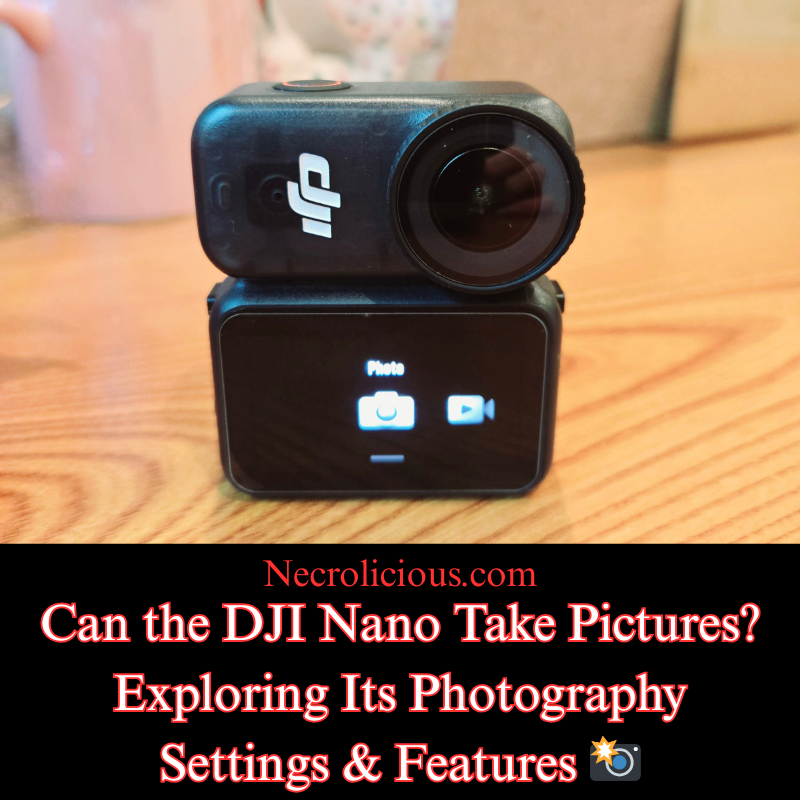
In the realm of compact action cameras, the DJI Osmo Nano stands out for its versatility & portability. Designed for adventurers & content creators alike, this device combines advanced video recording with robust still photography capabilities. If you have been wondering whether the DJI Osmo Nano can take pictures, the short answer is yes. Beyond that, it offers a range of settings & features that make it a compelling choice for capturing high-quality images on the go. This article delves into the specifics, highlighting how these elements enhance your photographic experience.
An Overview of the DJI Osmo Nano
The DJI Osmo Nano is an ultra-compact, wearable action camera featuring a modular design with a 1/1.3-inch sensor & a 143° wide field of view. Weighing just 52 grams for the camera unit, it is ideal for mounting in various positions, whether for sports, travel or everyday documentation. While primarily known for its 4K/60fps video recording & 10-bit D-Log M colour performance, the device’s photography functions provide professional-grade results in a diminutive form factor.
The DJI Osmo Nano excels in still photography thanks to its dedicated sensor & lens configuration, which support detailed image capture across diverse conditions. Below is a summary of the primary photo specifications:
Specification
Details
Sensor
1/1.3″ CMOS
Lens
FOV: 143°, Aperture: f/2.8, Focus Range: 0.35 m to ∞
ISO Range
100-25600
Electronic Shutter Speed
1/8000-30 s
Max Photo Resolution
6880 × 5160 (approximately 35 MP)
Still Photography Modes
Single, Countdown (Off/0.5/1/2/3/5/10 s), Burst (up to 30 images in 3 s)
Photo Formats
JPEG/RAW
These settings allow users to adapt to various lighting scenarios & creative needs. For instance, the wide ISO range facilitates low-light photography, while the burst mode is particularly useful for action shots where timing is critical. The option to shoot in RAW format provides greater flexibility in post-production, enabling adjustments to exposure & colour without loss of quality.
Additionally, the camera’s 13.5 stops of dynamic range ensure that images retain detail in both highlights & shadows, making it suitable for landscapes & high-contrast environments. Features such as Horizon Balancing & stabilisation, borrowed from DJI’s broader ecosystem, further aid in producing sharp, level photographs even during movement.
Practical Applications for Photography
With its magnetic mounting system & waterproof design (up to 10 m for the camera), the DJI Osmo Nano is well-suited for capturing stills in challenging settings. Whether documenting a hike, a pet’s adventures or urban scenes, the device’s photo modes integrate seamlessly with its video functions, allowing for hybrid content creation. Users can switch effortlessly between modes via the 1.96-inch touchscreen or the companion app, ensuring that spontaneous moments are never missed.
The DJI Osmo Nano not only answers the question of whether it can take pictures with a resounding yes but also delivers a suite of advanced settings & features that rival larger cameras. From its high-resolution sensor to versatile modes & formats, it empowers photographers to capture compelling images with ease. If you are seeking a compact yet capable device for your next project, the Osmo Nano merits consideration.
Unless otherwise noted, image assets above are NOT original content & are shared under fair use doctrine with NO claims to authorship or ownership. Contact necrolicious@necrolicious.com for credit or removal.
This post was sponsored by…ME! If you’d like to support, please buy my original meme merchandise or check out my affiliate links to get yourself some other cool things. Additional affiliate links may be contained in the above article. If you click on an affiliate link & sign up/make a purchase, I may earn a commission. This does not increase the price you pay for the product or service, so it helps support this website at no cost to you.
In the realm of video games, few events have illustrated the principle of karmic justice as starkly as the trajectory of Ubisoft following the release of Assassin’s Creed Shadows. This title, set in feudal Japan, drew widespread condemnation for its perceived disregard of historical accuracy & cultural sensitivity, particularly in its portrayal of Yasuke as a prominent black samurai. The ensuing backlash, especially from Japan, appears to have catalysed a cascade of misfortunes for the French gaming giant, culminating in financial turmoil, internal dissent, & structural collapse. As Ubisoft grapples with plummeting stock values, mass redundancies, & union strikes, one cannot overlook the irony: a company that sought to “diversify” history at the expense of authenticity now faces its own existential reckoning. This article examines the sequence of events, underscoring how cultural insensitivity can exact a heavy toll in the global market.
The Fabricated Legend: Thomas Lockley & the Yasuke Myth
At the heart of the controversy lies Thomas Lockley, a British academic at Nihon University whose 2019 book, African Samurai, reimagined Yasuke—a historical African retainer to Oda Nobunaga—as a legendary samurai warrior. Historical records, such as the Shinchōkōki chronicle & Jesuit accounts, depict Yasuke as a novelty bodyguard who served for roughly 15 months in the 1580s, with no evidence of samurai status, land grants, or heroic battles. Lockley, however, embellished these facts with speculative elements, including invented exploits, a fictional family, & dramatic feats, admitting on the book’s cover that much was “speculative fiction.”
Lockley’s influence extended beyond print; he allegedly used sockpuppet accounts to edit Wikipedia extensively, inserting his fabrications as established history. This astroturfing campaign gained traction, providing Ubisoft with a veneer of legitimacy for featuring Yasuke as a co-protagonist in Shadows. The game’s trailers portrayed him as a hyper-muscular figure engaging in anachronistic actions, such as skull-crushing violence & forcing villagers to bow—elements critics decried as caricatures that prioritised modern diversity agendas over Japanese cultural norms. When exposed in July 2024, Lockley deleted his social media profiles & faced a university investigation for misconduct, vanishing from public view.
Ubisoft’s reliance on this dubious scholarship amplified the insult. The company dismissed critics, including figures like Elon Musk, as “racist,” & delayed the game’s release from November 2024 to March 2025 to address the “Yasuke backlash.” Additional inaccuracies, such as the desecration of sacred torii gates & shrines without temple permissions, prompted outrage from Japanese politicians, priests, & even considerations of legal action by the prime minister’s office. Other elements, including Chinese architectural intrusions, stolen military banners, & non-binary characters, further alienated audiences who viewed the game as a Western imposition on Japanese heritage.
Japan’s Reprisal: Boycotts, Sales Collapse, & Global Repercussions
The karmic retribution manifested most acutely in Japan, where Assassin’s Creed Shadows was met with a resounding boycott. Despite Ubisoft’s efforts to polish the title post-delay, sales figures painted a grim picture. In its first week on PS5 in Japan, the game moved approximately 17,700 units—a mere 8% of the 212,000 units sold by Ghost of Tsushima in its debut three days. Globally, while it achieved a strong launch with over 3 million players in days & 5 million by July 2025, long-term performance faltered, reaching only about 4.3 million units by November 2025 & an estimated 4-5 million lifetime sales. This paled against predecessors like Assassin’s Creed Valhalla (over 20 million) & Odyssey (over 10 million).
The financial hit was exacerbated by development costs exceeding $300 million, compounded by prior flops like Star Wars Outlaws & Skull & Bones. On platforms like Amazon Japan, ratings plummeted, & social media echoed sentiments of cultural betrayal, with memes branding the game “woke slop.” This rejection not only tanked regional revenue but also amplified global “get woke, go broke” narratives, deterring potential buyers & eroding brand trust.
Ubisoft’s Implosion: From Internal Revolt to Financial Ruin
The fallout from Shadows accelerated Ubisoft’s broader decline, manifesting in a series of corporate setbacks that suggest a company in terminal stages. By January 2026, a “major reset” announcement on the 21st cancelled six projects, closed two studios, & delayed seven titles, triggering a 37% stock plunge to $0.91— a 40% year-to-date drop. Internal Slack channels overflowed with employee criticism of upper management, highlighting years of controversies, talent exodus, & creative stagnation.
French unions responded with unanimous approval for a three-day strike from 10-12 February 2026, protesting approximately 200 voluntary redundancies at Paris headquarters—representing 18% of its 1,100 staff. CEO Yves Guillemot faced demands for resignation amid accusations of oblivious leadership, no salary increases, & enforced remote work policies. Rumours of a Tencent bailout intensified, with the Guillemot family considering asset sales to avert total collapse.
This sequence underscores a direct link: the cultural affront in Shadows eroded market confidence, leading to revenue shortfalls & operational chaos.
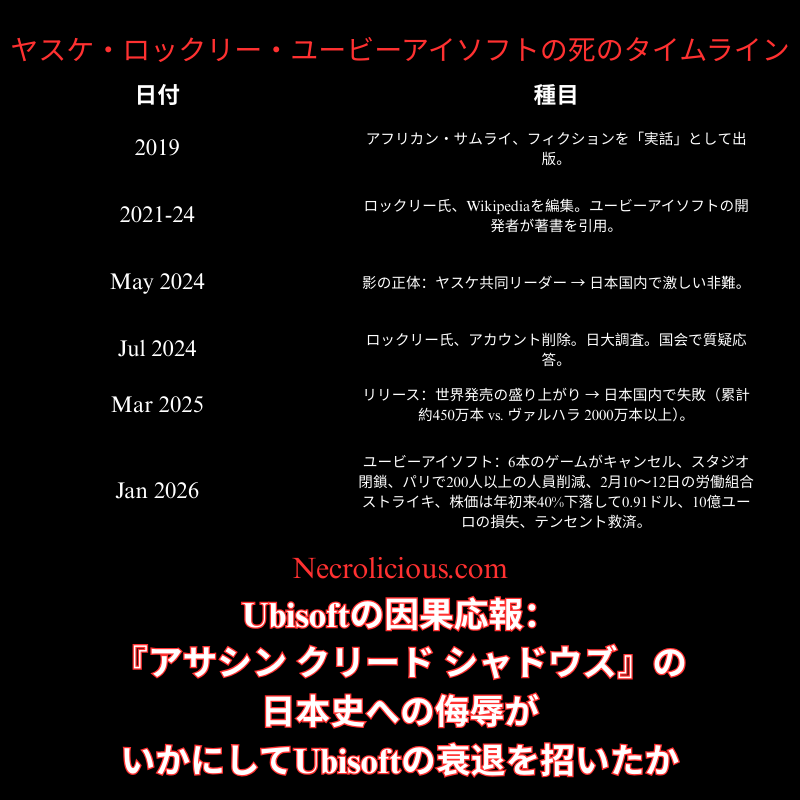
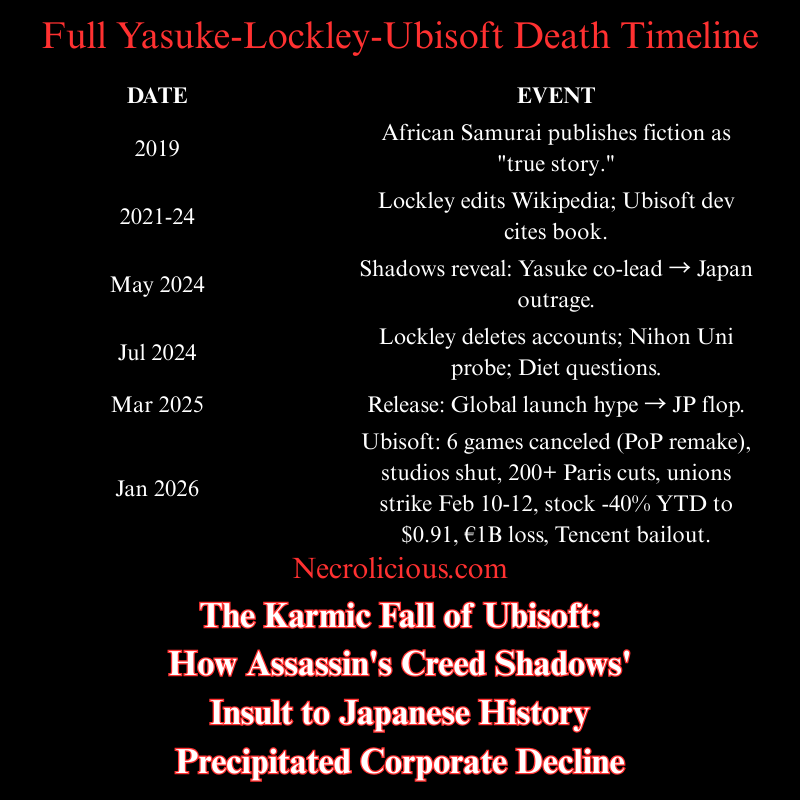
Full Yasuke-Lockley-Ubisoft Death Timeline
Date
Event
2019
African Samurai publishes fiction as “true story.”
2021-24
Lockley edits Wikipedia; Ubisoft dev cites book.
May 2024
Shadows reveal: Yasuke co-lead → Japan outrage.
Jul 2024
Lockley deletes accounts; Nihon Uni probe; Diet questions.
Mar 2025
Release: Global launch hype → JP flop (~4.5M lifetime vs. Valhalla 20M+).
Jan 2026
Ubisoft: 6 games canceled (PoP remake), studios shut, 200+ Paris cuts, unions strike Feb 10-12, stock -40% YTD to $0.91, €1B loss, Tencent bailout.
Verdict: Lockley’s grift for fame (pushed by DEI zealots) fed Ubisoft’s hubris—race-swapped Japanese history for “representation.” Japan/JP gamers boycotted, sales tanked, empire crumbles. “Get woke, Yasuke broke.” Tencent now owns AC lifeline; old Ubisoft RIP.
A Fortuitous Escape for Persian Heritage
In a parallel narrative, Iranians narrowly avoided a comparable cultural slight with the cancellation of the Prince of Persia: The Sands of Time remake. Developed primarily by Ubisoft’s Indian studios in Pune & Mumbai, leaks revealed a transformation of Persian protagonists into figures with “suspiciously Indian” features—darker skin tones, exaggerated eyes, & Bollywood-inspired aesthetics that deviated from ancient Iranian depictions. The prince resembled a “Bollywood dancer” rather than a historical Persian hero, while Princess Farah was amplified with henna motifs & “girlboss” traits. Announced in 2020 & rebooted in 2022 after a disastrous trailer, the project—plagued by outsourcing issues & unpolished visuals—was axed in January 2026’s reset, sparing Iran a potential boycott akin to Japan’s. While this averted a PR disaster, it highlighted Ubisoft’s pattern of prioritising cost-cutting & diversity mandates over cultural fidelity.
Reflections on Cultural Respect in Gaming
Ubisoft’s plight serves as a cautionary tale for the industry: disregarding historical & cultural integrity invites not only backlash but also tangible consequences. The insult to Japanese heritage through Assassin’s Creed Shadows—rooted in fabricated narratives & insensitive portrayals—has seemingly invoked karmic justice, propelling the company towards dissolution. With €1 billion in losses, ongoing strikes, & bailout speculations, Ubisoft’s future hangs in the balance. As gamers & developers alike reflect on this saga, the imperative for authentic representation becomes clear: true diversity honours history, rather than rewriting it.
Unless otherwise noted, image assets above are NOT original content & are shared under fair use doctrine with NO claims to authorship or ownership. Contact necrolicious@necrolicious.com for credit or removal.
This post was sponsored by…ME! If you’d like to support, please buy my original meme merchandise or check out my affiliate links to get yourself some other cool things. Additional affiliate links may be contained in the above article. If you click on an affiliate link & sign up/make a purchase, I may earn a commission. This does not increase the price you pay for the product or service, so it helps support this website at no cost to you.
To be clear, Samsung has not officially made any new hardware in partnership with DJI. This “bigger, better” experience stems from DJI Mimo app compatibility with the cover screens featured on Samsung’s Z Flip lineup. The Mimo app connects wirelessly to the Osmo Nano via Wi-Fi & Bluetooth, supporting full functionality including Pro mode on the cover screen, providing a larger, but still palm-sized, means to remotely access the camera preview & more advanced Mimo features that are not as easily accessed on the Nano’s Vision Dock. This setup proves particularly useful for POV shooting with the Nano magnetically mounted, allowing quick framing, parameter tweaks & monitoring on Samsung’s more spacious & vibrant Super AMOLED displays.
The DJI Osmo Nano pairs exceptionally well with Samsung’s Galaxy Z Flip series from the Z Flip5 onwards, where the outer cover screen serves as a larger, more capable alternative to the official Multifunctional Vision Dock’s 1.96-inch OLED touchscreen. By running the DJI Mimo app on the closed phone’s cover display (enabled via Samsung’s Good Lock or native customisations for any app support), users gain a bigger portable viewing & control interface for live preview, remote operation & granular settings adjustments – all without unfolding the device or relying on the smaller, somewhat harder to see & operate dock.
Contrasting Cover Screen Operation of the DJI Mimo App on Galaxy Z Flip5, Flip6 & Flip7
The cover screen experience evolves across models, with progressive improvements in size, resolution & usability for app-based control of the Osmo Nano.
The 3.4-inch Super AMOLED cover display (720 × 748 resolution) provides a solid step up from the Vision Dock’s 1.96-inch screen, offering roughly 70% more diagonal area for clearer live previews & easier touch interactions. Mimo app runs effectively when forced to the cover screen (via Good Lock or settings), enabling real-time viewing, basic remote start/stop & access to Pro mode parameters. Navigation feels more comfortable than on the dock for sliders & menus, though the resolution & brightness limit fine colour judgement in bright conditions compared to later models. Ideal for quick checks during action but may require occasional unfolding for the most detailed edits.
Retains the same 3.4-inch Super AMOLED size & 720 × 748 resolution as the Flip5, with enhancements in overall phone performance (better battery, processing & brightness). Mimo app operation mirrors the Flip5 closely on the cover screen – reliable wireless connection, live feed & granular controls – but benefits from improved touch response & outdoor visibility. Users report smoother app performance & less lag in previews, making it marginally preferable for extended monitoring without the dock. The experience remains compact yet noticeably larger than the Vision Dock, prioritising portability over expansive real estate.
Features a significantly enlarged 4.1-inch Super AMOLED cover display (1048 × 948 resolution, up to 120Hz refresh rate), representing the largest & highest-resolution cover screen in the series to date – with reduced bezels for edge-to-edge usability & approximately double the usable area of predecessors. This delivers the most compelling alternative to the Vision Dock: substantially bigger live previews, more precise touch targets for sliders/numeric inputs, superior colour accuracy & brightness (up to 2600 nits peak in some modes), & fluid navigation of Pro mode settings even in challenging lighting. Mimo app excels here for detailed tweaks, with real-time feedback on exposure, stabilisation & more feeling far less constrained. The larger interface supports better multitasking glimpses (e.g., quick parameter checks mid-shoot) & positions the Flip7 as the standout for app-driven Osmo Nano control.
Viewing Area Comparison Table
Device/Model
Cover Screen Type
Diagonal Size
Resolution (approx.)
Key Advantages for DJI Mimo App Operation on Cover Screen
Larger preview area; good for quick Pro mode access; vibrant but standard resolution
Galaxy Z Flip6
Super AMOLED Cover
3.4 inches
720 × 748
Same size as Flip5; enhanced brightness & performance for smoother app use
Galaxy Z Flip7
Super AMOLED Cover
4.1 inches
1048 × 948
Biggest & sharpest; edge-to-edge design; superior visibility & precision for detailed controls
The Mimo app unlocks superior granular adjustments on these cover screens compared to the Vision Dock, thanks to larger interfaces & precise controls. Key parameters easier to manage include:
Core Exposure Parameters (Pro mode > Manual “M”)
Shutter Speed – Large sliders & real-time preview judge motion blur instantly; dock feels cramped.
ISO – Precise selection with visible noise impact on bigger display.
Exposure Compensation (EV) – Intuitive live tweaks for balanced brightness.
Exposure Mode – Tap-to-toggle with full context visible.
Other Image & Advanced Parameters
White Balance – Sliders/presets with accurate colour judgement outdoors.
Color Profile – Clear toggle to D-Log M with previews.
Bitrate – Easy comparison of quality vs storage.
Stabilisation (EIS) – Mode switch with FOV previews.
Field of View (FOV) – Better composition on larger framing.
Additional Granular/Custom Settings
Custom Mode Saving – Easier naming & management of presets.
Audio Settings – Detailed sliders for mic gain & wind reduction.
Lastly, let’s not forget your phone’s ability to upload directly to social media–something the DJI Vision Dock just can’t do!
Overall, Samsung’s Galaxy Z Flip cover screen workflow – especially on the Flip7 – offers a bigger, often more practical way to operate the Mimo app for the Osmo Nano, blending foldable convenience with enhanced control. The Vision Dock retains advantages for fully standalone use (extended battery & direct mounts), but for app-centric precision & visibility, the Flip series stands out. For compatibility confirmation & updates, refer to DJI’s Mimo download page & Samsung device specs. The Osmo Nano’s 4K/60fps, 143° FOV & 10-bit D-Log M continue to deliver excellent results in this ecosystem. As a Flip6 owner, I can say that this works with these devices. It may also work with other flip-style phone models, such as those made by Motorola, but since I do not possess such a device, I personally cannot confirm.
As a small side note, DJI is presently offering an 8% discount on the Nano until February 2, 2026. Bundled with point back campaigns & other credit card rewards, this can jump up to about 10%, so get it while the getting is good!
Unless otherwise noted, image assets above are NOT original content & are shared under fair use doctrine with NO claims to authorship or ownership. Contact necrolicious@necrolicious.com for credit or removal.
This post was sponsored by…ME! If you’d like to support, please buy my original meme merchandise or check out my affiliate links to get yourself some other cool things. Additional affiliate links may be contained in the above article. If you click on an affiliate link & sign up/make a purchase, I may earn a commission. This does not increase the price you pay for the product or service, so it helps support this website at no cost to you.
For awhile, all sorts of internet influencers & gurus were saying that .store domains were the path to ecommerce profits & financial freedom. With a lot of introductory offers of only about a dollar for the first year, I decided to give it a try. However, I am sad to announce that the necrolicious.store website will be going down next month. But my meme merchandise will remain available on Printify Popup for everyone outside of Japan. The .store domain was a failed experiment & the renewal cost of nearly $60–far from the $1 introductory offer–is simply not justifiable, in my experience. In this article, we’ll explore my personal experiment with a .store domain, why it fell flat, & what alternatives might offer better value for aspiring online sellers. If you’re considering domain options for your e-commerce venture, read on to learn from my mistakes & optimise your strategy.
The Initial Appeal & My Dive into .store
Like many, I was swayed by the hype surrounding .store domains. Promoted heavily by influencers – likely earning commissions from referrals – these domains seemed like a budget-friendly entry point into e-commerce. With introductory offers as low as 99 cents from various domain registries, the barrier to entry was minimal. Intrigued, I decided to test the waters by registering building necrolicious.store, keeping it entirely separate from my established necrolicious.com site.
I invested significant effort into this project: days perfecting the design, integrating e-commerce platforms to handle sales seamlessly, & launching targeted marketing campaigns. Despite garnering over a million views on my ads via X (formerly Twitter), the results were starkly disappointing. In the year since launch, not a single sale materialised. As renewal approaches, the cost jumps from that enticing 99 cents to nearly $60 – a fee that’s hard to justify without any revenue.
This is not unusual. Registrars commonly offer first-year registrations for $0.98 to $5.88, but renewals typically range from $40 to $70 annually, reflecting wholesale registry fees around $40. In contrast, .com domains generally renew at $13 to $20 per year, resulting in a potential additional cost of $200 to $350 over five years for .store, excluding any price increases. This model functions as a loss-leader strategy, attracting users with low entry barriers but imposing higher ongoing costs. For high-revenue operations generating substantial sales, the incremental expense may be negligible. However, for smaller businesses or those with modest transaction volumes, it can erode profitability without commensurate benefits.
To illustrate:
Domain Type
First-Year Cost
Renewal Cost
5-Year Total (Estimated)
.store
$1–$6
$40–$70
$161–$346
.com
$6–$15
$13–$20
$58–$95
Why .store Domains May Erode Customer Trust
Determined to understand this failure, I conducted further research into consumer perceptions of alternative domains. It turns out that .store extensions often inspire less trust, much like cryptocurrencies do compared to traditional fiat currencies. To those in the know, alternatives to the mainstream can offer numerous advantages, such as niche branding or lower initial costs. However, norms — in this case .com domains — persist because they’re readily understood & reliable.
In my view, a .store domain can confuse potential customers to the point of outright distrust. This hesitation translates into reluctance when it comes to entering credit card details or completing a purchase. Shoppers appear far more comfortable with familiar .com domains, which signal legitimacy & security. If trust is the cornerstone of e-commerce, opting for a less conventional extension might be sabotaging your sales before they even begin as seemed to be the case with me.
Cutting Losses: When to Abandon a Failing Experiment
Faced with zero sales & an impending renewal fee, I’ve chosen to cut my losses rather than persist with this .store experiment. It’s a tough pill to swallow after the time & resources invested, but continuing would only compound the disappointment. Had the site generated even a few hundred dollars in revenue, the $60 renewal would feel justifiable but, as it stands, there’s little appeal in pouring more into a venture that’s yielded nothing.
This experience underscores a key lesson: introductory deals are tempting, but long-term viability hinges on customer engagement & trust. If your domain choice alienates your audience, no amount of marketing can bridge that gap.
Exploring Smarter (& FREE) Alternatives to .store Domains for E-commerce
So, what’s next? I’m pivoting towards more streamlined, third-party solutions that minimise upfront risks since they are FREE. The Printify Pop-Up store stands out as a promising option, requiring no domain fees while offering a straightforward way to sell custom merchandise. Though it provides fat fewer site customisation options, it’s ideal for testing ideas without being financially cost prohibitive.
For my fans in Japan, Suzuri presents similar appeal with its localised focus.
Both platforms operate on a commission-based model, meaning I don’t need to purchase inventory upfront – a stark contrast to managing my own .store site. Additionally, they handle customer support, freeing me from those operational headaches.
While much remains undecided, I may eventually integrate a storefront directly into necrolicious.com. In the interim, these third-party services will serve as reliable bridges, allowing me to focus on creation rather than logistics.
The Enduring Value of Owning Your Online Space
Though my .store domain proved a waste of time & I’d advise others to steer clear, building & maintaining your own website remains invaluable. In an era dominated by third-party social media platforms, relying solely on them leaves you vulnerable to algorithm changes or account issues. Branching out into site building has never been easier, empowering you to control your narrative & audience.
If you’re inspired to create your own website, start with reliable hosting. I recommend taking advantage of my affiliate link for Hostinger to get started swiftly & affordably. It’s a step towards independence that can pay dividends in the long run.
In summary, while innovative domains like .store may seem appealing, they often fall short in building the trust essential for e-commerce success. By learning from experiments like mine, you can make informed choices that align with your goals & audience preferences. What do you think about .store domains? Have you ever made one or bought something from one? How did it go?
Unless otherwise noted, image assets above are NOT original content & are shared under fair use doctrine with NO claims to authorship or ownership. Contact necrolicious@necrolicious.com for credit or removal.
This post was sponsored by…ME! If you’d like to support, please buy my original meme merchandise or check out my affiliate links to get yourself some other cool things. Additional affiliate links may be contained in the above article. If you click on an affiliate link & sign up/make a purchase, I may earn a commission. This does not increase the price you pay for the product or service, so it helps support this website at no cost to you.
約1年前、Samsung Galaxy Z Flip6用にMagSafe対応ケースを購入したことをきっかけに、UGREENのマグネット式モバイルバッテリーを試してみました。iPhoneと同じように便利に使えるだろうと考えたのですが、結果は残念なものでした。 一晩中充電しても、10,000mAhと謳う本製品からGalaxy Z Flip6(4,000mAh)のフル充電ができませんでした。それどころか、充電中にかなりの発熱が発生し、不安を感じるほどでした。
My Disappointing Experience with the UGREEN Magnetic Version
Not quite a year ago I tried buying the UGREEN Magnetic Mobile Battery since I had bought a MagSafe case for my Samsung Flip6 & thought it would enable me to use it just as well as an iPhone might. Unfortunately that did not go well. Even after charging it overnight. I was not able to get a full charge off that power bank despite it being 10,000 mAh & the Samsung Flip 6’s battery being 4,000 mAh. It also caused a worrying amount of heat in the process.
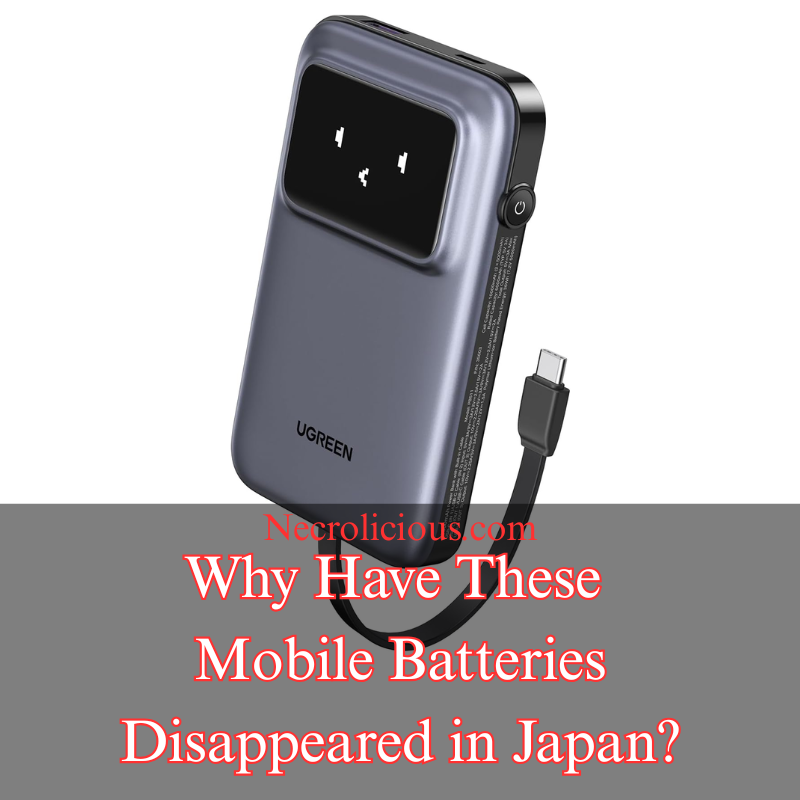
This was a very disappointing experience & I ended up returning the battery. I had initially intended to buy this wired UGREEN Uno 10000mAh instead, since it was undeniably more compatible with Samsungs, but at the time I did not have a particular need for a mobile battery so I kept putting off, even as sales dropped the price significantly, thinking I could always just buy it whenever.
The Return of the Need for a Portable Charger
As winter hit & I discovered heated clothing, the need for a mobile battery returned since the Zippo one I bought in 2019ish died & the Belkin one nearly that old was slow to charge & fast to discharge. With more devices relying on power on the go than ever, finding a dependable portable charger in Japan became essential.
My Search for the UGREEN Uno 10000mAh Amid Shortages
I thought I would just jump back on Amazon — where I had purchased the magnetic one — but, when I did, it was nowhere to be found. There was a newer slightly different one (the PB525) with double the capacity but it was not what I was looking for.
I never thought “personality” would be a feature I looked for in a battery, but this isn’t it…
So I went to the official UGREEN website which links to Amazon. There I discovered the listing showed as “Currently unavailable.”
Online Retailer Searches
Thinking it was strange, I tried searching online for other retailers but, even then, it was hard to find — with only the purple one having any sort of availability. Specific searches on Amazon.co.jp for “UGREEN Uno 10000mAh wired power bank” mostly turned up magnetic variants instead. confirming the wired model’s scarcity.
So I checked the nearby Bic Camera, where I had previously bought one as a gift for someone else. They had a lot of empty boxes which you have to take up to the register in order to purchase the actual item, so I figured they had a decent amount in stock.
I tried to check out that way, only to be told that they were completely out of stock. However, there was another Bic Camera location about a 10-minute walk away where I could buy it. In the process of explaining this, the salesman showed me his phone displaying the stock availability of the other locations. There were only two locations that were not completely blacked out indicating that the item was no longer available on a wide-spread level.
I went over to that over Bic Camera & had to do quite a bit of searching before I finally found it, but there was one last one. So I bought it.
As far as I am aware Ugreen is one of the most widely known & best-selling mobile battery manufacturers. It was really shocking that it was so difficult to get hold of this model in Tokyo.
Theories on the Power Bank Shortage in Japan
I tried conducting some additional research, but could not find any solid reason for this shortage — no recalls or other discontinuation announcements. I was previously aware of the DRAM shortage causing price hikes & other supply chain availability issues for any sort of electronic devices which require memory — from phones to gaming systems to computers — but I did not imagine that those would affect mobile batteries.
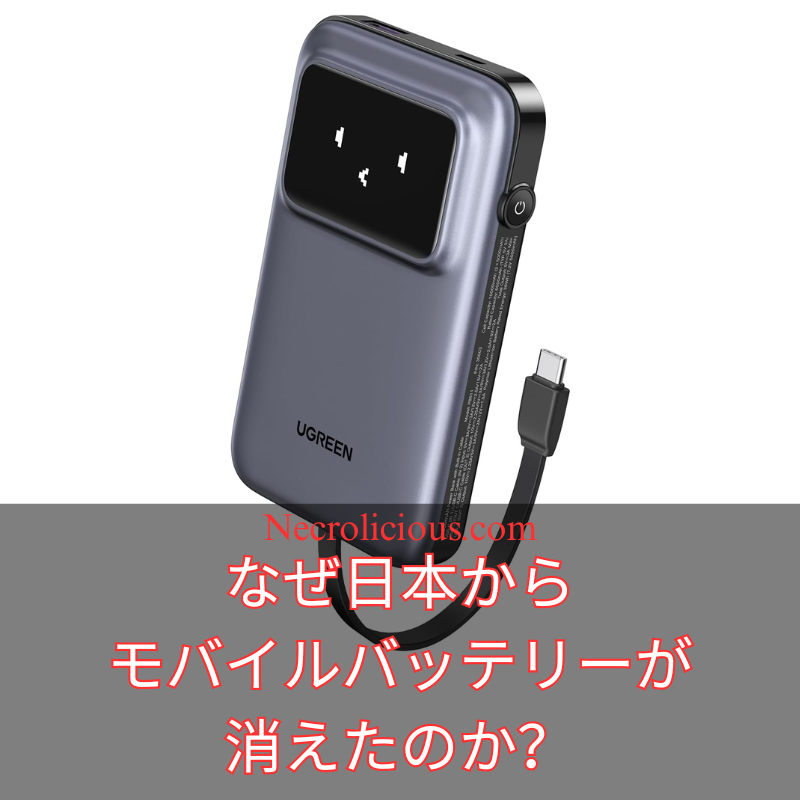
Given that this particular mobile battery has a display which has animated emojis based on the amount of charge remaining, I thought that perhaps there was some sort of memory-related component that made this particular model unavailable. However, further research indicated that no significant difference existed between this & a normal battery in terms of memory: none.
I am at a loss for why this has become such a rare item. Still, I am glad I was able to get what appears to be one of the last ones available in Tokyo. There are other bigger & better batteries out there, including others from Ugreen, but I wanted this one since I had already given one as a gift & wanted to match with the person I gave it to.
Performance Review of the UGREEN Uno 10000mAh
Now that I’ve used it, here’s my take on how this portable charger performs in real life. It is a lot better than the MagSafe one had been. It super-fast charges my phone without issues. The integrated cable is a nice feature. & the animated emoji indicator is a fun way to determine the charging status at a glance.
Pros and Cons
To help others considering this rare mobile battery, here’s a quick list:
Pros:
Fast & reliable charging for Samsung devices.
Built-in USB-C cable eliminates the need to buy/carry one.
Animated emoji display adds a playful touch to checking battery levels.
Compact size ideal for daily carry in Tokyo.
Cons:
Potential shortages make it hard to find.
No wireless charging unlike iPhone-focused magnetic models.
Overall, if you also manage to snag a UGREEN Uno 10000mAh amid these Japan-based shortages, it’s worth it for compatibility & features!
Unless otherwise noted, image assets above are NOT original content & are shared under fair use doctrine with NO claims to authorship or ownership. Contact necrolicious@necrolicious.com for credit or removal.
This post was sponsored by…ME! If you’d like to support, please buy my original meme merchandise or check out my affiliate links to get yourself some other cool things. Additional affiliate links may be contained in the above article. If you click on an affiliate link & sign up/make a purchase, I may earn a commission. This does not increase the price you pay for the product or service, so it helps support this website at no cost to you.