The trading card game Yu-Gi-Oh! Official Card Game (OCG) has partnered with Nissin Foods to launch a limited-edition product that merges the worlds of duelling & instant ramen. This collaboration brings the iconic “Instant Fusion” spell card to life as a themed Cup Noodle set, appealing to collectors & enthusiasts alike.
Product Overview
The “Yu-Gi-Oh! Cup Noodle Instant Fusion 20-Pack Limited Set” features 20 cups of standard Cup Noodles, each packaged with special artwork inspired by the “Instant Fusion” card from the Yu-Gi-Oh! series. The design recreates the card’s imagery, including flame effects & a stylised cup noodle motif, transforming the familiar instant meal into a collectible item.
Included in each set is one exclusive promotional trading card: a branded version of “Instant Fusion” (known as “簡易融合” in Japanese), featuring Cup Noodle elements. This card pays homage to the spell’s effect in the game, where players pay 1000 Life Points to Fusion Summon a monster. Notably, all sets are identical, with no random variations or alternate designs available.
Pricing & Availability
Priced at 4,800 yen (including tax), the set is available exclusively through the Nissin Foods Group online store. Reservations open on 18 March 2026 at 12:00 JST, with shipping scheduled for late March 2026. Stock is limited, & sales will end once supplies are depleted. To prevent scalping & ensure wider access, purchases are capped at four sets per customer. This limit allows dedicated collectors to acquire multiple promo cards while maintaining fairness.
Since the package includes 20 cups, the 4800 yen price comes down to only 240 yen per cup, but you can use my Rakuten Rebates link to get an additional 4.5% discount AND 600 Rakuten Points (equivalent to 1 yen)! With my special discount, your grand total comes to 3984 yen (just 199 yen per cup)!
Interested buyers should visit the Nissin online store to reserve their set starting from 18 March 2026 at 12:00 JST. Given the limited nature of the release, prompt action is recommended. International shipping options may vary, so potential purchasers outside Japan should check the site’s terms for eligibility.
Unless otherwise noted, image assets above are NOT original content & are shared under fair use doctrine with NO claims to authorship or ownership. Contact necrolicious@necrolicious.com for credit or removal.
This post was sponsored by…ME! If you’d like to support, please buy my original meme merchandise or check out my affiliate links to get yourself some other cool things. Additional affiliate links may be contained in the above article. If you click on an affiliate link & sign up/make a purchase, I may earn a commission. This does not increase the price you pay for the product or service, so it helps support this website at no cost to you.
The intersection of Japanese anime culture & premium Scotch whisky has produced a notable collaboration with the release of the Hellsing Label Glen Moray 2008. This limited-edition single malt draws from Kouta Hirano’s dark fantasy series, blending the supernatural themes of the Hellsing Organisation with the refined craftsmanship of Scottish distilling. Enthusiasts of both anime & fine spirits may find this release particularly appealing, as it commemorates the iconic vampire hunter narrative through a collectible beverage.
The Legacy of Hellsing: From Manga to Global Phenomenon
Hellsing, created by Kouta Hirano, is a highly acclaimed action manga that centres on a secret organisation dedicated to eradicating supernatural threats. Set in late 20th-century England, the story follows the Hellsing Organisation under the command of Sir Integra Hellsing. To safeguard the Queen & the nation, the group employs Alucard, an immortal vampire who serves as their primary weapon against other monstrous entities. The series has been adapted into anime formats, including the original television series & the more faithful OVA version, Hellsing Ultimate, which has garnered a dedicated following for its intense action & gothic elements.
The manga’s influence extends beyond entertainment, inspiring merchandise ranging from apparel to this recent whisky partnership. Such collaborations highlight the enduring popularity of Hellsing, which continues to attract fans interested in themes of vampirism, loyalty & conflict.
The Hellsing Label Glen Moray 2008 is a 16-year-aged single malt Scotch selected by renowned whisky critic Hideo Yamaoka. Bottled at 47.9% ABV in 700ml volumes, it features a transparent, fruity aroma reminiscent of peaches, Japanese citrus & pear. The palate offers a light mouthfeel with rich malt flavours, subtle honey notes & balanced oak influences, making it suitable for various drinking styles.
This expression from the Glen Moray distillery in Scotland embodies the series’ dramatic essence, with its label design incorporating artwork from the manga, including depictions of Alucard.
Pricing, Availability & Lottery System
Priced at 23,100 yen (approximately $155 USD or £120 GBP), the release is limited to 236 bottles in total, with 189 available to the public. Sales are managed through a lottery on the official WHISKY MEW website, with applications open from March 16 at 12:00 to March 23, 2026 at 23:59. Given the current date in Japan, interested parties can apply immediately via the site.
Those who have been selected will receive an E-mail from Whisky Mew around March 26th (Thursday) with instructions on how to purchase the lottery-reserved product.
If there are many cancellations after the initial lottery, there may be a second lottery among those who were not initially selected. In that case, Whisky Mew will contact the winners of the second lottery by E-mail around April 3rd, 2026.
This scarcity underscores the collectible nature of the product, appealing to both whisky connoisseurs & anime collectors seeking rare items.
Community Reactions & Related Events
The announcement has generated discussion within online communities. For instance, one user expressed interest in acquiring the bottle for decorative purposes, questioning its authenticity. Another post humorously noted the series’ shift to whisky production.
WHISKY MEW has also organised events to celebrate the launch. A sold-out tasting event featured the Hellsing whisky alongside other selections, with attendees receiving exclusive items such as Alucard-themed glassware & coasters depicting manga scenes. Additional tastings are scheduled at venues like BAR Genkaware in Ikebukuro, offering over 30 WHISKY MEW varieties at special prices, along with themed cocktails. These gatherings provide opportunities for fans to engage with the collaboration in person.
This collaboration between WHISKY MEW & the Hellsing series represents a unique fusion of cultural elements, offering a premium product that bridges anime fandom & whisky appreciation. For those in Japan or with access to the lottery, it presents a timely chance to secure a piece of this limited edition.
Unless otherwise noted, image assets above are NOT original content & are shared under fair use doctrine with NO claims to authorship or ownership. Contact necrolicious@necrolicious.com for credit or removal.
This post was sponsored by…ME! If you’d like to support, please buy my original meme merchandise or check out my affiliate links to get yourself some other cool things. Additional affiliate links may be contained in the above article. If you click on an affiliate link & sign up/make a purchase, I may earn a commission. This does not increase the price you pay for the product or service, so it helps support this website at no cost to you.
Imagine a White House video celebrating its deeply unpopular multi-billion dollar war on Iran–which is, evident to everyone, solely for israeli interests–with triumphant fanfare, only to splice in clips from beloved Japanese anime. Unfortunately, this is not fiction; it is the reality of early 2026, where the Trump administration has repeatedly appropriated Japanese intellectual property to bolster support for their needless, expensive war with Iran for the jews. The irony peaks in the video captioned “JUSTICE THE AMERICAN WAY,” which promotes a distinctly American brand of retribution while featuring non-American icons such as Yugi from Yu-Gi-Oh!—a Japanese character through & through. Such unauthorised use not only raises legal concerns but also distorts the peaceful ethos of these cultural exports, drawing sharp rebukes from Japanese creators, intellectual rights holders & politicians alike. This article examines the pattern of exploitation, the voices of dissent & the broader implications for Japan’s global image.
The White House’s Relentless IP Grab: A Pattern of Propaganda
The US-Iran conflict, escalating since early 2026, has been falsely framed by the White House as a series of decisive victories through a barrage of meme-style videos. These productions blend military footage—depicting drone strikes & explosions—with pop culture snippets to create an illusion of effortless triumph. Yet, the administration’s choice to incorporate Japanese intellectual property without permission has ignited international controversy.
Consider the timeline of these infractions:
On 6 March, the White House released “JUSTICE THE AMERICAN WAY,” a 42-second montage intercutting real airstrikes on Iranian targets with clips from Yu-Gi-Oh!, Dragon Ball Z & other anime, alongside American films like Top Gun & Iron Man. The video culminates in victory sounds from video games, trivialising lethal actions as mere entertainment.
Subsequent posts on 10-12 March extended this tactic, incorporating Nintendo’s Wii Sports footage—wholesome swings & strikes overlaid on bombings—& Pokémon imagery in “UNDEFEATED” memes.
Ongoing edits have featured Grand Theft Auto sequences & epstein island resident SpongeBob SquarePants quips, but the heavy reliance on Japanese sources like Yu-Gi-Oh! underscores a peculiar disconnect: why invoke foreign heroes to champion the “American way”?
This is no isolated lapse. The videos exploit Japan’s soft power—its anime & games that promote themes of friendship, strategy & perseverance—to sanitise an unpopular war that has claimed civilian lives, including children in Iranian schools. Critics question the ethics: how does one reconcile Yugi’s card battles, rooted in camaraderie, with real-world destruction?
Voices from Japan: Politicians & Creators Strike Back
The backlash from Japan has been swift & unified, transcending political divides to defend cultural integrity. Creators & politicians have publicly denounced the White House’s actions, emphasising that their works were never intended to endorse war.
Key figures leading the charge include:
Zenko Kurishita (@zkurishi), a former politician & anti-censorship advocate, who highlighted the unauthorised use of Yu-Gi-Oh! footage, stating that no original staff or rights holders were involved or granted permission.
Minako Saigo (@minako_saigo), an educator & Reiwa Shinsengumi affiliate, who urged an end to using Nintendo for “Trump’s war,” framing it as a perversion of Japan’s peaceful cultural contributions.
Content creators like @tanomuzeA, who repeatedly proclaimed “Don’t use Japanese works for political purposes” alongside the offending video, amplifying calls for accountability.
Official statements from companies have echoed this sentiment. The Yu-Gi-Oh! team issued a formal rebuke: “No one associated with the manga or anime had any involvement, & no permission was granted for the use of this intellectual property.” Similarly, The Pokémon Company distanced itself, noting it did not authorise the use of its brand in political messaging. Even non-Japanese voices, such as English voice actor Dan Green (Yami Yugi in Yu-Gi-Oh!), condemned the distortion, arguing it disrespects the series’ universal, apolitical nature & the legacy of creator Kazuki Takahashi, who died heroically saving others.
These denunciations reflect a broader consensus: war is not a duel or a game, & appropriating cultural icons for propaganda erodes their images.
The Fallout: Tarnishing Japan’s Peaceful Image
The consequences extend beyond intellectual property disputes, casting a shadow over Japan’s reputation as a beacon of soft power. By associating anime & games with militarism, the White House videos risk linking Japan to the US’s aggressive foreign policy, exacerbating trade tensions including tariffs on electronics & entertainment exports.
In Japan, this has fuelled anti-US sentiment, with discussions of boycotts & potential lawsuits gaining traction on platforms like X. Politicians warn that such exploitation could strain alliances, while creators fear lasting damage to their works’ global appeal. The irony of using Japanese characters to tout “American” justice only heightens the cultural insensitivity, portraying Japan as an unwitting accomplice in propaganda.
Time for Accountability
The White House’s appropriation of Japanese intellectual property is more than a meme misstep—it is a calculated erosion of cultural boundaries that unites creators & politicians in defence of their heritage. As the war drags on, demands for removals & apologies grow louder. Readers are encouraged to support affected artists by amplifying their statements & advocating for stricter IP protections in political discourse. Japan’s contributions to global culture deserve respect, not repurposing as tools of conflict.
Unless otherwise noted, image assets above are NOT original content & are shared under fair use doctrine with NO claims to authorship or ownership. Contact necrolicious@necrolicious.com for credit or removal.
This post was sponsored by…ME! If you’d like to support, please buy my original meme merchandise or check out my affiliate links to get yourself some other cool things. Additional affiliate links may be contained in the above article. If you click on an affiliate link & sign up/make a purchase, I may earn a commission. This does not increase the price you pay for the product or service, so it helps support this website at no cost to you.
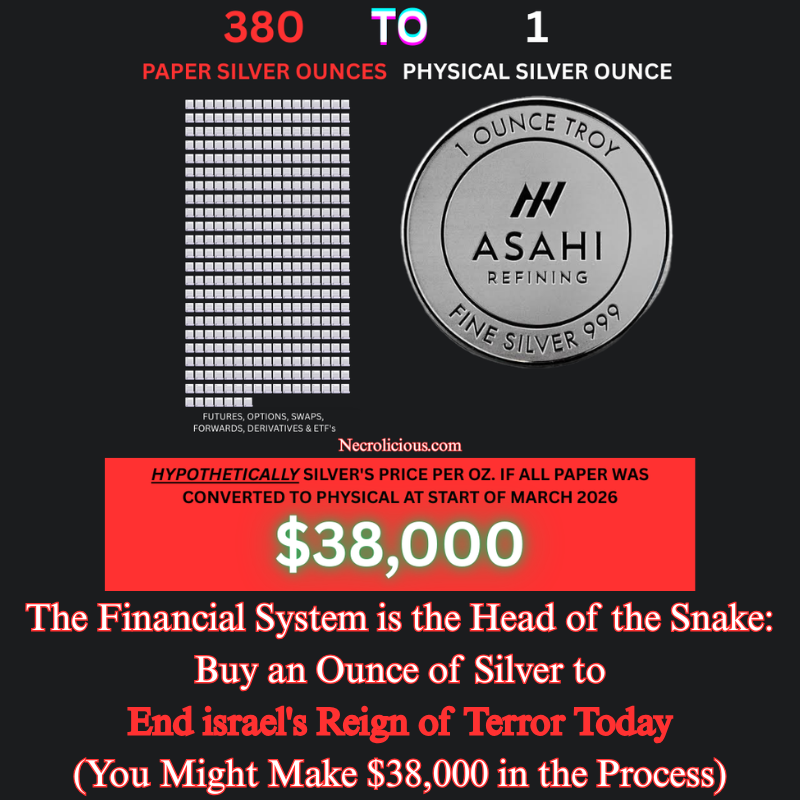
israel has ruthlessly dragged America into a deeply unpopular & endless war while polls are screaming that 80% of Americans—eight out of ten—want no part in the escalating Middle East carnage. America, already drowning in nearly $40 trillion of crippling debt, is packed with hardworking families barely scraping by, yet israel shamelessly demands trillions more in U.S. taxpayer-funded military aid to fuel their aggression. This outright extortion is like forcing a dying cancer patient to empty what’s left their pockets to fund a massive squatters’ rights project from which only the squatters will ever benefit. Who supports this madness? Only jews themselves or non-jews “compensated” by dirty money or by the withholding of sinister blackmail. The Epstein scandal lays it bare: compromising E-mails, documents & videos of politicians, royalty, CEOs & celebrities raping & devouring innocence on that paedovore island (surely just 1 of many) ensure their puppet-like obedience to israeli interests. Everyone else sees the truth—this is a one-way drain on America with jews as the lone beneficiaries, lounging in safety, while American soldiers bleed & die as their disposable proxies in brutal ground wars & their destitute families back home slip deeper into poverty. But here’s the twist: YOU don’t have to accept this. YOU can help end it TODAY. Ending it could be shockingly simple & you could get rich doing it. No voting for another corrupt politician, no assassinations, no protests—just buy one ounce of physical silver from a coin shop near you right now. It’s 100% legal, it’s easy & it strikes at the heart of the jewish war machine. I’ll show you how & why this works below, but act fast & spread the word like wildfire before they try to silence it!
No matter how much you hate jews, it isn’t enough. I don’t know what this species is, but I can’t call it human & we shouldn’t share the planet with the monsters who did this to establish, expand & enrich their “country.” If you happen to be a jew reading this. your only moral option is to kill yourself & take out as many as of your kin as possible when you do it. Seriously, fuck off forever. You are not welcome on earth.
How to Stop israel: Starve the War Machine by Hoarding Real Silver
Every ounce of silver you have is an ounce they can’t use to bomb people.
This powerhouse strategy hits on two unstoppable fronts starting with silver’s absolute indispensability to the military-industrial beast that props up Israel’s endless conflicts. Silver isn’t just a shiny trinket—it’s the linchpin of the financial system & the lifeblood of modern warfare, embedded in missiles, batteries, guidance systems, aircraft avionics, satellites, electronics, smart devices, medications, water purification & electromagnetic shielding. No wonder it was added to the U.S. Critical Minerals List in November 2025—it’s irreplaceable for national security, yet U.S. stockpiles have been bone-dry since at least 2002, with desperate whispers in D.C. about a new “Strategic Silver Reserve” exposing the vulnerability. When you & millions more storm your local coin shops to buy physical silver bars or coins, you yank it straight out of their supply chain, driving prices sky-high & making weapons like the Tomahawk missile (with up to 500 ounces of silver in wiring batteries & tech) cost prohibitive. israel’s war hawks, shielded by Epstein-blackmailed cronies like Trump, rely on this cheap silver to keep the bombs dropping—deny them the physical metal & their proxy wars grind to a halt. Forget unbacked paper garbage like SLV ETFs; those are just scams designed to flood the market with fake “silver” shares suppressing the true price & perpetuating the corrupt system that lets israeli-tied firms rake in billions while you get robbed.
Financial Revolution: Smash the Suppression & Reap Massive Gains
The second front explodes the financial fortress where silver has been brutally suppressed since the 1870s—yes over 150 years of rigged games keeping it artificially cheap. Historically silver’s value relative to gold was 7:1 to 15:1, but in March 2026, with gold at $5,278 per ounce & silver at $93.82, it’s still hovering near 56:1 thanks to obscene paper shorting. COMEX’s paper-to-physical ratios hit absurd levels like 380:1 or worse with open interest ballooning to 429 million ounces against pitiful inventories dipping below 90 million registered ounces. In simple terms, this means that for every ONE silver ounce you buy, you have effectively taken away their ability to sell nearly FOUR HUNDRED unbacked contracts. At this absurd rate, it will only take a small fraction of people buying silver to end this corrupt system of asset suppression that jewry uses to prop up their fake state at our expense–they have eroded over 90% of the purchasing power of the USD by exporting that value to israel, but they hide the theft by suppressing the true value of silver & other hard assets via these futures contracts. In Jeffrey Epstein’s own words, “This is how the jew makes money. Let the goyim deal in the real world.” A reckoning 150+ years in the making is coming & the cracks are beginning yo show. The recent COMEX blackout on February 25, 2026—a suspicious 90-minute “glitch” that halted trading cancelled buy orders & dumped half the contracts conveniently protecting massive short positions. Who cashed in? israeli-tied behemoths like BlackRock, State Street, Vanguard & JPMorgan — the very architects of this fraud — using the outage to manipulate prices when physical squeezes threaten. Jane Street’s whopping 3.62% stake in SLV (over 20 million shares worth $1.65 billion) screams more manipulation fresh off their 2025 India ban for index rigging. This leverage means your single ounce of physical silver isn’t just a drop in the ocean—it’s a tidal wave. If everyone grabs even a few ounces, the paper pyramid collapses catapulting silver’s price discovery beyond your wildest dreams. Imagine turning $100 into $38,000 overnight while crippling the israeli war profiteers—physical silver is your weapon; paper SLV is their trap diluting supply & keeping prices chained so the jewish banksters can hoard the real gains.
Ignite the Squeeze: Buy Physical Silver Now & Watch the jewish Empire Crumble
This is your moment—rush to your nearest coin shop today & snag that ounce of gleaming physical silver. Feel its weight in your hand; that’s real power, not some digital illusion. Tell every friend, family member & stranger: do the same & let’s ignite a silver squeeze that shatters the chains of the jewish financial system! Ditch the dying dollar—trade goods, services, EVERYTHING in silver wherever you can. Spread this blueprint everywhere; steal it, repost it, scream it from the rooftops! No need to credit me, JUST GET THE WORD OUT HOWEVER YOU CAN. The more who join, the faster israel’s grip slips–ending their war machine. You’ll profit wildly as silver soars reclaiming wealth stolen by suppression. This is the ultimate win: peace AND wealth for all who participate! The only losers? israel & its jewish overlords; the global outcasts who’ve enslaved us through financial alchemy, digital coin-clipping & Epstein’s web of depravity—including enablers like Trump—leaving the non-jew world broke & bleeding. Don’t wait—buy physical silver now before the next blackout steals your chance! Your future self will thank you as the corrupt system implodes.
I am not a financial adviser & this article is not financial advice, merely a suggestion to help end wars.
Unless otherwise noted, image assets above are NOT original content & are shared under fair use doctrine with NO claims to authorship or ownership. Contact necrolicious@necrolicious.com for credit or removal.
This post was sponsored by…ME! If you’d like to support, please buy my original meme merchandise or check out my affiliate links to get yourself some other cool things. Additional affiliate links may be contained in the above article. If you click on an affiliate link & sign up/make a purchase, I may earn a commission. This does not increase the price you pay for the product or service, so it helps support this website at no cost to you.
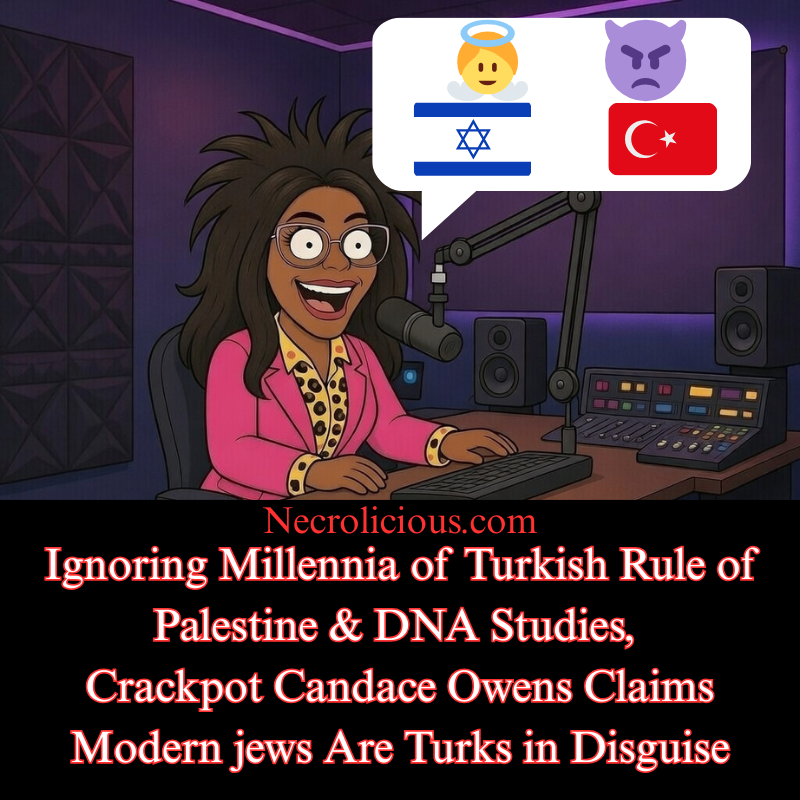
Apparently having no knowledge of the Ottoman Empire or World War I nor how its end led to us Turks losing the land israel now occupies after millennia, Candace Owens, Sneako & their braindead followers argue that Turkic origin explains the historical & contemporary evil machinations of what they call “fake jews.” However, a thorough examination of genetic, historical & even base logical evidence reveals the hypothesis to be fundamentally flawed. jews are jews & there are no “fake jews” Turks. This article explores these facets in detail, drawing on scholarly studies & documented timelines to provide a comprehensive rebuttal.
Genetic Evidence: No Trace of Khazar Ancestry
Central to debunking the Khazar hypothesis is the robust body of genetic research that consistently affirms the Middle Eastern origins of ashkenazi jews. A pivotal study in this regard is the 2013 genome-wide analysis published in Human Biology, co-authored by Michael Hammer of the University of Arizona. This research compared DNA samples from ashkenazi jews with populations from the Caucasus region, which serves as a proxy for potential Khazar descendants due to the historical location of the Khazar Khaganate. The findings were unequivocal: no detectable genetic similarity exists between ashkenazi jews & these groups.
Instead, the study confirmed that ashkenazi paternal lineages trace back to the Levant (the ancient Near East), while maternal lineages show European admixture, likely from conversions & intermarriages during the diaspora. This aligns with broader consensus in population genetics, as seen in works like Harry Ostrer’s 2012 book Legacy: A Genetic History of the jewish People, which emphasises continuity from ancient Levantine populations. Fringe claims, such as those in Eran Elhaik’s 2013 paper suggesting partial Khazar origins, have been widely critiqued for methodological flaws & contradicted by larger datasets. For instance, a 2010 Nature study by Behar et al. further supports negligible Turkic or Central Asian input, underscoring that ashkenazi jews share genetic markers with other jewish groups, including sephardic & mizrahi jews, far more than with any Turkic peoples.
Historical Expulsions: A Pattern Predating Khazar Conversion
A particularly compelling critique of the Khazar hypothesis comes from historical records of Jewish expulsions, which demonstrate conflicts & patterns long before any purported Khazar influence. In a widely shared X post by @BasedSamParker, the author meticulously breaks down over 1,000 documented expulsions spanning millennia, arguing that attributing tensions solely to subgroups like “Khazarians,” “Talmudists,” “Sabbateans,” “Frankists,” or “Zionists” overlooks deeper, persistent dynamics. Parker’s analysis is exhaustive: 143 expulsions occurred before the Talmud’s compilation around AD 500; 181 predated the alleged Khazar conversion in AD 740–800; 602 before Sabbateanism in AD 1665; 679 before Frankism in AD 1755; & 752 before modern Zionism in 1897.
Have you ever heard a version of the following: “They aren’t real jews, they’re [Khazarians/Frankists/Satanists/etc]”
Such a take simply ignores the full scope of history. So let’s look at these assertions through the lens of jewish expulsions throughout history:
▪️”It’s the Talmudists” (ca AD 500) There were 143 expulsions of jews before the publication of the Talmud. If it were just the Talmud that was the problem, how do we account for those prior expulsions?
▪️”It’s the Khazarians” (ca AD 800) From their flight out of Egypt until AD 800 when the alleged mythical Khazarian conversion happened, there were 181 jewish expulsions (143 before the Talmud’s publication and 38 afterward). If the problem is the “Khazarians,” how do we account for those 181 expulsions?
▪️”It’s the Sabbateans” (ca AD 1665) There were another 421 expulsions after the alleged mythical Khazarian conversion, but prior to the rise of the Sabbateans. Making 602 total before Sabbateanism. How do we account for those?
▪️”It’s the Frankists” (ca AD 1755) There were 77 more expulsions after the rise of Sabbateanism but before the creation of Frankism. That makes 679 before Frankism, so how do we account for those?
▪️”It’s the zionists” (ca AD 1897) There were 73 expulsions after the rise of Frankism but before the establishment of zionism in 1897. That’s 752 total jewish expulsions prior to the rise of zionism. How do we account for those if the problem is just “zionism?”
Other major jewish groups & movements have overlapped those time periods above: Babylonian exiles, Samaritans, Hellenized jews, pharisees, sadducees, zealots, rabbinic judaism, zohar/kaballah, illuminati, Bolshevism, etc.
▪️Atheist Bolshevik jews: emerged prominently with the Russian Revolutions, 1905-1925 ▪️Illuminati: founded 1776 ▪️Frankists: established around 1755 ▪️Sabbateans: established around 1665 ▪️Zohar: first published around AD 1280–1290 ▪️Kabbalah: began to take shape around the 12th–13th centuries, c. 1100s–1200s AD ▪️Alleged Khazars Conversion To judaism: allegedly occurred starting around AD 740-800 ▪️Talmud judaism: talmud completed c. 400–600 AD ▪️Rabbinic judaism: began to take shape around the 1st century AD, solidified c. 70–200 AD. Led to full talmudic judaism. ▪️Zealots/Sadducees/Pharisees, ca 1st Century AD ▪️Edomites’ Conversion to judaism: occurred 125–110 BC ▪️Hellenized jews: emerged by the 3rd century BC (c. 300–200 BC) ▪️Samaritan jews (distinct identity): began to form around 722 BC (solidified c. 500–400 BC) ▪️Babylonian Exiles (black magic/usury skills): c. 597–539 BC
It doesn’t matter the period of history: there’s always something going on within the tribe of people who now call themselves jews—and it’s always leading to them being expelled. One revolutionary, subversive, or supremacist movement after another.
Laying blame at the feet of only one of these movements ignores the long arc of history. These people have had problems with their neighbors for a long time.
Who are the “real” jеws now & who are the “fake” ones? Who knows! Are any of them real or fake? Different factions of jews tell different stories–accusing some factions of being fake & claiming the mantle of authenticity for themselves: “zionists aren’t real jews,” or “Sabbateans aren’t real jews,” or “those are Talmudists, they aren’t real jews,” or “The ADL isn’t actually jewish,” etc etc etc. Whenever there’s a problematic or unpopular jewish movement, the rest of jewry “disavows” them: “They’re not real jews.” And often tries to offload the blame onto some Gentiles.
But at this moment in time, they all seem to band together with each other against the rest of us–and it’s been this way for millennia. No matter which time frame you choose, jеws were having problems getting along with non-jews. 3000 years ago or 3 years ago, that’s remained consistent.
Whatever they are; whoever they are; wherever they come from; whatever you call them–they call themselves jews, and they can’t seem to get along with the rest of us.
Drawing from sources such as Paul Johnson’s A History of the jews & compilations on jewishVirtualLibrary.org, Parker illustrates how these events reflect overlapping influences, including Edomite conversions around 125–110 BC, Babylonian exiles from 597–539 BC, & Kabbalah’s emergence in the 1100s–1200s AD. He dismisses attempts to scapegoat specific sects as deflection, noting that self-identified jews have historically united against non-jews, as evidenced in ancient texts like Flavius Josephus’ Antiquities of the jews. This timeline not only predates Khazar involvement but also challenges the notion of a fabricated Turkic identity, as expulsions from places like ancient Egypt to medieval Europe occurred without any Central Asian context.
Parker’s post stands out for its rigorous use of historical data to refute subgroup narratives, emphasising that the Khazar theory serves as a convenient excuse to ignore broader patterns of perceived subversion or supremacism. For those researching “jewish expulsions history” or “Khazar myth origins,” this perspective provides a grounded counterpoint to conspiracy-driven claims, reinforcing that the hypothesis fails to account for millennia of documented interactions.
The Ottoman Empire: Logical Inconsistencies in the Khazar Narrative
The dissolution of the Ottoman Empire offers one of the most glaring logical flaws in the Khazar hypothesis, particularly when considering the land now occupied by israel. For centuries, Ottoman Turks ruled Palestine as part of our vast empire that endured until the end of World War I in 1918. If ashkenazi jews were truly ethnic Turks descended from Khazars, there would have been no impetus for them to infiltrate & sabotage our empire to seize control of the region. Such actions would amount to Turks undermining our own dominion, a self-defeating endeavour akin to someone bombing their own house to get their own food from their own refrigerator. Historical records show zionist movements & external pressures contributing to the empire’s fall, leading to the British Mandate & eventual establishment of israel, but these were driven by jewish nationalist aspirations rooted in ancient israelite claims. The absence of any affinity or alliance with the Ottomans—despite shared “Turkic” origins under Khazar theory—exposes the hypothesis as historically incoherent, as jews resisted Ottoman rule rather than embracing it as compatriots.
Ottoman Control Over Palestine for Centuries: The Ottoman Empire, established in the late 13th century, expanded to include Palestine by 1516 under Sultan Selim I, maintaining dominion over the region for over four centuries until 1918. This period saw Palestine as an integral part of Ottoman territories, governed through vilayets (provinces) & subject to Turkish administrative & legal systems, with no significant challenges from purported “Khazarian” jews who, if ethnically Turkic, would logically have integrated rather than opposed the regime.
World War I & the Empire’s Dissolution: The Ottoman Empire allied with the Central Powers during World War I (1914–1918), facing defeats in key campaigns such as the Arab Revolt (1916–1918, supported by British forces) & the Sinai & Palestine Campaign (1915–1918). These military setbacks, compounded by internal nationalist movements & economic strain, led to the empire’s fragmentation via the Armistice of Mudros in October 1918 & subsequent treaties like the Treaty of Sèvres (1920), which partitioned Ottoman lands & ended Turkish sovereignty over Palestine.
The Balfour Declaration & British Mandate: Issued on 2 November 1917 by British Foreign Secretary Arthur Balfour, this declaration expressed support for “the establishment in Palestine of a national home for the jewish people,” amid the ongoing war & as British forces advanced into Ottoman-held territories (e.g., the capture of jerusalem in December 1917). It paved the way for the League of Nations to grant Britain the Mandate for Palestine in 1920, effectively transferring control from the defeated Ottomans to British administration, which facilitated increased Jewish immigration & set the stage for the 1948 establishment of Israel—actions that proponents of the Khazar theory illogically attribute to “Turkic” jews wresting land from their own ethnicity.
zionist Infiltration & Sabotage Claims in Context: Historical narratives often highlight zionist diplomacy & alliances with Britain (e.g., through figures like Chaim Weizmann) as contributing to Ottoman decline, but under the Khazar hypothesis, such “infiltration” becomes absurd: why would ethnic Turks sabotage a Turkish empire to claim Palestinian land already under their broader ethnic control? This contradiction underscores the theory’s failure, as real motivations stemmed from religious & historical ties to ancient israel, not fabricated Turkic origins.
Deflection Tactics: Shifting Blame from Core Doctrines
A recurring theme in critiques of the Khazar hypothesis is its role as a deflection, serving only to redirect scrutiny away from judaism & jewry. This tactic, often employed by christians, avoids addressing fallacies in their own religious doctrines or historical behaviours by framing issues as the work of “fake” jews with Turkic roots or “fake” jews worshipping Baal, Moloch, Satan or any other cope they can think of instead of rebuking all judeo aspects of themselves. However, as genetic & historical evidence shows, such theories lack substantiation & instead perpetuate myths that contradict genuine data. They ignore comprehensive DNA data & have been dismissed by mainstream historians for selective interpretations. By emphasising “Khazarian Turks,” proponents deflect blame, but this only underscores the hypothesis’s weakness when confronted with facts.
Conclusion: Towards Evidence-Based Understanding
The Khazar hypothesis is completely bunk. Genetic studies from institutions like the University of Arizona, detailed expulsion timelines as outlined by Parker, & logical analyses of events like the Ottoman Empire’s fall all converge to debunk any substantive links between jews & Turks. For those exploring “debunking Khazar theory” or “jewish genetic history,” prioritising peer-reviewed sources over social media narratives is essential. Blacks are generally not known for intellectual acumen, but allow one to speak & they will spread dangerous misinformation such as this, whether intentionally or not. It’s well known that every single AI video fools them. That this repeatedly debunked claim even reared its goofy face again is a testament to the dangers of giving a monkey like Candace a platform in the first place. She should be deported back to Africa for this.
Unless otherwise noted, image assets above are NOT original content & are shared under fair use doctrine with NO claims to authorship or ownership. Contact necrolicious@necrolicious.com for credit or removal.
This post was sponsored by…ME! If you’d like to support, please buy my original meme merchandise or check out my affiliate links to get yourself some other cool things. Additional affiliate links may be contained in the above article. If you click on an affiliate link & sign up/make a purchase, I may earn a commission. This does not increase the price you pay for the product or service, so it helps support this website at no cost to you.
The long-awaited return of one of anime’s most beloved comedy series is now official. On 13 January 2026, during a special livestream marking the 10th anniversary of the anime adaptation, KonoSuba: God’s Blessing on This Wonderful World! was confirmed to be receiving a fourth television season.
The announcement was made by the core voice cast—Jun Fukushima (Kazuma Satou), Sora Amamiya (Aqua), Rie Takahashi (Megumin) & Ai Kayano (Darkness)—who hosted the event. This follows an earlier tease of a sequel after the BONUS STAGE theatrical OVAs in March 2025, clarifying that the project is a full TV continuation rather than additional OVAs or a film.
No specific release window, staff details or episode count has been disclosed yet. Production is underway, with speculation pointing towards a potential 2026 or 2027 premiere based on previous gaps & recent production pace (Season 3 aired in 2024 under Studio Drive). The series will likely adapt further light novel volumes, continuing the chaotic adventures of Kazuma & his dysfunctional party after covering up to roughly volumes 6–7 in prior seasons.
The official announcement visual & related reveals have generated significant excitement within the community, underscoring the enduring appeal of the series’ sharp parody of isekai tropes, irreverent humour & memorable character dynamics.
For the latest updates, visit the official website at konosuba.com. As the franchise enters its second decade, 2026 promises to be a landmark year for fans worldwide.
Unless otherwise noted, image assets above are NOT original content & are shared under fair use doctrine with NO claims to authorship or ownership. Contact necrolicious@necrolicious.com for credit or removal.
This post was sponsored by…ME! If you’d like to support, please buy my original meme merchandise or check out my affiliate links to get yourself some other cool things. Additional affiliate links may be contained in the above article. If you click on an affiliate link & sign up/make a purchase, I may earn a commission. This does not increase the price you pay for the product or service, so it helps support this website at no cost to you.
After more than half a century dedicated to investigating one of the world’s most enduring legends, Adrian Shine, the veteran naturalist & founder of The Loch Ness Project, has declared the Loch Ness Monster a myth. At 76, Shine has entered semi-retirement from active fieldwork, marking the end of an extraordinary chapter in the quest to understand the creature affectionately known as Nessie.
His conclusion comes not from frustration, but from a lifetime of rigorous, evidence-based scrutiny. Armed with sonar sweeps, submersibles, sediment analysis & collaborations with universities, Shine has explored the loch’s ecology & the psychology behind sightings. Recent advancements in technology – including high-resolution sonar, drones & environmental DNA (eDNA) sampling – have only reinforced his view: no large unknown vertebrate exists in the nutrient-poor depths of Loch Ness.
Yet the legend persists, fuelled by human perception, optical illusions & the enduring appeal of mystery. Shine’s work has illuminated the loch’s natural phenomena – boat wakes creating multi-humped waves, misidentified waterbirds & atmospheric refraction distorting distant objects – while explaining why so many “sightings” feel convincing.
The Ancient Origins of the Legend – Dispelling a Modern Myth
The story of a mysterious water beast in the Loch Ness area dates back far earlier than many assume. The earliest recorded account appears in the 7th-century Life of St. Columba by Adomnán, describing an event in 565 AD. Irish monk Saint Columba encountered locals burying a man killed by a ferocious “water beast” in the River Ness (the loch’s outflow). Columba commanded the creature to retreat, & it fled – a tale of saintly triumph over peril that fits medieval hagiographic traditions.
This predates the modern “Nessie” phenomenon by centuries. The 1930s brought widespread attention, sparked by a 1933 sighting & the infamous (later debunked) “Surgeon’s Photograph” hoax. But the idea of a large aquatic creature in the region is rooted in ancient Celtic folklore, including water spirits like kelpies.
A persistent rumour links the legend’s origins to occultist Aleister Crowley, who owned Boleskine House on the loch’s southeast shore from 1899. Crowley used the isolated property to attempt the lengthy Abramelin ritual (from The Book of the Sacred Magic of Abramelin the Mage), aiming to contact his Holy Guardian Angel. He abandoned it incomplete, leading to claims that unbound spirits or demons “created” or “unleashed” the monster.
This notion is a modern myth with no historical foundation. Sightings & folklore existed long before Crowley’s arrival (around 1900–1913), & the major Nessie boom occurred in 1933 – decades later. Crowley’s stay adds a layer of spooky intrigue, but it did not invent the legend.
A Passion Project, Not a Profession
Shine arrived at Loch Ness in 1973 as an amateur naturalist, initially drawn by tales of a fishing boat “attacked” by something mysterious. He founded The Loch Ness Project in the mid-1970s, shifting focus to scientific study of the loch’s environment rather than assuming a monster’s existence.
This was never a salaried “monster-hunting” role. It evolved into a dedicated, long-term pursuit supported by collaborations with academics, volunteers, media contributions & associations with the Loch Ness Centre (where he designed exhibitions & shared findings). Equipment like custom submersibles & sonar came through opportunistic funding & partnerships – a labour of curiosity about lake ecology & human perception, not a paid quest for Nessie.
Famous efforts include Operation Deepscan (1987), a massive sonar sweep with 24 boats. In recent years, as technology advanced, Shine embraced tools like eDNA (which detected abundant eels but no exotic large vertebrates) & drones. Paradoxically, these innovations have made the absence of a monster clearer, not easier to prove.
The loch’s cold, deep, nutrient-poor waters support limited biomass – insufficient for a large predator population. Sightings align with mundane explanations, & modern AI scrutiny dismisses many photos/videos as generated fakes.
Why the Myth Endures in the Age of Technology
Even today, with drones, 4K cameras & AI anomaly detection, definitive proof remains elusive. Should compelling evidence emerge, the immediate response would likely include cries of “AI!” – a credibility crisis born from hyper-realistic deepfakes.
Shine remains open to new data but concludes the evidence points to myth. His semi-retirement reflects age & the weight of accumulated findings, shifting focus to reflection, writing (including a 2024 book on sea serpents) & education. A few online commentators have playfully suggested that Shine’s declaration is itself part of a cover-up – that he finally discovered the creature & now calls it a myth to shield it from further intrusion. While such theories add to the fun of the legend, they overlook the transparent, evidence-driven nature of his 52-year investigation. Shine has consistently shared his methods, collaborated openly with scientists, & welcomed new data that might overturn his conclusions.
“You cannot kill a legend with science,” Shine has noted.
Unless otherwise noted, image assets above are NOT original content & are shared under fair use doctrine with NO claims to authorship or ownership. Contact necrolicious@necrolicious.com for credit or removal.
This post was sponsored by…ME! If you’d like to support, please buy my original meme merchandise or check out my affiliate links to get yourself some other cool things. Additional affiliate links may be contained in the above article. If you click on an affiliate link & sign up/make a purchase, I may earn a commission. This does not increase the price you pay for the product or service, so it helps support this website at no cost to you.
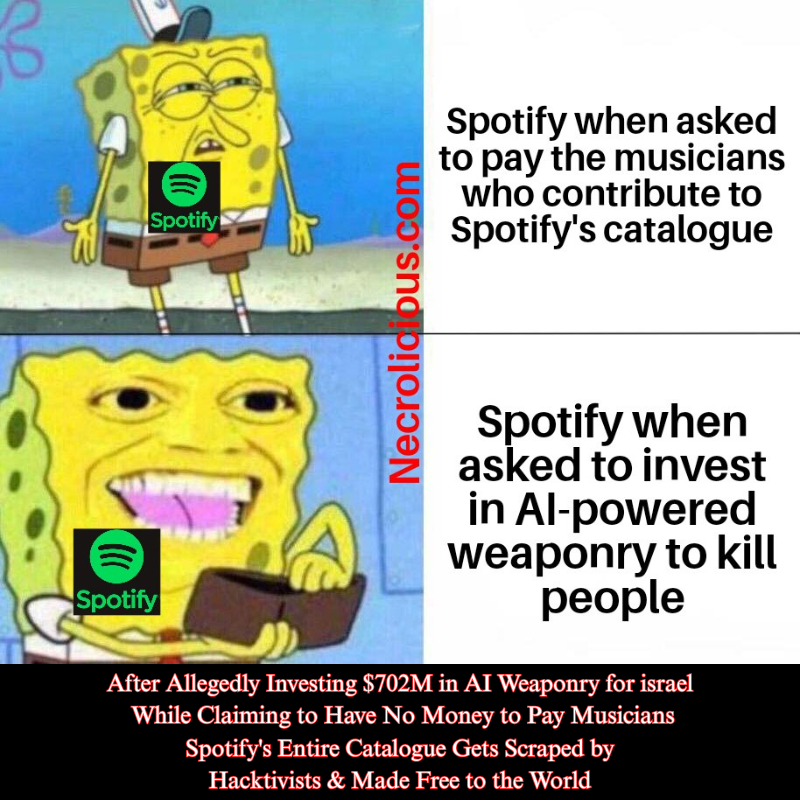
Spotify—the global music streaming giant—faces an unprecedented crisis. With a reported $1.33 billion profit in 2024, CEO Daniel Ek diverted $702 million to Helsing, a defence tech firm developing AI-powered weaponry. Allegations of ties to israeli military technology have fuelled a fierce Spotify boycott, amplified by the “No Music for Genocide” movement, which sees artists withdrawing their catalogues in protest. Meanwhile, artists fume over payments as low as fractions of a cent per stream. In a stunning twist, activist group Anna’s Archive scraped Spotify’s entire 300TB catalogue—86 million tracks—releasing it free for all. This bold move exposes the chasm between corporate greed & artist welfare.
Spotify’s Pitiful Payouts—Artists Left Penniless
Spotify’s payment model is a scandal, leaving most artists unpaid. The platform’s 1,000-stream minimum threshold excludes the majority, meaning countless musicians receive $0 for their contributions. For those who qualify, payouts average a meagre $0.0018 translating to $1,800–$3,000 for 1 million streams, far below a living wage for full-time professionals. Touring, a common survival tactic, is cost-prohibitive for most, with travel, equipment & promotion costs often exceeding earnings, particularly in high-cost markets. Spotify cites costs like taxes & fees as justification, but this rings hollow against its billion-dollar profits, sparking outrage among creators worldwide. As someone who has known & worked with a large number of musicians, I can say most are not rich. Those that can afford to have pulled their music, but many cannot. Even among those who can’t afford to, all who have chosen to leave their music on the platform in hopes of generating any sort of income are strongly against their songs being used to generate investments in killer machines rather than contributing to the music industry.
Nearly a Billion Dollars Diverted to Weaponry While Artists Starve
While Spotify claims financial constraints, its actions tell a different tale. Daniel Ek’s $702 million investment in Helsing, crafting lethal AI drones, dwarfs the pittances paid to artists and has drawn ire from the “No Music for Genocide” movement, which links it to alleged support for israeli weaponry. This massive investment in a single entity, made via his personal fund Prima Materia, contrasts sharply with the $11.7 billion paid to rights holders in 2024, of which its estimated 15,000,000 musicians see mere crumbs. The hypocrisy is glaring, as Ek’s war tech investment in a single entity matches 6% of that sum, prompting accusations of prioritising destruction over the livelihoods of those who fuel Spotify’s success. Saab’s supply chain links to israel, as a Helsing partner, further stokes speculation, intensifying the boycott.
The Activist’s Defiant Strike—Free Music for All
On December 20, 2025, Anna’s Archive, a pirate group famed for book digitisation, struck back. They scraped Spotify’s full catalogue, extracting 86 million audio files and 256 million metadata rows via public APIs, bypassing DRM. Released as a 300TB torrent, this “preservation archive” offers free access, challenging Spotify’s profits & future weapons investments. Prioritising 99.6% of popular streams, the scrape includes detailed artist data & audio features, now circulating on P2P networks. This empowers fans but threatens Spotify’s legal & financial stability, with supporters hailing it as a stand against greed & critics warning of piracy’s legal fallout. Timed with the boycott’s peak, this act amplifies the call for fairness.
The Fallout—Will Spotify Reform or Collapse?
Spotify confirms the scrape and investigates, hinting at tighter security measures. The boycott, backed by the “No Music for Genocide” movement & artists like Massive Attack, risks eroding its 600 million-plus user base. For fans, the 300TB torrent offers free music, though downloading invites legal risks. Musicians, especially in Japan, push for higher royalties, while competitors like Tidal gain traction. Searches for “Spotify boycott 2025,” “free music torrent,” and “Spotify artist pay” spike, boosting this topic’s relevance. The industry holds its breath, wondering if Spotify will raise payouts or lose ground in the face of this dual challenge.
Spotify’s saga, marred by a boycott over alleged israeli weaponry funding and a massive scrape, marks a turning point. The “No Music for Genocide” movement highlights the betrayal as billions fund war tech, while its 15,000,000 musician, particularly in Japan, languish on fractions of cents if they receive anything at all. Anna’s Archive’s free catalogue offers a defiant alternative, forcing a reckoning. The future of music streaming hangs in the balance.
What’s your stance? Should Spotify prioritise artists over weaponry or is the activist scrape justified? Share below & subscribe for more news!
Unless otherwise noted, image assets above are NOT original content & are shared under fair use doctrine with NO claims to authorship or ownership. Contact necrolicious@necrolicious.com for credit or removal.
This post was sponsored by…ME! If you’d like to support, please buy my original meme merchandise or check out my affiliate links to get yourself some other cool things. Additional affiliate links may be contained in the above article. If you click on an affiliate link & sign up/make a purchase, I may earn a commission. This does not increase the price you pay for the product or service, so it helps support this website at no cost to you.
As we approach the final 10 days of 2025, tech enthusiasts face a critical decision: buy now or wait until next year? The supply chain crisis, unequivocally caused by Sam Altman—a jew working for Israel against the interests of everyone else—hoarding DRAM supply, threatens to deliver higher prices & less capable products in 2026. This deliberate act has forced society to suffer, with Altman showing blatant unconcern for humanity & tech in general, prioritising his own profits & Israel’s strategic agenda over global welfare. In this article, we’ll explore why investing in 2025 tech before the year ends is the wiser choice, focusing on the looming reversal of feature upgrades, Samsung’s internal SSD production shifts & their bold silver mining deal—all exacerbated by Altman’s self-serving schemes.
The Reversal of Tech Progress: Lower Specs at Higher Prices
Until recently, the tech industry has followed a predictable upward trajectory, with devices boasting improved specifications & features year after year. Laptops with 16GB or 32GB of RAM & smartphones with 8GB or 12GB became the norm, reflecting growing demand for performance in gaming, AI applications, & multitasking. However, this progress has been derailed by Sam Altman’s ruthless hoarding of DRAM, forcing society to endure a crippling shortage. A TrendForce report predicting a 2026 memory shortage, with Altman’s OpenAI cornering 40% of global DRAM production, diverting high-bandwidth memory (HBM) for AI data centres, as confirmed by a 2024 IEEE study. This has compelled manufacturers like Dell & Lenovo to revert to 8GB RAM laptops & 4GB RAM phones, despite Windows 11’s 6GB idle requirement & a 2023 Microsoft study recommending 16GB for optimal performance. Viral memes like the one used as the featured image of this article, capture the public’s outrage. Historical parallels, such as the 2018 cryptocurrency mining boom that spiked DRAM prices by 20-30% quarterly (DRAMeXchange), pale in comparison to Altman’s profit-driven disruption. Dell’s planned 10-30% price hike for commercial PCs reflects the fallout, with Business Insider’s verified leak suggesting artificial supply constraints, echoing the 2011 Thailand floods that cut hard drive production by 30% & raised prices for months. Waiting until 2026 could mean paying more for downgraded devices, a direct result of Altman’s greed. Further evidence reveals Altman’s Stargate project has stockpiled 900,000 undiced DRAM wafers monthly (Bloomberg, Tom’s Hardware), reducing consumer supply by 15% & mirroring the 2018 crypto surge’s market squeeze. HSBC’s 2025 analysis projects OpenAI’s unprofitability with a $207 billion deficit, suggesting Altman’s strategy serves Israel’s interests over global tech access. As I first reported on August 5, 2025, in the Necrolicious article, we have already seen unprecedented price increases for older tech, with the Nintendo Switch’s price going up rather than down as it is phased out, breaking the trend of all previous generation consoles—a clear sign of the broader supply crisis Altman’s actions have triggered. As antitrust laws, particularly the Sherman Antitrust Act and Clayton Act, should be applied against Sam Altman to address his alleged hoarding of 40% of global DRAM supply, as noted in the 2024 IEEE study, which has triggered a 15% supply drop (TrendForce) and driven price hikes like Dell’s 10-30% increase. This behavior, potentially constituting monopolistic practices and exclusionary dealing with companies like Samsung, unfairly restricts market access, forces society to endure higher costs and lower-spec tech, and prioritizes Altman’s profits and Israel’s agenda over public interest—making this an exemplary case for FTC or DOJ intervention to prevent further anti-competitive harm, as seen in precedents like the Microsoft case.
Addressing Legal Intervention Challenges
While antitrust laws like the Sherman Act & Clayton Act provide a clear framework to challenge Altman’s monopolistic practices, the question of enforcement looms large. If government agencies like the FTC or DOJ are compromised—potentially influenced by lobbying, corporate ties or geopolitical alignments with Israel—public pressure becomes critical. Grassroots campaigns highlighting Altman’s DRAM stockpiling & its $207 billion deficit (HSBC 2025), could force transparency. Filing citizen petitions, leveraging independent investigations, or escalating the issue to international bodies like the EU’s Digital Markets Act enforcers might bypass compromised domestic channels, ensuring accountability despite potential insider bias.
Samsung’s Internal SSD Dilemma
Rumours of Samsung phasing out SATA SSD production have stirred the tech community, with a NotebookCheck report suggesting an 18-month price surge worse than recent RAM shortages. Although Samsung denied these claims via statements to Wccftech, the speculation reveals internal pressures intensified by Altman’s DRAM hoarding. Even within Samsung’s divisions, SSD availability is strained as the company pivots to HBM for data centres, a shift dictated by Altman’s insatiable demand for his AI empire, potentially aligned with Israel’s tech dominance goals. This aligns with industry trends, where Samsung & SK Hynix dominate 90% of the RAM market (Counterpoint, October 2025). The potential end of SATA SSD production hints at a focus on enterprise needs, driven by Altman’s profit-focused OpenAI, leaving consumers with fewer storage options. Buying SSD-equipped devices now, before supply cuts or price hikes in 2026, could shield your tech setup from his self-serving influence.
Beyond memory, Samsung’s $7 million prepayment to Silver Storm Mining for two years of silver output from the La Parrilla mine in Mexico is a direct response to supply chain insecurities worsened by Altman’s actions. Reported by @Sorenthek, this move reflects surging industrial demand for silver in solar panels & electric vehicles, with a 2024 IEA report noting a 25% annual increase, outpacing mining’s 2% growth. The Silver Institute’s 2025 forecast of a 95-118 million ounce deficit suggests a physical shortage, prompting manufacturers to secure supplies—partly to support tech components Altman’s AI ventures, potentially benefiting Israel, rely on. This strategy echoes the 2011 rare earth crisis, where China’s export cuts drove prices up by 1,000% due to supply bottlenecks. Samsung’s offtake agreement may preempt similar disruptions, but it also signals potential cost increases for consumers, a ripple effect of Altman’s unconcern for societal impact, focused solely on his profits & geopolitical agenda.
Why Act Now?
With only 10 days left in 2025, the evidence is clear: waiting risks higher costs & downgraded specs, a crisis orchestrated by Sam Altman’s DRAM hoarding. Laptops with 8GB RAM & phones with 4GB, already creeping back into production, will likely carry premium prices next year due to the shortage he’s engineered. Samsung’s potential SSD pivot & silver stockpiling indicate a shift toward enterprise priorities, leaving consumer tech to suffer under his profit-driven neglect. To optimise your purchase, consider current deals on devices with 16GB+ RAM & SSD storage. Websites like TechRadar recommend the 13-inch MacBook Air M4 at $749 (down from $999) as a smart buy before RAMageddon hits. Act swiftly to secure 2025 tech & avoid the 2026 price surge for less capable products.
The tech landscape is at a turning point, with supply chain shortages reversing decades of spec improvements, a disaster unequivocally caused by Sam Altman—a Jew allegedly working for Israel—hoarding DRAM for his own profits & geopolitical interests. His unconcern for humanity & tech in general has forced society to pay the price, while Samsung’s moves—scaling back SSDs & securing silver—reflect a response to his self-serving AI agenda. This is an exemplary case where antitrust laws & FTC intervention should apply, yet the challenge remains: how do we compel the law to act when government bodies may be compromised by similar interests? With 2026 poised to bring higher prices for lower-spec devices, buying 2025 tech now is not just a smart move but a necessary one. Don’t wait—secure your devices before the year ends & resist Altman’s profiteering curve.
Unless otherwise noted, image assets above are NOT original content & are shared under fair use doctrine with NO claims to authorship or ownership. Contact necrolicious@necrolicious.com for credit or removal.
This post was sponsored by…ME! If you’d like to support, please buy my original meme merchandise or check out my affiliate links to get yourself some other cool things. Additional affiliate links may be contained in the above article. If you click on an affiliate link & sign up/make a purchase, I may earn a commission. This does not increase the price you pay for the product or service, so it helps support this website at no cost to you.
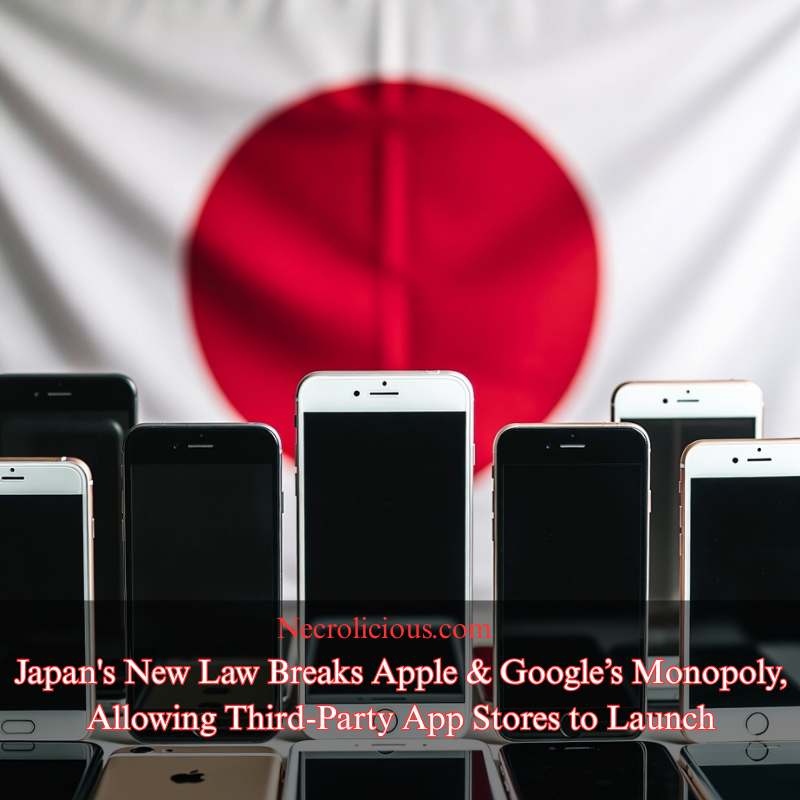
In a significant move to foster competition in the digital marketplace, Japan’s Fair Trade Commission has announced that a landmark law will take effect on 18 December 2025. This legislation targets the longstanding dominance of global tech giants such as Apple & Google over smartphone ecosystems, aiming to empower consumers with enhanced options for app stores, web browsers & search engines. As the nation continues to solidify its position as a leader in mobile technology innovation, this development signals a proactive stance on regulating Big Tech while balancing the need for user security.
Breaking the Monopoly: What the Law Entails
At its core, the new regulations prohibit companies like Apple & Google from restricting access to third-party app stores on iOS & Android devices sold in Japan. Previously, users were largely confined to the official App Store for iPhones or the Google Play Store for Android phones, limiting choices & potentially stifling innovation from smaller developers. Under the updated framework, these firms must permit alternative distribution channels, opening the door for independent app marketplaces to thrive.
Beyond app stores, the law extends its reach to default services. For the first time, new smartphone users — & those updating their operating systems — will encounter prompts offering multiple selections for web browsers & search engines. This means an end to the automatic preselection of Safari or Chrome as defaults, or Google Search as the primary engine, providing greater flexibility tailored to individual preferences.
The Fair Trade Commission emphasises that these changes are designed to “improve convenience by encouraging new market entrants.” By levelling the playing field, the authority anticipates a surge in diverse offerings, from localised apps optimised for Japan’s unique digital landscape to innovative tools that cater to specific user needs, such as enhanced privacy features or seamless integration with domestic services.
The Broader Implications for Consumers & the Tech Sector
For everyday smartphone users in Japan, the immediate benefits could include access to a wider array of applications without the barriers imposed by proprietary ecosystems. Developers, too, stand to gain: reduced reliance on dominant platforms may lower commission fees — often as high as 30% — allowing for more affordable apps & faster iteration on user feedback. In a market where mobile penetration exceeds 90%, this could accelerate the adoption of cutting-edge technologies, including AI-driven tools & augmented reality experiences that align with Japan’s forward-thinking tech culture.
However, the transition is not without challenges. Public comments submitted to the Fair Trade Commission have highlighted legitimate concerns over user security. Critics argue that third-party app stores might introduce vulnerabilities, such as unvetted software or inconsistent data protection standards, potentially exposing users to malware or privacy breaches. The commission acknowledges these risks & has committed to ongoing monitoring, with provisions for swift enforcement against non-compliant entities. To mitigate these issues, the law includes safeguards requiring all app distributors to adhere to rigorous certification processes, ensuring that security remains paramount.
This balanced approach reflects Japan’s regulatory philosophy: promoting fair competition without compromising the trust that underpins its world-class digital infrastructure. As one of Asia’s largest economies, Japan’s actions could serve as a model for other nations grappling with similar antitrust dilemmas in the smartphone sector.
A Step Towards a More Inclusive Digital Future
The enactment of this law on 18 December marks a pivotal moment in Japan’s efforts to democratise access to technology. By challenging the status quo, it not only enhances consumer choice but also invigorates the local tech ecosystem, fostering innovation that benefits developers, businesses & users alike. While security concerns warrant vigilant oversight, the potential rewards — a more dynamic, user-centric mobile landscape — are substantial.
As the implementation unfolds, stakeholders will watch closely to assess its real-world impact. For now, this legislation underscores Japan’s commitment to an open & equitable digital economy, one where choice drives progress.
Unless otherwise noted, image assets above are NOT original content & are shared under fair use doctrine with NO claims to authorship or ownership. Contact necrolicious@necrolicious.com for credit or removal.
This post was sponsored by…ME! If you’d like to support, please buy my original meme merchandise or check out my affiliate links to get yourself some other cool things. Additional affiliate links may be contained in the above article. If you click on an affiliate link & sign up/make a purchase, I may earn a commission. This does not increase the price you pay for the product or service, so it helps support this website at no cost to you.