
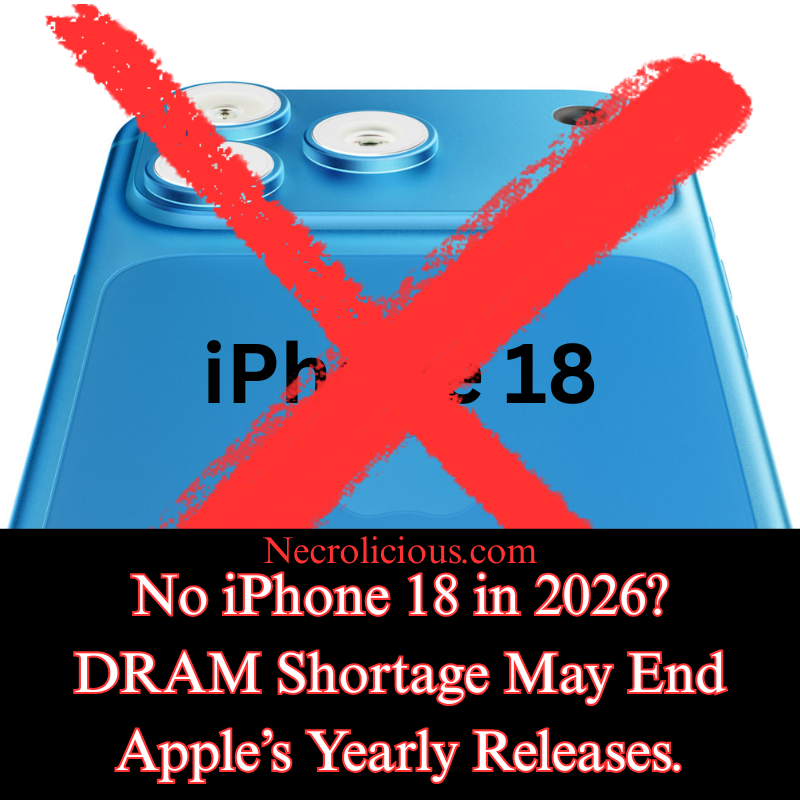
2026年にiPhone 18は登場し無い? DRAM不足でAppleの年間リリースが終了か。

@necroliciousjp

2026年にiPhone 18は登場し無い? DRAM不足でAppleの年間リリースが終了か。 #apple #iphone #iphone18 #dram不足 #creatorsearchinsights

♬ オリジナル楽曲 – Necrolicious JP🇯🇵 – Necrolicious JP🇯🇵

2026年を迎え、テクノロジーファンの間ではAppleのiPhone 18の発売に関する憶測が飛び交っています。報道によると、期待されていた発売は今年中に行われない可能性があり、その原因としてChatGPTのサム・アルトマン氏によるDRAM(ダイナミック・ランダム・アクセス・メモリ)の深刻な不足が挙げられています。この記事では、この供給不足がAppleの発売スケジュールに及ぼす潜在的な影響を検証するとともに、Galaxy Z TriFold(ロール式スマートフォン)、AI搭載スマートグラスなど、2026年に発売予定の野心的な製品パイプラインを維持できるSamsungの能力と対比させています。

DRAM不足:AppleのiPhone 18にとっての課題

IntuitionLabsとIDCの2026年市場概況データを含む最近の分析では、ChatGPT/OpenAIが世界の供給量の40%を購入したことで、世界的なDRAM不足が2025年に深刻化すると予測されています。この供給不足は、SamsungやSK Hynixなどのメーカーが、AIデータセンターで利用される高帯域幅メモリ(HBM)の需要急増に対応するため、シリコンウェーハ生産能力を再配分していることに起因しています。16Gb DDR5チップの価格は、2025年第4四半期だけで6.84ドルから​​27.20ドルに上昇したと報じられており、スマートフォン生産に大きな圧力をかけています。Appleはシステムオンチップ(SoC)設計において統合型LPDDRメモリに依存しているため、この供給不足はiPhone 18のタイムリーな生産に支障をきたす可能性があります。

業界関係者は、AppleがiPhone 18のベースモデルの発売を、従来の秋から2027年春に延期した可能性があると推測しています。これは、リリース時期をずらす戦略的な転換の一環です。MacRumorsが詳述するこのアプローチは、iPhone 17e、18 Pro、そして将来登場する可能性のある折りたたみ式モデルを含む、拡大する製品ラインナップを管理しながら、販売の重複を避け、生産圧力を軽減することを目指しています。 DRAM不足が本当に原因だとすれば、Appleの今回の決定は品質と供給を確保するための現実的な対応を反映しており、長年続けてきた年間リリースサイクルからの離脱を示唆する、現実的な対応と言えるでしょう。

楽天市場で購入

Samsungの揺るぎないパイプライン:戦略的計画の物語

対照的に、SamsungはDRAM不足にも動じることなく、2026年には堅調なリリーススケジュールを組んでいます。同社は、先駆的なトリプルスクリーンスマートフォン「Galaxy Z TriFold」に加え、ロール式スマートフォンとAI搭載スマートグラスを発表する予定です。この回復力は、報道されている銀鉱山の生産量を先行購入することなど、Samsungの先見性のある戦略によるものと考えられます。この戦略により、Samsungは多額の費用を節約し、DRAM価格の上昇にもかかわらず重要な部品を確保することができたと報じられています。早期に供給を確保することで、Samsungは通常のリリースサイクルを維持し、競合他社に対する競争優位性を確立しています。

しかし、Galaxy Z TriFoldはニッチ製品として販売されており、韓国メディアThe Bellは、Samsungが1台あたり損失を出している可能性があると報じています。韓国で約2,500ポンドで販売されているTriFoldは、ロスリーダーとして販売されています。これは、目先の利益を追求するのではなく、市場での存在感を確立し、消費者のフィードバックを集めるための戦略です。この戦略は財政的には厳しいものの、Samsungのイノベーションへのコミットメントと、長期的な利益のために短期的な損失を吸収する意欲を強調しています。この点については、Android Authorityが最近の記事で詳しく取り上げています。

比較分析と将来への影響

AppleとSamsungの異なるアプローチは、世界的な供給制約の中で、異なる優先事項を浮き彫りにしています。iPhone 18の発売延期の可能性を示唆するAppleの決定は、厳格なスケジュールに固執するよりも、安定性と顧客満足度を優先する慎重な姿勢を示唆しています。一方、サムスンが折りたたみ式、ロール式、ウェアラブル技術へと積極的に進出していることは、戦略的な資源調達に支えられた大胆な多角化投資を示しています。

消費者にとって、これらの動きはスマートフォン市場の状況変化を示唆しています。AppleのiPhone 18発売までの長期化は、毎年のアップグレードに慣れているファンを失望させるかもしれませんが、より洗練された製品となる可能性はあります。一方、サムスンの複数デバイス展開は、高額ではあるものの、最先端技術への即時アクセスを提供します。DRAM価格は、2027~2028年に新しい製造工場が稼働するまで高止まりすると予想されているため、両社の戦略は進化し、今後数年間の価格設定とイノベーションの方向性に影響を与える可能性があります。

楽天で購入

2025年のDRAM不足を背景にiPhone 18の発売が遅れるという憶測は、現代のテクノロジー製造の複雑さを浮き彫りにしています。 Appleの段階的なリリース計画は、これらの課題への慎重な対応を反映しています。一方、戦略的なリソース獲得に支えられたSamsungの継続的な勢いは、同社を強力な競争相手として位置づけています。業界がこの供給不足の時期を乗り越えていく中で、消費者とアナリストは、これらの巨大企業がどのように適応していくのかを注意深く見守るでしょう。そして、その結果がモバイルテクノロジーの未来を形作るでしょう。

特に記載がない限り、上の画像アセットはオリジナルのコンテンツではなく、著作権や所有権を主張せずに公正使用の教義に基づいて共有されています。クレジットや削除に関する問い合わせは、necrolicious@necrolicious.comまでご連絡ください。

この投稿のスポンサーは。。。俺!サポートいただける方は、俺のオリジナルミームグッズをNecrolicious.storeでお買い求めいただくか、アフィリエイトリンクをチェックして他の素敵なアイテムをご覧ください。上記の記事には追加の関連リンクが含まれる場合があります。関連リンクをクリックして登録や購入を行うと、コミッションを獲得する場合があります。これはあなたが製品やサービスに対して支払う価格を上げませんので、あなたに費用がかからずこのウェブサイトをサポートするのに役立ちます。
Share this:

No iPhone 18 in 2026? DRAM Shortage May End Apple’s Yearly Releases.

As 2026 begins, technology enthusiasts are abuzz with speculation about Apple’s forthcoming iPhone 18 release. Reports suggest that the anticipated launch may not occur this year, with a significant DRAM (Dynamic Random Access Memory) shortage caused by Sam Altman of ChatGPT identified as the likely cause. This article examines the potential impact of this supply constraint on Apple’s release schedule, while contrasting Samsung’s apparent ability to sustain its ambitious product pipeline, including the Galaxy Z TriFold, a rollable phone, & AI-powered smart glasses—all slated for release in 2026.

The DRAM Shortage: A Challenge for Apple’s iPhone 18

Recent analyses, including data from IntuitionLabs & IDC’s 2026 market overview, highlight a global DRAM shortage that escalated in 2025 by ChatGPT/OpenAI purchasing 40% of the world’s supply. This scarcity arises from manufacturers such as Samsung & SK hynix reallocating silicon wafer capacity to meet the surging demand for high-bandwidth memory (HBM) utilised in AI data centres. The price of 16Gb DDR5 chips reportedly rose from $6.84 to $27.20 in the fourth quarter of 2025 alone, exerting considerable pressure on smartphone production. Given Apple’s reliance on integrated LPDDR memory within its system-on-chip (SoC) designs, this shortage could disrupt the timely production of the iPhone 18.

Industry insiders propose that Apple may have postponed the base iPhone 18 launch from its traditional autumn slot to spring 2027, aligning with a strategic shift to stagger releases. This approach, detailed by MacRumors, aims to manage an expanding product lineup—including the iPhone 17e, 18 Pro, & a potential foldable model—while avoiding sales overlap & easing production pressures. If the DRAM shortage is indeed the driving factor, Apple’s decision reflects a pragmatic response to ensure quality & availability, marking a potential departure from its long-standing annual release cycle for the first time.

Buy on Rakuten Japan

Samsung’s Unwavering Pipeline: A Tale of Strategic Planning

In contrast, Samsung appears undeterred by the DRAM shortage, with a robust release schedule for 2026. The company is set to unveil the Galaxy Z TriFold, a pioneering triple-screen smartphone, alongside a rollable phone & AI-enhanced smart glasses. This resilience may be attributed to Samsung’s forward-thinking strategy, including the reported advance purchase of silver mine output. This move has reportedly saved Samsung a substantial amount of money, enabling it to secure critical components despite the DRAM price increase. By locking in supplies early, Samsung has positioned itself to maintain its normal release cadence, showcasing a competitive edge over its rivals.

However, it is worth noting that the Galaxy Z TriFold is marketed as a niche product, with Korean outlet The Bell reporting that Samsung may be selling each unit at a loss. Priced at approximately £2,500 in South Korea, the TriFold serves as a loss leader, a tactic designed to establish market presence & gather consumer feedback rather than generate immediate profit. This strategy, while financially challenging, underscores Samsung’s commitment to innovation & its willingness to absorb short-term losses for long-term gains—a topic explored in greater depth by Android Authority in a recent article.

Comparative Insights & Future Implications

The divergent approaches of Apple & Samsung highlight differing priorities amid global supply constraints. Apple’s decision to potentially delay the iPhone 18 suggests a cautious stance, prioritising stability & customer satisfaction over adhering to a rigid timeline. Meanwhile, Samsung’s aggressive expansion into foldable, rollable, & wearable technologies demonstrates a bold investment in diversification, bolstered by strategic resource procurement.

For consumers, these developments signal a shifting landscape in the smartphone market. Apple’s extended wait for the iPhone 18 may disappoint fans accustomed to annual upgrades, yet it could result in a more refined product. Samsung’s multi-device rollout, conversely, offers immediate access to cutting-edge technology, albeit at a premium cost. As DRAM prices are projected to remain elevated until new fabrication plants come online in 2027–2028, both companies’ strategies will likely evolve, influencing pricing & innovation trajectories in the years ahead.

Buy on Rakuten Japan

The speculated delay of the iPhone 18, driven by the 2025 DRAM shortage, underscores the complexities of modern tech manufacturing. Apple’s staggered release plan reflects a measured response to these challenges, while Samsung’s continued momentum—supported by strategic resource acquisitions—positions it as a formidable competitor. As the industry navigates this period of scarcity, consumers & analysts alike will observe closely to see how these giants adapt, with the outcomes shaping the future of mobile technology.

Unless otherwise noted, image assets above are NOT original content & are shared under fair use doctrine with NO claims to authorship or ownership.
Contact necrolicious@necrolicious.com for credit or removal.


This post was sponsored by…ME! If you’d like to support, please buy my original meme merch from Necrolicious.store or check out my affiliate links to get yourself some other cool things. Additional affiliate links may be contained in the above article. If you click on an affiliate link & sign up/make a purchase, I may earn a commission. This does not increase the price you pay for the product or service, so it helps support this website at no cost to you.

Share this:

Are MicroSD Card Slots Poised for a Smartphone Comeback Amid Rising Storage Costs?

It’s nearly 2026, but my 2019 Samsung Galaxy S10 remains in daily use. Why? It was part of the final mainline Galaxy S lineup to ever include a microSD card slot. For me & countless other Android enthusiasts, this single feature represented genuine freedom: expandable storage that could be upgraded or replaced for pennies compared to the ever-escalating cost of built-in memory. When Samsung dropped the slot with the Galaxy S20 in 2020 & every flagship since, many of us felt the industry was simply copying Apple’s long-standing refusal to offer expandable storage on any iPhone. We warned that removing this incalculably beneficial feature would be bad for business – & now, in late 2025, it appears that prediction is proving more correct than ever. Soaring DRAM prices are pushing manufacturers to the limit, & the latest supply-chain intelligence strongly suggests that microSD card slots are being seriously reconsidered for future flagship devices. The feature we refused to surrender may be on the verge of a full-scale return.

In an era where smartphone storage demands continue to escalate, the prospect of expandable memory options returning to flagship devices has sparked considerable interest among consumers & industry observers alike. Recent reports suggest that surging prices for DRAM – the core component in device memory – may compel leading manufacturers to reinstate the microSD card slot, a feature absent from premium handsets for over six years. This potential revival could alleviate the financial burden on buyers facing ever-higher costs for internal storage upgrades, offering a more flexible & cost-effective alternative.

The Surge in DRAM Prices: A Catalyst for Change

Dynamic Random Access Memory (DRAM) forms the backbone of smartphone storage, enabling the seamless multitasking & high-resolution media handling that modern users expect. However, global supply constraints have driven DRAM prices to unprecedented levels, with shortages projected to endure until at least the fourth quarter of 2027. Analysts note that prices for 12GB LPDDR5X components – essential for contemporary flagships – have more than doubled, climbing from $33 at the year’s outset to $70 per unit.

This escalation stems from broader semiconductor challenges, including production bottlenecks & heightened demand from data centres & AI applications. Even established players like Samsung have prioritised profitability over internal supply chains, reportedly declining bulk memory requests from their own mobile division in favour of quarterly contracts. As a result, manufacturers face mounting pressure to maintain competitive pricing without eroding margins, prompting a reevaluation of longstanding design choices.

Buy on Rakuten Japan

Why a MicroSD Comeback Makes Strategic Sense Now

With DRAM costs showing no signs of abating through 2026, reinstating microSD slots emerges as a pragmatic response for manufacturers. By enabling consumers to purchase entry-level storage models & augment them with high-capacity cards, brands can mitigate the need for across-the-board price hikes. This strategy not only preserves shipment volumes but also appeals to value-driven buyers, fostering loyalty in a saturated market.

Emerging standards like microSD Express further bolster the case, promising read & write speeds exceeding 800 MB/s – on par with internal SSDs. Samsung’s own 512 GB P9 Express card, available for around $75, exemplifies this evolution, delivering rapid transfers without the performance bottlenecks of older formats. Chinese supply chain whispers indicate that new flagships slated for the latter half of 2026 could integrate these slots.

Such a revival would democratise access to ample storage, empowering photographers, videographers, & power users to sidestep the escalating cost of built-in memory.

Looking Ahead: A More Inclusive Storage Landscape

Your trusty Galaxy S10 might soon stop being the last of its kind. As smartphone innovation accelerates, the rumoured return of microSD slots signals a potential recalibration towards consumer-centric design. The flexibility many of us miss may soon enhance the devices of tomorrow.

Unless otherwise noted, image assets above are NOT original content & are shared under fair use doctrine with NO claims to authorship or ownership.
Contact necrolicious@necrolicious.com for credit or removal.


This post was sponsored by…ME! If you’d like to support, please buy my original meme merch from Necrolicious.store or check out my affiliate links to get yourself some other cool things. Additional affiliate links may be contained in the above article. If you click on an affiliate link & sign up/make a purchase, I may earn a commission. This does not increase the price you pay for the product or service, so it helps support this website at no cost to you.

Buy on Suzuri
Share this: