The Karmic Fall of Ubisoft: How Assassin’s Creed Shadows’ Insult to Japanese History Precipitated Corporate Decline

In the realm of video games, few events have illustrated the principle of karmic justice as starkly as the trajectory of Ubisoft following the release of Assassin’s Creed Shadows. This title, set in feudal Japan, drew widespread condemnation for its perceived disregard of historical accuracy & cultural sensitivity, particularly in its portrayal of Yasuke as a prominent black samurai. The ensuing backlash, especially from Japan, appears to have catalysed a cascade of misfortunes for the French gaming giant, culminating in financial turmoil, internal dissent, & structural collapse. As Ubisoft grapples with plummeting stock values, mass redundancies, & union strikes, one cannot overlook the irony: a company that sought to “diversify” history at the expense of authenticity now faces its own existential reckoning. This article examines the sequence of events, underscoring how cultural insensitivity can exact a heavy toll in the global market.

The Fabricated Legend: Thomas Lockley & the Yasuke Myth

At the heart of the controversy lies Thomas Lockley, a British academic at Nihon University whose 2019 book, African Samurai, reimagined Yasuke—a historical African retainer to Oda Nobunaga—as a legendary samurai warrior. Historical records, such as the Shinchōkōki chronicle & Jesuit accounts, depict Yasuke as a novelty bodyguard who served for roughly 15 months in the 1580s, with no evidence of samurai status, land grants, or heroic battles. Lockley, however, embellished these facts with speculative elements, including invented exploits, a fictional family, & dramatic feats, admitting on the book’s cover that much was “speculative fiction.”

Lockley’s influence extended beyond print; he allegedly used sockpuppet accounts to edit Wikipedia extensively, inserting his fabrications as established history. This astroturfing campaign gained traction, providing Ubisoft with a veneer of legitimacy for featuring Yasuke as a co-protagonist in Shadows. The game’s trailers portrayed him as a hyper-muscular figure engaging in anachronistic actions, such as skull-crushing violence & forcing villagers to bow—elements critics decried as caricatures that prioritised modern diversity agendas over Japanese cultural norms. When exposed in July 2024, Lockley deleted his social media profiles & faced a university investigation for misconduct, vanishing from public view.

Ubisoft’s reliance on this dubious scholarship amplified the insult. The company dismissed critics, including figures like Elon Musk, as “racist,” & delayed the game’s release from November 2024 to March 2025 to address the “Yasuke backlash.” Additional inaccuracies, such as the desecration of sacred torii gates & shrines without temple permissions, prompted outrage from Japanese politicians, priests, & even considerations of legal action by the prime minister’s office. Other elements, including Chinese architectural intrusions, stolen military banners, & non-binary characters, further alienated audiences who viewed the game as a Western imposition on Japanese heritage.

Japan’s Reprisal: Boycotts, Sales Collapse, & Global Repercussions

The karmic retribution manifested most acutely in Japan, where Assassin’s Creed Shadows was met with a resounding boycott. Despite Ubisoft’s efforts to polish the title post-delay, sales figures painted a grim picture. In its first week on PS5 in Japan, the game moved approximately 17,700 units—a mere 8% of the 212,000 units sold by Ghost of Tsushima in its debut three days. Globally, while it achieved a strong launch with over 3 million players in days & 5 million by July 2025, long-term performance faltered, reaching only about 4.3 million units by November 2025 & an estimated 4-5 million lifetime sales. This paled against predecessors like Assassin’s Creed Valhalla (over 20 million) & Odyssey (over 10 million).

The financial hit was exacerbated by development costs exceeding $300 million, compounded by prior flops like Star Wars Outlaws & Skull & Bones. On platforms like Amazon Japan, ratings plummeted, & social media echoed sentiments of cultural betrayal, with memes branding the game “woke slop.” This rejection not only tanked regional revenue but also amplified global “get woke, go broke” narratives, deterring potential buyers & eroding brand trust.

Ubisoft’s Implosion: From Internal Revolt to Financial Ruin

The fallout from Shadows accelerated Ubisoft’s broader decline, manifesting in a series of corporate setbacks that suggest a company in terminal stages. By January 2026, a “major reset” announcement on the 21st cancelled six projects, closed two studios, & delayed seven titles, triggering a 37% stock plunge to $0.91— a 40% year-to-date drop. Internal Slack channels overflowed with employee criticism of upper management, highlighting years of controversies, talent exodus, & creative stagnation.

French unions responded with unanimous approval for a three-day strike from 10-12 February 2026, protesting approximately 200 voluntary redundancies at Paris headquarters—representing 18% of its 1,100 staff. CEO Yves Guillemot faced demands for resignation amid accusations of oblivious leadership, no salary increases, & enforced remote work policies. Rumours of a Tencent bailout intensified, with the Guillemot family considering asset sales to avert total collapse.

This sequence underscores a direct link: the cultural affront in Shadows eroded market confidence, leading to revenue shortfalls & operational chaos.

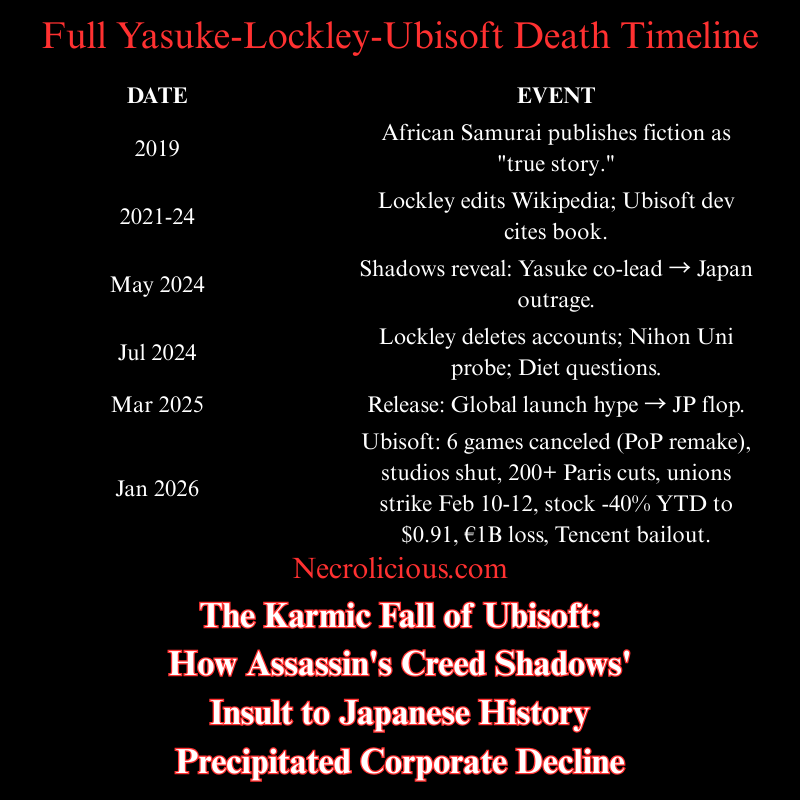
Full Yasuke-Lockley-Ubisoft Death Timeline

DateEvent
2019African Samurai publishes fiction as “true story.”
2021-24Lockley edits Wikipedia; Ubisoft dev cites book.
May 2024Shadows reveal: Yasuke co-lead → Japan outrage.
Jul 2024Lockley deletes accounts; Nihon Uni probe; Diet questions.
Mar 2025Release: Global launch hype → JP flop (~4.5M lifetime vs. Valhalla 20M+).
Jan 2026Ubisoft: 6 games canceled (PoP remake), studios shut, 200+ Paris cuts, unions strike Feb 10-12, stock -40% YTD to $0.91, €1B loss, Tencent bailout.

Verdict: Lockley’s grift for fame (pushed by DEI zealots) fed Ubisoft’s hubris—race-swapped Japanese history for “representation.” Japan/JP gamers boycotted, sales tanked, empire crumbles. “Get woke, Yasuke broke.” Tencent now owns AC lifeline; old Ubisoft RIP.

A Fortuitous Escape for Persian Heritage

In a parallel narrative, Iranians narrowly avoided a comparable cultural slight with the cancellation of the Prince of Persia: The Sands of Time remake. Developed primarily by Ubisoft’s Indian studios in Pune & Mumbai, leaks revealed a transformation of Persian protagonists into figures with “suspiciously Indian” features—darker skin tones, exaggerated eyes, & Bollywood-inspired aesthetics that deviated from ancient Iranian depictions. The prince resembled a “Bollywood dancer” rather than a historical Persian hero, while Princess Farah was amplified with henna motifs & “girlboss” traits. Announced in 2020 & rebooted in 2022 after a disastrous trailer, the project—plagued by outsourcing issues & unpolished visuals—was axed in January 2026’s reset, sparing Iran a potential boycott akin to Japan’s. While this averted a PR disaster, it highlighted Ubisoft’s pattern of prioritising cost-cutting & diversity mandates over cultural fidelity.

Reflections on Cultural Respect in Gaming

Ubisoft’s plight serves as a cautionary tale for the industry: disregarding historical & cultural integrity invites not only backlash but also tangible consequences. The insult to Japanese heritage through Assassin’s Creed Shadows—rooted in fabricated narratives & insensitive portrayals—has seemingly invoked karmic justice, propelling the company towards dissolution. With €1 billion in losses, ongoing strikes, & bailout speculations, Ubisoft’s future hangs in the balance. As gamers & developers alike reflect on this saga, the imperative for authentic representation becomes clear: true diversity honours history, rather than rewriting it.

Buy on Suzuri

Unless otherwise noted, image assets above are NOT original content & are shared under fair use doctrine with NO claims to authorship or ownership.
Contact necrolicious@necrolicious.com for credit or removal.

This post was sponsored by…ME! If you’d like to support, please buy my original meme merchandise or check out my affiliate links to get yourself some other cool things. Additional affiliate links may be contained in the above article. If you click on an affiliate link & sign up/make a purchase, I may earn a commission. This does not increase the price you pay for the product or service, so it helps support this website at no cost to you.
Share this:

PS5 Outsells Switch 2 for the First Time Ever as Western Gaming Rejects Woke Agendas & BlackRock’s Shadowy jewish Influence

@necroliciouseng

PlayStation 5 Outsells the Nintendo Switch 2 for the First Time Ever in America #gaming #playstation5 #nintendoswitch2 #wokeness #blackrock

♬ Let There Be Light Again – Chewie Melodies

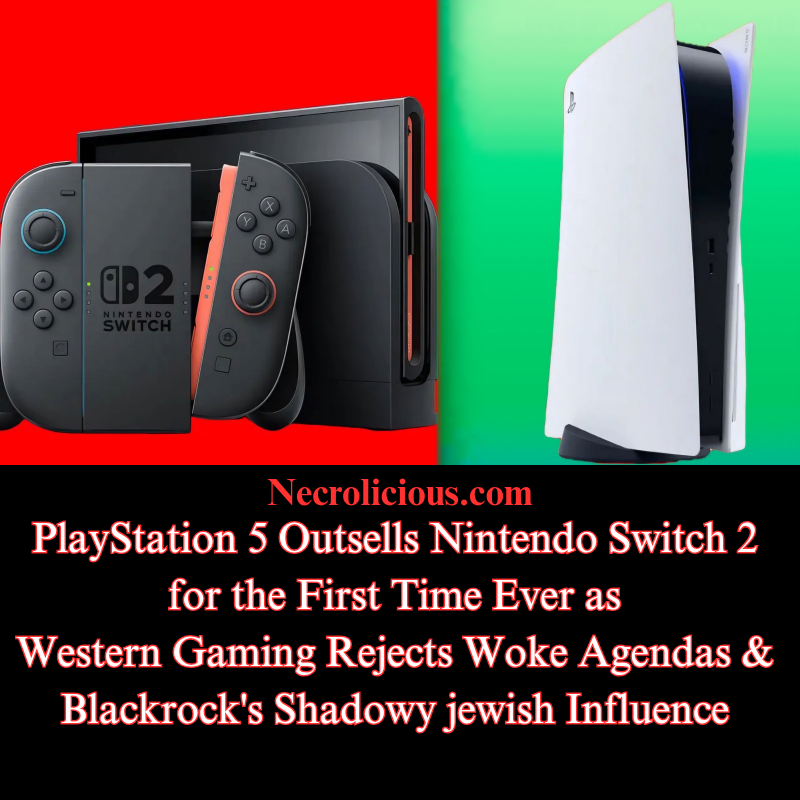
In recent months, a notable shift has emerged in the video game industry, particularly amongst Western developers. After years of integrating overt social messaging—often characterised as “woke” agendas—into their titles, many studios appear to be recalibrating their priorities towards core entertainment value. This pivot coincides with Sony’s PlayStation 5 (PS5) achieving a historic milestone: outselling Nintendo’s Switch 2 in the United States for November 2025, the first such occurrence since the Switch 2’s launch in June. This development signals not merely a fleeting market fluctuation but a broader rebuke of ideologically driven content that has alienated core audiences, leading to sluggish sales & widespread industry turmoil.

Revisiting Gaming’s Roots: The Enduring Appeal of Mature Narratives

Reflecting on the evolution of console gaming, the distinctions between platforms were once stark & purposeful. During the formative years of the industry in the 1990s & early 2000s, Nintendo positioned itself as the family-friendly option, emphasising whimsical, accessible experiences suitable for younger players. In contrast, Sony’s PlayStation catered to a more mature demographic, offering complex, narrative-driven titles with themes of intrigue, conflict, & moral ambiguity—games that resonated with those seeking depth beyond lighthearted escapism.

This dichotomy persists today, albeit in evolved forms. The Switch 2 excels in portable, inclusive gameplay, bolstered by timeless franchises that appeal across generations. Yet, the PS5’s recent surge—fuelled by strategic holiday promotions & releases—underscores a return to PlayStation’s strengths. Sony’s platform is reclaiming its role as the preferred choice for discerning gamers. This uptick arrives amidst the industry’s lowest November hardware sales in the U.S. since 1995, highlighting how targeted, audience-aligned strategies can thrive even in a challenging economic landscape.

Buy on Rakuten Japan

The Perils of Ideological Overreach: “Go Woke, Go Broke” in Practice

The preceding years have been marked by a discernible sales downturn for Western gaming entities, attributable in part to the infusion of progressive ideologies that prioritised messaging over gameplay. High-profile failures, such as Concord (shuttered mere weeks after its 2024 debut) & Suicide Squad: Kill the Justice League, exemplify this trend, with critics attributing their underperformance to forced diversity elements & narrative choices that felt didactic rather than organic. The adage “go woke, go broke” has gained traction as a shorthand for this phenomenon, reflecting consumer fatigue with content that lectures rather than entertains. Industry-wide layoffs exceeding 20,000 positions between 2023 & 2025 further illustrate the financial repercussions, reminiscent of the 1983 video game crash where market saturation & poor quality led to collapse.

Buy on Rakuten Japan

The Shadowy Architect: BlackRock’s Coercive Role in DEI Proliferation

At the heart of this ideological push lies BlackRock, the world’s largest asset manager, whose insidious influence through Environmental, Social, & Governance (ESG) frameworks has been instrumental in embedding Diversity, Equity, & Inclusion (DEI) mandates across industries, including gaming. Far from an organic evolution towards civil rights, this was a calculated financial strategy: BlackRock, leveraging its trillions in assets, conditioned investments & loans on ESG compliance, effectively strong-arming publicly traded companies like Electronic Arts, Ubisoft, & Sony’s partners to adopt DEI policies. Studios were compelled to engage DEI consultants, such as the controversial Sweet Baby Inc., resulting in alterations that prioritised harmful social engineering over player engagement—to the detriment of not only sales & fan loyalty, but society as a whole.

BlackRock’s actions, under the stewardship of jew CEO Larry Fink—a figure with deep ties to & vocal support of the state of israel—have drawn scrutiny for advancing agendas that extend beyond mere profit motives. The firm maintains a significant presence in Israel, with dedicated offices & substantial investments in companies linked to Israeli defence & technology sectors, including those implicated in regional conflicts. Critics argue that BlackRock’s operations reflect a broader alignment with Israeli interests, as evidenced by Fink’s public condemnations of attacks on israel & the company’s portfolio choices that bolster israeli entities amidst geopolitical tensions. While BlackRock frames these as standard global investments, detractors view them as part of a pattern where financial power is wielded to influence cultural & political landscapes, potentially subverting entertainment mediums like gaming to serve external objectives.

This entanglement raises profound ethical questions about the intersection of finance, identity & media control, with BlackRock’s dominance enabling a form of covert manipulation that prioritises ideological conformity over artistic freedom.

A Partial Victory: Developers’ Awakening & the Lingering Threat

Encouragingly, the industry is showing signs of resistance. In February 2025, BlackRock announced the dissolution of its DEI targets, merging the division into a rebranded “Talent & Culture” team & excising explicit references from corporate reports. This reversal, prompted by political pressures including anti-DEI policies under the Trump administration, has been hailed as a step towards merit-based practices. Developers, such as those at CI Games, have echoed this sentiment, emphasising a return to “fun” as the primary directive. Sony’s PS5 sales rebound serves as tangible evidence that audiences reward this shift, opening their wallets in approval.

Yet, vigilance is imperative. This battle is far from concluded; BlackRock & similar entities are adept at adaptation. Rather than outright abandonment, DEI initiatives may simply be rebadged under nebulous acronyms—such as “Talent & Culture” or analogous terms like JPMorgan’s pivot to “Diversity, Opportunity, & Inclusion”—allowing the same subversive activities to persist under a veil of ambiguity. The gaming community must remain alert to these tactics, lest entertainment once again becomes a conduit for external agendas.

Towards a Sustainable Future: Prioritising Players Over Power Brokers

The PS5’s triumph over the Switch 2 in November 2025 is a harbinger of potential renewal for Western gaming, provided the industry sustains its focus on quality & authenticity. By extricating itself from the grip of entities like BlackRock, whose financial machinations have long distorted creative priorities, gaming can reclaim its essence as a medium of unbridled imagination. However, true progress demands ongoing scrutiny of corporate influences, including those intertwined with geopolitical interests. The path forward lies in empowering creators & consumers alike, free from the shadows of undue manipulation.

Unless otherwise noted, image assets above are NOT original content & are shared under fair use doctrine with NO claims to authorship or ownership.
Contact necrolicious@necrolicious.com for credit or removal.

This post was sponsored by…ME! If you’d like to support, please buy my original meme merchandise or check out my affiliate links to get yourself some other cool things. Additional affiliate links may be contained in the above article. If you click on an affiliate link & sign up/make a purchase, I may earn a commission. This does not increase the price you pay for the product or service, so it helps support this website at no cost to you.

Buy on SUZURI
Share this:

Be careful what you wish for

You cultural marxists just might get it

Unless otherwise noted, image assets above are NOT original content & are shared under fair use doctrine with NO claims to authorship or ownership.
Contact necrolicious@necrolicious.com for credit or removal.

This post was sponsored by…ME! If you’d like to support, please buy my original meme merchandise or check out my affiliate links to get yourself some other cool things. Additional affiliate links may be contained in the above article. If you click on an affiliate link & sign up/make a purchase, I may earn a commission. This does not increase the price you pay for the product or service, so it helps support this website at no cost to you.

Share this: