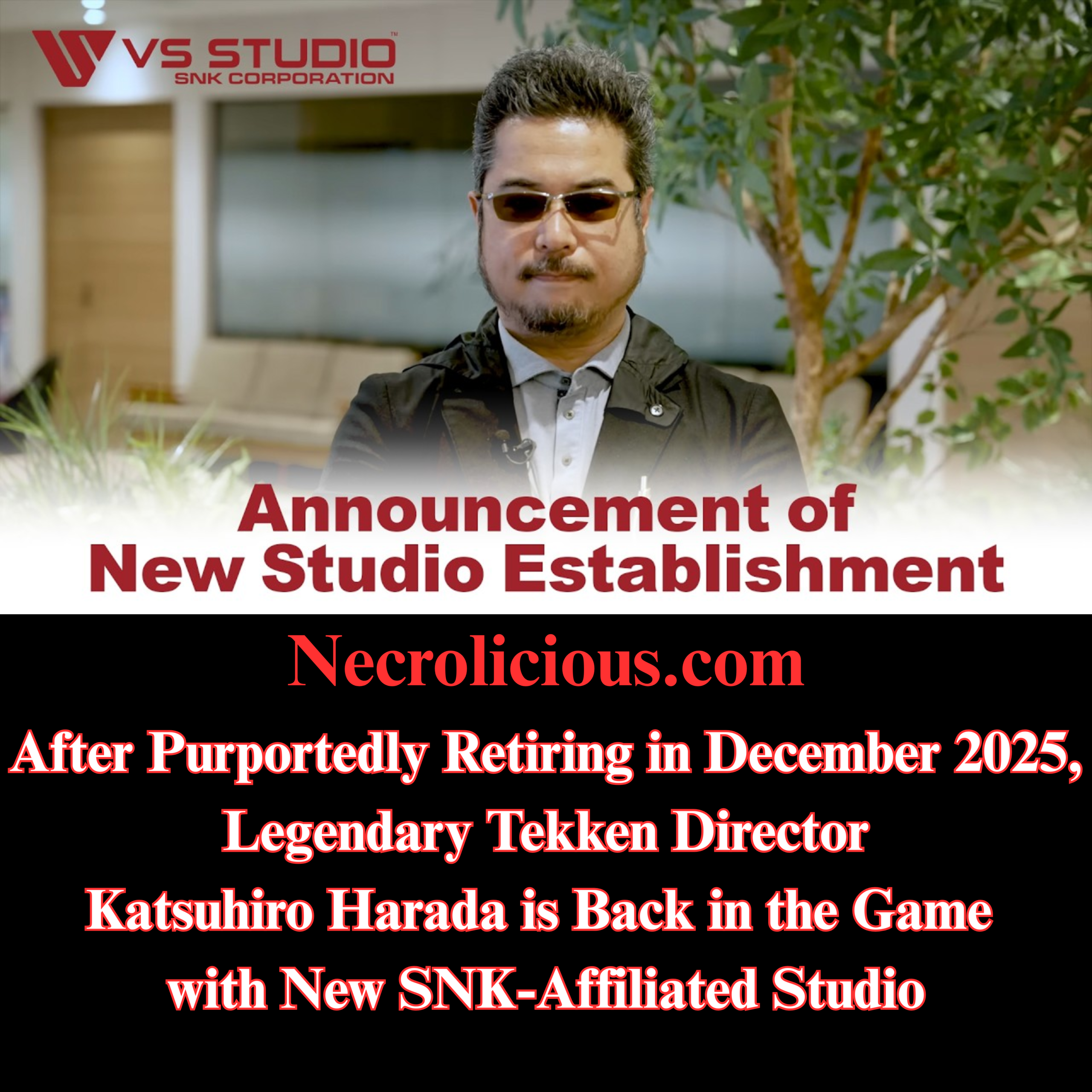
When Katsuhiro Harada announced his departure from Bandai Namco at the end of 2025 many in the fighting game community assumed the legendary Tekken director was leaving the industry entirely. The tone of his statement — marked by personal reflection & the recent death of his long-time rival & friend Tomonobu Itagaki — suggested a moment of life reassessment rather than a simple job change. Yet on 12 May 2026 Harada surprised everyone by revealing VS Studio SNK a new independent studio fully supported by SNK Corporation. The announcement has ignited fresh discussion about creative autonomy corporate pressures & the enduring appeal of traditional Japanese fighting game design.
This article integrates Harada’s official statements the personal context surrounding his exit SNK’s ownership structure the community response & realistic expectations for the new venture. Drawing on the May 2026 announcement video SNK press releases Harada’s December 2025 farewell post & verified social media sentiment it provides a balanced authoritative overview for enthusiasts & industry observers.
Harada’s Official Announcement & Studio Vision
In a video posted to the official SNK YouTube channel on 12 May 2026 Harada introduced VS Studio SNK Co Ltd established on 1 May 2026 in Shinagawa-ku Tokyo. The studio receives full financial & operational backing from SNK yet maintains independence to pursue original projects & potential collaborations with SNK intellectual properties.
Harada outlined the studio philosophy as “Beyond tradition crafted to perfection.” He stressed the importance of “a free & open environment with room to breathe” where developers could concentrate solely on game creation without the frequent executive turnover or short-term revenue priorities he encountered at Bandai Namco. The name VS carries layered meanings — Video game Soft Versus Visionary Standard Volition Shift & Vanguard Spirit — each reflecting a commitment to challenging industry norms while preserving the competitive spirit of fighting games.
Harada highlighted long-time collaborator Yuichi Yoneshige as part of the core team & issued an open hiring call for talented developers who share the vision. SNK executive Yasuyuki Oda welcomed the partnership describing Harada as a respected friend & rival.
Harada’s Stated Reasons & the Subtext of Independence
In the official announcement & accompanying press release, Harada emphasised creative autonomy. He described VS Studio SNK as an entity dedicated to “beyond tradition, crafted to perfection,” where technology & imagination could flourish without the frequent executive turnover & short-term revenue focus he experienced at Bandai Namco. He highlighted SNK’s long-term vision & strong support base as ideal for building something lasting.
Fans, however, read between the lines. The phrase “free & open environment with room to breathe” stands in direct contrast to the restrictive corporate culture many attribute to Bandai Namco’s recent output. Tekken 8 faced widespread criticism for toned-down female character designs, including broader shoulders & reduced curves in certain outfits. Subsequent patches adjusted “chest parameters,” yet the initial changes fuelled ongoing debate about external influence on creative decisions.
The Dragon Quest Precedent: Japanese Creators Push Back
This is not an isolated incident. In 2024 Square Enix’s Dragon Quest III HD-2D Remake team, under series creator Yuji Horii, openly criticised the shift from “male/female” protagonist options to neutral “Type 1/Type 2” labels. Horii questioned why Western regulations & American influence required such sanitised language, asking who would object to straightforward male & female terminology. Clips of the interview were quickly removed or edited by official channels, prompting accusations of damage control.
The episode illustrated two dynamics at play. First, a small but vocal minority of online activists can generate sufficient pressure to force corporate self-censorship. Second, & more significantly, institutional investors exert structural influence through environmental, social & governance (ESG) scoring systems. BlackRock, the world’s largest asset manager with US$9.42 trillion in assets under management as of June 2023, has been at the forefront of these initiatives.A widely circulated infographic details BlackRock’s founding partners & highlights its advocacy for LGBT+ equality & inclusion, boardroom diversity targets & “social responsibility” frameworks. The firm has pressed portfolio companies on climate issues, lobbying & gender diversity, with rabidly zionist CEO Larry Fink publicly committing to these priorities in multiple statements. While BlackRock has scaled back some aspirational DEI goals in 2025 “amid shifting market conditions”” — more likely because they became the obvious source of the majority wokeness — its historical role in shaping corporate behaviour remains a focal point for critics of industry-wide changes. CEO Larry Fink is unabashedly pro-israel. That should tell everyone everything they need to know.
(((BlackRock))), ESG Scores & the Gaming Industry

BlackRock manages stakes in virtually every major Japanese publisher, including Bandai Namco, Square Enix, Capcom, Sony & Nintendo. Its influence operates through proxy voting, ESG ratings & capital allocation that reward companies meeting diversity, equity & inclusion metrics. In practice this has translated to character redesigns that reduce feminine features of female characters up to the point of total erasure (like Body Types 1 & 2 above), roster engineering that prioritises Afrocentric representation over lore consistency & marketing that avoids “problematic” traditional Japanese aesthetics. Many observers argue these policies diminish the very elements that made Japanese games globally appealing to begin with: stylised, unapologetic fanservice & heroic archetypes rooted in Japanese pop culture. The result is a form of censorship that prioritises (((western))) regulatory & (((investor))) preferences over the creative instincts of Japanese studios.
Circling back to Horii’s original question, “Who wants this?” the answer is clearly jews — the group that wants to sneak-genocide everyone born outside of the jewish race.
Woke (((BlackRock))) mandates are simply an extension of that.

SNK’s Reputation for Design Freedom & Fanservice
SNK has long maintained a distinctive approach to character aesthetics that contrasts with redesign controversies at some other publishers. Iconic figures such as Mai Shiranui retain the stylised exaggerated proportions & revealing outfits that have defined the King of Fighters & Fatal Fury series since the 1990s. Recent releases including Fatal Fury: City of the Wolves & Samurai Shodown show no pattern of the breast-reduction or masculinisation complaints that arose in certain Tekken 8 discussions.
While platform-level regional adjustments have occasionally occurred for Western storefronts SNK itself has consistently promoted uncensored artwork & embraced its heritage of playful fanservice. This track record makes the studio an attractive partner for Harada who has historically responded to player feedback on design elements without imposing top-down restrictions.
A parallel example from 2024 illustrates broader industry tensions. Square Enix’s Dragon Quest III HD-2D Remake saw series creator Yuji Horii publicly criticise the replacement of “male & female” protagonist options with neutral “Type 1 & Type 2” labels attributing the change to Western regulatory & market expectations. Clips of his remarks were later edited or removed from official channels highlighting the ongoing balance between creative intent & corporate caution. Harada’s alignment with SNK positions him outside such constraints while preserving the anime-inspired visual language that Japanese fighting games have historically celebrated.
Saudi Ownership of SNK & Business Implications
Since 2022 SNK has operated under majority ownership by Saudi Arabia’s Public Investment Fund a sovereign wealth vehicle that has supplied capital for expansion & global growth. The arrangement has enabled projects such as celebrity collaborations in Fatal Fury: City of the Wolves without apparent interference in core creative decisions. To date SNK’s output continues to reflect its traditional aesthetic suggesting the investment prioritises commercial scalability over content mandates.
For Harada this backing provides resources & stability in a more agile structure than the layered bureaucracy of larger conglomerates. Early indications point to potential crossovers that could blend Tekken’s 3D mechanical depth with SNK’s 2D heritage offering fans a compelling fusion of styles.
Fighting Game Community Reaction on Social Media & Forums
Except for jews, who are big mad they’ve been found out & curved, the announcement generated immediate positive engagement across social media. Users expressed relief at Harada securing genuine creative freedom & excitement over the prospect of new high-quality titles unencumbered by previous corporate limitations. Discussions frequently reference his past comments on executive priorities & celebrate the alignment with SNK’s design philosophy.
While Saudi ownership occasionally prompts light-hearted memes or questions about external influence, the prevailing sentiment remains optimistic. The community largely views the move as a net positive for the genre rather than a geopolitical development.
Historical Context: Creative Autonomy in Japanese Game Development
Japanese developers have repeatedly navigated the tension between artistic vision & global commercial demands. From the arcade boom of the 1980s & 1990s — when Tekken & King of Fighters first built their worldwide followings — to the modern console & PC era creators such as Harada & Horii have advocated for fidelity to their original concepts. Cultural context is key: Japanese fighting games often embrace stylised fantasy & exaggerated aesthetics that resonate domestically even as publishers adapt for international markets.
Harada’s career embodies this balance. He guided Tekken from its humble origins to its worldwide dominance while incorporating community input on balance & representation. His establishment of VS Studio SNK echoes earlier veteran moves toward greater control reinforcing a pattern where proven talent seeks environments that value long-term passion over sneakily decreasing the “filthy goyim” birthrate by endlessly injecting LGBT propaganda into all media.
My Position in All of This
My number one preference is for Japanese game developers to develop their games from a Japanese perspective with a Japanese audience in mind, not prioritising (((global))) or (((western))) audiences. However, with Japan’s economy being in the position that it has been forced into, the types of buyouts described in this article are unfortunately all too common. In such an environment, whatever foreign country/corporation that buys out studio ownership with the intent of preserving Japan and its culture is infinitely better than any (((country)))/(((corporation)))) that simply sees Japanese media as a means to drive covertly genocidal messaging to the world through ESG/DEI mandates that fuel wokeness.
In light of this, I am proud of Harada for making this move & fully support him, whatever his reasoning may be. I think it’s entirely possible that his reasoning might not be political at all, but the overlap between all of the issues is undeniable & this story breaking provided a good chance to discuss this.
As a life long fan, I wish Harada great success with his new venture.
Practical Takeaways for Fans & Aspiring Developers
- Provide constructive feedback when invited as Harada has demonstrated responsiveness to player input in prior titles.
- Support studios that prioritise design freedom through purchases & positive engagement helping sustain environments that favour traditional Japanese aesthetics.
- Recognise that creative independence operates within commercial realities: even independent studios require funding & audience interest to thrive.
For developers, Harada’s path illustrates that extensive experience & reputation can open doors to new ventures. The studio’s inclusive hiring approach including openness to talent over 50 underscores the value placed on institutional knowledge.
Balanced Analysis: Business Realities & Creative Potential
Harada’s transition highlights a recurring industry pattern where seasoned creators pursue smaller more focused structures to realise long-held visions. SNK’s Saudi-backed model offers financial stability without evident artistic restrictions a combination that could prove advantageous for producing enduring fighting games.
The market remains competitive with established franchises competing for attention. Success for VS Studio SNK will hinge on execution quality community engagement & the ability to deliver distinctive player-versus-player experiences. Overall the announcement provides genuine optimism for enthusiasts who value thoughtful design & passionate development over rapid monetisation.
Further Reading
For more on gaming industry shifts see Nintendo Switch 2 Price Increase: How ChatGPT & the DRAM Shortage Are Driving Worldwide Electronics Costs Higher.
Explore creative influences in LEGO Batman: Legacy of the Dark Knight – Arkham Inspiration Release Details & Everything Fans Need to Know.
For Japanese media nuances read Looney Tunes Gets the Silent Treatment in Japan.
Stay updated via the Necrolicious homepage.
FAQ
Did Harada cite Tomonobu Itagaki’s death as a factor in his reflections?
Yes. Harada referenced the loss of colleagues including Itagaki as part of his personal reassessment of the time remaining for creative work.
Was Harada initially thought to be retiring from games?
Yes. His December 2025 statement led many to assume a full exit from the industry until the VS Studio SNK announcement clarified otherwise.
What was the DJ mix released after his departure?
Harada produced TEKKEN: A 30-Year Journey – Harada’s Final Mix a 60-minute nonstop edit he described as his first & last such project serving as a personal farewell to the Tekken era at Bandai Namco.
Does SNK enforce restrictive design policies?
No recent evidence indicates SNK imposes redesign mandates or ideological guidelines. The studio continues to support its signature stylised character designs.
What can fans expect from VS Studio SNK?
Early signals suggest original fighting games & potential crossovers with SNK franchises delivered with Tekken-level polish & a focus on long-term quality.

Buy on Printify
Unless otherwise noted, image assets above are NOT original content & are shared under fair use doctrine with NO claims to authorship or ownership.
Contact necrolicious@necrolicious.com for credit or removal.
This post was sponsored by…ME! If you’d like to support, please buy my original meme merchandise or check out my affiliate links to get yourself some other cool things. Additional affiliate links may be contained in the above article. If you click on an affiliate link & sign up/make a purchase, I may earn a commission. This does not increase the price you pay for the product or service, so it helps support this website at no cost to you.
If you would like to support my work more directly, I accept voluntary cryptocurrency donations in BTC, ETH, XRP & XLM sent directly to necrolicious.x. necrolicious.x is an Unstoppable Domains name that resolves to the wallet addresses I have configured. Simply enter necrolicious.x as the recipient in a supported wallet (such as Trust Wallet, Blockchain.com or others that support Unstoppable Domains). Donation Disclaimer: All cryptocurrency donations sent to me are final, voluntary gifts & are non-refundable & irreversible. These donations are not tax-deductible since I am not a registered charitable organization, & no tax receipts will be issued. No memo or destination tag is required for XRP or XLM donations, as the domain resolves directly to a wallet address. By sending a donation you acknowledge & accept all associated risks, including cryptocurrency price volatility, network fees & potential loss of funds due to incorrect network selection or transaction errors. I am not responsible or liable for any loss related to your donation. No goods, services or other benefits are provided in exchange for donations. This is not financial, tax, legal or investment advice. Please consult a qualified professional regarding any implications of your donation.