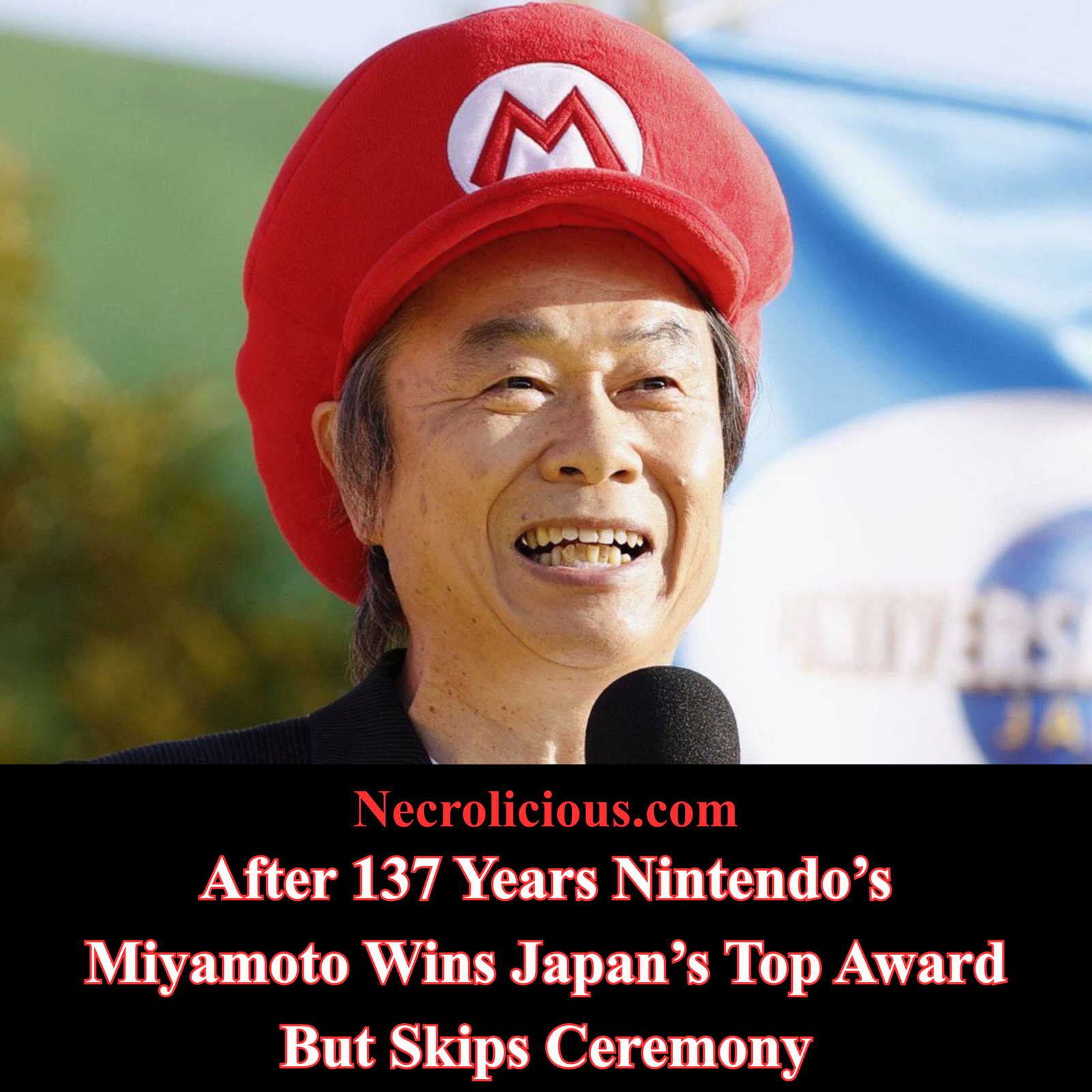
On 3 November 2026, Culture Day, Japan’s Emperor presented the Order of Culture at the Imperial Palace in Tokyo. Seven of the eight recipients attended the formal ceremony in the Matsu-no-Ma hall. Shigeru Miyamoto, Nintendo’s executive fellow & the first person from the video game industry to receive the honour, was absent. No official explanation has been issued by Miyamoto, Nintendo or the Imperial Household Agency. The award itself stands: Miyamoto remains one of the 2026 recipients, recognised for decades of work that helped establish interactive entertainment as a cultural form in Japan & beyond.
The Order of Culture, established in 1937, is Japan’s highest cultural distinction. It is conferred on individuals who have made remarkable contributions to the advancement of Japanese culture in fields such as art, literature, science & technology. Recipients are typically drawn from those previously named Persons of Cultural Merit. The presentation is a closed ceremony; members of the public do not attend. In 2026 the other recipients included Nobel chemistry laureate Kenso Soai, lighting designer Motoko Ishii, architect Toyo Ito, biologist Tsuneyoshi Kuroiwa, French literature scholar Tetsuya Shiokawa, composer Shunichi Tokura & immunologist Shigekazu Nagata. Miyamoto’s selection marked the first time the media arts category explicitly recognised gaming.
Nintendo’s Long Path from Hanafuda Cards to National Recognition
Nintendo was founded in 1889 in Kyoto by Fusajiro Yamauchi as a manufacturer of hanafuda playing cards. For much of the twentieth century the company produced traditional Japanese cards & later diversified into toys & arcade machines. The decisive shift into home video games came in the late 1970s, after Shigeru Miyamoto joined in 1977. Titles such as Donkey Kong, Super Mario Bros. & The Legend of Zelda established Nintendo as a global force & demonstrated that games could reach audiences across generations.
From the company’s founding to Miyamoto’s 2026 award is 137 years, not the roughly 200 years sometimes assumed. The gap is still substantial. During that period Japanese cultural institutions gradually expanded the categories considered worthy of the highest honours. Film director Akira Kurosawa received the Order of Culture in 1985. Manga artist Tetsuya Chiba became the first recipient from the manga field in 2024. No anime director has yet received the Order of Culture itself, although several, including Rintaro (Shigeyuki Hayashi), have been named Persons of Cultural Merit, a lower-tier recognition.
Miyamoto had already received the Person of Cultural Merit award in 2019, the first for anyone in the games industry. The 2026 elevation to the Order of Culture therefore represents a further step. In comments after the October announcement he emphasised collaboration: the work was not the achievement of one person but the result of many people over decades. He accepted the honour on their behalf. That stance is consistent with Nintendo’s long-standing public posture of shared creation rather than individual authorship.
What the Absence Does & Does Not Change
The decision not to attend the 3 November ceremony does not revoke or diminish the award. Official announcements from the Ministry of Education, Culture, Sports, Science & Technology list Miyamoto among the eight recipients. Contemporary reporting from Jiji Press, The Japan Times & Nippon.com notes the absence without attributing a cause. Possible explanations—scheduling, health or preference for a lower-profile reception—remain speculative. In the absence of a statement, the only verifiable fact is that he did not receive the medal in person from the Emperor on Culture Day.
This practical detail is useful for anyone tracking the event. The ceremony is not open to the public. Coverage comes from pooled press photographs of the seven attendees & from subsequent remarks by those present. Miyamoto’s earlier press conference in Kyoto on 22 October remains the primary public statement associated with the honour.
Broader Context & Practical Observations
The recognition arrives at a moment when games are consumed across three generations in many Japanese households. Miyamoto has noted this shift himself. Parents & grandparents who grew up with Nintendo systems now play with children, a demographic reality that strengthens the argument for treating interactive media as culture rather than mere entertainment. At the same time, the industry continues to face questions about labour practices, intellectual-property control & the balance between commercial success & artistic risk. An imperial honour does not resolve those issues; it simply registers that the medium has crossed a formal cultural threshold in Japan.
For readers interested in the longer arc, Nintendo’s evolution from 1889 card maker to global games publisher is documented in company histories & in Miyamoto’s own interviews. The 2019 Person of Cultural Merit award & the 2026 Order of Culture form two clear markers on that timeline. Comparable milestones in adjacent media include Chiba’s 2024 manga recognition & earlier film honours. Tracking these awards offers a concrete way to observe how Japanese institutions gradually incorporate newer forms.
The absence of an official reason for non-attendance is itself noteworthy. Japanese public figures & organisations often issue brief statements in such cases. The lack of one leaves the record incomplete on a minor but visible point. It does not, however, alter the fact of the award or the historical sequence that led to it.
Key Timeline Points
- 1889: Nintendo founded as a hanafuda card manufacturer
- 1977: Shigeru Miyamoto joins the company
- 1985: Akira Kurosawa receives the Order of Culture
- 2019: Miyamoto named Person of Cultural Merit (first from games)
- 2024: Tetsuya Chiba receives the Order of Culture (first from manga)
- 3 November 2026: Order of Culture ceremony; Miyamoto absent, award still conferred
FAQ
Is the Order of Culture ceremony open to the public?
No. It is a formal presentation by the Emperor at the Imperial Palace & is not open to the general public.
Did Miyamoto still receive the award?
Yes. He is listed among the official 2026 recipients. Only the in-person presentation on 3 November was missed.
Has any reason been given for his absence?
No official reason has been reported by Miyamoto, Nintendo or government sources.
How long has Nintendo existed?
The company was founded in 1889, 137 years before the 2026 award.
Have other interactive or popular media figures received the same honour?
Tetsuya Chiba (manga, 2024) is the clearest recent parallel. No anime director has received the Order of Culture itself.
This account draws on contemporaneous reporting from Jiji Press, The Japan Times & Nippon.com, together with the October government announcement of the 2026 recipients. It aims to separate verified facts from the speculation that inevitably surrounds a high-profile absence.
Unless otherwise noted, image assets above are NOT original content & are shared under fair use doctrine with NO claims to authorship or ownership.
Contact necrolicious@necrolicious.com for credit or removal.
This post was sponsored by…ME! If you’d like to support, please buy my original meme merchandise or check out my affiliate links to get yourself some other cool things. Additional affiliate links may be contained in the above article. If you click on an affiliate link & sign up/make a purchase, I may earn a commission. This does not increase the price you pay for the product or service, so it helps support this website at no cost to you.
If you would like to support my work more directly, I accept voluntary cryptocurrency donations in BTC, ETH, XRP & XLM sent directly to necrolicious.x. necrolicious.x is an Unstoppable Domains name that resolves to the wallet addresses I have configured. Simply enter necrolicious.x as the recipient in a supported wallet (such as Trust Wallet, Blockchain.com or others that support Unstoppable Domains). Donation Disclaimer: All cryptocurrency donations sent to me are final, voluntary gifts & are non-refundable & irreversible. These donations are not tax-deductible since I am not a registered charitable organization, & no tax receipts will be issued. No memo or destination tag is required for XRP or XLM donations, as the domain resolves directly to a wallet address. By sending a donation you acknowledge & accept all associated risks, including cryptocurrency price volatility, network fees & potential loss of funds due to incorrect network selection or transaction errors. I am not responsible or liable for any loss related to your donation. No goods, services or other benefits are provided in exchange for donations. This is not financial, tax, legal or investment advice. Please consult a qualified professional regarding any implications of your donation.