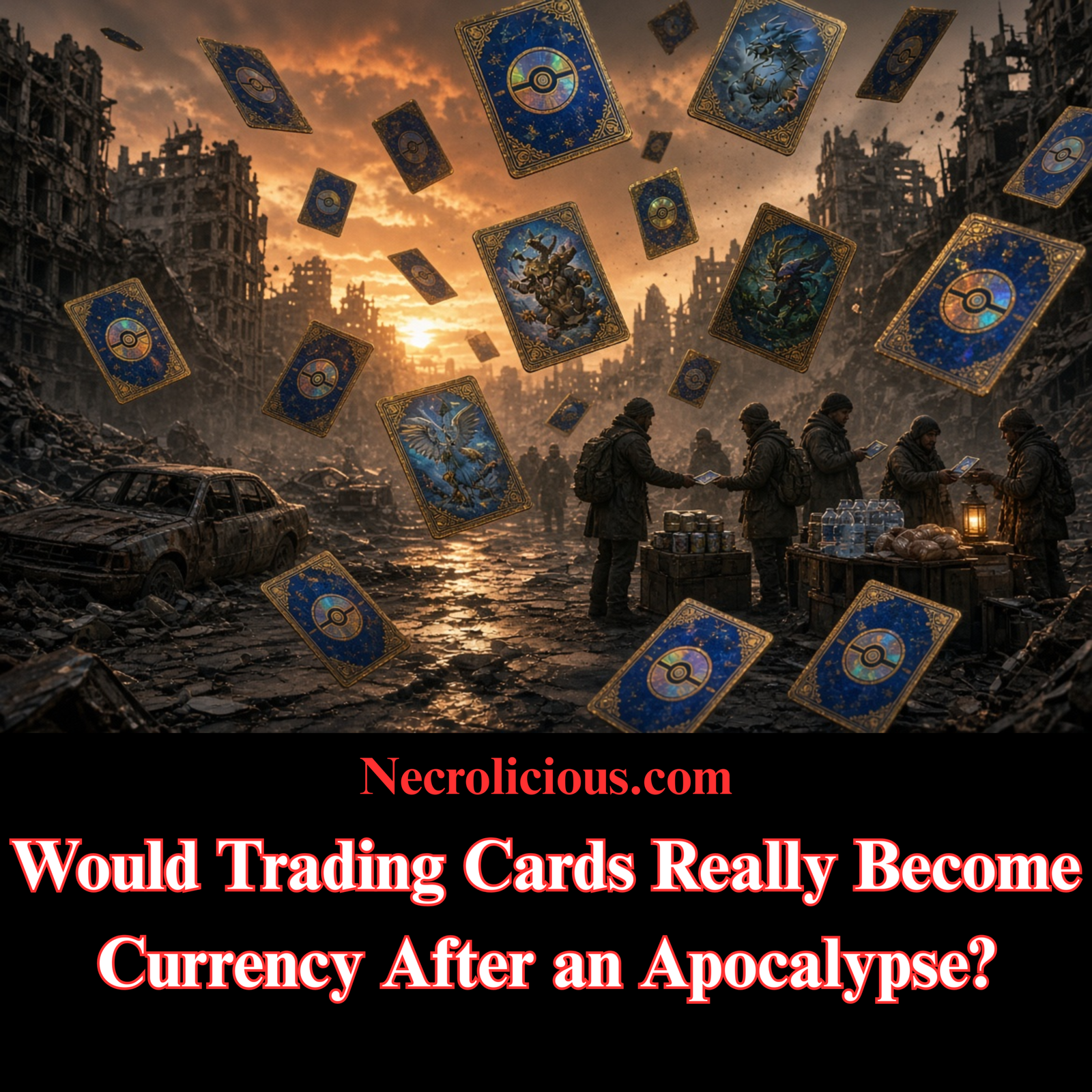
A venture capitalist told The Hollywood Reporter that if civilisation collapsed tomorrow, Pokémon cards would be the next day’s global currency. The line travelled quickly through gaming press because it sounds vivid. It also collapses two different ideas into one claim.
Cards can hold collector value after a shock. That is not the same as working as money at a till. This piece separates those functions, checks what Peter Levin actually said, then tests the grocery-store problem & the counterfeit problem that already exists while institutions are still standing.
What Levin Said — & What He Did Not Say
Peter Levin is founder of Griffin Gaming Partners, which manages over $1.6 billion in gaming assets. Levin himself is a trading card collector who claims to hold more than 500,000 cards. In the September 2026 interview he called Pokémon “a global phenomenon” & added that he was “absolutely convinced that if the world suffered an apocalypse tomorrow, the following day the global currency would be Pokémon cards.” He tied the remark to reported investment performance, including the claim that Pokémon cards have beaten the S&P 500 by about 3,000%.
That currency line was specific to Pokémon. Later in the same conversation he discussed other trading card games as market stories, not as post-collapse cash. He said Pokémon had created an “umbrella” under which Yu-Gi-Oh, Digimon & One Piece could expand. He described One Piece as growing faster than any card game in history, including Pokémon. He called Magic: The Gathering a Hasbro business approaching $2 billion a year.
Coverage that treats the apocalypse remark as a general TCG forecast overstates the quote. The colourful prediction attached to one franchise. The rest was industry commentary.
Store of Value Is Not the Same as Money
Economics textbooks still use a simple test. Money should store value, serve as a unit of account & work as a medium of exchange. Collectibles often manage the first task inside a specialist market. They usually fail the other two.
A first-edition holographic Charizard can sit in a safe as a scarce object people still recognise. That does not tell a shopkeeper how to price bread, milk & batteries in card units by lunchtime. The card’s price depends on set, language, print run, surface wear, centering & whether a grader once assigned a number. Those variables make a poor yardstick.
Anyone who has sorted bulk boxes knows the texture of this problem. Commons arrive by the thousand. Chase cards arrive as exceptions. The pile does not behave like identical coins. One scratched holofoil is not interchangeable with another copy that looks similar in a dim aisle. Condition is not a rounding error. It is the product.
Historical parallels are useful here. Rare stamps, art & numismatic coins have preserved wealth for some holders during inflation or political stress. They have rarely become the thing you spend for supper. Uniform bullion, cigarettes, fuel & food have done that work because they can be counted quickly & used up. Cards sit closer to art than to specie.
Japan’s own market already shows how far collectable paper can travel as an asset class without becoming cash. The domestic trading card sector’s expansion, theft risk & regulatory attention are documented in Japan’s $2.1B Trading Card Boom Sparks Regulation. Scarcity, grading & crime followed the prices. Tills did not start quoting Charizard.
Why the Grocery Checkout Does Not Work
Picture the practical sequence. A customer offers a slabbed card for a basket of staples. Staff must authenticate it, grade it by eye, convert it into a local price & make change. None of those steps is cheap when the lights are unreliable & the queue is hungry.
Divisibility is the next failure. You cannot cut a high-value card into tenths without destroying the premium. You cannot treat a pack of bulk Energy cards as tidy small change when nobody agrees they are worth a tin of fish. Liquidity concentrates at the top. The bottom of the print run is wallpaper.
Durability works against circulation. Money is meant to be handled. Pokémon cardboard is meant to stay flat. A week in a pocket would erase the finish that supports resale. Graded slabs delay that damage until someone cracks them, swaps the contents or copies the label.
The realistic collapse use is narrower. Two people who already collect might settle a large trade: a known rare for fuel, medicine or transport. That is barter among specialists. It is not a payment rail. Commons from mass retail would be nearly worthless as money. The scarce pieces would be too lumpy, too fragile & too disputed to circulate as daily cash.
The same prestige logic appears in other Japanese collector markets, where limited goods command attention without replacing currency. Department-store otaku merchandising follows scarcity & display, not till replacement, as outlined in Otaku Merchandise Sales Outperforming Traditional Luxury Brands in Japan’s High-End Department Stores.
Counterfeiting Is Already the Core Risk
Forgery would not arrive after the collapse. It is already the tax on this hobby.
Professional Sports Authenticator reported intercepting more than $200 million in fraudulent collectibles in 2025 & called the figure conservative. Counterfeit submissions rose as a share of the queue. Fake Pokémon cards submitted to PSA jumped 125% year over year. Trading card games accounted for more than half of the counterfeits the company recorded, with Pokémon leading the category. Altered cards rose as well. Those numbers capture only what reached a grading desk. Raw fakes on marketplaces sit outside that count.
The pattern is rational. High resale prices attract printers. Modern cards are paper, ink & foil. The tools to imitate them have improved. Community checks — light tests, texture, back-pattern comparison — still catch many poor copies. They do not scale to a panicked crowd making five-second decisions.
Remove the current defences & the problem worsens. No lab queue. No online population comparing print lines. No customs seizures. No civil courts for a bad trade. Demand for anything that “looks official” would rise just as verification collapsed. Trust would shrink to face-to-face circles. Outside those circles, cards would be treated as colourful paper.
Slabs would last a little longer as tokens of prior authentication. Then labels get copied. Inners get swapped. Alteration, already rising on Pokémon according to PSA, becomes easier when nobody can send the object back to a reference archive.
Crime has already followed value in ordinary times, from shop raids to reports of organised buying for overseas resale. A collapse would not civilise that incentive. It would strip away the remaining friction.
What Would Survive in Practice
Levin’s remark works as a comment on brand recognition. Pokémon is widely known across age groups & borders. Recognition can support a residual collector bid. Recognition is not acceptance at retail.
If cards kept purchasing power, it would likely look like this:
- Rare, widely recognised pieces used for occasional high-value settlement among people who can inspect them
- Sealed product treated as a bulky store of value, not as small change
- Graded slabs trusted only while the holder’s reputation lasts
- Commons & damaged copies discarded or reused as scrap
Other games Levin mentioned would follow the same logic. One Piece’s growth rate & Magic: The Gathering’s revenue matter to publishers today. They do not solve fungibility after institutions fail. Licensed crossovers & limited collabs can intensify collecting without creating a currency. Even a light promotional hook such as Yu-Gi-Oh’s Cup Noodle Instant Fusion collaboration shows how brands travel through everyday products while remaining merchandising, not money.
Long-running Japanese game intellectual property holds cultural weight for the same reason Pokémon does: memory, characters & repeat contact. That weight still does not turn a printed card into a unit of account. Durable franchises can outlast platforms, as seen when service titles close & older catalogues retain fans, including coverage such as Castlevania: Grimoire of Souls Ends Service on Apple Arcade. Survival of an IP is not the same as monetary function.
Practical Takeaways for Collectors
Treat the apocalypse line as rhetoric, then use the underlying market facts.
- Separate hobby value from spendability. A card can be scarce & still be a poor medium of exchange.
- Authentication skill matters more than slogans. Learn backs, texture & light behaviour on cards you actually own.
- Storage protects the only premium that exists. Circulation destroys it.
- Diversify scarce objects if the goal is shock insurance. Uniform goods & skills clear local markets faster than unique cardboard.
- Watch fraud data from graders as a leading indicator. Rising fake rates tell you where the money already is.
From handling cards as a collector & from building a small trading-card project, the tactile lesson is consistent. People will overpay for a story they recognise. They will not pause a food queue to debate print quality. Those instincts can coexist. They should not be merged into a single forecast.
FAQ
Did Peter Levin say Yu-Gi-Oh, One Piece & Magic: The Gathering would be apocalypse currency?
No. The currency sentence named Pokémon only. The other titles appeared later as growth examples.
Could Pokémon cards keep any value after a collapse?
Yes, inside a narrow circle of people who already collect & can inspect authenticity. That is residual demand, not a payment system.
Why not use common cards as small change?
Commons are plentiful, easy to copy & weakly desired. They fail as a unit of account once nobody agrees they buy a fixed basket of goods.
Is counterfeiting already serious?
Yes. PSA’s 2025 fraud reporting put intercepted fake & altered collectibles above $200 million, with Pokémon fakes up 125% year over year among submissions.
What historically works better as emergency exchange?
Items that are uniform, consumed & easy to count: food, fuel, ammunition in some settings, labour & widely recognised bullion. Unique collectables settle occasional large trades at best.
Unless otherwise noted, image assets above are NOT original content & are shared under fair use doctrine with NO claims to authorship or ownership.
Contact necrolicious@necrolicious.com for credit or removal.
This post was sponsored by…ME! If you’d like to support, please buy my original meme merchandise or check out my affiliate links to get yourself some other cool things. Additional affiliate links may be contained in the above article. If you click on an affiliate link & sign up/make a purchase, I may earn a commission. This does not increase the price you pay for the product or service, so it helps support this website at no cost to you.
If you would like to support my work more directly, I accept voluntary cryptocurrency donations in BTC, ETH, XRP & XLM sent directly to necrolicious.x. necrolicious.x is an Unstoppable Domains name that resolves to the wallet addresses I have configured. Simply enter necrolicious.x as the recipient in a supported wallet (such as Trust Wallet, Blockchain.com or others that support Unstoppable Domains). Donation Disclaimer: All cryptocurrency donations sent to me are final, voluntary gifts & are non-refundable & irreversible. These donations are not tax-deductible since I am not a registered charitable organization, & no tax receipts will be issued. No memo or destination tag is required for XRP or XLM donations, as the domain resolves directly to a wallet address. By sending a donation you acknowledge & accept all associated risks, including cryptocurrency price volatility, network fees & potential loss of funds due to incorrect network selection or transaction errors. I am not responsible or liable for any loss related to your donation. No goods, services or other benefits are provided in exchange for donations. This is not financial, tax, legal or investment advice. Please consult a qualified professional regarding any implications of your donation.