$250 Silver By End of 2025?

It’s been a while since I’ve posted about the Silver Squeeze & I think we’re long overdue for an update.

Faithful believers will be pleased to see that we have already achieved a year-to-date gain of over 80%, with much of it coming within the past couple of months.

However, as has been frequently noted, silver’s price action tends to mimic that of gold to a certain extent. Generally, gold moves higher, but silver lags, then eventually explodes higher to not only meet, but exceed, gold’s performance. With gold recently performing very well, first passing its all-time record high of about $2000 & then doubling that, surpassing $4000. As of right now, the price sits at about $4200 but has nearly hit the $4400 mark in recent days.

Silver has not yet reached a doubling of its all-time high. Therefore, if we can rely on its historical performance, we can not only expect it to double its current high of about $50, landing at about $100, but that would only amount to half of what gold has done. Therefore, many are calling for a jump even higher to $150 or $200.

This would not only meet historical precedent for performance but land us at what many call an inflation-adjusted equivalent to the approximately $50 price that it reached in 1980.

As Mike Maloney has said, if we were to compare current pricing to 1980 pricing, even at around $50, silver is only equivalent to about $12 in 1980 USD.

So when will this happen? When will we finally get the long-awaited revaluation? An increasing number of voices from the finance world are calling for this jump as soon as within the remainder of this year.

With only about two months left in 2025, that means we can reasonably expect a profound move within the span of the next approximately nine weeks.

Further rate cuts (the next of which is expected on October 29th) from America’s Federal Reserve Bank, which have help propel us to the current price will certainly help further upward price action, but while will likely shoot the price higher into the stratosphere will be a failure of delivery, likely out of London.

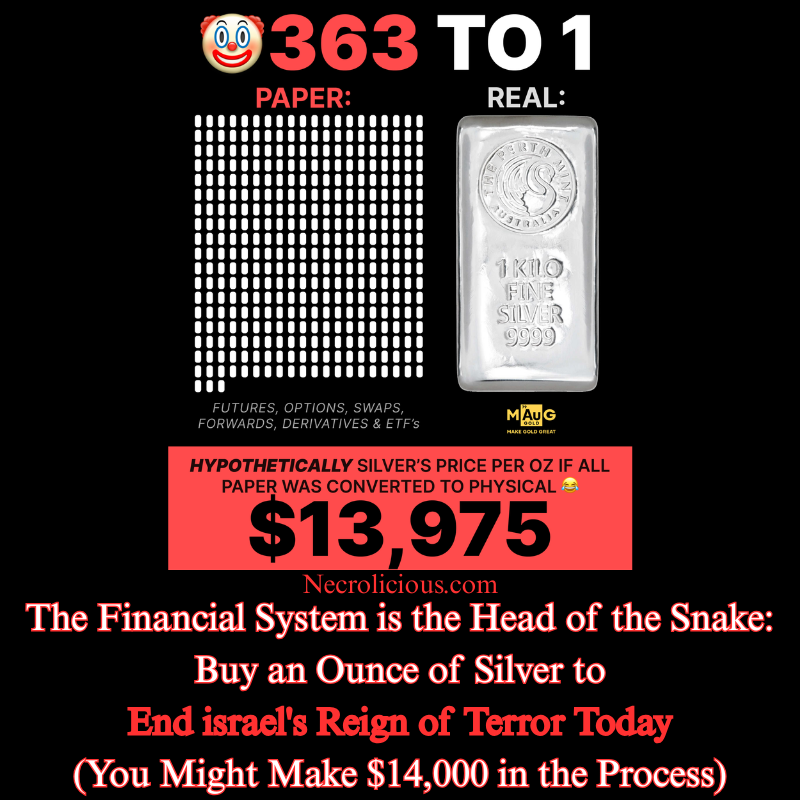
What does failure of delivery mean? Silver is traded not physically but in futures contracts. However, it has come to a point where nearly 400 contracts are being distributed to buyers for every one ounce of silver that physically exists in inventory. An increasing number of people are growing wise to this & requesting physical delivery so that they don’t get left being a bag holder. Persistent “backwardation” serves as a testament to this.

This means that this paper game can no longer continue, as inventory simply will not allow it. When more & more people are refusing contractual silver & want delivery of real, physical silver, they simply do not want the risk of trading paper. It is said that the LBMA is not only empty but that they are flying to China to load up on silver there in order to replenish as much as they can of their dwindling physical supply, to little avail.

However, it is said that China has shut down retail physical sales for the most part, with only silver priced above $128 being available for purchase at all.

Londoners must be exceptionally desperate to be paying over double the spot price in China to replenish their supply to continue the illusion of solvency. I suppose merely paying a little over double spot price is a much better deal than paying at a truly adjusted ratio of 400 times the current spot price.

In their desperation, they are attracting all sorts of attention. What previously worked when nobody was looking is instead raising eyebrows & wallets to drain all of the physical silver possible as fast as possible to not only profit from this but to survive through impending the financial implications.

Long lines to buy silver & gold are seen throughout

China,

India,

Vietnam,

Singapore,

& Australia for retail buyers of bullion.

The lines exist in Japan as well, but due to the orderly nature of things, they are better hidden here than elsewhere. For example, when you go to Ginza Tanaka, you are issued a ticket & told to come back in a certain number of hours. Therefore, the lines are not so much seen running outside of the door & down the block, but if this orderly system was not in place, you certainly would see such a thing.

But cracks are showing by numerous online retailers selling out or halting sales.

It can also be said that the predicted price of $150 to $200 might be extremely conservative. I have written on this before, but to recapture the essence, I will briefly explain it again. Whilst it is true that silver has been trading at a ratio of 400 paper contracts to one ounce of silver, merely adjusting the price up 400 times does not give you the true price. The reason for this is silver has throughout history been priced comparatively to gold. However, gold is also manipulated in the same way, with approximately 130 contracts being traded for every one ounce owned. Therefore, it makes sense to first look at an adjustment to the gold price & then look at the gold-to-silver ratio to determine silver’s real price. If we were to do that here, we need to multiply gold’s approximately $4400 price by 130 times. Then we would look at the historical average of silver-to-gold ratios, which brings us to 7 to 1.

In other words, for every one ounce of gold, it takes seven ounces of silver to be of equivalent value. But even that is not adequate because we can only look at above-ground silver. While more silver exists in the earth, from the time a mine is found to the time it becomes operational can be upwards of 10 years. With silver having a running deficit of approximately 200 million ounces every year for the past five years with no immediate relief in sight, this has driven the amount of above-ground silver to be equivalent to a one-to-one ratio with gold.

As more & more industries, including the technology sector, military sector, pharmaceutical sector, etc. all require an extreme amount of silver just to remain operational, given all these contributing factors, seeing silver truly revalued thousands of times over to a price in the thousands or even tens of thousands is not out of the realm of possibility. The paper contract games have served the Comex & its counterparts well for as long as they were able to keep them hidden, but those days are over, & the true price of silver could make itself apparent by the end of the year.

I’m not a financial advisor & this is not financial advice, I’m just heavily invested in silver.

If you want to start investing in precious metals & want a FREE half-ounce of silver, sign up for Kinesis using my link!

Share this:

What is the #Silversqueeze?

The Silver Squeeze (#silversqueeze) is heating up again, with prices now closing in on $40 (approximately 6,000 yen)/per ounce. However, since many people are unaware of what the Silver Squeeze is let alone how to profit from it, I continue to seek new and better ways to explain it so everyone can profit together.

Financial expert Michael Maloney has significantly simplified the concept in a video he posted back in March.

I have also translated this video into Japanese with the help of AI.

In the video, Maloney explains that a short squeeze occurs when entities & individuals borrow silver ETFs with the expectation that the price of silver will drop. They sell the shares they borrow, planning to buy back the shares at a lower price before returning them, so they can profit from the difference. This practice suppresses the true price of silver because they are trading silver contracts for which no physical silver exists. Currently, the COMEX allows approximately 400 paper contracts for every one ounce of physical silver they hold. Furthermore, each of those 400 contracts can also be leveraged up to 100 times–meaning the true value of silver is somewhere between 400x-4000x the current price. However, many individuals &, more importantly, entire nations within the BRICS bloc, have identified this scam & are calling the bluff. They are buying up all of the physical silver supply. Since there is not enough physical silver to back the ETF contracts, this action breaks the scam of the entities leveraging the criminally lax policies of the COMEX. It paves the way for true price discovery. The price of silver has been suppressed since the Coinage Act of 1873. Therefore, when true price discovery occurs, silver may jump in price anywhere between $1,200 per ounce to $12 million per ounce. Even by the lowest estimates, these are astronomical numbers, considering the current price is still under $40. With profit potential this massive, it can only be compared to buying Bitcoin when it was first released.

Step-by-Step Guide to Short Selling

Short selling is a trading strategy where an investor sells a security they do not own, with the expectation that its price will decline, allowing them to buy it back at a lower price to return to the lender and pocket the difference. Here’s how it works:

  1. Identify a Security to Short:
    • The investor identifies a security (e.g., a stock or, in this case, silver ETFs) that they believe will decrease in value. This could be based on fundamental analysis, technical indicators, or market sentiment.
  2. Borrow the Security:
    • The investor borrows the security from a broker or another investor who owns it. This borrowing is typically facilitated through a margin account, which allows the investor to borrow securities against the value of other assets in their account.
    • The broker will charge a fee or interest for lending the security, and the investor must maintain a certain level of margin (collateral) in their account.
  3. Sell the Borrowed Security:
    • The investor immediately sells the borrowed security on the open market at the current market price. This sale generates cash, which is held by the broker as collateral.
  4. Wait for the Price to Drop:
    • The investor waits for the price of the security to decline, as anticipated. During this period, they monitor the market and may use stop-loss orders or other risk management tools to limit potential losses if the price moves against them.
  5. Buy Back the Security (Cover the Short):
    • Once the price has dropped to a level the investor finds favorable, they buy back the same amount of the security they sold. This is known as “covering” the short position.
    • The investor returns the borrowed securities to the lender, and the difference between the sale price and the buyback price (minus borrowing fees and interest) is their profit.
  6. Return the Security:
    • The investor returns the exact number of shares (or units of the security) to the broker or lender, closing out the short position.

Example:

  • Suppose an investor shorts 100 shares of a silver ETF at $40 per share, receiving $4,000.
  • If the price drops to $30 per share, they buy back 100 shares for $3,000.
  • They return the 100 shares to the lender and keep the $1,000 difference as profit (minus any fees).

Risks of Short Selling:

  • Unlimited Losses: Unlike buying a security (where the maximum loss is the initial investment), short selling has theoretically unlimited loss potential because there is no cap on how high the price can rise.
  • Margin Calls: If the price of the security rises significantly, the investor may face a margin call, requiring them to deposit additional funds or close the position at a loss.
  • Short Squeeze Risk: If the price rises sharply, the investor may be forced to buy back the security at a higher price, leading to substantial losses.

Step-by-Step Guide to a Short Squeeze

A short squeeze occurs when the price of a heavily shorted security rises sharply, forcing short sellers to buy back the security to cover their positions, which in turn drives the price even higher. Here’s how it unfolds:

  1. Heavy Short Interest:
    • A security (e.g., silver ETFs) has a high number of shares sold short, meaning many investors are betting on a price decline. This creates a large short interest ratio, indicating that a significant portion of the float (shares available for trading) is shorted.
  2. Price Begins to Rise:
    • For various reasons (e.g., increased demand, positive news, or coordinated buying by long investors), the price of the security starts to rise. This could be due to fundamental factors, market manipulation, or a combination of both.
  3. Short Sellers Face Losses:
    • As the price rises, short sellers begin to incur losses because they must buy back the security at a higher price than they sold it for. This creates pressure on them to cover their positions to limit further losses.
  4. Covering Positions Drives Price Higher:
    • To cover their short positions, short sellers must buy back the security on the open market. This buying activity increases demand, which further drives up the price. This creates a feedback loop where the rising price forces more short sellers to cover, exacerbating the price increase.
  5. Panic Buying and Exponential Price Increase:
    • As more short sellers rush to cover their positions, the demand spike can lead to an exponential increase in the price. This is the essence of a short squeeze, where the price can rise dramatically in a short period.
  6. Long Investors Profit:
    • Investors who anticipated the short squeeze (often called “long squeezers”) benefit from the price increase. They may have bought the security at a lower price and are now selling at a much higher price, realizing significant profits.

Example:

  • Suppose 50% of a silver ETF’s float is shorted, and the price is $40 per share.
  • A group of investors (e.g., BRICS nations or retail investors) starts buying physical silver en masse, pushing the price to $45.
  • Short sellers, facing losses, begin to cover by buying back shares, which pushes the price to $50.
  • The increased demand from covering short positions continues to drive the price higher, potentially reaching $60 or more, causing severe losses for short sellers and massive gains for long investors.

How a Short Squeeze Breaks Short Selling (i.e. The Goal of the #Silversqueeze Movement)

  1. Forced Buy-Back to Exit with a Massive Short Position and Severe Supply Shortage:
    • Short sellers must return the borrowed securities to the lender by buying back the exact number of contracts they sold short. In the case of silver, the total short position is a staggering 882 million ounces, as reported in the COT (Commitments of Traders) data from July 8, 2025. However, the critical issue is the extreme imbalance between paper contracts and physical supply: the COMEX currently allows approximately 400 paper contracts for every one ounce of physical silver, meaning there is only enough silver inventory to fulfill 1 in 400 contracts, possibly only 1 in 4000 contracts.
    • To exit their positions, short sellers must purchase these 882 million ounces on the open market. With only a fraction of this amount (approximately 2.205 million ounces of physical silver available if we assume 882 million ÷ 400 = 2.205 million ounces of backing), the demand triggered by a short squeeze far exceeds the available supply. At the current price of approximately $40 per ounce, the theoretical cost to buy back 882 million ounces is $35.28 billion. If the squeeze drives the price to $60 per ounce due to the supply shortage, the cost would rise to $52.92 billion, resulting in potential losses of $17.64 billion for short sellers who sold at the lower price. This lack of physical silver to meet the demand makes the buy-back process catastrophic, breaking the short selling strategy.
  2. Loss of Control Over Exit Timing and Price Due to Supply Constraints:
    • Normally, short sellers can choose when to buy back the securities based on their market analysis. However, with only 1 in 400 contracts backed by physical silver, a short squeeze triggers a rapid price increase as demand outstrips the minuscule 2.205 million ounces of available inventory. This forces short sellers to act quickly to limit losses, stripping them of control over the timing and price of the buy-back.
    • Margin calls become inevitable as the value of the shorted contracts soars, compelling short sellers to buy back at exorbitant prices in a market where physical silver is virtually unobtainable.
  3. Increased Demand from Covering Positions Exacerbated by Supply Shortage:
    • As short sellers rush to buy back the 882 million ounces to exit their positions, their buying activity collides with a market where only about 2.205 million ounces of physical silver can theoretically back the contracts. This demand surge, far exceeding the available supply, drives the price exponentially higher, creating a feedback loop that intensifies the squeeze. The more short sellers attempt to cover, the more they contribute to the price increase, making it nearly impossible to exit without massive losses.
  4. Exponential Losses Due to Price Escalation and Supply Scarcity:
    • The necessity to buy back at higher prices, compounded by the lack of physical silver, results in exponential losses. For example, if a short seller sold contracts representing 100,000 ounces at $40 per ounce and the price rises to $60 due to the squeeze and supply shortage, they must buy back those 100,000 ounces at $60 each, incurring a $2 million loss. Scaled to the 882 million ounces, with only 2.205 million ounces available, the losses could escalate to billions as prices could theoretically soar to hundreds or thousands of dollars per ounce in a full squeeze scenario.
  5. Market Manipulation and Coordinated Buying Amplify the Supply Crisis:
    • Coordinated buying by long investors, such as nations within the BRICS block demanding physical delivery, intensifies the squeeze by further depleting the already scant 2.205 million ounces of physical silver. This makes it nearly impossible for short sellers to source the 882 million ounces needed to exit, exposing the scam of leveraging 400:1 paper contracts and forcing buy-backs in a market with no adequate supply.
  6. True Price Discovery and Long-Term Impact Driven by Supply Reality:
    • The short squeeze leads to true price discovery, where the market price reflects the actual supply (a mere 2.205 million ounces against 882 million ounces of short interest) and demand dynamics, rather than being suppressed by short selling activities. For short sellers, this means their strategy of betting on a price decline is obliterated, as the market corrects to a valuation reflecting the severe supply shortage.
    • The long-term impact is a potential deterrent for short sellers in markets with such a dramatic imbalance, especially as the physical silver shortage becomes undeniable.

Comparison and Connection

  • Short Selling vs. Short Squeeze: Short selling is a strategy to profit from a price decline, while a short squeeze is a market phenomenon that occurs when the price rises sharply, undermining the short selling strategy. The short squeeze breaks short selling by forcing short sellers to act against their original plan, often at great financial cost.
  • Silver Specifics: In the context of silver, the short squeeze is particularly impactful because of the high ratio of paper contracts to physical silver (400:1 on the COMEX). When investors demand physical delivery, it exposes the lack of physical silver, triggering a squeeze that can lead to exponential price increases.
  • Historical Context: The suppression of silver prices since the Coinage Act of 1873 sets the stage for a potential massive price jump during a squeeze, similar to early Bitcoin adoption, where early investors saw exponential returns due to underestimated value and growing demand.

TLDR

In poker terms, short sellers are bluffing & silver investors are calling the short sellers’ bluff.
When the short sellers lose, silver will be repriced between 400-4000 times the current price.

I’m not a financial advisor & this is not financial advice, I’m just heavily invested in silver.

If you want to start investing in precious metals & want a FREE half-ounce of silver, sign up for Kinesis using my link!

Share this:

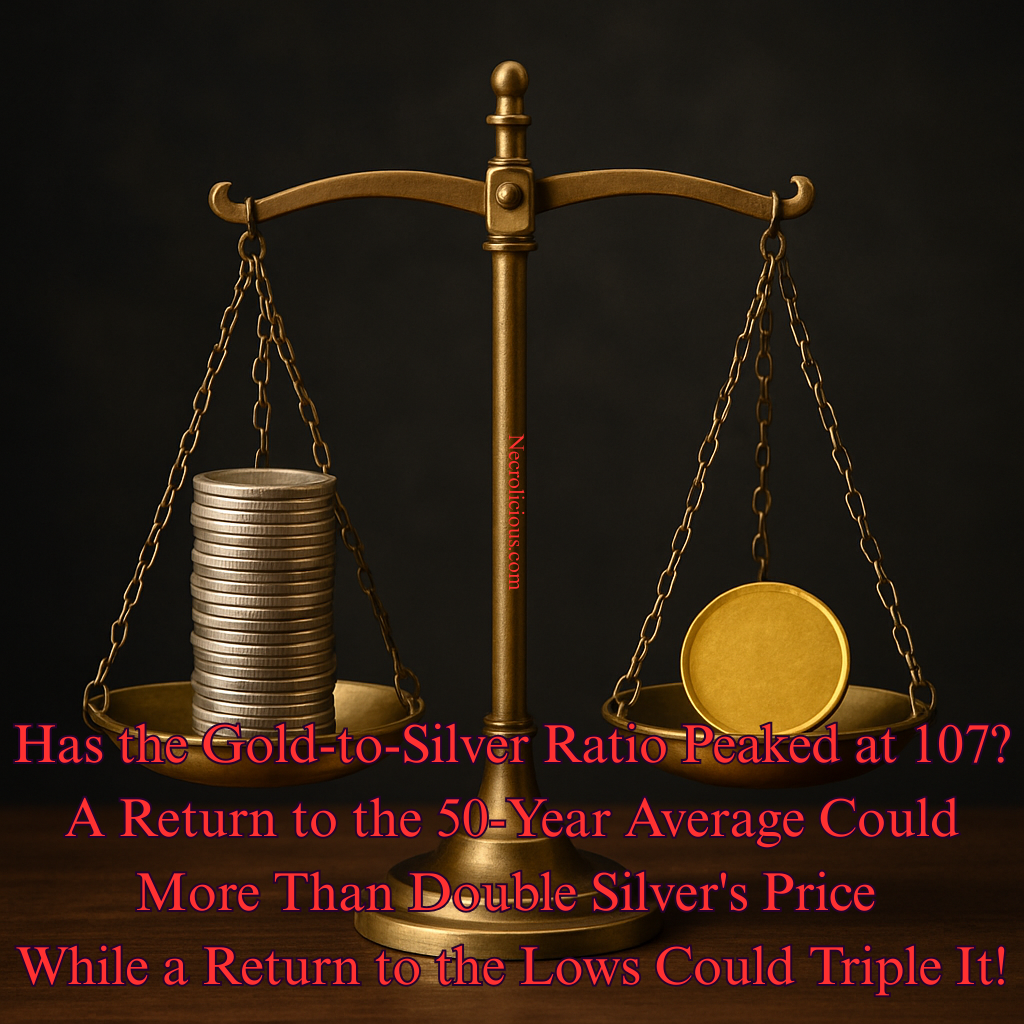
Has the Gold-to-Silver Ratio Peaked at 107? A Return to the 50-Year Average Could More Than Double Silver’s Price While a Return to the Lows Could Triple It!

Recently, the gold-to-silver ratio has hovered between 100 and 107 ounces of silver equaling the cost of one ounce of gold. However, data from the past 50 years shows that the average ratio is significantly lower, lingering in the low 50s. A return to this average could more than double silver’s price.

Delving deeper, the ratio’s most recent low was in 2011, at just 32 ounces of silver equaling one ounce of gold. A return to this level would mean approximately a tripling of silver’s current price. Moreover, historical analysis beyond the past 50 years shows that the gold-to-silver ratio has varied between 2:1 and 15:1, averaging around 7:1. Current mining ratios align with this, as 7 ounces of silver are mined for every 1 ounce of gold.

Additional arguments highlight silver’s unique dynamics. While gold is primarily stored in vaults, silver is consumed in various industries, including medicinal, energy (solar and battery technologies), coinage, and jewelry. Some believe the real gold-to-silver ratio could be as low as 1:1, awaiting price discovery and revaluation based on inflation, scarcity as well as other factors.

All these logistics suggest silver may represent one of the safest investment opportunities. For reference, here are charts based on today’s prices can illustrate potential silver prices if the gold-to-silver ratio reverts to historical averages or even approaches a 1:1 valuation against gold. Note that even the 85-1 ratio. currently exceeds the spot price as of this writing. In my non-professional opinion, this is further indication of silver’s unnatural price manipulation, which cannot continue infinitely for a commodity with a finite supply & average annual deficits of nearly 200 million ounces for the past 5 years running.

USD

Gold-to-Silver RatioSilver Price ($ per troy ounce)
103:1$32.36
75:1$44.44
60:1$55.55
50:1$66.66
40:1$83.33
30:1$111.10
20:1$166.65
10:1$333.30
1:1$3,333.00

JPY

Gold-to-Silver RatioSilver Price (JPY per troy ounce)
103:14,628.40
75:16,355.99
60:17,944.99
50:19,533.99
40:111,917.49
30:115,889.99
20:123,834.98
10:147,669.96
1:1476,699.59

I’m not a financial advisor & this is not financial advice, I’m just heavily invested in silver.

If you want to start investing in precious metals & want a FREE half-ounce of silver, sign up for Kinesis using my link!

Share this:

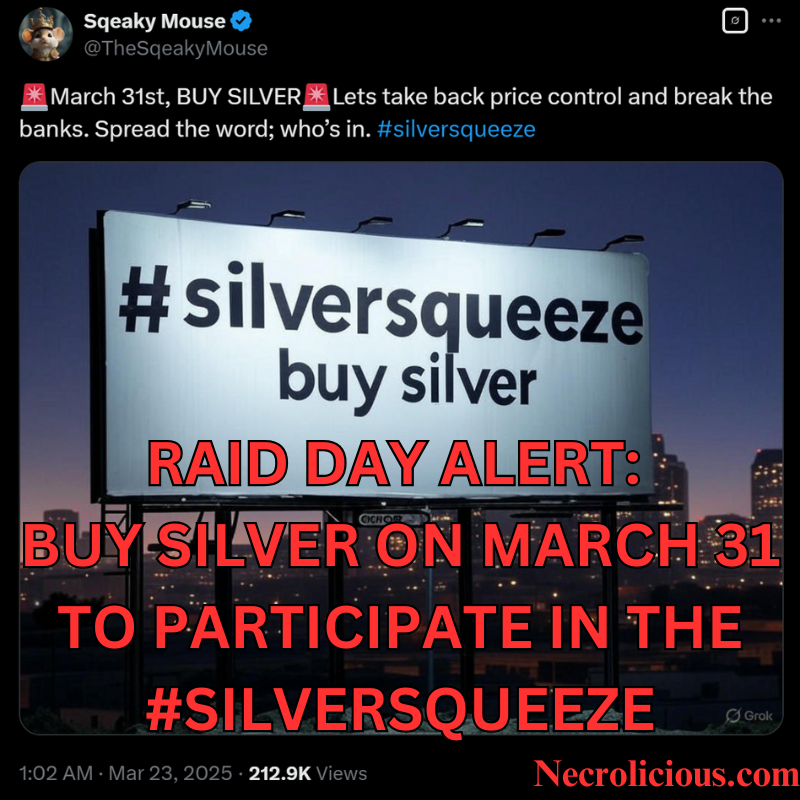
Mark Your Calendars: The Next #SilverSqueeze Raid Day is March 31, 2025

A striking post on X by user @TheSqeakyMouse reignited a financial movement that first gained traction in 2021: the #SilverSqueeze. The post called for a coordinated effort to “take back price control & break the banks” by buying silver on 31 March. The message quickly garnered attention, sparking replies from users pledging to join the movement, with many committing to purchase physical silver in significant quantities. But what exactly is the #SilverSqueeze, & why is it making waves again in 2025? Let’s delve into the history, motivations, & potential implications of this movement for investors & the silver market.

The #SilverSqueeze movement initially emerged in early 2021, following the infamous GameStop short squeeze orchestrated by Reddit’s r/WallStreetBets community. As detailed in a post from r/SilverSqueeze on 16 February 2021, the aim was to target the silver market, which many believed to be manipulated by large financial institutions through short positions. The strategy was simple yet ambitious: encourage retail investors to buy physical silver—whether coins, bars, or silver-backed ETFs—to drive up demand & force a short squeeze. This scenario would compel short-sellers to repurchase silver at inflated prices to cover their positions. The movement gained traction on platforms like Reddit, Twitter, & TikTok, with users sharing images of their silver purchases & rallying others to join.

Fast forward to 2025, & @TheSqeakyMouse’s post suggests the #SilverSqueeze is far from over. The billboard image shared in the post—representing a powerful visual of grassroots activism—underscores the movement’s persistence. Replies to the post indicate growing momentum.

@TheSqeakyMouse emphasised the importance of focusing on physical silver, stressing the value of tangible investments over paper assets like ETFs or stocks. This focus aligns with the original ethos of the 2021 movement, as physical purchases directly influence supply & demand dynamics in a way that paper trades often fail to achieve.

Silver’s market dynamics make it an ideal candidate for such a movement. According to a 2024 report from Sprott, the global silver market is relatively small, valued at approximately $30 billion annually—dwarfed by larger commodities like gold or copper. This smaller market size allows even modest shifts in demand to result in significant price volatility. The report also highlighted that global silver demand in 2024 was projected to reach 1.21 billion ounces, marking the second-highest level on record, driven by industrial applications in green technologies like solar panels & heightened investment interest amidst economic uncertainty. Yet, supply struggled to keep pace, with inventory depletion on exchanges such as the London Bullion Market Association (LBMA) signalling potential price increases.

Historically, silver has been a volatile asset. Hero Bullion notes that silver prices have ranged from a low of $5.84 to a high of $49.45, with significant crashes, such as the 2013 drop from $27 to $18 per ounce. However, as Blackwell Global points out, silver’s dual role as both an industrial metal & a safe-haven investment makes it sensitive to a broad array of factors, including geopolitical tensions, regulatory changes, & the gold-silver ratio—a metric traders use to gauge relative value. In 2024, silver’s price trends continued to reflect this volatility, with Live Mint reporting a price of ₹77,800/kg in Delhi on 31 March 2024—a slight uptick that might foreshadow further movement if the #SilverSqueeze gains traction.

What does this mean for investors in 2025? The #SilverSqueeze taps into a broader sentiment of distrust towards financial institutions, echoing the anti-establishment fervour of the 2021 GameStop saga. For those considering participation, the emphasis on physical silver offers a tangible way to engage, though it also carries risks. Silver’s inherent volatility presents opportunities for gains but equally leaves room for dramatic price swings.

The #SilverSqueeze is more than just a financial strategy—it represents a call to action for retail investors to challenge the status quo. Whether it will succeed in “breaking the banks” remains uncertain, but as 31 March 2025 approaches, the silver market may be bracing for a turbulent ride. Are you ready to join the squeeze?

I’m not a financial advisor & this is not financial advice, I’m just heavily invested in silver.

If you want to start investing in precious metals & want a FREE half-ounce of silver, sign up for Kinesis using my link!

Share this:

Why Silver, Not Gold

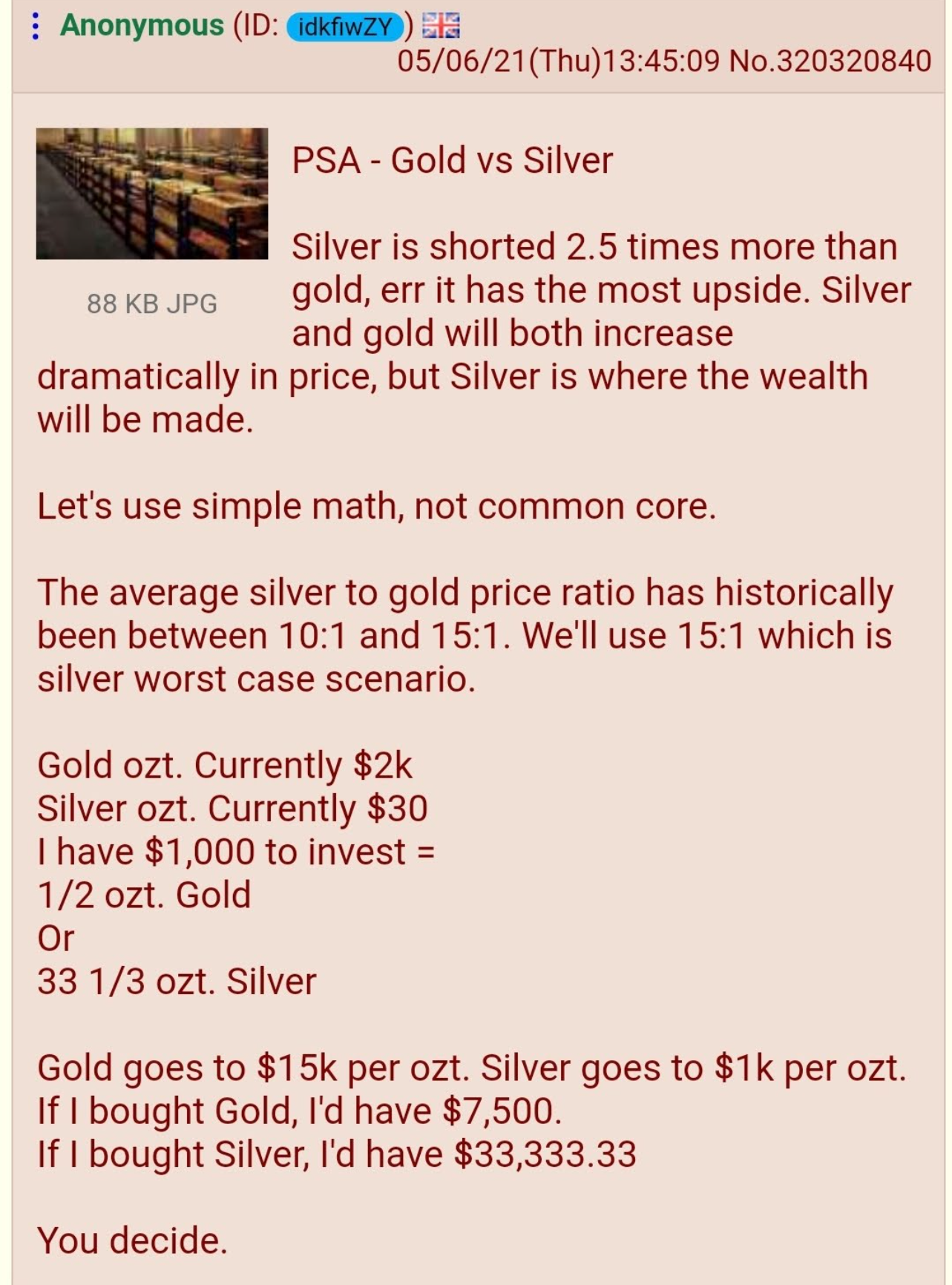
As suggested by the cover image, this is a copypasta that has been floating around the internet for a number of years. So far, no writer has come forth to claim authorship/ownership, however, what is contained here is so important that I find myself searching for it on the Internet time & time again, so I am copying it here on my own site for my own convenience as much as anyone else’s. Note that the pricing figures presented here are from 2021, so gold has already seen an increase of about 50%!

PSA – Gold vs Silver


Silver is shorted 2.5 times more than gold, err it has the most upside. Silver and gold will both increase dramatically in price, but Silver is where the wealth will be made.

Let’s use simple math, not common core.

The average silver to gold price ratio has historically been between 10:1 and 15:1. We’ll use 15:1 which is silver worst case scenario.

Gold ozt. Currently $2k
Silver ozt. Currently $30

I have $1,000 to invest =

1/2 ozt. Gold
Or
33 1/3 ozt. Silver

Gold goes to $15k per ozt. Silver goes to $1k per ozt.


If I bought Gold, I’d have $7,500
If I bought Silver, Il’d have $33,333.33

You decide.

I’m not a financial advisor & this is not financial advice, I’m just heavily invested in silver.

If you want to start investing in precious metals & want a FREE half-ounce of silver, sign up for Kinesis using my link!

Share this:

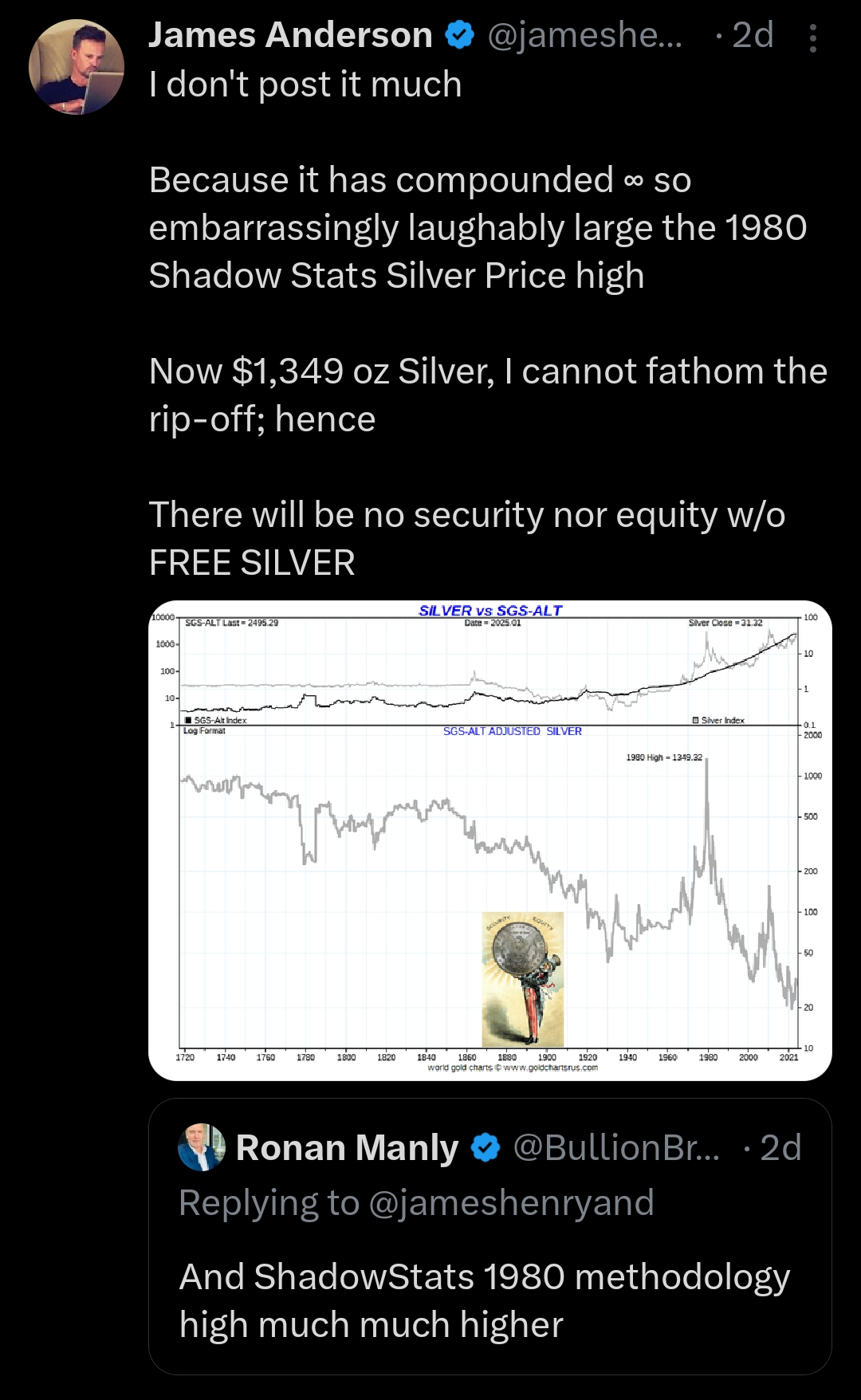
Adjusted for Real Inflation, 1 Ounce of Silver Should Now Cost $1349 Hints SD Bullion’s James Anderson

In a recent post on X, James Anderson of the popular American precious metal dealer SD Bullion continued the trend of highlighting both price manipulation of the current market & presenting the opportunity for retail investors to capitalise on it before an inevitable critical revaluation of the precious metals sector takes place.

What is ShadowStats?

ShadowStats is a website created by economist John Williams that provides alternative analyses of U.S. government economic statistics. Williams contends that more recent changes in government reporting methods over the years have been made to intentionally obfuscate & underreport real statistics of inflation/other economic issues. The site offers a return to the pre-manipulation methodologies to reveal key economic indicators like inflation, unemployment, GDP, etc. This is what Anderson referenced when making his statement.

Are Calls for $1300 Silver a New Normal?

This price actually reflects the writings of Echo, which I previously commented on, but who now seems to be banned from X. He wrote that the real price of silver is between $1,200 to $1,200,000, so while it’s on the low end, the price Anderson calls out is congruent with this.

What is the Gold-Silver Ratio (GSR)?

The Gold-Silver Ratio (GSR) is a measure used to determine the relative value of gold to silver. It’s calculated by dividing the current price of gold by the current price of silver. The ratio indicates how many ounces of silver are needed to purchase one ounce of gold. Historically, the GSR has averaged about 7 ounces of silver to 1 ounce of gold. 7:1 is also the current mining ratio in 2025. However, gold is now about $2900 per ounce & the price of silver is $32 per ounce. so the GSR has been floating around 90:1, which is outrageous. Ignoring all inflation, a price adjustment for silver just based on current mining ratios alone means that it should cost, at a minimum, $414/ounce–14x its current price.

Is Silver the Investment Opportunity of a Lifetime?

With current silver prices hovering around $32/ounce as of this writing, an adjustment to $1349/ounce presents a potential return of about 42x any initial investment. The low entry of just $32 means that pretty much anyone can get into silver at these prices. but with supply deficits in the hundreds of millions of ounces & industrial as well as military demands being prioritised, retail sales of silver bullion may become unsustainable to the point of outright unavailability soon.

I’m not a financial advisor & this is not financial advice, I’m just heavily invested in silver.

If you want to start investing in precious metals & want a FREE half-ounce of silver, sign up for Kinesis using my link!

Share this:

With New 25% Tariffs Going Into Effect Monday, Is This the Best Weekend Ever to Buy Silver?

United States President Trump announced 25% tariffs on Canadian & Mexican imports. The US imports significant amounts of silver from Mexico & Canada, which could be directly impacted by these tariff, potentially decreasing supply & increasing pricing. Those who buy silver & gold during the weekend market closure, could potentially see a 25% gain on their investment when market trading hours resume on Monday.

Understanding the Silver Squeeze Movement & the Impact of Tariffs

In recent times, the #silversqueeze movement has caught the attention of investors & enthusiasts alike, sparking a surge in interest around silver as an investment. But what exactly is this movement, & how does it intertwine with the recent news about a potential 25% tariff on silver imports into the US? Let’s dive into this fascinating topic in a way that’s easy to grasp.

What is the Silver Squeeze Movement?

The #silversqueeze movement refers to a grassroots effort by investors to increase the price of silver by buying physical silver in bulk. The idea is to create a “squeeze” on silver’s availability, forcing those with short positions (who have bet that the price will go down) to buy back at higher prices, thus driving the price up even further. This movement gained traction through social media platforms like X, where users share updates, strategies, & insights on silver investments.

The movement isn’t just about making a profit; it’s also seen as a way to challenge the traditional financial institutions that have historically influenced silver prices. By reducing the available supply of silver for industrial use & investment, enthusiasts hope to demonstrate the power of collective action in the commodities market.

Impact of a 25% Tariff on Silver Imports

Now, let’s talk about the recent development that could add fuel to the silver squeeze fire: a proposed 25% tariff on silver imports into the US. Silver imports are significant for the US, with around 150 million ounces coming in each year, primarily from Mexico & Canada. A tariff would mean that importers would have to pay an additional 25% on these imports, which would inevitably increase the cost of silver within the US market.

This tariff could have several implications:

  1. Increased Silver Prices: The added cost of tariffs would likely lead to higher prices for silver in the US as importers pass on the extra cost to consumers. This could make the #silversqueeze strategy even more effective by naturally reducing the supply of affordable silver.
  2. Safe-Haven Appeal: Silver, like gold, is often considered a safe-haven asset during times of economic uncertainty. Tariffs could create economic turbulence, pushing investors towards silver as a hedge against inflation or market volatility, further driving demand & prices up.
  3. Supply Chain Disruptions: With tariffs, the supply of silver might become less predictable, affecting industries that rely on silver for electronics, medicine, solar panels, & jewelry. This could lead to a short-term squeeze on supply, aligning with the goals of the #silversqueeze movement.

The #silversqueeze movement combined with the new tariff on silver imports presents a unique scenario for the silver market. Investors are watching closely as these dynamics could significantly alter silver’s price & availability. Whether you’re a seasoned investor or new to the silver market, understanding these trends is crucial. Keep an eye on the movement & the tariff developments, as they could offer both opportunities & challenges in the world of silver investment.

I’m not a financial advisor & this is not financial advice, I’m just heavily invested in silver.

If you want to start investing in precious metals & want a FREE half-ounce of silver, sign up for Kinesis using my link!

Share this:

Evidence of Dwindling Silver Supply Called Out by Scottsdale Mint Founder & CEO

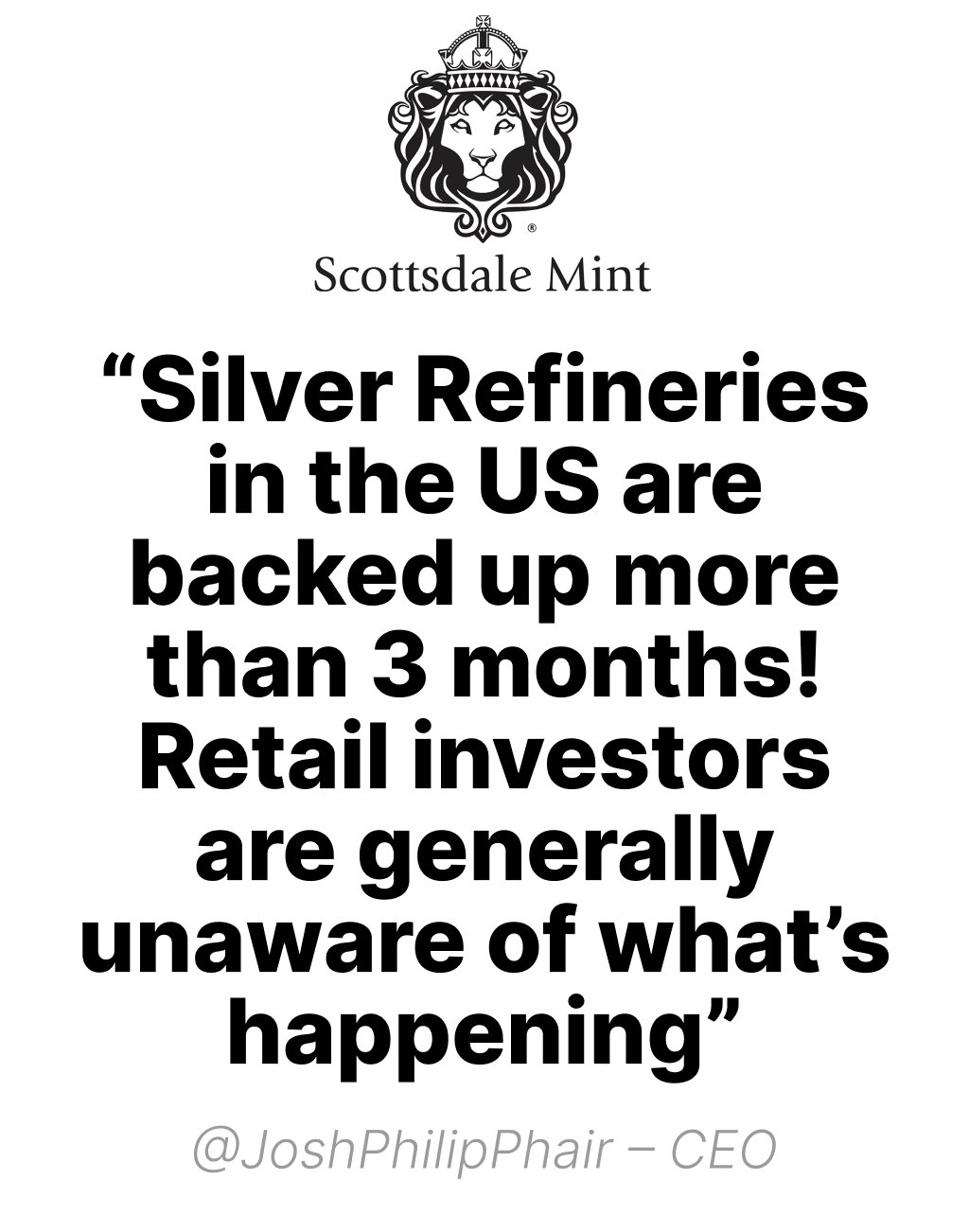
“Silver Refineries in the US are backed up more than 3 Months!!! They are processing so much material into Comex Good Delivery (on behalf of the banks) that industrial consumption is having issues finding reasonably priced physical Silver. *Retail investors are generally unaware of what’s happening.” posted Founder & CEO of Scottsdale Mint Co-Founder & CEO of The Wyoming Reserve Opportunity Zone Fund Corporation Josh Philip Phair on X.

The comments follow mounting evidence of silver production deficits to the tune of 200,000,000 troy ounces as well as banks carrying short positions of nearly that much, while COMEX, by all accounts, allegedly cannot stand for physical delivery with paper silver trading at approximately a 400:1 ratio to real silver inventory.

Will we soon see the long-awaited #silversqueeze come to fruition with silver stackers becoming millionaires overtnight?

I’m not a financial advisor & this is not financial advice, I’m just heavily invested in silver.

If you want to start investing in precious metals & want a FREE half-ounce of silver, sign up for Kinesis using my link!

Image credit: Make Gold Great Again

Share this:

Why a Vampire Has No Reflection: Mythology & Science

Vampires have been a subject of fascination for centuries, their legends steeped in mystery, fear, & allure. One of the most iconic traits of these supernatural beings is their inability to cast a reflection. But why is this the case? Let us delve into the origins of this idea, its evolution in folklore, & its connection to science & symbolism.

Origins in Folklore

The concept of vampires lacking a reflection has its roots in European folklore. In many cultures, mirrors were seen as more than tools for personal grooming; they were believed to reveal the soul. This belief tied mirrors to spiritual realms, making them instruments of truth.

Vampires, often portrayed as soulless creatures, were thought to lack the essence needed to cast a reflection. The absence of a reflection symbolised their detachment from humanity & their rejection of divine order. In Eastern European traditions, mirrors were sometimes used during funerals to prevent the deceased from returning as vampires.

Literary Evolution

The notion of a vampire’s missing reflection was cemented in popular culture through literature. Bram Stoker’s 1897 novel Dracula is perhaps the most influential work to popularise this concept. In the story, Count Dracula’s lack of reflection is described as unsettling evidence of his otherworldly nature.

This idea was embraced & expanded upon in subsequent vampire stories, films, & television series, reinforcing its place in the modern vampire mythos. The reflection trope became a metaphor for the vampire’s disconnection from life & morality, emphasising their unnatural existence.

Symbolism & Interpretation

From a symbolic perspective, the absence of a reflection represents more than a supernatural quirk. It serves as a profound metaphor for self-awareness—or the lack thereof. Mirrors are often associated with introspection & identity. A vampire’s inability to see their reflection could signify their loss of humanity & self-identity.

Moreover, it ties into the theme of vanity. In some interpretations, vampires, being eternally youthful & beautiful, are portrayed as the ultimate narcissists. The lack of reflection denies them the ability to admire their appearance, serving as poetic irony.

Science Meets Myth

While the vampire myth is fictional, some scientific explanations have been offered to rationalise this phenomenon within the context of storytelling. Mirrors, particularly older ones, were traditionally made with silver—a material often linked to purity & protection against evil. Silver is considered toxic to vampires in many legends, so their inability to reflect in mirrors may be a consequence of this aversion.

Modern physics offers a more whimsical explanation: if vampires absorb all light rather than reflecting it, they might effectively appear invisible in mirrors. While entirely speculative, such theories add an entertaining layer of realism to the supernatural myth.

Legacy of the Reflection Myth

The idea of vampires having no reflection has become a lasting symbol of their otherness. It underscores their position as creatures trapped between life & death, humanity & monstrosity. This trait remains a staple in modern interpretations, continuing to captivate audiences & spark curiosity.

The allure of the vampire legend lies in its ability to evolve while maintaining its mystique. The reflection myth is just one of the many facets that keep vampires endlessly intriguing. It serves as a reminder of how folklore, symbolism, & creative imagination combine to shape enduring myths.

Unless otherwise noted, image assets above are NOT original content & are shared under fair use doctrine with NO claims to authorship or ownership.
Contact necrolicious@necrolicious.com for credit or removal.


This post was sponsored by…ME! If you’d like to support, please buy my original meme merch from Necrolicious.store or check out my affiliate links to get yourself some other cool things. Additional affiliate links may be contained in the above article. If you click on an affiliate link & sign up/make a purchase, I may earn a commission. This does not increase the price you pay for the product or service, so it helps support this website at no cost to you.
If you want to start investing in precious metals & want a FREE half-ounce of silver, sign up for Kinesis using my link!

Share this:

#silversqueeze Development?

Crescat Capital macro strategist Otavio Costa has taken to X to note:

“Traders are currently swapping [silver] futures contracts for the actual physical asset at record levels.”

Could this abrupt spike in physical silver demand be indicative of the #silversqueeze moment many silver stackers have been waiting for?

Will it be a small bump up are are we looking at the big silver revaluation that’s 150+ years in the making that will reshape the entire world of finance & beyond?

I’m not a financial advisor & this is not financial advice, I’m just heavily invested in silver.

Unless otherwise noted, image assets above are NOT original content & are shared under fair use doctrine with NO claims to authorship or ownership.
Contact necrolicious@necrolicious.com for credit or removal.


This post was sponsored by…ME! If you’d like to support, please buy my original meme merch from Necrolicious.store or check out my affiliate links to get yourself some other cool things. Additional affiliate links may be contained in the above article. If you click on an affiliate link & sign up/make a purchase, I may earn a commission. This does not increase the price you pay for the product or service, so it helps support this website at no cost to you.

If you want to start investing in precious metals & want a FREE half-ounce of silver, sign up for Kinesis using my link!

Share this: