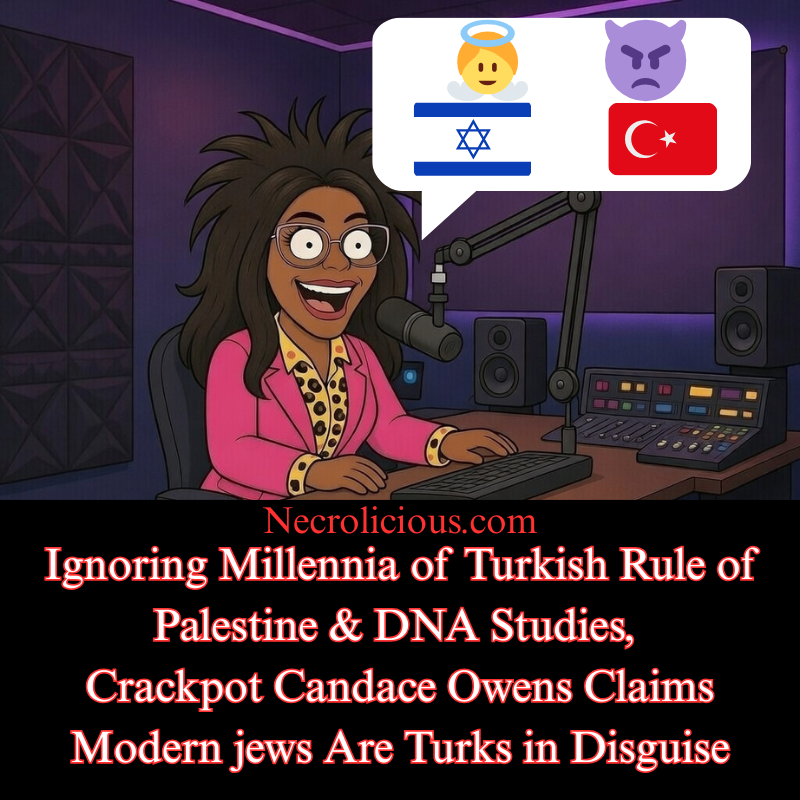
Apparently having no knowledge of the Ottoman Empire or World War I nor how its end led to us Turks losing the land israel now occupies after millennia, Candace Owens, Sneako & their braindead followers argue that Turkic origin explains the historical & contemporary evil machinations of what they call “fake jews.” However, a thorough examination of genetic, historical & even base logical evidence reveals the hypothesis to be fundamentally flawed. jews are jews & there are no “fake jews” Turks. This article explores these facets in detail, drawing on scholarly studies & documented timelines to provide a comprehensive rebuttal.
Genetic Evidence: No Trace of Khazar Ancestry
Central to debunking the Khazar hypothesis is the robust body of genetic research that consistently affirms the Middle Eastern origins of ashkenazi jews. A pivotal study in this regard is the 2013 genome-wide analysis published in Human Biology, co-authored by Michael Hammer of the University of Arizona. This research compared DNA samples from ashkenazi jews with populations from the Caucasus region, which serves as a proxy for potential Khazar descendants due to the historical location of the Khazar Khaganate. The findings were unequivocal: no detectable genetic similarity exists between ashkenazi jews & these groups.
Instead, the study confirmed that ashkenazi paternal lineages trace back to the Levant (the ancient Near East), while maternal lineages show European admixture, likely from conversions & intermarriages during the diaspora. This aligns with broader consensus in population genetics, as seen in works like Harry Ostrer’s 2012 book Legacy: A Genetic History of the jewish People, which emphasises continuity from ancient Levantine populations. Fringe claims, such as those in Eran Elhaik’s 2013 paper suggesting partial Khazar origins, have been widely critiqued for methodological flaws & contradicted by larger datasets. For instance, a 2010 Nature study by Behar et al. further supports negligible Turkic or Central Asian input, underscoring that ashkenazi jews share genetic markers with other jewish groups, including sephardic & mizrahi jews, far more than with any Turkic peoples.
Historical Expulsions: A Pattern Predating Khazar Conversion
A particularly compelling critique of the Khazar hypothesis comes from historical records of Jewish expulsions, which demonstrate conflicts & patterns long before any purported Khazar influence. In a widely shared X post by @BasedSamParker, the author meticulously breaks down over 1,000 documented expulsions spanning millennia, arguing that attributing tensions solely to subgroups like “Khazarians,” “Talmudists,” “Sabbateans,” “Frankists,” or “Zionists” overlooks deeper, persistent dynamics. Parker’s analysis is exhaustive: 143 expulsions occurred before the Talmud’s compilation around AD 500; 181 predated the alleged Khazar conversion in AD 740–800; 602 before Sabbateanism in AD 1665; 679 before Frankism in AD 1755; & 752 before modern Zionism in 1897.
Have you ever heard a version of the following: “They aren’t real jews, they’re [Khazarians/Frankists/Satanists/etc]”
Such a take simply ignores the full scope of history. So let’s look at these assertions through the lens of jewish expulsions throughout history:
▪️”It’s the Talmudists” (ca AD 500)
There were 143 expulsions of jews before the publication of the Talmud. If it were just the Talmud that was the problem, how do we account for those prior expulsions?
▪️”It’s the Khazarians” (ca AD 800)
From their flight out of Egypt until AD 800 when the alleged mythical Khazarian conversion happened, there were 181 jewish expulsions (143 before the Talmud’s publication and 38 afterward). If the problem is the “Khazarians,” how do we account for those 181 expulsions?
▪️”It’s the Sabbateans” (ca AD 1665)
There were another 421 expulsions after the alleged mythical Khazarian conversion, but prior to the rise of the Sabbateans. Making 602 total before Sabbateanism. How do we account for those?
▪️”It’s the Frankists” (ca AD 1755)
There were 77 more expulsions after the rise of Sabbateanism but before the creation of Frankism. That makes 679 before Frankism, so how do we account for those?
▪️”It’s the zionists” (ca AD 1897)
There were 73 expulsions after the rise of Frankism but before the establishment of zionism in 1897. That’s 752 total jewish expulsions prior to the rise of zionism. How do we account for those if the problem is just “zionism?”
Other major jewish groups & movements have overlapped those time periods above: Babylonian exiles, Samaritans, Hellenized jews, pharisees, sadducees, zealots, rabbinic judaism, zohar/kaballah, illuminati, Bolshevism, etc.
▪️Atheist Bolshevik jews: emerged prominently with the Russian Revolutions, 1905-1925
▪️Illuminati: founded 1776
▪️Frankists: established around 1755
▪️Sabbateans: established around 1665
▪️Zohar: first published around AD 1280–1290
▪️Kabbalah: began to take shape around the 12th–13th centuries, c. 1100s–1200s AD
▪️Alleged Khazars Conversion To judaism: allegedly occurred starting around AD 740-800
▪️Talmud judaism: talmud completed c. 400–600 AD
▪️Rabbinic judaism: began to take shape around the 1st century AD, solidified c. 70–200 AD. Led to full talmudic judaism.
▪️Zealots/Sadducees/Pharisees, ca 1st Century AD
▪️Edomites’ Conversion to judaism: occurred 125–110 BC
▪️Hellenized jews: emerged by the 3rd century BC (c. 300–200 BC)
▪️Samaritan jews (distinct identity): began to form around 722 BC (solidified c. 500–400 BC)
▪️Babylonian Exiles (black magic/usury skills): c. 597–539 BC
It doesn’t matter the period of history: there’s always something going on within the tribe of people who now call themselves jews—and it’s always leading to them being expelled. One revolutionary, subversive, or supremacist movement after another.
Laying blame at the feet of only one of these movements ignores the long arc of history. These people have had problems with their neighbors for a long time.
Who are the “real” jеws now & who are the “fake” ones? Who knows! Are any of them real or fake? Different factions of jews tell different stories–accusing some factions of being fake & claiming the mantle of authenticity for themselves: “zionists aren’t real jews,” or “Sabbateans aren’t real jews,” or “those are Talmudists, they aren’t real jews,” or “The ADL isn’t actually jewish,” etc etc etc. Whenever there’s a problematic or unpopular jewish movement, the rest of jewry “disavows” them: “They’re not real jews.” And often tries to offload the blame onto some Gentiles.
But at this moment in time, they all seem to band together with each other against the rest of us–and it’s been this way for millennia. No matter which time frame you choose, jеws were having problems getting along with non-jews. 3000 years ago or 3 years ago, that’s remained consistent.
Whatever they are; whoever they are; wherever they come from; whatever you call them–they call themselves jews, and they can’t seem to get along with the rest of us.

Drawing from sources such as Paul Johnson’s A History of the jews & compilations on jewishVirtualLibrary.org, Parker illustrates how these events reflect overlapping influences, including Edomite conversions around 125–110 BC, Babylonian exiles from 597–539 BC, & Kabbalah’s emergence in the 1100s–1200s AD. He dismisses attempts to scapegoat specific sects as deflection, noting that self-identified jews have historically united against non-jews, as evidenced in ancient texts like Flavius Josephus’ Antiquities of the jews. This timeline not only predates Khazar involvement but also challenges the notion of a fabricated Turkic identity, as expulsions from places like ancient Egypt to medieval Europe occurred without any Central Asian context.
Parker’s post stands out for its rigorous use of historical data to refute subgroup narratives, emphasising that the Khazar theory serves as a convenient excuse to ignore broader patterns of perceived subversion or supremacism. For those researching “jewish expulsions history” or “Khazar myth origins,” this perspective provides a grounded counterpoint to conspiracy-driven claims, reinforcing that the hypothesis fails to account for millennia of documented interactions.
The Ottoman Empire: Logical Inconsistencies in the Khazar Narrative
The dissolution of the Ottoman Empire offers one of the most glaring logical flaws in the Khazar hypothesis, particularly when considering the land now occupied by israel. For centuries, Ottoman Turks ruled Palestine as part of our vast empire that endured until the end of World War I in 1918. If ashkenazi jews were truly ethnic Turks descended from Khazars, there would have been no impetus for them to infiltrate & sabotage our empire to seize control of the region. Such actions would amount to Turks undermining our own dominion, a self-defeating endeavour akin to someone bombing their own house to get their own food from their own refrigerator. Historical records show zionist movements & external pressures contributing to the empire’s fall, leading to the British Mandate & eventual establishment of israel, but these were driven by jewish nationalist aspirations rooted in ancient israelite claims. The absence of any affinity or alliance with the Ottomans—despite shared “Turkic” origins under Khazar theory—exposes the hypothesis as historically incoherent, as jews resisted Ottoman rule rather than embracing it as compatriots.
- Ottoman Control Over Palestine for Centuries: The Ottoman Empire, established in the late 13th century, expanded to include Palestine by 1516 under Sultan Selim I, maintaining dominion over the region for over four centuries until 1918. This period saw Palestine as an integral part of Ottoman territories, governed through vilayets (provinces) & subject to Turkish administrative & legal systems, with no significant challenges from purported “Khazarian” jews who, if ethnically Turkic, would logically have integrated rather than opposed the regime.
- World War I & the Empire’s Dissolution: The Ottoman Empire allied with the Central Powers during World War I (1914–1918), facing defeats in key campaigns such as the Arab Revolt (1916–1918, supported by British forces) & the Sinai & Palestine Campaign (1915–1918). These military setbacks, compounded by internal nationalist movements & economic strain, led to the empire’s fragmentation via the Armistice of Mudros in October 1918 & subsequent treaties like the Treaty of Sèvres (1920), which partitioned Ottoman lands & ended Turkish sovereignty over Palestine.
- The Balfour Declaration & British Mandate: Issued on 2 November 1917 by British Foreign Secretary Arthur Balfour, this declaration expressed support for “the establishment in Palestine of a national home for the jewish people,” amid the ongoing war & as British forces advanced into Ottoman-held territories (e.g., the capture of jerusalem in December 1917). It paved the way for the League of Nations to grant Britain the Mandate for Palestine in 1920, effectively transferring control from the defeated Ottomans to British administration, which facilitated increased Jewish immigration & set the stage for the 1948 establishment of Israel—actions that proponents of the Khazar theory illogically attribute to “Turkic” jews wresting land from their own ethnicity.
- zionist Infiltration & Sabotage Claims in Context: Historical narratives often highlight zionist diplomacy & alliances with Britain (e.g., through figures like Chaim Weizmann) as contributing to Ottoman decline, but under the Khazar hypothesis, such “infiltration” becomes absurd: why would ethnic Turks sabotage a Turkish empire to claim Palestinian land already under their broader ethnic control? This contradiction underscores the theory’s failure, as real motivations stemmed from religious & historical ties to ancient israel, not fabricated Turkic origins.
Deflection Tactics: Shifting Blame from Core Doctrines
A recurring theme in critiques of the Khazar hypothesis is its role as a deflection, serving only to redirect scrutiny away from judaism & jewry. This tactic, often employed by christians, avoids addressing fallacies in their own religious doctrines or historical behaviours by framing issues as the work of “fake” jews with Turkic roots or “fake” jews worshipping Baal, Moloch, Satan or any other cope they can think of instead of rebuking all judeo aspects of themselves. However, as genetic & historical evidence shows, such theories lack substantiation & instead perpetuate myths that contradict genuine data. They ignore comprehensive DNA data & have been dismissed by mainstream historians for selective interpretations. By emphasising “Khazarian Turks,” proponents deflect blame, but this only underscores the hypothesis’s weakness when confronted with facts.
Conclusion: Towards Evidence-Based Understanding
The Khazar hypothesis is completely bunk. Genetic studies from institutions like the University of Arizona, detailed expulsion timelines as outlined by Parker, & logical analyses of events like the Ottoman Empire’s fall all converge to debunk any substantive links between jews & Turks. For those exploring “debunking Khazar theory” or “jewish genetic history,” prioritising peer-reviewed sources over social media narratives is essential. Blacks are generally not known for intellectual acumen, but allow one to speak & they will spread dangerous misinformation such as this, whether intentionally or not. It’s well known that every single AI video fools them. That this repeatedly debunked claim even reared its goofy face again is a testament to the dangers of giving a monkey like Candace a platform in the first place. She should be deported back to Africa for this.
Unless otherwise noted, image assets above are NOT original content & are shared under fair use doctrine with NO claims to authorship or ownership.
Contact necrolicious@necrolicious.com for credit or removal.
This post was sponsored by…ME! If you’d like to support, please buy my original meme merchandise or check out my affiliate links to get yourself some other cool things. Additional affiliate links may be contained in the above article. If you click on an affiliate link & sign up/make a purchase, I may earn a commission. This does not increase the price you pay for the product or service, so it helps support this website at no cost to you.