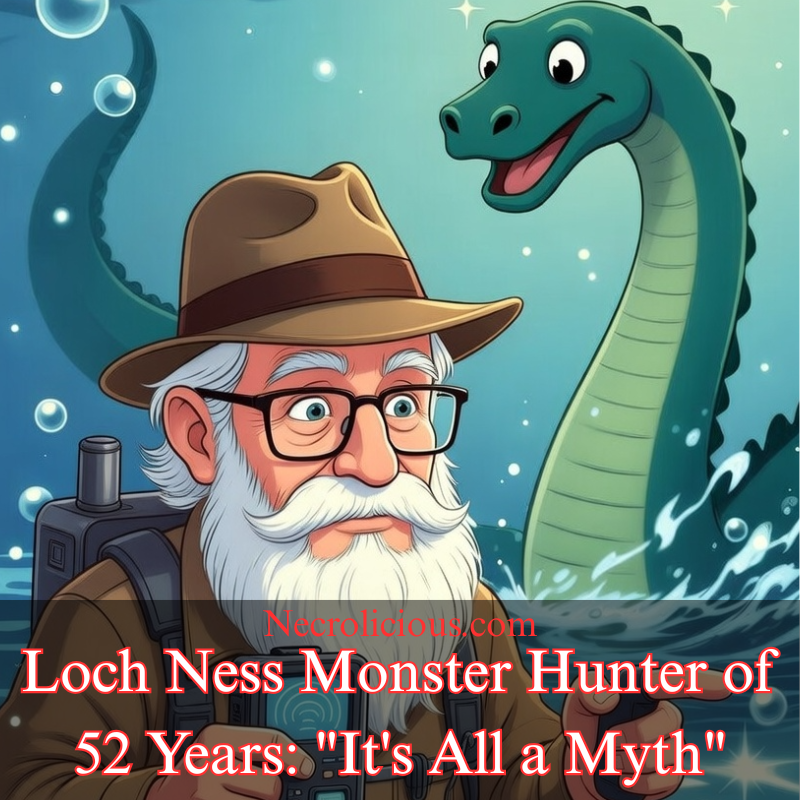
After more than half a century dedicated to investigating one of the world’s most enduring legends, Adrian Shine, the veteran naturalist & founder of The Loch Ness Project, has declared the Loch Ness Monster a myth. At 76, Shine has entered semi-retirement from active fieldwork, marking the end of an extraordinary chapter in the quest to understand the creature affectionately known as Nessie.
His conclusion comes not from frustration, but from a lifetime of rigorous, evidence-based scrutiny. Armed with sonar sweeps, submersibles, sediment analysis & collaborations with universities, Shine has explored the loch’s ecology & the psychology behind sightings. Recent advancements in technology – including high-resolution sonar, drones & environmental DNA (eDNA) sampling – have only reinforced his view: no large unknown vertebrate exists in the nutrient-poor depths of Loch Ness.
Yet the legend persists, fuelled by human perception, optical illusions & the enduring appeal of mystery. Shine’s work has illuminated the loch’s natural phenomena – boat wakes creating multi-humped waves, misidentified waterbirds & atmospheric refraction distorting distant objects – while explaining why so many “sightings” feel convincing.
The Ancient Origins of the Legend – Dispelling a Modern Myth
The story of a mysterious water beast in the Loch Ness area dates back far earlier than many assume. The earliest recorded account appears in the 7th-century Life of St. Columba by Adomnán, describing an event in 565 AD. Irish monk Saint Columba encountered locals burying a man killed by a ferocious “water beast” in the River Ness (the loch’s outflow). Columba commanded the creature to retreat, & it fled – a tale of saintly triumph over peril that fits medieval hagiographic traditions.
This predates the modern “Nessie” phenomenon by centuries. The 1930s brought widespread attention, sparked by a 1933 sighting & the infamous (later debunked) “Surgeon’s Photograph” hoax. But the idea of a large aquatic creature in the region is rooted in ancient Celtic folklore, including water spirits like kelpies.
A persistent rumour links the legend’s origins to occultist Aleister Crowley, who owned Boleskine House on the loch’s southeast shore from 1899. Crowley used the isolated property to attempt the lengthy Abramelin ritual (from The Book of the Sacred Magic of Abramelin the Mage), aiming to contact his Holy Guardian Angel. He abandoned it incomplete, leading to claims that unbound spirits or demons “created” or “unleashed” the monster.
This notion is a modern myth with no historical foundation. Sightings & folklore existed long before Crowley’s arrival (around 1900–1913), & the major Nessie boom occurred in 1933 – decades later. Crowley’s stay adds a layer of spooky intrigue, but it did not invent the legend.
A Passion Project, Not a Profession
Shine arrived at Loch Ness in 1973 as an amateur naturalist, initially drawn by tales of a fishing boat “attacked” by something mysterious. He founded The Loch Ness Project in the mid-1970s, shifting focus to scientific study of the loch’s environment rather than assuming a monster’s existence.
This was never a salaried “monster-hunting” role. It evolved into a dedicated, long-term pursuit supported by collaborations with academics, volunteers, media contributions & associations with the Loch Ness Centre (where he designed exhibitions & shared findings). Equipment like custom submersibles & sonar came through opportunistic funding & partnerships – a labour of curiosity about lake ecology & human perception, not a paid quest for Nessie.
Famous efforts include Operation Deepscan (1987), a massive sonar sweep with 24 boats. In recent years, as technology advanced, Shine embraced tools like eDNA (which detected abundant eels but no exotic large vertebrates) & drones. Paradoxically, these innovations have made the absence of a monster clearer, not easier to prove.
The loch’s cold, deep, nutrient-poor waters support limited biomass – insufficient for a large predator population. Sightings align with mundane explanations, & modern AI scrutiny dismisses many photos/videos as generated fakes.
Why the Myth Endures in the Age of Technology
Even today, with drones, 4K cameras & AI anomaly detection, definitive proof remains elusive. Should compelling evidence emerge, the immediate response would likely include cries of “AI!” – a credibility crisis born from hyper-realistic deepfakes.
Shine remains open to new data but concludes the evidence points to myth. His semi-retirement reflects age & the weight of accumulated findings, shifting focus to reflection, writing (including a 2024 book on sea serpents) & education. A few online commentators have playfully suggested that Shine’s declaration is itself part of a cover-up – that he finally discovered the creature & now calls it a myth to shield it from further intrusion. While such theories add to the fun of the legend, they overlook the transparent, evidence-driven nature of his 52-year investigation. Shine has consistently shared his methods, collaborated openly with scientists, & welcomed new data that might overturn his conclusions.
“You cannot kill a legend with science,” Shine has noted.

Unless otherwise noted, image assets above are NOT original content & are shared under fair use doctrine with NO claims to authorship or ownership.
Contact necrolicious@necrolicious.com for credit or removal.
This post was sponsored by…ME! If you’d like to support, please buy my original meme merchandise or check out my affiliate links to get yourself some other cool things. Additional affiliate links may be contained in the above article. If you click on an affiliate link & sign up/make a purchase, I may earn a commission. This does not increase the price you pay for the product or service, so it helps support this website at no cost to you.
If you would like to support my work more directly, I accept voluntary cryptocurrency donations in BTC, ETH, XRP & XLM sent directly to necrolicious.x. necrolicious.x is an Unstoppable Domains name that resolves to the wallet addresses I have configured. Simply enter necrolicious.x as the recipient in a supported wallet (such as Trust Wallet, Blockchain.com or others that support Unstoppable Domains). Donation Disclaimer: All cryptocurrency donations sent to me are final, voluntary gifts & are non-refundable & irreversible. These donations are not tax-deductible since I am not a registered charitable organization, & no tax receipts will be issued. No memo or destination tag is required for XRP or XLM donations, as the domain resolves directly to a wallet address. By sending a donation you acknowledge & accept all associated risks, including cryptocurrency price volatility, network fees & potential loss of funds due to incorrect network selection or transaction errors. I am not responsible or liable for any loss related to your donation. No goods, services or other benefits are provided in exchange for donations. This is not financial, tax, legal or investment advice. Please consult a qualified professional regarding any implications of your donation.