In the realm of video games, few events have illustrated the principle of karmic justice as starkly as the trajectory of Ubisoft following the release of Assassin’s Creed Shadows. This title, set in feudal Japan, drew widespread condemnation for its perceived disregard of historical accuracy & cultural sensitivity, particularly in its portrayal of Yasuke as a prominent black samurai. The ensuing backlash, especially from Japan, appears to have catalysed a cascade of misfortunes for the French gaming giant, culminating in financial turmoil, internal dissent, & structural collapse. As Ubisoft grapples with plummeting stock values, mass redundancies, & union strikes, one cannot overlook the irony: a company that sought to “diversify” history at the expense of authenticity now faces its own existential reckoning. This article examines the sequence of events, underscoring how cultural insensitivity can exact a heavy toll in the global market.
The Fabricated Legend: Thomas Lockley & the Yasuke Myth
At the heart of the controversy lies Thomas Lockley, a British academic at Nihon University whose 2019 book, African Samurai, reimagined Yasuke—a historical African retainer to Oda Nobunaga—as a legendary samurai warrior. Historical records, such as the Shinchōkōki chronicle & Jesuit accounts, depict Yasuke as a novelty bodyguard who served for roughly 15 months in the 1580s, with no evidence of samurai status, land grants, or heroic battles. Lockley, however, embellished these facts with speculative elements, including invented exploits, a fictional family, & dramatic feats, admitting on the book’s cover that much was “speculative fiction.”
Lockley’s influence extended beyond print; he allegedly used sockpuppet accounts to edit Wikipedia extensively, inserting his fabrications as established history. This astroturfing campaign gained traction, providing Ubisoft with a veneer of legitimacy for featuring Yasuke as a co-protagonist in Shadows. The game’s trailers portrayed him as a hyper-muscular figure engaging in anachronistic actions, such as skull-crushing violence & forcing villagers to bow—elements critics decried as caricatures that prioritised modern diversity agendas over Japanese cultural norms. When exposed in July 2024, Lockley deleted his social media profiles & faced a university investigation for misconduct, vanishing from public view.
Ubisoft’s reliance on this dubious scholarship amplified the insult. The company dismissed critics, including figures like Elon Musk, as “racist,” & delayed the game’s release from November 2024 to March 2025 to address the “Yasuke backlash.” Additional inaccuracies, such as the desecration of sacred torii gates & shrines without temple permissions, prompted outrage from Japanese politicians, priests, & even considerations of legal action by the prime minister’s office. Other elements, including Chinese architectural intrusions, stolen military banners, & non-binary characters, further alienated audiences who viewed the game as a Western imposition on Japanese heritage.
Japan’s Reprisal: Boycotts, Sales Collapse, & Global Repercussions
The karmic retribution manifested most acutely in Japan, where Assassin’s Creed Shadows was met with a resounding boycott. Despite Ubisoft’s efforts to polish the title post-delay, sales figures painted a grim picture. In its first week on PS5 in Japan, the game moved approximately 17,700 units—a mere 8% of the 212,000 units sold by Ghost of Tsushima in its debut three days. Globally, while it achieved a strong launch with over 3 million players in days & 5 million by July 2025, long-term performance faltered, reaching only about 4.3 million units by November 2025 & an estimated 4-5 million lifetime sales. This paled against predecessors like Assassin’s Creed Valhalla (over 20 million) & Odyssey (over 10 million).
The financial hit was exacerbated by development costs exceeding $300 million, compounded by prior flops like Star Wars Outlaws & Skull & Bones. On platforms like Amazon Japan, ratings plummeted, & social media echoed sentiments of cultural betrayal, with memes branding the game “woke slop.” This rejection not only tanked regional revenue but also amplified global “get woke, go broke” narratives, deterring potential buyers & eroding brand trust.
Ubisoft’s Implosion: From Internal Revolt to Financial Ruin
The fallout from Shadows accelerated Ubisoft’s broader decline, manifesting in a series of corporate setbacks that suggest a company in terminal stages. By January 2026, a “major reset” announcement on the 21st cancelled six projects, closed two studios, & delayed seven titles, triggering a 37% stock plunge to $0.91— a 40% year-to-date drop. Internal Slack channels overflowed with employee criticism of upper management, highlighting years of controversies, talent exodus, & creative stagnation.
French unions responded with unanimous approval for a three-day strike from 10-12 February 2026, protesting approximately 200 voluntary redundancies at Paris headquarters—representing 18% of its 1,100 staff. CEO Yves Guillemot faced demands for resignation amid accusations of oblivious leadership, no salary increases, & enforced remote work policies. Rumours of a Tencent bailout intensified, with the Guillemot family considering asset sales to avert total collapse.
This sequence underscores a direct link: the cultural affront in Shadows eroded market confidence, leading to revenue shortfalls & operational chaos.
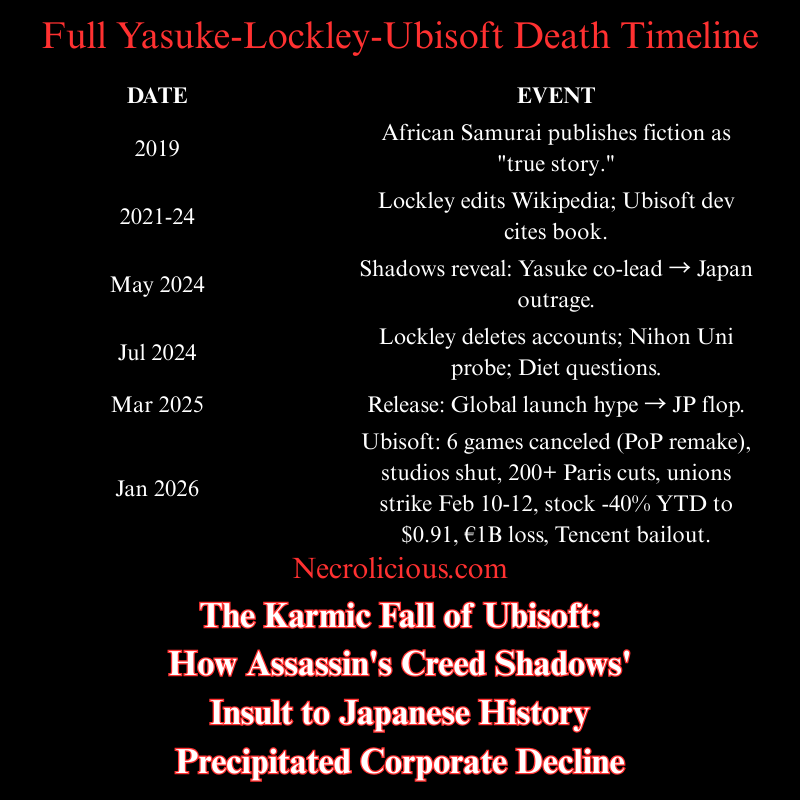
Full Yasuke-Lockley-Ubisoft Death Timeline
| Date | Event |
|---|---|
| 2019 | African Samurai publishes fiction as “true story.” |
| 2021-24 | Lockley edits Wikipedia; Ubisoft dev cites book. |
| May 2024 | Shadows reveal: Yasuke co-lead → Japan outrage. |
| Jul 2024 | Lockley deletes accounts; Nihon Uni probe; Diet questions. |
| Mar 2025 | Release: Global launch hype → JP flop (~4.5M lifetime vs. Valhalla 20M+). |
| Jan 2026 | Ubisoft: 6 games canceled (PoP remake), studios shut, 200+ Paris cuts, unions strike Feb 10-12, stock -40% YTD to $0.91, €1B loss, Tencent bailout. |
Verdict: Lockley’s grift for fame (pushed by DEI zealots) fed Ubisoft’s hubris—race-swapped Japanese history for “representation.” Japan/JP gamers boycotted, sales tanked, empire crumbles. “Get woke, Yasuke broke.” Tencent now owns AC lifeline; old Ubisoft RIP.
A Fortuitous Escape for Persian Heritage
In a parallel narrative, Iranians narrowly avoided a comparable cultural slight with the cancellation of the Prince of Persia: The Sands of Time remake. Developed primarily by Ubisoft’s Indian studios in Pune & Mumbai, leaks revealed a transformation of Persian protagonists into figures with “suspiciously Indian” features—darker skin tones, exaggerated eyes, & Bollywood-inspired aesthetics that deviated from ancient Iranian depictions. The prince resembled a “Bollywood dancer” rather than a historical Persian hero, while Princess Farah was amplified with henna motifs & “girlboss” traits. Announced in 2020 & rebooted in 2022 after a disastrous trailer, the project—plagued by outsourcing issues & unpolished visuals—was axed in January 2026’s reset, sparing Iran a potential boycott akin to Japan’s. While this averted a PR disaster, it highlighted Ubisoft’s pattern of prioritising cost-cutting & diversity mandates over cultural fidelity.
Reflections on Cultural Respect in Gaming
Ubisoft’s plight serves as a cautionary tale for the industry: disregarding historical & cultural integrity invites not only backlash but also tangible consequences. The insult to Japanese heritage through Assassin’s Creed Shadows—rooted in fabricated narratives & insensitive portrayals—has seemingly invoked karmic justice, propelling the company towards dissolution. With €1 billion in losses, ongoing strikes, & bailout speculations, Ubisoft’s future hangs in the balance. As gamers & developers alike reflect on this saga, the imperative for authentic representation becomes clear: true diversity honours history, rather than rewriting it.

Unless otherwise noted, image assets above are NOT original content & are shared under fair use doctrine with NO claims to authorship or ownership.
Contact necrolicious@necrolicious.com for credit or removal.
This post was sponsored by…ME! If you’d like to support, please buy my original meme merchandise or check out my affiliate links to get yourself some other cool things. Additional affiliate links may be contained in the above article. If you click on an affiliate link & sign up/make a purchase, I may earn a commission. This does not increase the price you pay for the product or service, so it helps support this website at no cost to you.